Personal support from Vienna · Web design, SEO & GEO, software
Kodlogy Knowledge Base & FAQ
This knowledge base from Kodlogy Technologies GmbH in Vienna brings together 3,000 practical questions and answers on web design, online shops, SEO & GEO optimisation, local SEO, Google Ads, ChatGPT Ads, social media, WordPress, hosting, software development, mobile apps, AI agents, automation and IT & computer services.
The content combines clear explanations with concrete decision-making and practical questions. Where relevant, internal links lead directly to the corresponding Kodlogy services; selected further sources also point to official documentation and neutral expert information. Use the search to filter all 3,000 questions in real time – the search covers only the question text and the answer.
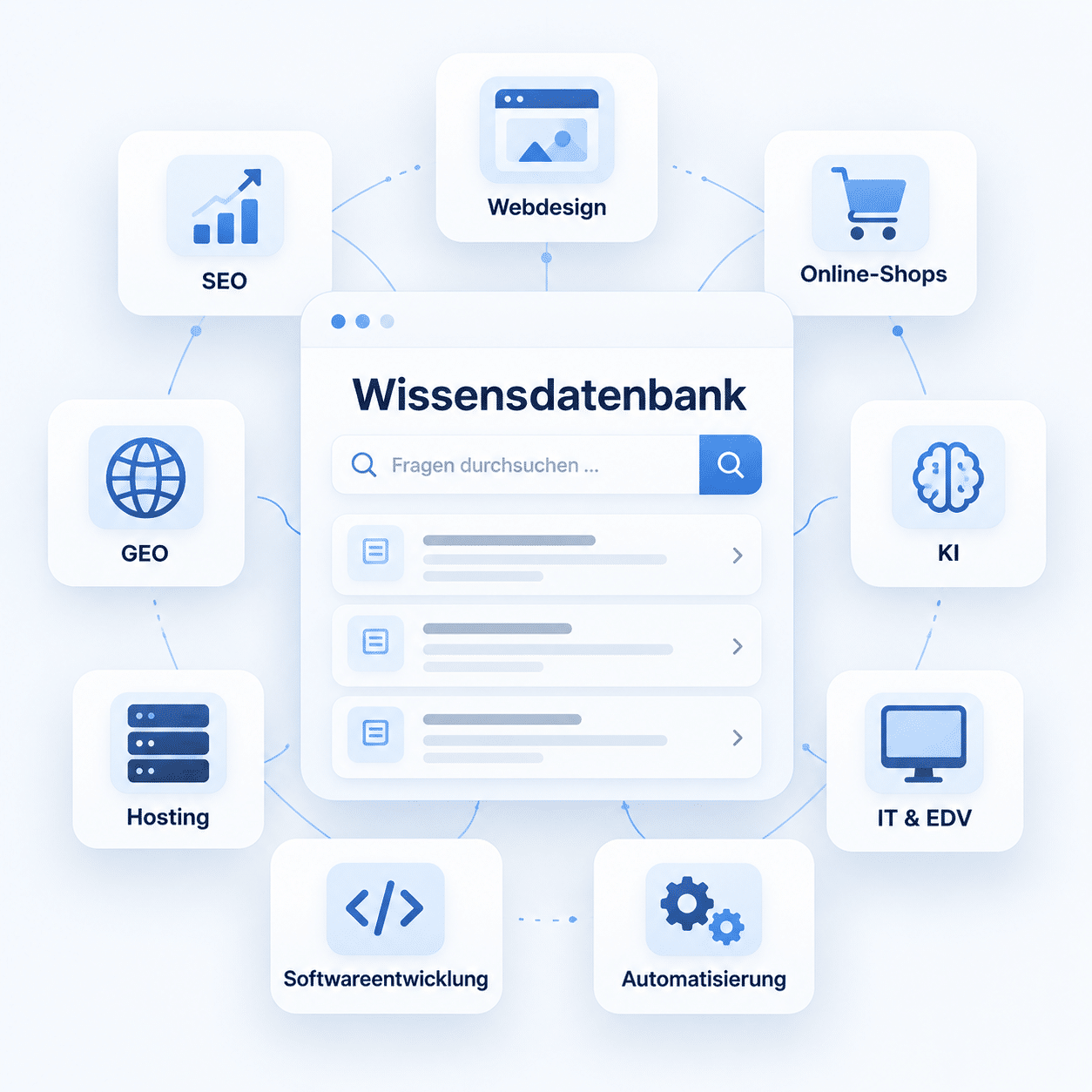
Practical answers and decision aids on Web design & website creation. Use the search above or open the relevant question directly.
A company website is a business's central digital presence and brings together services, trust, contact options and relevant information. A good implementation combines the subject-matter idea with clear requirements and measurable goals.
A concrete need in the area of “company website” often arises when a website is meant to build more trust, explain services more clearly or support more qualified enquiries. A brief review of the current situation helps to distinguish a genuine need from a mere wish-list project.
In a project on “company website”, business value can arise above all from these points: clear positioning, trust, understandable services and qualified enquiries. Which of these benefits are actually relevant depends on the specific use case.
In practice, a project on “company website” starts with a review of the current situation and is then implemented systematically: clarify goals and target groups, plan content and page structure, develop UX and design, implement technically, test on devices and carry out the go-live in a controlled manner. Before going live, a controlled test with realistic scenarios is recommended.
Price differences for services relating to “company website” often result from these factors: number of pages, design requirements, content, functions, languages, interfaces and the condition of an existing website. Only once the scope has been clarified can quotes and follow-up costs be compared sensibly. You can find the scope of services and consulting options here: website creation Vienna.
For a project on “company website”, the schedule should be set on the basis of the specific requirements. The time required depends in particular on scope, content approvals, design coordination, functions and available access. Approvals and dependencies on third-party systems should be planned in as separate time factors.
The area of “company website” is not automatically the most important next step. What matters is whether it solves a specific problem better than the alternatives. This leads to a decision based on business goals rather than on individual tools.
Typical pitfalls in the area of “company website” include: unclear goals, overloaded pages, poor mobile display, lack of measurability and technical dependencies. Many of these problems can be avoided with a thorough review before the project starts.
For “company website”, these metrics are particularly meaningful: qualified enquiries, conversion rate, user journeys, loading times, Core Web Vitals and the use of important contact points. Measurement should be as simple as possible, but as detailed as necessary for the decision.
Anyone wishing to approach a project on “company website” professionally should first clarify requirements, risks and desired results together. You can find more information on the relevant Kodlogy service at web design agency Vienna.
A WordPress website uses the WordPress content management system so that content can be maintained flexibly and functions extended modularly. For businesses, the specific application matters more than the technical term itself.
Further information: WordPress documentation.
The topic “WordPress website” is particularly relevant when a website is meant to build more trust, explain services more clearly or support more qualified enquiries. Before implementation, target group, processes and technical requirements should be considered together.
In a project on “WordPress website”, business value can arise above all from these points: editorial flexibility, extensibility and easy content maintenance. Which of these benefits are actually relevant depends on the specific use case.
For “WordPress website”, a step-by-step approach has proven effective: clarify goals and target groups, plan content and page structure, develop UX and design, implement technically, test on devices and carry out the go-live in a controlled manner. The technical implementation should always remain linked to the actual business or process goal.
The effort in the area of “WordPress website” is determined mainly by the following points: number of pages, design requirements, content, functions, languages, interfaces and the condition of an existing website. A reliable price can only be given once the scope and interfaces have been described clearly enough.
The timeframe for a project on “WordPress website” depends heavily on the starting situation. The time required depends in particular on scope, content approvals, design coordination, functions and available access. Serious planning takes into account not only implementation but also testing, coordination and possible corrections.
A project on “WordPress website” should be implemented when the necessary prerequisites are in place and a clear benefit can be defined. This avoids budget flowing into a measure that does not currently solve a clear bottleneck.
In a project on “WordPress website”, these factors in particular lead to unnecessary rework or poorer results: unclear goals, overloaded pages, poor mobile display, lack of measurability and technical dependencies. Where sensitive data or permissions are involved, security and data protection requirements should also be checked.
Progress in the area of “WordPress website” is best tracked using the following values: qualified enquiries, conversion rate, user journeys, loading times, Core Web Vitals and the use of important contact points. This shows whether optimisations are really having an effect or merely generating activity.
If a project on “WordPress website” is to be specifically planned or implemented, a brief expert review can clarify the most sensible next step. You can find more information for a specific project at professional website creation.
Responsive web design automatically adapts layout, navigation and content to smartphone, tablet and desktop. Its practical relevance depends on the respective use case.
Further information: MDN: Responsive design.
Businesses should check their needs in the area of “responsive web design” when a website is meant to build more trust, explain services more clearly or support more qualified enquiries. What matters is whether a relevant bottleneck can be improved in a targeted way.
In a project on “responsive web design”, business value can arise above all from these points: mobile usability, consistent display and a better user experience. However, the actual impact depends on the starting situation, objectives and quality of implementation.
The typical project path in the area of “responsive web design” can be summarised as follows: clarify goals and target groups, plan content and page structure, develop UX and design, implement technically, test on devices and carry out the go-live in a controlled manner. With existing systems, dependencies and possible effects must be taken into account before making changes.
The costs of a project on “responsive web design” depend on the actual scope. Relevant factors are: number of pages, design requirements, content, functions, languages, interfaces and the condition of an existing website. This allows the budget to be aligned with actual requirements rather than with a standard package.
A flat duration for a project on “responsive web design” would not be credible. The time required depends in particular on scope, content approvals, design coordination, functions and available access. For more complex projects, step-by-step implementation is often more reliable than a single big go-live.
The area of “responsive web design” is not automatically the most important next step. What matters is whether it solves a specific problem better than the alternatives. If important foundations are missing, it may make more sense to create them first.
In a project on “responsive web design”, these factors in particular lead to unnecessary rework or poorer results: unclear goals, overloaded pages, poor mobile display, lack of measurability and technical dependencies. The more other systems are affected, the more important testing, backups and a fallback plan become.
For “responsive web design”, these metrics are particularly meaningful: qualified enquiries, conversion rate, user journeys, loading times, Core Web Vitals and the use of important contact points. Individual values should not be viewed in isolation; only the trend over time provides a reliable picture.
If a project on “responsive web design” is to be specifically planned or implemented, a brief expert review can clarify the most sensible next step. If you need support, you can find the relevant Kodlogy service at web design in Vienna.
A website relaunch renews an existing website technically, visually and often also structurally or in terms of content. Which form makes sense depends on the respective use case and the existing technical basis.
The topic “website relaunch” is particularly relevant when a website is meant to build more trust, explain services more clearly or support more qualified enquiries. It is important to assess the measure not in isolation but in the context of the other digital activities.
A solution in the area of “website relaunch” can support these goals in particular: modern technology, better user guidance, clean migration and retention of important URLs. However, the actual impact depends on the starting situation, objectives and quality of implementation.
For a project on “website relaunch”, a clear sequence is important. The following steps are typical: clarify goals and target groups, plan content and page structure, develop UX and design, implement technically, test on devices and carry out the go-live in a controlled manner. Tests and clear acceptance criteria help to identify problems before going live.
A reliable quote in the area of “website relaunch” requires these factors to be clarified: number of pages, design requirements, content, functions, languages, interfaces and the condition of an existing website. A reliable price can only be given once the scope and interfaces have been described clearly enough. For the next step, you can find out about the relevant service here: website creation Vienna.
When scheduling “website relaunch”, technical and organisational dependencies should be considered together. The time required depends in particular on scope, content approvals, design coordination, functions and available access. Approvals and dependencies on third-party systems should be planned in as separate time factors.
Prioritising “website relaunch” makes sense when the expected benefit clearly justifies the effort and possible follow-up costs. Priority should therefore be derived from the concrete benefit rather than from a general trend.
Typical problems in the area of “website relaunch” arise from these points: unclear goals, overloaded pages, poor mobile display, lack of measurability and technical dependencies. Clear responsibilities, testing and documented changes significantly reduce these risks.
The quality of an implementation in the area of “website relaunch” cannot be read from a single figure. Relevant signals are: qualified enquiries, conversion rate, user journeys, loading times, Core Web Vitals and the use of important contact points. Measurement should be as simple as possible, but as detailed as necessary for the decision.
In a project on “website relaunch”, the scope of services and the target picture should be clearly defined before implementation. If you would like to discuss the topic specifically with Kodlogy, you can find more information here: modern company website creation.
A landing page is a focused target page for a specific offer, a campaign or a defined target group. To put it into context, technical, organisational and business requirements should be considered together.
Businesses should check their needs in the area of “landing page” when a website is meant to build more trust, explain services more clearly or support more qualified enquiries. A sensible priority only emerges from the interplay of benefit, effort and urgency.
In the area of “landing page”, these benefits are particularly relevant in practice: a clear message, few distractions, a strong call to action and measurable conversion. In practice, what counts is not the number of functions but the measurable contribution to the desired result.
In practice, a project on “landing page” starts with a review of the current situation and is then implemented systematically: clarify goals and target groups, plan content and page structure, develop UX and design, implement technically, test on devices and carry out the go-live in a controlled manner. A step-by-step approach reduces risks and makes early corrections possible.
The costs of a project on “landing page” depend on the actual scope. Relevant factors are: number of pages, design requirements, content, functions, languages, interfaces and the condition of an existing website. For fair costing, must-have requirements and optional extensions should be considered separately.
For a project on “landing page”, the schedule should be set on the basis of the specific requirements. The time required depends in particular on scope, content approvals, design coordination, functions and available access. A reliable schedule can only be drawn up after a brief review of the current situation.
Whether “landing page” should be a priority now depends on the goal, the current bottleneck, the expected benefit and the available resources. A comparison with alternatives usually quickly clarifies the most sensible order.
A poor implementation in the area of “landing page” often shows in these points: unclear goals, overloaded pages, poor mobile display, lack of measurability and technical dependencies. Regular checks are particularly important when systems or requirements change continuously.
These metrics are particularly suitable for evaluation in the area of “landing page”: qualified enquiries, conversion rate, user journeys, loading times, Core Web Vitals and the use of important contact points. Regular monitoring makes it easier to identify problems early and make targeted improvements.
Anyone wishing to approach a project on “landing page” professionally should first clarify requirements, risks and desired results together. Details on consulting and implementation can be found on our service page Kodlogy web design Vienna.
A one-pager brings together the most important content of a website on a single long page with clear sections. Which form makes sense depends on the respective use case and the existing technical basis.
A project on “one-pager” makes sense above all when a website is meant to build more trust, explain services more clearly or support more qualified enquiries. Before implementation, target group, processes and technical requirements should be considered together.
In the area of “one-pager”, these benefits are particularly relevant in practice: compact communication, quick orientation and simple navigation. In practice, what counts is not the number of functions but the measurable contribution to the desired result.
For “one-pager”, a step-by-step approach has proven effective: clarify goals and target groups, plan content and page structure, develop UX and design, implement technically, test on devices and carry out the go-live in a controlled manner. Before going live, a controlled test with realistic scenarios is recommended.
When costing a project on “one-pager”, these factors play a particular role: number of pages, design requirements, content, functions, languages, interfaces and the condition of an existing website. In addition to the initial implementation, operation, maintenance and possible extensions should also be taken into account.
With “one-pager”, planning, implementation and visible impact can occur at different times. The time required depends in particular on scope, content approvals, design coordination, functions and available access. Incomplete access, data or approvals are common causes of delays.
Whether “one-pager” should be a priority now depends on the goal, the current bottleneck, the expected benefit and the available resources. Follow-up costs, internal capacity and technical dependencies should also be taken into account.
The most common risks with “one-pager” include: unclear goals, overloaded pages, poor mobile display, lack of measurability and technical dependencies. Where sensitive data or permissions are involved, security and data protection requirements should also be checked.
Whether an implementation of “one-pager” works should be checked using clear KPIs. These include: qualified enquiries, conversion rate, user journeys, loading times, Core Web Vitals and the use of important contact points. Regular monitoring makes it easier to identify problems early and make targeted improvements.
Businesses can best plan a project in the area of “one-pager” when needs, existing systems and desired results are aligned in advance. For the next step, you can find out about the relevant service here: professional web design by Kodlogy.
UX design shapes processes, structure and interactions so that users can achieve their goals as clearly and efficiently as possible. Its practical relevance depends on the respective use case.
A project on “UX design” can be a suitable measure when a website is meant to build more trust, explain services more clearly or support more qualified enquiries. Whether the topic is a priority should be decided on the basis of the expected benefit and the available resources.
A solution in the area of “UX design” can support these goals in particular: user guidance, clarity, low friction and a higher likelihood of conversion. In practice, what counts is not the number of functions but the measurable contribution to the desired result.
With “UX design”, you should not proceed ad hoc. It makes sense to: clarify goals and target groups, plan content and page structure, develop UX and design, implement technically, test on devices and carry out the go-live in a controlled manner. Documentation and traceable decisions make later maintenance and further development easier.
Price differences for services relating to “UX design” often result from these factors: number of pages, design requirements, content, functions, languages, interfaces and the condition of an existing website. In addition to the initial implementation, operation, maintenance and possible extensions should also be taken into account. Details on consulting and implementation can be found on our service page website creation Vienna.
When scheduling “UX design”, technical and organisational dependencies should be considered together. The time required depends in particular on scope, content approvals, design coordination, functions and available access. Incomplete access, data or approvals are common causes of delays.
The area of “UX design” is not automatically the most important next step. What matters is whether it solves a specific problem better than the alternatives. Priority should therefore be derived from the concrete benefit rather than from a general trend.
Typical pitfalls in the area of “UX design” include: unclear goals, overloaded pages, poor mobile display, lack of measurability and technical dependencies. Many of these problems can be avoided with a thorough review before the project starts.
These metrics are particularly helpful for measuring the success of “UX design”: qualified enquiries, conversion rate, user journeys, loading times, Core Web Vitals and the use of important contact points. The metrics should be defined before the start and then compared against a baseline.
For a service in the area of “UX design”, a clear review of goal, starting situation and technical scope is worthwhile before commissioning. You can find more information on the relevant Kodlogy service at web design agency Vienna.
UI design shapes the visible controls, typography, spacing, colours and components of a digital interface. To put it into context, technical, organisational and business requirements should be considered together.
A project on “UI design” makes sense above all when a website is meant to build more trust, explain services more clearly or support more qualified enquiries. A brief review of the current situation helps to distinguish a genuine need from a mere wish-list project.
In the area of “UI design”, these benefits are particularly relevant in practice: visual clarity, brand impact, consistency and usability. It therefore makes sense to define a baseline and suitable success criteria in advance.
The typical project path in the area of “UI design” can be summarised as follows: clarify goals and target groups, plan content and page structure, develop UX and design, implement technically, test on devices and carry out the go-live in a controlled manner. With existing systems, dependencies and possible effects must be taken into account before making changes.
For a service in the area of “UI design”, a flat price is rarely credible. The deciding factors are: number of pages, design requirements, content, functions, languages, interfaces and the condition of an existing website. A low-cost start is not automatically more economical if extensive rework is needed later.
When scheduling “UI design”, technical and organisational dependencies should be considered together. The time required depends in particular on scope, content approvals, design coordination, functions and available access. Incomplete access, data or approvals are common causes of delays.
The right time for a project on “UI design” depends on the current situation and the most important business or process goals. Follow-up costs, internal capacity and technical dependencies should also be taken into account.
In a project on “UI design”, these factors in particular lead to unnecessary rework or poorer results: unclear goals, overloaded pages, poor mobile display, lack of measurability and technical dependencies. For critical functions, changes should first be tested in a secure test environment.
These metrics are particularly suitable for evaluation in the area of “UI design”: qualified enquiries, conversion rate, user journeys, loading times, Core Web Vitals and the use of important contact points. The metrics should be defined before the start and then compared against a baseline.
If a project on “UI design” is to be specifically planned or implemented, a brief expert review can clarify the most sensible next step. You can find more information on the relevant Kodlogy service at professional website creation.
Conversion optimisation improves pages in a targeted way so that more visitors carry out a desired action such as an enquiry, purchase or appointment booking. Its practical relevance depends on the respective use case.
A concrete need in the area of “conversion optimisation” often arises when a website is meant to build more trust, explain services more clearly or support more qualified enquiries. This shows whether the benefit is short-term, strategic or currently only minor.
In the area of “conversion optimisation”, these benefits are particularly relevant in practice: measurable actions, better user guidance and fewer drop-offs. For this to create business value, the goals should be defined measurably in advance.
A professional implementation in the area of “conversion optimisation” follows a clear process: clarify goals and target groups, plan content and page structure, develop UX and design, implement technically, test on devices and carry out the go-live in a controlled manner. Tests and clear acceptance criteria help to identify problems before going live.
The costs of a project on “conversion optimisation” depend on the actual scope. Relevant factors are: number of pages, design requirements, content, functions, languages, interfaces and the condition of an existing website. Only once the scope has been clarified can quotes and follow-up costs be compared sensibly.
How quickly a project on “conversion optimisation” progresses can only be reliably assessed after a review of the current situation. The time required depends in particular on scope, content approvals, design coordination, functions and available access. A reliable schedule can only be drawn up after a brief review of the current situation.
With a limited budget, the area of “conversion optimisation” should be weighed against other measures in terms of impact, urgency and dependencies. Priority should therefore be derived from the concrete benefit rather than from a general trend.
Typical pitfalls in the area of “conversion optimisation” include: unclear goals, overloaded pages, poor mobile display, lack of measurability and technical dependencies. Clear responsibilities, testing and documented changes significantly reduce these risks.
Sensible monitoring for a project on “conversion optimisation” includes: qualified enquiries, conversion rate, user journeys, loading times, Core Web Vitals and the use of important contact points. This shows whether optimisations are really having an effect or merely generating activity.
Businesses can best plan a project in the area of “conversion optimisation” when needs, existing systems and desired results are aligned in advance. You can find the scope of services and consulting options here: web design in Vienna.
Website navigation structures access to content and helps users and search systems find important areas quickly. In practice, what matters most is aligning the topic with a specific goal.
A project on “website navigation” can be a suitable measure when a website is meant to build more trust, explain services more clearly or support more qualified enquiries. A sensible priority only emerges from the interplay of benefit, effort and urgency.
With “website navigation”, these benefits are in the foreground: orientation, internal linking and short paths to relevant content. The greatest benefit arises when technology, content and processes are aligned with the same goal.
A professional implementation in the area of “website navigation” follows a clear process: clarify goals and target groups, plan content and page structure, develop UX and design, implement technically, test on devices and carry out the go-live in a controlled manner. A step-by-step approach reduces risks and makes early corrections possible.
When costing a project on “website navigation”, these factors play a particular role: number of pages, design requirements, content, functions, languages, interfaces and the condition of an existing website. For fair costing, must-have requirements and optional extensions should be considered separately. You can find the relevant service and contact options at website creation Vienna.
The duration of a project on “website navigation” is determined by several dependencies. The time required depends in particular on scope, content approvals, design coordination, functions and available access. A reliable schedule can only be drawn up after a brief review of the current situation.
Prioritising “website navigation” makes sense when the expected benefit clearly justifies the effort and possible follow-up costs. This keeps the implementation focused and makes it easier to evaluate later.
With “website navigation”, you should pay particular attention to the following weaknesses: unclear goals, overloaded pages, poor mobile display, lack of measurability and technical dependencies. Where sensitive data or permissions are involved, security and data protection requirements should also be checked.
These metrics are particularly helpful for measuring the success of “website navigation”: qualified enquiries, conversion rate, user journeys, loading times, Core Web Vitals and the use of important contact points. In addition to quantitative data, qualitative feedback can provide important insights.
If a project on “website navigation” is to be specifically planned or implemented, a brief expert review can clarify the most sensible next step. You can find the scope of services and consulting options here: modern company website creation.
Information architecture organises pages, content and hierarchies so that relationships remain understandable and scalable. Its practical relevance depends on the respective use case.
For SMEs and larger companies, “information architecture” becomes interesting when a website is meant to build more trust, explain services more clearly or support more qualified enquiries. The specific need can usually be narrowed down quickly via goals, problems and existing systems.
A solution in the area of “information architecture” can support these goals in particular: logical structure, clear topic clusters and better findability. However, the actual impact depends on the starting situation, objectives and quality of implementation.
Instead of starting unrelated individual measures, you should take a structured approach to “information architecture”: clarify goals and target groups, plan content and page structure, develop UX and design, implement technically, test on devices and carry out the go-live in a controlled manner. With existing systems, dependencies and possible effects must be taken into account before making changes.
When costing a project on “information architecture”, these factors play a particular role: number of pages, design requirements, content, functions, languages, interfaces and the condition of an existing website. A specific assessment therefore makes more sense than a flat price with no reference to the project.
A realistic schedule for “information architecture” needs more than a flat number of weeks. The time required depends in particular on scope, content approvals, design coordination, functions and available access. The timeframe should therefore be agreed before the project starts on the basis of the specific requirements.
Whether “information architecture” should be a priority now depends on the goal, the current bottleneck, the expected benefit and the available resources. This avoids budget flowing into a measure that does not currently solve a clear bottleneck.
Anyone planning a project on “information architecture” should check the following points early on: unclear goals, overloaded pages, poor mobile display, lack of measurability and technical dependencies. For critical functions, changes should first be tested in a secure test environment.
Whether an implementation of “information architecture” works should be checked using clear KPIs. These include: qualified enquiries, conversion rate, user journeys, loading times, Core Web Vitals and the use of important contact points. Measurement should be as simple as possible, but as detailed as necessary for the decision.
Anyone wishing to approach a project on “information architecture” professionally should first clarify requirements, risks and desired results together. You can find more information on the relevant Kodlogy service at Kodlogy web design Vienna.
Mobile website optimisation improves usability, readability, loading time and conversion specifically on smartphones and smaller displays. Typical focal points are: mobile performance, easy operation and better contact or purchase paths.
A project on “mobile website optimisation” makes sense above all when a website is meant to build more trust, explain services more clearly or support more qualified enquiries. A sensible priority only emerges from the interplay of benefit, effort and urgency.
The main strengths of “mobile website optimisation” can be summarised as follows: mobile performance, easy operation and better contact or purchase paths. However, the actual impact depends on the starting situation, objectives and quality of implementation.
The typical project path in the area of “mobile website optimisation” can be summarised as follows: clarify goals and target groups, plan content and page structure, develop UX and design, implement technically, test on devices and carry out the go-live in a controlled manner. Interim results should be reviewed regularly before the next step begins.
For a service in the area of “mobile website optimisation”, a flat price is rarely credible. The deciding factors are: number of pages, design requirements, content, functions, languages, interfaces and the condition of an existing website. A low-cost start is not automatically more economical if extensive rework is needed later.
The duration of a project on “mobile website optimisation” is determined by several dependencies. The time required depends in particular on scope, content approvals, design coordination, functions and available access. Approvals and dependencies on third-party systems should be planned in as separate time factors.
Whether “mobile website optimisation” should be a priority now depends on the goal, the current bottleneck, the expected benefit and the available resources. Priority should therefore be derived from the concrete benefit rather than from a general trend.
In a project on “mobile website optimisation”, these factors in particular lead to unnecessary rework or poorer results: unclear goals, overloaded pages, poor mobile display, lack of measurability and technical dependencies. The more other systems are affected, the more important testing, backups and a fallback plan become.
Sensible monitoring for a project on “mobile website optimisation” includes: qualified enquiries, conversion rate, user journeys, loading times, Core Web Vitals and the use of important contact points. Which KPIs take priority depends on the respective goal and usage scenario.
In a project on “mobile website optimisation”, the scope of services and the target picture should be clearly defined before implementation. You can find more information on the relevant Kodlogy service at professional web design by Kodlogy.
Core Web Vitals assess key aspects of a website's perceived loading performance, responsiveness and layout stability. For businesses, the specific application matters more than the technical term itself.
Further information: web.dev: Core Web Vitals.
A project on “Core Web Vitals in web design” can be a suitable measure when a website is meant to build more trust, explain services more clearly or support more qualified enquiries. The specific need can usually be narrowed down quickly via goals, problems and existing systems.
A solution in the area of “Core Web Vitals in web design” can support these goals in particular: fast perceived loading, stable display and a good technical user experience. The measure should always be assessed against a specific business goal.
With “Core Web Vitals in web design”, you should not proceed ad hoc. It makes sense to: clarify goals and target groups, plan content and page structure, develop UX and design, implement technically, test on devices and carry out the go-live in a controlled manner. With existing systems, dependencies and possible effects must be taken into account before making changes.
When costing a project on “Core Web Vitals in web design”, these factors play a particular role: number of pages, design requirements, content, functions, languages, interfaces and the condition of an existing website. For fair costing, must-have requirements and optional extensions should be considered separately. For an individual project assessment, you can find more details at website creation Vienna.
A realistic schedule for “Core Web Vitals in web design” needs more than a flat number of weeks. The time required depends in particular on scope, content approvals, design coordination, functions and available access. First results and full impact can be some time apart.
Before deciding on “Core Web Vitals in web design”, benefits, effort, risks and dependencies should be compared with other measures. A sound decision is based on measurable goals and a realistic starting situation.
The risk in implementing “Core Web Vitals in web design” increases in particular due to the following weaknesses: unclear goals, overloaded pages, poor mobile display, lack of measurability and technical dependencies. Where sensitive data or permissions are involved, security and data protection requirements should also be checked.
The quality of an implementation in the area of “Core Web Vitals in web design” cannot be read from a single figure. Relevant signals are: qualified enquiries, conversion rate, user journeys, loading times, Core Web Vitals and the use of important contact points. The metrics should be defined before the start and then compared against a baseline.
For a project in the area of “Core Web Vitals in web design”, a brief analysis of the existing situation is usually the most efficient starting point. For planning, technical implementation or ongoing support, you can find details at web design agency Vienna.
An accessible or low-barrier website reduces digital barriers and takes into account keyboard operation, contrast, structure and alternative text, among other things. To put it into context, technical, organisational and business requirements should be considered together.
Further information: W3C: WCAG.
Looking into “accessible website” is particularly worthwhile when a website is meant to build more trust, explain services more clearly or support more qualified enquiries. A sensible priority only emerges from the interplay of benefit, effort and urgency.
In a project on “accessible website”, business value can arise above all from these points: accessibility, understandable operation and a more robust content structure. The greatest benefit arises when technology, content and processes are aligned with the same goal.
For “accessible website”, a step-by-step approach has proven effective: clarify goals and target groups, plan content and page structure, develop UX and design, implement technically, test on devices and carry out the go-live in a controlled manner. Documentation and traceable decisions make later maintenance and further development easier.
Price differences for services relating to “accessible website” often result from these factors: number of pages, design requirements, content, functions, languages, interfaces and the condition of an existing website. A low-cost start is not automatically more economical if extensive rework is needed later.
The timeframe for a project on “accessible website” depends heavily on the starting situation. The time required depends in particular on scope, content approvals, design coordination, functions and available access. Approvals and dependencies on third-party systems should be planned in as separate time factors.
With a limited budget, the area of “accessible website” should be weighed against other measures in terms of impact, urgency and dependencies. If important foundations are missing, it may make more sense to create them first.
A poor implementation in the area of “accessible website” often shows in these points: unclear goals, overloaded pages, poor mobile display, lack of measurability and technical dependencies. Regular checks are particularly important when systems or requirements change continuously.
These metrics are particularly helpful for measuring the success of “accessible website”: qualified enquiries, conversion rate, user journeys, loading times, Core Web Vitals and the use of important contact points. This shows whether optimisations are really having an effect or merely generating activity.
For a service in the area of “accessible website”, a clear review of goal, starting situation and technical scope is worthwhile before commissioning. Further details on the service and contact options can be found at professional website creation.
A multilingual website provides content in a structured way in several languages and takes navigation, translations and technical language signals into account. In practical use, the following points are central: international target groups, consistent content and clear language assignment.
For SMEs and larger companies, “multilingual website” becomes interesting when a website is meant to build more trust, explain services more clearly or support more qualified enquiries. The specific need can usually be narrowed down quickly via goals, problems and existing systems.
The business value of a project on “multilingual website” can lie in the following points: international target groups, consistent content and clear language assignment. For this to create business value, the goals should be defined measurably in advance.
A professional implementation in the area of “multilingual website” follows a clear process: clarify goals and target groups, plan content and page structure, develop UX and design, implement technically, test on devices and carry out the go-live in a controlled manner. Interim results should be reviewed regularly before the next step begins.
For a service in the area of “multilingual website”, a flat price is rarely credible. The deciding factors are: number of pages, design requirements, content, functions, languages, interfaces and the condition of an existing website. It is important to clearly separate services and assumptions in the quote.
How quickly a project on “multilingual website” progresses can only be reliably assessed after a review of the current situation. The time required depends in particular on scope, content approvals, design coordination, functions and available access. Incomplete access, data or approvals are common causes of delays.
The area of “multilingual website” is not automatically the most important next step. What matters is whether it solves a specific problem better than the alternatives. A sound decision is based on measurable goals and a realistic starting situation.
In a project on “multilingual website”, these factors in particular lead to unnecessary rework or poorer results: unclear goals, overloaded pages, poor mobile display, lack of measurability and technical dependencies. Clear responsibilities, testing and documented changes significantly reduce these risks.
These metrics are particularly suitable for evaluation in the area of “multilingual website”: qualified enquiries, conversion rate, user journeys, loading times, Core Web Vitals and the use of important contact points. This shows whether optimisations are really having an effect or merely generating activity.
For a project in the area of “multilingual website”, a brief analysis of the existing situation is usually the most efficient starting point. You can find the relevant service and contact options at web design in Vienna.
A B2B website aligns content, value arguments and contact options with business customers and often longer decision-making processes. Its practical relevance depends on the respective use case.
The topic “B2B website” is particularly relevant when a website is meant to build more trust, explain services more clearly or support more qualified enquiries. Before implementation, target group, processes and technical requirements should be considered together.
A solution in the area of “B2B website” can support these goals in particular: lead generation, expertise, trust building and clear services. The measure should always be assessed against a specific business goal.
The typical project path in the area of “B2B website” can be summarised as follows: clarify goals and target groups, plan content and page structure, develop UX and design, implement technically, test on devices and carry out the go-live in a controlled manner. Interim results should be reviewed regularly before the next step begins.
A reliable quote in the area of “B2B website” requires these factors to be clarified: number of pages, design requirements, content, functions, languages, interfaces and the condition of an existing website. A low-cost start is not automatically more economical if extensive rework is needed later. For an individual project assessment, you can find more details at website creation Vienna.
The duration of a project on “B2B website” is determined by several dependencies. The time required depends in particular on scope, content approvals, design coordination, functions and available access. For more complex projects, step-by-step implementation is often more reliable than a single big go-live.
With a limited budget, the area of “B2B website” should be weighed against other measures in terms of impact, urgency and dependencies. This leads to a decision based on business goals rather than on individual tools.
Anyone planning a project on “B2B website” should check the following points early on: unclear goals, overloaded pages, poor mobile display, lack of measurability and technical dependencies. For critical functions, changes should first be tested in a secure test environment.
These metrics are particularly suitable for evaluation in the area of “B2B website”: qualified enquiries, conversion rate, user journeys, loading times, Core Web Vitals and the use of important contact points. The metrics should be defined before the start and then compared against a baseline.
If a project on “B2B website” is to be specifically planned or implemented, a brief expert review can clarify the most sensible next step. If you need support, you can find the relevant Kodlogy service at modern company website creation.
A website for service providers explains services, differences, references and contact options in such a way that prospects can build trust more quickly. What matters is how the topic is embedded in existing processes and goals.
The topic “website for service providers” is particularly relevant when a website is meant to build more trust, explain services more clearly or support more qualified enquiries. A brief review of the current situation helps to distinguish a genuine need from a mere wish-list project.
With “website for service providers”, these benefits are in the foreground: local and professional visibility, trust and concrete enquiries. The measure should always be assessed against a specific business goal.
A solid project in the area of “website for service providers” combines planning, implementation and monitoring. Typically: clarify goals and target groups, plan content and page structure, develop UX and design, implement technically, test on devices and carry out the go-live in a controlled manner. With existing systems, dependencies and possible effects must be taken into account before making changes.
The costs of a project on “website for service providers” depend on the actual scope. Relevant factors are: number of pages, design requirements, content, functions, languages, interfaces and the condition of an existing website. It is important to clearly separate services and assumptions in the quote.
For a project on “website for service providers”, the schedule should be set on the basis of the specific requirements. The time required depends in particular on scope, content approvals, design coordination, functions and available access. A reliable schedule can only be drawn up after a brief review of the current situation.
Whether a project in the area of “website for service providers” is a good fit should be checked against a specific use case; a trend alone is not sufficient reason. This keeps the implementation focused and makes it easier to evaluate later.
With “website for service providers”, you should pay particular attention to the following weaknesses: unclear goals, overloaded pages, poor mobile display, lack of measurability and technical dependencies. Clear responsibilities, testing and documented changes significantly reduce these risks.
The quality of an implementation in the area of “website for service providers” cannot be read from a single figure. Relevant signals are: qualified enquiries, conversion rate, user journeys, loading times, Core Web Vitals and the use of important contact points. Individual values should not be viewed in isolation; only the trend over time provides a reliable picture.
Businesses can best plan a project in the area of “website for service providers” when needs, existing systems and desired results are aligned in advance. For an individual project assessment, you can find more details at Kodlogy web design Vienna.
A website for local businesses combines services, location signals, contact options and local content for customers in a specific region. Which form makes sense depends on the respective use case and the existing technical basis.
Looking into “website for local businesses” is particularly worthwhile when a website is meant to build more trust, explain services more clearly or support more qualified enquiries. The specific need can usually be narrowed down quickly via goals, problems and existing systems.
The potential benefit in the area of “website for local businesses” focuses on the following points: regional findability, direct contact options and local relevance. It therefore makes sense to define a baseline and suitable success criteria in advance.
For a project on “website for local businesses”, a clear sequence is important. The following steps are typical: clarify goals and target groups, plan content and page structure, develop UX and design, implement technically, test on devices and carry out the go-live in a controlled manner. The technical implementation should always remain linked to the actual business or process goal.
How much effort “website for local businesses” requires depends on several points. These include: number of pages, design requirements, content, functions, languages, interfaces and the condition of an existing website. In addition to the initial implementation, operation, maintenance and possible extensions should also be taken into account.
How quickly a project on “website for local businesses” progresses can only be reliably assessed after a review of the current situation. The time required depends in particular on scope, content approvals, design coordination, functions and available access. A reliable schedule can only be drawn up after a brief review of the current situation.
Prioritising “website for local businesses” makes sense when the expected benefit clearly justifies the effort and possible follow-up costs. Follow-up costs, internal capacity and technical dependencies should also be taken into account.
A poor implementation in the area of “website for local businesses” often shows in these points: unclear goals, overloaded pages, poor mobile display, lack of measurability and technical dependencies. Clear responsibilities, testing and documented changes significantly reduce these risks.
For a project on “website for local businesses”, metrics should be defined before the start. Typical ones are: qualified enquiries, conversion rate, user journeys, loading times, Core Web Vitals and the use of important contact points. Which KPIs take priority depends on the respective goal and usage scenario.
Businesses can best plan a project in the area of “website for local businesses” when needs, existing systems and desired results are aligned in advance. If you would like to discuss the topic specifically with Kodlogy, you can find more information here: professional web design by Kodlogy.
Contact forms and lead elements capture enquiries in a structured way and reduce unnecessary hurdles between interest and contact. For businesses, the specific application matters more than the technical term itself.
The topic “contact forms & lead generation” is particularly relevant when a website is meant to build more trust, explain services more clearly or support more qualified enquiries. What matters is whether a relevant bottleneck can be improved in a targeted way.
The business value of a project on “contact forms & lead generation” can lie in the following points: more qualified leads, clear forms and measurable enquiries. However, the actual impact depends on the starting situation, objectives and quality of implementation.
Instead of starting unrelated individual measures, you should take a structured approach to “contact forms & lead generation”: clarify goals and target groups, plan content and page structure, develop UX and design, implement technically, test on devices and carry out the go-live in a controlled manner. It is important to define responsibilities and approvals early.
A reliable quote in the area of “contact forms & lead generation” requires these factors to be clarified: number of pages, design requirements, content, functions, languages, interfaces and the condition of an existing website. A reliable price can only be given once the scope and interfaces have been described clearly enough. If you need support, you can find the relevant Kodlogy service at website creation Vienna.
A realistic schedule for “contact forms & lead generation” needs more than a flat number of weeks. The time required depends in particular on scope, content approvals, design coordination, functions and available access. First results and full impact can be some time apart.
Whether a project in the area of “contact forms & lead generation” is a good fit should be checked against a specific use case; a trend alone is not sufficient reason. Follow-up costs, internal capacity and technical dependencies should also be taken into account.
The most common risks with “contact forms & lead generation” include: unclear goals, overloaded pages, poor mobile display, lack of measurability and technical dependencies. For critical functions, changes should first be tested in a secure test environment.
The quality of an implementation in the area of “contact forms & lead generation” cannot be read from a single figure. Relevant signals are: qualified enquiries, conversion rate, user journeys, loading times, Core Web Vitals and the use of important contact points. Which KPIs take priority depends on the respective goal and usage scenario.
If a project on “contact forms & lead generation” is to be specifically planned or implemented, a brief expert review can clarify the most sensible next step. If you need support, you can find the relevant Kodlogy service at web design agency Vienna.
Tracking and consent combine data-protection-compliant consent with clean measurement of important user actions. A good implementation combines the subject-matter idea with clear requirements and measurable goals.
Further information: European Commission: Data protection.
The topic “tracking & consent on websites” should go on the priority list when a website is meant to build more trust, explain services more clearly or support more qualified enquiries. What matters is whether a relevant bottleneck can be improved in a targeted way.
The main strengths of “tracking & consent on websites” can be summarised as follows: measurable user journeys, reliable data and controlled consent. Blanket guarantees of success would nevertheless not be credible, because results and impact depend on several factors.
In practice, a project on “tracking & consent on websites” starts with a review of the current situation and is then implemented systematically: clarify goals and target groups, plan content and page structure, develop UX and design, implement technically, test on devices and carry out the go-live in a controlled manner. Before going live, a controlled test with realistic scenarios is recommended.
A reliable quote in the area of “tracking & consent on websites” requires these factors to be clarified: number of pages, design requirements, content, functions, languages, interfaces and the condition of an existing website. This allows the budget to be aligned with actual requirements rather than with a standard package.
The timeframe for a project on “tracking & consent on websites” depends heavily on the starting situation. The time required depends in particular on scope, content approvals, design coordination, functions and available access. Serious planning takes into account not only implementation but also testing, coordination and possible corrections.
The right time for a project on “tracking & consent on websites” depends on the current situation and the most important business or process goals. A sound decision is based on measurable goals and a realistic starting situation.
With “tracking & consent on websites”, you should pay particular attention to the following weaknesses: unclear goals, overloaded pages, poor mobile display, lack of measurability and technical dependencies. Regular checks are particularly important when systems or requirements change continuously.
These metrics are particularly helpful for measuring the success of “tracking & consent on websites”: qualified enquiries, conversion rate, user journeys, loading times, Core Web Vitals and the use of important contact points. Individual values should not be viewed in isolation; only the trend over time provides a reliable picture.
In a project on “tracking & consent on websites”, the scope of services and the target picture should be clearly defined before implementation. For the next step, you can find out about the relevant service here: professional website creation.
Website maintenance keeps content, technology, forms and important pages up to date and functional after go-live. Typical focal points are: up-to-date content, stability, security and continuous improvement.
Businesses should check their needs in the area of “website maintenance after launch” when a website is meant to build more trust, explain services more clearly or support more qualified enquiries. It is important to assess the measure not in isolation but in the context of the other digital activities.
The main strengths of “website maintenance after launch” can be summarised as follows: up-to-date content, stability, security and continuous improvement. The measure should always be assessed against a specific business goal.
For a project on “website maintenance after launch”, a clear sequence is important. The following steps are typical: clarify goals and target groups, plan content and page structure, develop UX and design, implement technically, test on devices and carry out the go-live in a controlled manner. It is important to define responsibilities and approvals early.
A reliable quote in the area of “website maintenance after launch” requires these factors to be clarified: number of pages, design requirements, content, functions, languages, interfaces and the condition of an existing website. For fair costing, must-have requirements and optional extensions should be considered separately.
A flat duration for a project on “website maintenance after launch” would not be credible. The time required depends in particular on scope, content approvals, design coordination, functions and available access. Serious planning takes into account not only implementation but also testing, coordination and possible corrections.
The area of “website maintenance after launch” is not automatically the most important next step. What matters is whether it solves a specific problem better than the alternatives. Priority should therefore be derived from the concrete benefit rather than from a general trend.
A poor implementation in the area of “website maintenance after launch” often shows in these points: unclear goals, overloaded pages, poor mobile display, lack of measurability and technical dependencies. Many of these problems can be avoided with a thorough review before the project starts.
For a project on “website maintenance after launch”, metrics should be defined before the start. Typical ones are: qualified enquiries, conversion rate, user journeys, loading times, Core Web Vitals and the use of important contact points. It is important to link measurement to the actual business or process goal.
For a project in the area of “website maintenance after launch”, a brief analysis of the existing situation is usually the most efficient starting point. Further details on the service and contact options can be found at web design in Vienna.
A good web design briefing defines goals, target groups, content, functions, responsibilities and success criteria before the project starts. What matters is how the topic is embedded in existing processes and goals.
A concrete need in the area of “web design agency & project briefing” often arises when a website is meant to build more trust, explain services more clearly or support more qualified enquiries. A brief review of the current situation helps to distinguish a genuine need from a mere wish-list project.
For businesses, these advantages of “web design agency & project briefing” are particularly relevant: clear expectations, realistic planning and fewer coordination losses. The measure should always be assessed against a specific business goal.
In practice, a project on “web design agency & project briefing” starts with a review of the current situation and is then implemented systematically: clarify goals and target groups, plan content and page structure, develop UX and design, implement technically, test on devices and carry out the go-live in a controlled manner. Before going live, a controlled test with realistic scenarios is recommended.
Budget planning for a project on “web design agency & project briefing” should take the following points into account in particular: number of pages, design requirements, content, functions, languages, interfaces and the condition of an existing website. A specific assessment therefore makes more sense than a flat price with no reference to the project. You can find more information for a specific project at website creation Vienna.
With “web design agency & project briefing”, planning, implementation and visible impact can occur at different times. The time required depends in particular on scope, content approvals, design coordination, functions and available access. A schedule with clear milestones therefore makes more sense than a blanket commitment.
Whether “web design agency & project briefing” should be a priority now depends on the goal, the current bottleneck, the expected benefit and the available resources. Priority should therefore be derived from the concrete benefit rather than from a general trend.
The risk in implementing “web design agency & project briefing” increases in particular due to the following weaknesses: unclear goals, overloaded pages, poor mobile display, lack of measurability and technical dependencies. Risks should be considered not only when something goes wrong, but already during planning and acceptance.
For “web design agency & project briefing”, these metrics are particularly meaningful: qualified enquiries, conversion rate, user journeys, loading times, Core Web Vitals and the use of important contact points. Individual values should not be viewed in isolation; only the trend over time provides a reliable picture.
If a project on “web design agency & project briefing” is to be specifically planned or implemented, a brief expert review can clarify the most sensible next step. Further details on the service and contact options can be found at modern company website creation.
Practical answers and decision aids on Online shop & e-commerce. Use the search above or open the relevant question directly.
A WooCommerce shop extends WordPress with e-commerce functions for products, basket, checkout, payments and orders. In practice, what matters most is aligning the topic with a specific goal.
Further information: WooCommerce documentation.
A project on “WooCommerce shop” makes sense above all when products or services are to be sold online, ordering processes digitalised or existing shop processes improved. A sensible priority only emerges from the interplay of benefit, effort and urgency.
For businesses, these advantages of “WooCommerce shop” are particularly relevant: flexible shop structure, WordPress integration and individual extensibility. The measure should always be assessed against a specific business goal.
The typical project path in the area of “WooCommerce shop” can be summarised as follows: clarify business model and product range, plan shop structure, implement product and checkout processes, integrate payment and shipping logic, test and monitor operation. It is important to define responsibilities and approvals early.
Price differences for services relating to “WooCommerce shop” often result from these factors: size of product range, design, product data, payment methods, shipping logic, interfaces, multilingual support and custom functions. Only once the scope has been clarified can quotes and follow-up costs be compared sensibly. For planning, technical implementation or ongoing support, you can find details at online shop design Vienna.
How quickly a project on “WooCommerce shop” progresses can only be reliably assessed after a review of the current situation. The time required depends in particular on product data, integrations, payment and shipping logic, approvals and the desired degree of customisation. Incomplete access, data or approvals are common causes of delays.
Prioritising “WooCommerce shop” makes sense when the expected benefit clearly justifies the effort and possible follow-up costs. A comparison with alternatives usually quickly clarifies the most sensible order.
Typical problems in the area of “WooCommerce shop” arise from these points: complicated navigation, unclear product data, checkout friction, lack of testing, security gaps and poorly coordinated interfaces. Clear documentation makes it easier to quickly narrow down the causes of problems.
Progress in the area of “WooCommerce shop” is best tracked using the following values: conversion rate, basket abandonment, revenue, average order value, checkout completion and technical shop performance. The metrics should be defined before the start and then compared against a baseline.
For “WooCommerce shop”, an individual assessment makes sense, because requirements and existing systems differ from business to business. If you would like to discuss the topic specifically with Kodlogy, you can find more information here: WooCommerce agency Vienna.
An online shop concept defines target groups, product range, navigation, purchasing process, technology and operational processes before implementation. For businesses, the specific application matters more than the technical term itself.
For SMEs and larger companies, “online shop concept” becomes interesting when products or services are to be sold online, ordering processes digitalised or existing shop processes improved. Whether the topic is a priority should be decided on the basis of the expected benefit and the available resources.
A solution in the area of “online shop concept” can support these goals in particular: clear priorities, fewer wrong turns in development and a clear purchasing process. The greatest benefit arises when technology, content and processes are aligned with the same goal.
A professional implementation in the area of “online shop concept” follows a clear process: clarify business model and product range, plan shop structure, implement product and checkout processes, integrate payment and shipping logic, test and monitor operation. Tests and clear acceptance criteria help to identify problems before going live.
How much effort “online shop concept” requires depends on several points. These include: size of product range, design, product data, payment methods, shipping logic, interfaces, multilingual support and custom functions. For fair costing, must-have requirements and optional extensions should be considered separately.
The timeframe for a project on “online shop concept” depends heavily on the starting situation. The time required depends in particular on product data, integrations, payment and shipping logic, approvals and the desired degree of customisation. Serious planning takes into account not only implementation but also testing, coordination and possible corrections.
Whether “online shop concept” should be a priority now depends on the goal, the current bottleneck, the expected benefit and the available resources. Priority should therefore be derived from the concrete benefit rather than from a general trend.
With “online shop concept”, you should pay particular attention to the following weaknesses: complicated navigation, unclear product data, checkout friction, lack of testing, security gaps and poorly coordinated interfaces. Regular checks are particularly important when systems or requirements change continuously.
These metrics are particularly suitable for evaluation in the area of “online shop concept”: conversion rate, basket abandonment, revenue, average order value, checkout completion and technical shop performance. Which KPIs take priority depends on the respective goal and usage scenario.
If a project on “online shop concept” is to be specifically planned or implemented, a brief expert review can clarify the most sensible next step. If you would like to discuss the topic specifically with Kodlogy, you can find more information here: professional online shop design.
Product categories and navigation structure a product range so that users can quickly understand, filter and find products. Its practical relevance depends on the respective use case.
A project on “product categories & navigation” makes sense above all when products or services are to be sold online, ordering processes digitalised or existing shop processes improved. A brief review of the current situation helps to distinguish a genuine need from a mere wish-list project.
The main strengths of “product categories & navigation” can be summarised as follows: orientation, product findability and shorter paths to purchase. The greatest benefit arises when technology, content and processes are aligned with the same goal.
For a project on “product categories & navigation”, a clear sequence is important. The following steps are typical: clarify business model and product range, plan shop structure, implement product and checkout processes, integrate payment and shipping logic, test and monitor operation. Tests and clear acceptance criteria help to identify problems before going live.
How much effort “product categories & navigation” requires depends on several points. These include: size of product range, design, product data, payment methods, shipping logic, interfaces, multilingual support and custom functions. This allows the budget to be aligned with actual requirements rather than with a standard package.
With “product categories & navigation”, planning, implementation and visible impact can occur at different times. The time required depends in particular on product data, integrations, payment and shipping logic, approvals and the desired degree of customisation. Incomplete access, data or approvals are common causes of delays.
Whether a project in the area of “product categories & navigation” is a good fit should be checked against a specific use case; a trend alone is not sufficient reason. Priority should therefore be derived from the concrete benefit rather than from a general trend.
The most common risks with “product categories & navigation” include: complicated navigation, unclear product data, checkout friction, lack of testing, security gaps and poorly coordinated interfaces. Regular checks are particularly important when systems or requirements change continuously.
Sensible monitoring for a project on “product categories & navigation” includes: conversion rate, basket abandonment, revenue, average order value, checkout completion and technical shop performance. The metrics should be defined before the start and then compared against a baseline.
In a project on “product categories & navigation”, the scope of services and the target picture should be clearly defined before implementation. You can find the relevant service and contact options at E-commerce agency Vienna.
Product pages combine images, benefits, features, price, availability and purchase options into a convincing sales page. What matters is a suitable implementation and these focal points: trust, product understanding and better purchasing decisions.
Looking into “product pages” is particularly worthwhile when products or services are to be sold online, ordering processes digitalised or existing shop processes improved. What matters is whether a relevant bottleneck can be improved in a targeted way.
A solution in the area of “product pages” can support these goals in particular: trust, product understanding and better purchasing decisions. For this to create business value, the goals should be defined measurably in advance.
The typical project path in the area of “product pages” can be summarised as follows: clarify business model and product range, plan shop structure, implement product and checkout processes, integrate payment and shipping logic, test and monitor operation. The technical implementation should always remain linked to the actual business or process goal.
The effort in the area of “product pages” is determined mainly by the following points: size of product range, design, product data, payment methods, shipping logic, interfaces, multilingual support and custom functions. This allows the budget to be aligned with actual requirements rather than with a standard package. If you would like to discuss the topic specifically with Kodlogy, you can find more information here: WooCommerce shop design.
A flat duration for a project on “product pages” would not be credible. The time required depends in particular on product data, integrations, payment and shipping logic, approvals and the desired degree of customisation. For more complex projects, step-by-step implementation is often more reliable than a single big go-live.
Whether a project in the area of “product pages” is a good fit should be checked against a specific use case; a trend alone is not sufficient reason. Follow-up costs, internal capacity and technical dependencies should also be taken into account.
The risk in implementing “product pages” increases in particular due to the following weaknesses: complicated navigation, unclear product data, checkout friction, lack of testing, security gaps and poorly coordinated interfaces. For critical functions, changes should first be tested in a secure test environment.
These metrics are particularly suitable for evaluation in the area of “product pages”: conversion rate, basket abandonment, revenue, average order value, checkout completion and technical shop performance. It is important to link measurement to the actual business or process goal.
Anyone wishing to approach a project on “product pages” professionally should first clarify requirements, risks and desired results together. For an individual project assessment, you can find more details at online shop development Vienna.
Checkout optimisation reduces friction in the last step of the purchasing process and makes input, payment and confirmation as clear as possible. For businesses, the specific application matters more than the technical term itself.
Further information: WooCommerce documentation.
For SMEs and larger companies, “checkout optimisation” becomes interesting when products or services are to be sold online, ordering processes digitalised or existing shop processes improved. A brief review of the current situation helps to distinguish a genuine need from a mere wish-list project.
The potential benefit in the area of “checkout optimisation” focuses on the following points: fewer drop-offs, a higher completion rate and understandable ordering steps. The greatest benefit arises when technology, content and processes are aligned with the same goal.
For “checkout optimisation”, a step-by-step approach has proven effective: clarify business model and product range, plan shop structure, implement product and checkout processes, integrate payment and shipping logic, test and monitor operation. A step-by-step approach reduces risks and makes early corrections possible.
The effort in the area of “checkout optimisation” is determined mainly by the following points: size of product range, design, product data, payment methods, shipping logic, interfaces, multilingual support and custom functions. It is important to clearly separate services and assumptions in the quote.
A flat duration for a project on “checkout optimisation” would not be credible. The time required depends in particular on product data, integrations, payment and shipping logic, approvals and the desired degree of customisation. A reliable schedule can only be drawn up after a brief review of the current situation.
Whether “checkout optimisation” should be a priority now depends on the goal, the current bottleneck, the expected benefit and the available resources. Priority should therefore be derived from the concrete benefit rather than from a general trend.
Typical problems in the area of “checkout optimisation” arise from these points: complicated navigation, unclear product data, checkout friction, lack of testing, security gaps and poorly coordinated interfaces. For critical functions, changes should first be tested in a secure test environment.
For “checkout optimisation”, these metrics are particularly meaningful: conversion rate, basket abandonment, revenue, average order value, checkout completion and technical shop performance. In addition to quantitative data, qualitative feedback can provide important insights.
For a project in the area of “checkout optimisation”, a brief analysis of the existing situation is usually the most efficient starting point. Details on consulting and implementation can be found on our service page Kodlogy e-commerce.
Payment methods determine how customers can pay in the online shop, for example by card, bank transfer or connected payment services. Its practical relevance depends on the respective use case.
Further information: WooCommerce documentation.
The topic “payment methods” is particularly relevant when products or services are to be sold online, ordering processes digitalised or existing shop processes improved. This shows whether the benefit is short-term, strategic or currently only minor.
In the area of “payment methods”, these benefits are particularly relevant in practice: trust, convenience and suitable options for target groups. In practice, what counts is not the number of functions but the measurable contribution to the desired result.
For a project on “payment methods”, a clear sequence is important. The following steps are typical: clarify business model and product range, plan shop structure, implement product and checkout processes, integrate payment and shipping logic, test and monitor operation. Documentation and traceable decisions make later maintenance and further development easier.
A reliable quote in the area of “payment methods” requires these factors to be clarified: size of product range, design, product data, payment methods, shipping logic, interfaces, multilingual support and custom functions. For fair costing, must-have requirements and optional extensions should be considered separately.
For a project on “payment methods”, the schedule should be set on the basis of the specific requirements. The time required depends in particular on product data, integrations, payment and shipping logic, approvals and the desired degree of customisation. First results and full impact can be some time apart.
Prioritising “payment methods” makes sense when the expected benefit clearly justifies the effort and possible follow-up costs. This avoids budget flowing into a measure that does not currently solve a clear bottleneck.
Anyone planning a project on “payment methods” should check the following points early on: complicated navigation, unclear product data, checkout friction, lack of testing, security gaps and poorly coordinated interfaces. The more other systems are affected, the more important testing, backups and a fallback plan become.
The quality of an implementation in the area of “payment methods” cannot be read from a single figure. Relevant signals are: conversion rate, basket abandonment, revenue, average order value, checkout completion and technical shop performance. The metrics should be defined before the start and then compared against a baseline.
If a project on “payment methods” is to be specifically planned or implemented, a brief expert review can clarify the most sensible next step. You can find more information for a specific project at online shop for businesses.
Shipping and delivery zones govern costs, regions, shipping methods and conditions for delivering orders. In practice, what matters most is aligning the topic with a specific goal.
Further information: WooCommerce documentation.
The topic “shipping & delivery zones” should go on the priority list when products or services are to be sold online, ordering processes digitalised or existing shop processes improved. This shows whether the benefit is short-term, strategic or currently only minor.
In a project on “shipping & delivery zones”, business value can arise above all from these points: transparent delivery terms, correct costs and automated shipping logic. Blanket guarantees of success would nevertheless not be credible, because results and impact depend on several factors.
Instead of starting unrelated individual measures, you should take a structured approach to “shipping & delivery zones”: clarify business model and product range, plan shop structure, implement product and checkout processes, integrate payment and shipping logic, test and monitor operation. Tests and clear acceptance criteria help to identify problems before going live.
When costing a project on “shipping & delivery zones”, these factors play a particular role: size of product range, design, product data, payment methods, shipping logic, interfaces, multilingual support and custom functions. This allows the budget to be aligned with actual requirements rather than with a standard package. For planning, technical implementation or ongoing support, you can find details at online shop design Vienna.
A flat duration for a project on “shipping & delivery zones” would not be credible. The time required depends in particular on product data, integrations, payment and shipping logic, approvals and the desired degree of customisation. A reliable schedule can only be drawn up after a brief review of the current situation.
With a limited budget, the area of “shipping & delivery zones” should be weighed against other measures in terms of impact, urgency and dependencies. A comparison with alternatives usually quickly clarifies the most sensible order.
The risk in implementing “shipping & delivery zones” increases in particular due to the following weaknesses: complicated navigation, unclear product data, checkout friction, lack of testing, security gaps and poorly coordinated interfaces. Clear documentation makes it easier to quickly narrow down the causes of problems.
These metrics are particularly helpful for measuring the success of “shipping & delivery zones”: conversion rate, basket abandonment, revenue, average order value, checkout completion and technical shop performance. Which KPIs take priority depends on the respective goal and usage scenario.
If there are several technical or organisational dependencies with “shipping & delivery zones”, a structured initial consultation helps with prioritisation. You can find the scope of services and consulting options here: WooCommerce agency Vienna.
A multilingual online shop provides the product range, checkout and content in a structured way for different languages or markets. A good implementation combines the subject-matter idea with clear requirements and measurable goals.
The topic “multilingual online shop” should go on the priority list when products or services are to be sold online, ordering processes digitalised or existing shop processes improved. Before implementation, target group, processes and technical requirements should be considered together.
In the area of “multilingual online shop”, these benefits are particularly relevant in practice: international reach, clear language guidance and consistent product information. However, the actual impact depends on the starting situation, objectives and quality of implementation.
For a project on “multilingual online shop”, a clear sequence is important. The following steps are typical: clarify business model and product range, plan shop structure, implement product and checkout processes, integrate payment and shipping logic, test and monitor operation. A step-by-step approach reduces risks and makes early corrections possible.
Price differences for services relating to “multilingual online shop” often result from these factors: size of product range, design, product data, payment methods, shipping logic, interfaces, multilingual support and custom functions. A specific assessment therefore makes more sense than a flat price with no reference to the project.
When scheduling “multilingual online shop”, technical and organisational dependencies should be considered together. The time required depends in particular on product data, integrations, payment and shipping logic, approvals and the desired degree of customisation. Serious planning takes into account not only implementation but also testing, coordination and possible corrections.
The area of “multilingual online shop” is not automatically the most important next step. What matters is whether it solves a specific problem better than the alternatives. Priority should therefore be derived from the concrete benefit rather than from a general trend.
The most common risks with “multilingual online shop” include: complicated navigation, unclear product data, checkout friction, lack of testing, security gaps and poorly coordinated interfaces. Many of these problems can be avoided with a thorough review before the project starts.
The quality of an implementation in the area of “multilingual online shop” cannot be read from a single figure. Relevant signals are: conversion rate, basket abandonment, revenue, average order value, checkout completion and technical shop performance. The metrics should be defined before the start and then compared against a baseline.
In a project on “multilingual online shop”, the scope of services and the target picture should be clearly defined before implementation. You can find more information for a specific project at professional online shop design.
A B2B online shop takes business customer processes into account, such as customer groups, individual prices, approvals or larger order quantities. In practice, what matters most is aligning the topic with a specific goal.
For SMEs and larger companies, “B2B online shop” becomes interesting when products or services are to be sold online, ordering processes digitalised or existing shop processes improved. Before implementation, target group, processes and technical requirements should be considered together.
In a project on “B2B online shop”, business value can arise above all from these points: efficient ordering, individual terms and digital B2B processes. However, the actual impact depends on the starting situation, objectives and quality of implementation.
With “B2B online shop”, you should not proceed ad hoc. It makes sense to: clarify business model and product range, plan shop structure, implement product and checkout processes, integrate payment and shipping logic, test and monitor operation. The technical implementation should always remain linked to the actual business or process goal.
A reliable quote in the area of “B2B online shop” requires these factors to be clarified: size of product range, design, product data, payment methods, shipping logic, interfaces, multilingual support and custom functions. It is important to clearly separate services and assumptions in the quote.
How quickly a project on “B2B online shop” progresses can only be reliably assessed after a review of the current situation. The time required depends in particular on product data, integrations, payment and shipping logic, approvals and the desired degree of customisation. Approvals and dependencies on third-party systems should be planned in as separate time factors.
The area of “B2B online shop” is not automatically the most important next step. What matters is whether it solves a specific problem better than the alternatives. A comparison with alternatives usually quickly clarifies the most sensible order.
The most common risks with “B2B online shop” include: complicated navigation, unclear product data, checkout friction, lack of testing, security gaps and poorly coordinated interfaces. The more other systems are affected, the more important testing, backups and a fallback plan become.
For a project on “B2B online shop”, metrics should be defined before the start. Typical ones are: conversion rate, basket abandonment, revenue, average order value, checkout completion and technical shop performance. It is important to link measurement to the actual business or process goal.
Anyone wishing to approach a project on “B2B online shop” professionally should first clarify requirements, risks and desired results together. You can find more information on the relevant Kodlogy service at E-commerce agency Vienna.
Subscriptions and recurring payments automate regular billing for recurring products or services. For businesses, the specific application matters more than the technical term itself.
A project on “subscriptions & recurring payments” makes sense above all when products or services are to be sold online, ordering processes digitalised or existing shop processes improved. It is important to assess the measure not in isolation but in the context of the other digital activities.
For businesses, these advantages of “subscriptions & recurring payments” are particularly relevant: predictable revenue, automated billing and convenient renewals. For this to create business value, the goals should be defined measurably in advance.
The typical project path in the area of “subscriptions & recurring payments” can be summarised as follows: clarify business model and product range, plan shop structure, implement product and checkout processes, integrate payment and shipping logic, test and monitor operation. With existing systems, dependencies and possible effects must be taken into account before making changes.
The costs of a project on “subscriptions & recurring payments” depend on the actual scope. Relevant factors are: size of product range, design, product data, payment methods, shipping logic, interfaces, multilingual support and custom functions. It is important to clearly separate services and assumptions in the quote. You can find out more about professional implementation by Kodlogy at WooCommerce shop design.
A flat duration for a project on “subscriptions & recurring payments” would not be credible. The time required depends in particular on product data, integrations, payment and shipping logic, approvals and the desired degree of customisation. Serious planning takes into account not only implementation but also testing, coordination and possible corrections.
A project on “subscriptions & recurring payments” should be implemented when the necessary prerequisites are in place and a clear benefit can be defined. A sound decision is based on measurable goals and a realistic starting situation.
Typical pitfalls in the area of “subscriptions & recurring payments” include: complicated navigation, unclear product data, checkout friction, lack of testing, security gaps and poorly coordinated interfaces. For critical functions, changes should first be tested in a secure test environment.
Sensible monitoring for a project on “subscriptions & recurring payments” includes: conversion rate, basket abandonment, revenue, average order value, checkout completion and technical shop performance. Measurement should be as simple as possible, but as detailed as necessary for the decision.
For a project in the area of “subscriptions & recurring payments”, a brief analysis of the existing situation is usually the most efficient starting point. Details on consulting and implementation can be found on our service page online shop development Vienna.
Vouchers and discount logic control promotions, conditions, customer groups and time-limited price advantages in the shop. To put it into context, technical, organisational and business requirements should be considered together.
Businesses should check their needs in the area of “vouchers & discount logic” when products or services are to be sold online, ordering processes digitalised or existing shop processes improved. A sensible priority only emerges from the interplay of benefit, effort and urgency.
In the area of “vouchers & discount logic”, these benefits are particularly relevant in practice: targeted promotions, transparent rules and flexible campaigns. Blanket guarantees of success would nevertheless not be credible, because results and impact depend on several factors.
Instead of starting unrelated individual measures, you should take a structured approach to “vouchers & discount logic”: clarify business model and product range, plan shop structure, implement product and checkout processes, integrate payment and shipping logic, test and monitor operation. With existing systems, dependencies and possible effects must be taken into account before making changes.
When costing a project on “vouchers & discount logic”, these factors play a particular role: size of product range, design, product data, payment methods, shipping logic, interfaces, multilingual support and custom functions. This allows the budget to be aligned with actual requirements rather than with a standard package.
The timeframe for a project on “vouchers & discount logic” depends heavily on the starting situation. The time required depends in particular on product data, integrations, payment and shipping logic, approvals and the desired degree of customisation. For more complex projects, step-by-step implementation is often more reliable than a single big go-live.
Whether a project in the area of “vouchers & discount logic” is a good fit should be checked against a specific use case; a trend alone is not sufficient reason. This avoids budget flowing into a measure that does not currently solve a clear bottleneck.
Typical pitfalls in the area of “vouchers & discount logic” include: complicated navigation, unclear product data, checkout friction, lack of testing, security gaps and poorly coordinated interfaces. Clear documentation makes it easier to quickly narrow down the causes of problems.
For a project on “vouchers & discount logic”, metrics should be defined before the start. Typical ones are: conversion rate, basket abandonment, revenue, average order value, checkout completion and technical shop performance. Measurement should be as simple as possible, but as detailed as necessary for the decision.
Businesses can best plan a project in the area of “vouchers & discount logic” when needs, existing systems and desired results are aligned in advance. You can find out more about professional implementation by Kodlogy at Kodlogy e-commerce.
An inventory management or ERP integration synchronises stock, products, orders or customer data between the shop and internal systems. For businesses, the main points are: less duplicate data entry, more up-to-date data and more efficient processes.
Businesses should check their needs in the area of “inventory management & ERP integration” when products or services are to be sold online, ordering processes digitalised or existing shop processes improved. It is important to assess the measure not in isolation but in the context of the other digital activities.
The main strengths of “inventory management & ERP integration” can be summarised as follows: less duplicate data entry, more up-to-date data and more efficient processes. Blanket guarantees of success would nevertheless not be credible, because results and impact depend on several factors.
For a project on “inventory management & ERP integration”, a clear sequence is important. The following steps are typical: clarify business model and product range, plan shop structure, implement product and checkout processes, integrate payment and shipping logic, test and monitor operation. Before going live, a controlled test with realistic scenarios is recommended.
The costs of a project on “inventory management & ERP integration” depend on the actual scope. Relevant factors are: size of product range, design, product data, payment methods, shipping logic, interfaces, multilingual support and custom functions. For fair costing, must-have requirements and optional extensions should be considered separately.
For a project on “inventory management & ERP integration”, the schedule should be set on the basis of the specific requirements. The time required depends in particular on product data, integrations, payment and shipping logic, approvals and the desired degree of customisation. A schedule with clear milestones therefore makes more sense than a blanket commitment.
Prioritising “inventory management & ERP integration” makes sense when the expected benefit clearly justifies the effort and possible follow-up costs. Follow-up costs, internal capacity and technical dependencies should also be taken into account.
With “inventory management & ERP integration”, you should pay particular attention to the following weaknesses: complicated navigation, unclear product data, checkout friction, lack of testing, security gaps and poorly coordinated interfaces. Where sensitive data or permissions are involved, security and data protection requirements should also be checked.
These metrics are particularly helpful for measuring the success of “inventory management & ERP integration”: conversion rate, basket abandonment, revenue, average order value, checkout completion and technical shop performance. Measurement should be as simple as possible, but as detailed as necessary for the decision.
Anyone wishing to approach a project on “inventory management & ERP integration” professionally should first clarify requirements, risks and desired results together. You can find more information on the relevant Kodlogy service at online shop for businesses.
A CRM integration connects shop and customer data with sales, service or marketing processes. Which form makes sense depends on the respective use case and the existing technical basis.
For SMEs and larger companies, “CRM integration” becomes interesting when products or services are to be sold online, ordering processes digitalised or existing shop processes improved. The specific need can usually be narrowed down quickly via goals, problems and existing systems.
The potential benefit in the area of “CRM integration” focuses on the following points: more centralised customer data, better follow-up and automated follow-on processes. The greatest benefit arises when technology, content and processes are aligned with the same goal.
Instead of starting unrelated individual measures, you should take a structured approach to “CRM integration”: clarify business model and product range, plan shop structure, implement product and checkout processes, integrate payment and shipping logic, test and monitor operation. With existing systems, dependencies and possible effects must be taken into account before making changes.
A reliable quote in the area of “CRM integration” requires these factors to be clarified: size of product range, design, product data, payment methods, shipping logic, interfaces, multilingual support and custom functions. A reliable price can only be given once the scope and interfaces have been described clearly enough. You can find the scope of services and consulting options here: online shop design Vienna.
A flat duration for a project on “CRM integration” would not be credible. The time required depends in particular on product data, integrations, payment and shipping logic, approvals and the desired degree of customisation. Serious planning takes into account not only implementation but also testing, coordination and possible corrections.
Whether a project in the area of “CRM integration” is a good fit should be checked against a specific use case; a trend alone is not sufficient reason. If important foundations are missing, it may make more sense to create them first.
In a project on “CRM integration”, these factors in particular lead to unnecessary rework or poorer results: complicated navigation, unclear product data, checkout friction, lack of testing, security gaps and poorly coordinated interfaces. Where sensitive data or permissions are involved, security and data protection requirements should also be checked.
Progress in the area of “CRM integration” is best tracked using the following values: conversion rate, basket abandonment, revenue, average order value, checkout completion and technical shop performance. It is important to link measurement to the actual business or process goal.
Anyone wishing to approach a project on “CRM integration” professionally should first clarify requirements, risks and desired results together. Further details on the service and contact options can be found at WooCommerce agency Vienna.
Shop interfaces and APIs connect WooCommerce or other shops with external services and company systems. For businesses, the specific application matters more than the technical term itself.
For SMEs and larger companies, “interfaces & APIs in the shop” becomes interesting when products or services are to be sold online, ordering processes digitalised or existing shop processes improved. The specific need can usually be narrowed down quickly via goals, problems and existing systems.
The main strengths of “interfaces & APIs in the shop” can be summarised as follows: automated data exchange, fewer manual steps and extended functions. For this to create business value, the goals should be defined measurably in advance.
A solid project in the area of “interfaces & APIs in the shop” combines planning, implementation and monitoring. Typically: clarify business model and product range, plan shop structure, implement product and checkout processes, integrate payment and shipping logic, test and monitor operation. With existing systems, dependencies and possible effects must be taken into account before making changes.
For a service in the area of “interfaces & APIs in the shop”, a flat price is rarely credible. The deciding factors are: size of product range, design, product data, payment methods, shipping logic, interfaces, multilingual support and custom functions. A low-cost start is not automatically more economical if extensive rework is needed later.
The timeframe for a project on “interfaces & APIs in the shop” depends heavily on the starting situation. The time required depends in particular on product data, integrations, payment and shipping logic, approvals and the desired degree of customisation. First results and full impact can be some time apart.
Whether “interfaces & APIs in the shop” should be a priority now depends on the goal, the current bottleneck, the expected benefit and the available resources. A sound decision is based on measurable goals and a realistic starting situation.
The most common risks with “interfaces & APIs in the shop” include: complicated navigation, unclear product data, checkout friction, lack of testing, security gaps and poorly coordinated interfaces. Where sensitive data or permissions are involved, security and data protection requirements should also be checked.
Whether an implementation of “interfaces & APIs in the shop” works should be checked using clear KPIs. These include: conversion rate, basket abandonment, revenue, average order value, checkout completion and technical shop performance. Regular monitoring makes it easier to identify problems early and make targeted improvements.
If there are several technical or organisational dependencies with “interfaces & APIs in the shop”, a structured initial consultation helps with prioritisation. If you would like to discuss the topic specifically with Kodlogy, you can find more information here: professional online shop design.
Shop performance covers loading times, server behaviour, database, images and front-end optimisation in e-commerce. To put it into context, technical, organisational and business requirements should be considered together.
Businesses should check their needs in the area of “shop performance” when products or services are to be sold online, ordering processes digitalised or existing shop processes improved. Before implementation, target group, processes and technical requirements should be considered together.
With “shop performance”, these benefits are in the foreground: a faster shopping experience, fewer drop-offs and more stable shop use. For this to create business value, the goals should be defined measurably in advance.
For “shop performance”, a step-by-step approach has proven effective: clarify business model and product range, plan shop structure, implement product and checkout processes, integrate payment and shipping logic, test and monitor operation. Before going live, a controlled test with realistic scenarios is recommended.
When costing a project on “shop performance”, these factors play a particular role: size of product range, design, product data, payment methods, shipping logic, interfaces, multilingual support and custom functions. A specific assessment therefore makes more sense than a flat price with no reference to the project.
How quickly a project on “shop performance” progresses can only be reliably assessed after a review of the current situation. The time required depends in particular on product data, integrations, payment and shipping logic, approvals and the desired degree of customisation. Incomplete access, data or approvals are common causes of delays.
Whether a project in the area of “shop performance” is a good fit should be checked against a specific use case; a trend alone is not sufficient reason. This leads to a decision based on business goals rather than on individual tools.
The risk in implementing “shop performance” increases in particular due to the following weaknesses: complicated navigation, unclear product data, checkout friction, lack of testing, security gaps and poorly coordinated interfaces. Clear responsibilities, testing and documented changes significantly reduce these risks.
Progress in the area of “shop performance” is best tracked using the following values: conversion rate, basket abandonment, revenue, average order value, checkout completion and technical shop performance. Individual values should not be viewed in isolation; only the trend over time provides a reliable picture.
Businesses can best plan a project in the area of “shop performance” when needs, existing systems and desired results are aligned in advance. If you would like to discuss the topic specifically with Kodlogy, you can find more information here: E-commerce agency Vienna.
Mobile commerce optimises product search, product pages and checkout for purchases via smartphones. A good implementation combines the subject-matter idea with clear requirements and measurable goals.
A project on “mobile commerce” makes sense above all when products or services are to be sold online, ordering processes digitalised or existing shop processes improved. Before implementation, target group, processes and technical requirements should be considered together.
In the area of “mobile commerce”, these benefits are particularly relevant in practice: mobile usability, short purchase paths and higher chances of conversion. However, the actual impact depends on the starting situation, objectives and quality of implementation.
With “mobile commerce”, you should not proceed ad hoc. It makes sense to: clarify business model and product range, plan shop structure, implement product and checkout processes, integrate payment and shipping logic, test and monitor operation. Documentation and traceable decisions make later maintenance and further development easier.
Budget planning for a project on “mobile commerce” should take the following points into account in particular: size of product range, design, product data, payment methods, shipping logic, interfaces, multilingual support and custom functions. It is important to clearly separate services and assumptions in the quote. You can find the relevant service and contact options at WooCommerce shop design.
A realistic schedule for “mobile commerce” needs more than a flat number of weeks. The time required depends in particular on product data, integrations, payment and shipping logic, approvals and the desired degree of customisation. A reliable schedule can only be drawn up after a brief review of the current situation.
Before deciding on “mobile commerce”, benefits, effort, risks and dependencies should be compared with other measures. Priority should therefore be derived from the concrete benefit rather than from a general trend.
With “mobile commerce”, you should pay particular attention to the following weaknesses: complicated navigation, unclear product data, checkout friction, lack of testing, security gaps and poorly coordinated interfaces. Risks should be considered not only when something goes wrong, but already during planning and acceptance.
Whether an implementation of “mobile commerce” works should be checked using clear KPIs. These include: conversion rate, basket abandonment, revenue, average order value, checkout completion and technical shop performance. Which KPIs take priority depends on the respective goal and usage scenario.
If a project on “mobile commerce” is to be specifically planned or implemented, a brief expert review can clarify the most sensible next step. You can find more information on the relevant Kodlogy service at online shop development Vienna.
Shop security protects accounts, orders, payment processes and technical components against misuse or outages. For businesses, the specific application matters more than the technical term itself.
The topic “shop security” should go on the priority list when products or services are to be sold online, ordering processes digitalised or existing shop processes improved. Before implementation, target group, processes and technical requirements should be considered together.
The potential benefit in the area of “shop security” focuses on the following points: protection of sensitive processes, stable availability and lower security risk. Blanket guarantees of success would nevertheless not be credible, because results and impact depend on several factors.
Instead of starting unrelated individual measures, you should take a structured approach to “shop security”: clarify business model and product range, plan shop structure, implement product and checkout processes, integrate payment and shipping logic, test and monitor operation. A step-by-step approach reduces risks and makes early corrections possible.
How much effort “shop security” requires depends on several points. These include: size of product range, design, product data, payment methods, shipping logic, interfaces, multilingual support and custom functions. A reliable price can only be given once the scope and interfaces have been described clearly enough.
How quickly a project on “shop security” progresses can only be reliably assessed after a review of the current situation. The time required depends in particular on product data, integrations, payment and shipping logic, approvals and the desired degree of customisation. The timeframe should therefore be agreed before the project starts on the basis of the specific requirements.
Prioritising “shop security” makes sense when the expected benefit clearly justifies the effort and possible follow-up costs. A comparison with alternatives usually quickly clarifies the most sensible order.
With “shop security”, you should pay particular attention to the following weaknesses: complicated navigation, unclear product data, checkout friction, lack of testing, security gaps and poorly coordinated interfaces. Many of these problems can be avoided with a thorough review before the project starts.
These metrics are particularly helpful for measuring the success of “shop security”: conversion rate, basket abandonment, revenue, average order value, checkout completion and technical shop performance. It is important to link measurement to the actual business or process goal.
For “shop security”, an individual assessment makes sense, because requirements and existing systems differ from business to business. If you need support, you can find the relevant Kodlogy service at Kodlogy e-commerce.
E-commerce tracking measures product views, baskets, purchases and other steps of the purchasing process. A good implementation combines the subject-matter idea with clear requirements and measurable goals.
Businesses should check their needs in the area of “tracking & e-commerce analytics” when products or services are to be sold online, ordering processes digitalised or existing shop processes improved. Whether the topic is a priority should be decided on the basis of the expected benefit and the available resources.
The main strengths of “tracking & e-commerce analytics” can be summarised as follows: reliable decisions, funnel analysis and measurable optimisation. For this to create business value, the goals should be defined measurably in advance.
Instead of starting unrelated individual measures, you should take a structured approach to “tracking & e-commerce analytics”: clarify business model and product range, plan shop structure, implement product and checkout processes, integrate payment and shipping logic, test and monitor operation. A step-by-step approach reduces risks and makes early corrections possible.
For a service in the area of “tracking & e-commerce analytics”, a flat price is rarely credible. The deciding factors are: size of product range, design, product data, payment methods, shipping logic, interfaces, multilingual support and custom functions. Only once the scope has been clarified can quotes and follow-up costs be compared sensibly.
The duration of a project on “tracking & e-commerce analytics” is determined by several dependencies. The time required depends in particular on product data, integrations, payment and shipping logic, approvals and the desired degree of customisation. The timeframe should therefore be agreed before the project starts on the basis of the specific requirements.
The right time for a project on “tracking & e-commerce analytics” depends on the current situation and the most important business or process goals. This leads to a decision based on business goals rather than on individual tools.
With “tracking & e-commerce analytics”, you should pay particular attention to the following weaknesses: complicated navigation, unclear product data, checkout friction, lack of testing, security gaps and poorly coordinated interfaces. Clear documentation makes it easier to quickly narrow down the causes of problems.
Sensible monitoring for a project on “tracking & e-commerce analytics” includes: conversion rate, basket abandonment, revenue, average order value, checkout completion and technical shop performance. Individual values should not be viewed in isolation; only the trend over time provides a reliable picture.
Anyone wishing to approach a project on “tracking & e-commerce analytics” professionally should first clarify requirements, risks and desired results together. You can find out more about professional implementation by Kodlogy at online shop for businesses.
Shop SEO optimises categories, product pages, technology and internal linking for organic search visibility. Its practical relevance depends on the respective use case.
Looking into “SEO for online shops” is particularly worthwhile when products or services are to be sold online, ordering processes digitalised or existing shop processes improved. A brief review of the current situation helps to distinguish a genuine need from a mere wish-list project.
A solution in the area of “SEO for online shops” can support these goals in particular: qualified search traffic, better product findability and structured content. However, the actual impact depends on the starting situation, objectives and quality of implementation.
The typical project path in the area of “SEO for online shops” can be summarised as follows: clarify business model and product range, plan shop structure, implement product and checkout processes, integrate payment and shipping logic, test and monitor operation. Before going live, a controlled test with realistic scenarios is recommended.
For a service in the area of “SEO for online shops”, a flat price is rarely credible. The deciding factors are: size of product range, design, product data, payment methods, shipping logic, interfaces, multilingual support and custom functions. It is important to clearly separate services and assumptions in the quote. If you need support, you can find the relevant Kodlogy service at online shop design Vienna.
When scheduling “SEO for online shops”, technical and organisational dependencies should be considered together. The time required depends in particular on product data, integrations, payment and shipping logic, approvals and the desired degree of customisation. Serious planning takes into account not only implementation but also testing, coordination and possible corrections.
With a limited budget, the area of “SEO for online shops” should be weighed against other measures in terms of impact, urgency and dependencies. Priority should therefore be derived from the concrete benefit rather than from a general trend.
Anyone planning a project on “SEO for online shops” should check the following points early on: complicated navigation, unclear product data, checkout friction, lack of testing, security gaps and poorly coordinated interfaces. Where sensitive data or permissions are involved, security and data protection requirements should also be checked.
Sensible monitoring for a project on “SEO for online shops” includes: conversion rate, basket abandonment, revenue, average order value, checkout completion and technical shop performance. The metrics should be defined before the start and then compared against a baseline.
Anyone wishing to approach a project on “SEO for online shops” professionally should first clarify requirements, risks and desired results together. You can find out more about professional implementation by Kodlogy at WooCommerce agency Vienna.
A shop migration transfers products, customers, orders, URLs and technical functions to a new system or setup. Which form makes sense depends on the respective use case and the existing technical basis.
For SMEs and larger companies, “shop migration” becomes interesting when products or services are to be sold online, ordering processes digitalised or existing shop processes improved. The specific need can usually be narrowed down quickly via goals, problems and existing systems.
The business value of a project on “shop migration” can lie in the following points: a controlled system change, data transfer and retention of important URLs. Blanket guarantees of success would nevertheless not be credible, because results and impact depend on several factors.
The typical project path in the area of “shop migration” can be summarised as follows: clarify business model and product range, plan shop structure, implement product and checkout processes, integrate payment and shipping logic, test and monitor operation. A step-by-step approach reduces risks and makes early corrections possible.
The costs of a project on “shop migration” depend on the actual scope. Relevant factors are: size of product range, design, product data, payment methods, shipping logic, interfaces, multilingual support and custom functions. A specific assessment therefore makes more sense than a flat price with no reference to the project.
For a project on “shop migration”, the schedule should be set on the basis of the specific requirements. The time required depends in particular on product data, integrations, payment and shipping logic, approvals and the desired degree of customisation. A schedule with clear milestones therefore makes more sense than a blanket commitment.
The area of “shop migration” is not automatically the most important next step. What matters is whether it solves a specific problem better than the alternatives. This leads to a decision based on business goals rather than on individual tools.
Typical problems in the area of “shop migration” arise from these points: complicated navigation, unclear product data, checkout friction, lack of testing, security gaps and poorly coordinated interfaces. Clear responsibilities, testing and documented changes significantly reduce these risks.
Progress in the area of “shop migration” is best tracked using the following values: conversion rate, basket abandonment, revenue, average order value, checkout completion and technical shop performance. This shows whether optimisations are really having an effect or merely generating activity.
For a project in the area of “shop migration”, a brief analysis of the existing situation is usually the most efficient starting point. You can find the scope of services and consulting options here: professional online shop design.
WooCommerce maintenance keeps the shop, plugins, theme, payment methods and core functions up to date and checked. Its practical relevance depends on the respective use case.
Further information: WooCommerce: Site Administration.
The topic “WooCommerce maintenance” should go on the priority list when products or services are to be sold online, ordering processes digitalised or existing shop processes improved. This shows whether the benefit is short-term, strategic or currently only minor.
The potential benefit in the area of “WooCommerce maintenance” focuses on the following points: stability, security and reliable purchasing processes. The measure should always be assessed against a specific business goal.
A professional implementation in the area of “WooCommerce maintenance” follows a clear process: clarify business model and product range, plan shop structure, implement product and checkout processes, integrate payment and shipping logic, test and monitor operation. It is important to define responsibilities and approvals early.
How much effort “WooCommerce maintenance” requires depends on several points. These include: size of product range, design, product data, payment methods, shipping logic, interfaces, multilingual support and custom functions. A reliable price can only be given once the scope and interfaces have been described clearly enough.
With “WooCommerce maintenance”, planning, implementation and visible impact can occur at different times. The time required depends in particular on product data, integrations, payment and shipping logic, approvals and the desired degree of customisation. The timeframe should therefore be agreed before the project starts on the basis of the specific requirements.
The area of “WooCommerce maintenance” is not automatically the most important next step. What matters is whether it solves a specific problem better than the alternatives. This keeps the implementation focused and makes it easier to evaluate later.
Typical problems in the area of “WooCommerce maintenance” arise from these points: complicated navigation, unclear product data, checkout friction, lack of testing, security gaps and poorly coordinated interfaces. The more other systems are affected, the more important testing, backups and a fallback plan become.
Progress in the area of “WooCommerce maintenance” is best tracked using the following values: conversion rate, basket abandonment, revenue, average order value, checkout completion and technical shop performance. The metrics should be defined before the start and then compared against a baseline.
Businesses can best plan a project in the area of “WooCommerce maintenance” when needs, existing systems and desired results are aligned in advance. For the next step, you can find out about the relevant service here: E-commerce agency Vienna.
E-commerce project planning defines goals, product range, technology, integrations, responsibilities and priorities before the start. Which form makes sense depends on the respective use case and the existing technical basis.
Looking into “e-commerce agency & project planning” is particularly worthwhile when products or services are to be sold online, ordering processes digitalised or existing shop processes improved. A sensible priority only emerges from the interplay of benefit, effort and urgency.
In a project on “e-commerce agency & project planning”, business value can arise above all from these points: realistic implementation, clear responsibilities and fewer project risks. It therefore makes sense to define a baseline and suitable success criteria in advance.
The typical project path in the area of “e-commerce agency & project planning” can be summarised as follows: clarify business model and product range, plan shop structure, implement product and checkout processes, integrate payment and shipping logic, test and monitor operation. A step-by-step approach reduces risks and makes early corrections possible.
Price differences for services relating to “e-commerce agency & project planning” often result from these factors: size of product range, design, product data, payment methods, shipping logic, interfaces, multilingual support and custom functions. This allows the budget to be aligned with actual requirements rather than with a standard package. You can find out more about professional implementation by Kodlogy at WooCommerce shop design.
With “e-commerce agency & project planning”, planning, implementation and visible impact can occur at different times. The time required depends in particular on product data, integrations, payment and shipping logic, approvals and the desired degree of customisation. A reliable schedule can only be drawn up after a brief review of the current situation.
Whether “e-commerce agency & project planning” should be a priority now depends on the goal, the current bottleneck, the expected benefit and the available resources. This leads to a decision based on business goals rather than on individual tools.
The most common risks with “e-commerce agency & project planning” include: complicated navigation, unclear product data, checkout friction, lack of testing, security gaps and poorly coordinated interfaces. Regular checks are particularly important when systems or requirements change continuously.
These metrics are particularly suitable for evaluation in the area of “e-commerce agency & project planning”: conversion rate, basket abandonment, revenue, average order value, checkout completion and technical shop performance. The metrics should be defined before the start and then compared against a baseline.
Anyone wishing to approach a project on “e-commerce agency & project planning” professionally should first clarify requirements, risks and desired results together. Further details on the service and contact options can be found at online shop development Vienna.
Practical answers and decision aids on SEO basics & technical search engine optimisation. Use the search above or open the relevant question directly.
SEO covers technical, content and structural measures so that relevant pages can be found and understood by search engines and matched to suitable search queries. For businesses, the specific application matters more than the technical term itself.
Further information: Google SEO Starter Guide.
A project on “SEO” makes sense above all when organic visibility is to be built, technical search problems solved or content aligned more precisely with real search intent. A sensible priority only emerges from the interplay of benefit, effort and urgency.
The potential benefit in the area of “SEO” focuses on the following points: crawlability, relevance, helpful content and sustainable organic visibility. Blanket guarantees of success would nevertheless not be credible, because results and impact depend on several factors.
A solid project in the area of “SEO” combines planning, implementation and monitoring. Typically: check the starting situation and indexing, analyse search intent, set technical and content priorities, implement measures and measure impact continuously. It is important to define responsibilities and approvals early.
The effort in the area of “SEO” is determined mainly by the following points: website size, competition, technical starting point, content volume, required analyses and ongoing support. A reliable price can only be given once the scope and interfaces have been described clearly enough. You can find more information for a specific project at SEO agency Vienna.
A flat duration for a project on “SEO” would not be credible. The time required depends in particular on competition, crawling, indexing, content volume, technical implementation and the domain's starting position. Serious planning takes into account not only implementation but also testing, coordination and possible corrections.
The right time for a project on “SEO” depends on the current situation and the most important business or process goals. If important foundations are missing, it may make more sense to create them first.
A poor implementation in the area of “SEO” often shows in these points: keyword stuffing, scaled thin content, technical indexing errors, unnatural links, duplicate content and lack of measurement. Clear documentation makes it easier to quickly narrow down the causes of problems.
Progress in the area of “SEO” is best tracked using the following values: organic clicks, impressions, relevant rankings, qualified traffic, conversions, indexing status and visibility of important topics. This shows whether optimisations are really having an effect or merely generating activity.
For a service in the area of “SEO”, a clear review of goal, starting situation and technical scope is worthwhile before commissioning. You can find out more about professional implementation by Kodlogy at SEO & GEO agency Vienna.
Keyword research examines search terms, topics, questions and their search intent in order to align content with real information needs. What matters is how the topic is embedded in existing processes and goals.
A project on “keyword research” can be a suitable measure when organic visibility is to be built, technical search problems solved or content aligned more precisely with real search intent. Before implementation, target group, processes and technical requirements should be considered together.
For businesses, these advantages of “keyword research” are particularly relevant: topic prioritisation, search intent and relevant content ideas. Blanket guarantees of success would nevertheless not be credible, because results and impact depend on several factors.
For “keyword research”, a step-by-step approach has proven effective: check the starting situation and indexing, analyse search intent, set technical and content priorities, implement measures and measure impact continuously. Before going live, a controlled test with realistic scenarios is recommended.
Budget planning for a project on “keyword research” should take the following points into account in particular: website size, competition, technical starting point, content volume, required analyses and ongoing support. In addition to the initial implementation, operation, maintenance and possible extensions should also be taken into account.
The timeframe for a project on “keyword research” depends heavily on the starting situation. The time required depends in particular on competition, crawling, indexing, content volume, technical implementation and the domain's starting position. For more complex projects, step-by-step implementation is often more reliable than a single big go-live.
Before deciding on “keyword research”, benefits, effort, risks and dependencies should be compared with other measures. A sound decision is based on measurable goals and a realistic starting situation.
The most common risks with “keyword research” include: keyword stuffing, scaled thin content, technical indexing errors, unnatural links, duplicate content and lack of measurement. Where sensitive data or permissions are involved, security and data protection requirements should also be checked.
For a project on “keyword research”, metrics should be defined before the start. Typical ones are: organic clicks, impressions, relevant rankings, qualified traffic, conversions, indexing status and visibility of important topics. It is important to link measurement to the actual business or process goal.
For a project in the area of “keyword research”, a brief analysis of the existing situation is usually the most efficient starting point. If you need support, you can find the relevant Kodlogy service at GEO agency Vienna.
Search intent describes the goal behind a search query, such as information, comparison, navigation or purchase intent. In practical use, the following points are central: suitable content, higher relevance and better user satisfaction.
A project on “search intent” can be a suitable measure when organic visibility is to be built, technical search problems solved or content aligned more precisely with real search intent. The specific need can usually be narrowed down quickly via goals, problems and existing systems.
The main strengths of “search intent” can be summarised as follows: suitable content, higher relevance and better user satisfaction. In practice, what counts is not the number of functions but the measurable contribution to the desired result.
The typical project path in the area of “search intent” can be summarised as follows: check the starting situation and indexing, analyse search intent, set technical and content priorities, implement measures and measure impact continuously. A step-by-step approach reduces risks and makes early corrections possible.
How much effort “search intent” requires depends on several points. These include: website size, competition, technical starting point, content volume, required analyses and ongoing support. A reliable price can only be given once the scope and interfaces have been described clearly enough.
When scheduling “search intent”, technical and organisational dependencies should be considered together. The time required depends in particular on competition, crawling, indexing, content volume, technical implementation and the domain's starting position. First results and full impact can be some time apart.
The right time for a project on “search intent” depends on the current situation and the most important business or process goals. If important foundations are missing, it may make more sense to create them first.
With “search intent”, you should pay particular attention to the following weaknesses: keyword stuffing, scaled thin content, technical indexing errors, unnatural links, duplicate content and lack of measurement. Many of these problems can be avoided with a thorough review before the project starts.
These metrics are particularly suitable for evaluation in the area of “search intent”: organic clicks, impressions, relevant rankings, qualified traffic, conversions, indexing status and visibility of important topics. Regular monitoring makes it easier to identify problems early and make targeted improvements.
For a project in the area of “search intent”, a brief analysis of the existing situation is usually the most efficient starting point. You can find out more about professional implementation by Kodlogy at optimise AI visibility.
On-page SEO optimises content, headings, internal links, metadata and page elements directly on a website. For businesses, the specific application matters more than the technical term itself.
A concrete need in the area of “on-page SEO” often arises when organic visibility is to be built, technical search problems solved or content aligned more precisely with real search intent. Whether the topic is a priority should be decided on the basis of the expected benefit and the available resources.
For businesses, these advantages of “on-page SEO” are particularly relevant: clarity of content, relevance and an understandable page structure. The greatest benefit arises when technology, content and processes are aligned with the same goal.
Instead of starting unrelated individual measures, you should take a structured approach to “on-page SEO”: check the starting situation and indexing, analyse search intent, set technical and content priorities, implement measures and measure impact continuously. Before going live, a controlled test with realistic scenarios is recommended.
The costs of a project on “on-page SEO” depend on the actual scope. Relevant factors are: website size, competition, technical starting point, content volume, required analyses and ongoing support. It is important to clearly separate services and assumptions in the quote. You can find the scope of services and consulting options here: SEO for Google and AI search.
A flat duration for a project on “on-page SEO” would not be credible. The time required depends in particular on competition, crawling, indexing, content volume, technical implementation and the domain's starting position. Serious planning takes into account not only implementation but also testing, coordination and possible corrections.
Prioritising “on-page SEO” makes sense when the expected benefit clearly justifies the effort and possible follow-up costs. Follow-up costs, internal capacity and technical dependencies should also be taken into account.
The risk in implementing “on-page SEO” increases in particular due to the following weaknesses: keyword stuffing, scaled thin content, technical indexing errors, unnatural links, duplicate content and lack of measurement. Clear responsibilities, testing and documented changes significantly reduce these risks.
Sensible monitoring for a project on “on-page SEO” includes: organic clicks, impressions, relevant rankings, qualified traffic, conversions, indexing status and visibility of important topics. It is important to link measurement to the actual business or process goal.
For “on-page SEO”, an individual assessment makes sense, because requirements and existing systems differ from business to business. You can find the scope of services and consulting options here: Generative Engine Optimization Vienna.
Technical SEO improves crawling, rendering, indexing, performance and technical signals of a website. In practice, what matters most is aligning the topic with a specific goal.
The topic “technical SEO” should go on the priority list when organic visibility is to be built, technical search problems solved or content aligned more precisely with real search intent. A brief review of the current situation helps to distinguish a genuine need from a mere wish-list project.
For businesses, these advantages of “technical SEO” are particularly relevant: clean indexability, stable technology and better accessibility for search systems. The greatest benefit arises when technology, content and processes are aligned with the same goal.
In practice, a project on “technical SEO” starts with a review of the current situation and is then implemented systematically: check the starting situation and indexing, analyse search intent, set technical and content priorities, implement measures and measure impact continuously. The technical implementation should always remain linked to the actual business or process goal.
A reliable quote in the area of “technical SEO” requires these factors to be clarified: website size, competition, technical starting point, content volume, required analyses and ongoing support. A reliable price can only be given once the scope and interfaces have been described clearly enough.
A flat duration for a project on “technical SEO” would not be credible. The time required depends in particular on competition, crawling, indexing, content volume, technical implementation and the domain's starting position. Approvals and dependencies on third-party systems should be planned in as separate time factors.
The right time for a project on “technical SEO” depends on the current situation and the most important business or process goals. A comparison with alternatives usually quickly clarifies the most sensible order.
Anyone planning a project on “technical SEO” should check the following points early on: keyword stuffing, scaled thin content, technical indexing errors, unnatural links, duplicate content and lack of measurement. Where sensitive data or permissions are involved, security and data protection requirements should also be checked.
The quality of an implementation in the area of “technical SEO” cannot be read from a single figure. Relevant signals are: organic clicks, impressions, relevant rankings, qualified traffic, conversions, indexing status and visibility of important topics. This shows whether optimisations are really having an effect or merely generating activity.
Anyone wishing to approach a project on “technical SEO” professionally should first clarify requirements, risks and desired results together. For planning, technical implementation or ongoing support, you can find details at SEO and GEO with Kodlogy.
Crawlability and indexing determine whether search engines can reach, process and include pages in their index. Which form makes sense depends on the respective use case and the existing technical basis.
Further information: Google Search Central: Crawling & indexing.
Looking into “crawlability & indexing” is particularly worthwhile when organic visibility is to be built, technical search problems solved or content aligned more precisely with real search intent. Whether the topic is a priority should be decided on the basis of the expected benefit and the available resources.
A solution in the area of “crawlability & indexing” can support these goals in particular: findable content, controlled indexing and fewer technical exclusions. However, the actual impact depends on the starting situation, objectives and quality of implementation.
For “crawlability & indexing”, a step-by-step approach has proven effective: check the starting situation and indexing, analyse search intent, set technical and content priorities, implement measures and measure impact continuously. A step-by-step approach reduces risks and makes early corrections possible.
The costs of a project on “crawlability & indexing” depend on the actual scope. Relevant factors are: website size, competition, technical starting point, content volume, required analyses and ongoing support. In addition to the initial implementation, operation, maintenance and possible extensions should also be taken into account.
For a project on “crawlability & indexing”, the schedule should be set on the basis of the specific requirements. The time required depends in particular on competition, crawling, indexing, content volume, technical implementation and the domain's starting position. For more complex projects, step-by-step implementation is often more reliable than a single big go-live.
Whether “crawlability & indexing” should be a priority now depends on the goal, the current bottleneck, the expected benefit and the available resources. This leads to a decision based on business goals rather than on individual tools.
With “crawlability & indexing”, you should pay particular attention to the following weaknesses: keyword stuffing, scaled thin content, technical indexing errors, unnatural links, duplicate content and lack of measurement. Many of these problems can be avoided with a thorough review before the project starts.
Whether a “Crawlability & indexing” implementation works should be checked against clear KPIs. These include: organic clicks, impressions, relevant rankings, qualified traffic, conversions, indexing status and visibility for important topics. This shows whether optimisations are really having an effect or merely generating activity.
If you want to approach a “Crawlability & indexing” project professionally, you should first clarify requirements, risks and desired results together. You can find further information for a specific project at Visibility in Google and ChatGPT.
An XML sitemap lists the important URLs of a website in a structured way and can help search engines discover relevant pages. What matters is how the topic is embedded into existing processes and goals.
Companies should assess their need for “XML sitemap” if they want to build organic visibility, solve technical search problems or align content more closely with real search intent. Whether the topic is a priority should be decided on the basis of the expected benefit and the available resources.
With “XML sitemap”, the main benefits are the following: URL discovery, a transparent page structure and more efficient crawling. In practice, what counts is not the number of features but the measurable contribution to the desired result.
Instead of launching unconnected individual measures, you should approach “XML sitemap” in a structured way: review the starting position and indexing, analyse search intent, set technical and content priorities, implement measures and measure the impact continuously. With existing systems, dependencies and possible effects must be considered before making changes.
The costs of an “XML sitemap” project depend on the actual scope. Relevant factors are: website size, competition, technical starting position, content volume, required analyses and ongoing support. In addition to the initial implementation, operation, maintenance and possible extensions should also be taken into account. For the next step, you can find out more about the right service here: SEO agency Vienna.
When scheduling “XML sitemap”, technical and organisational dependencies should be considered together. The time required depends in particular on competition, crawling, indexing, content volume, technical implementation and the starting position of the domain. The timeframe should therefore be agreed before the project starts, based on the specific requirements.
An “XML sitemap” implementation should take place when the necessary prerequisites are in place and a clear benefit can be defined. This avoids spending budget on a measure that does not currently solve a clear bottleneck.
In an “XML sitemap” project, the following factors in particular lead to unnecessary rework or poorer results: keyword stuffing, scaled thin content, technical indexing errors, unnatural links, duplicate content and missing measurement. The more other systems are affected, the more important tests, backups and a fallback plan become.
When monitoring the success of “XML sitemap”, these metrics are particularly helpful: organic clicks, impressions, relevant rankings, qualified traffic, conversions, indexing status and visibility for important topics. Individual values should not be viewed in isolation; only the trend over time provides a reliable picture.
In an “XML sitemap” project, the scope of services and the target outcome should be clearly defined before implementation. You can find the related service and contact options at SEO & GEO agency Vienna.
The robots.txt controls which areas of a website search engine crawlers may or should not access. A good implementation combines the subject-matter idea with clear requirements and measurable goals.
A specific need for “Robots.txt” often exists when organic visibility is to be built, technical search problems solved or content aligned more closely with real search intent. It is important not to assess the measure in isolation but in the context of your other digital activities.
With “Robots.txt”, the main benefits are the following: crawl control, keeping unnecessary areas out and technical control. Which of these benefits are actually relevant depends on the specific use case.
In practice, a “Robots.txt” project starts with an assessment of the current situation and is then implemented systematically: review the starting position and indexing, analyse search intent, set technical and content priorities, implement measures and measure the impact continuously. It is important to define responsibilities and approvals early.
The costs of a “Robots.txt” project depend on the actual scope. Relevant factors are: website size, competition, technical starting position, content volume, required analyses and ongoing support. It is important to clearly separate services and assumptions in the quote.
Giving a flat duration for a “Robots.txt” project would not be serious. The time required depends in particular on competition, crawling, indexing, content volume, technical implementation and the starting position of the domain. The timeframe should therefore be agreed before the project starts, based on the specific requirements.
Whether a “Robots.txt” project is a good fit should be assessed on the basis of a concrete use case; a trend alone is not a sufficient reason. If important foundations are missing, it may make more sense to create them first.
In a “Robots.txt” project, the following factors in particular lead to unnecessary rework or poorer results: keyword stuffing, scaled thin content, technical indexing errors, unnatural links, duplicate content and missing measurement. The more other systems are affected, the more important tests, backups and a fallback plan become.
For “Robots.txt”, these metrics are especially meaningful: organic clicks, impressions, relevant rankings, qualified traffic, conversions, indexing status and visibility for important topics. Regular monitoring makes it easier to spot problems early and make targeted improvements.
In a “Robots.txt” project, the scope of services and the target outcome should be clearly defined before implementation. You can find the related service and contact options at GEO agency Vienna.
For similar or duplicate URLs, canonical tags signal which version should be treated as the preferred main address. Its practical relevance depends on the specific use case.
A “Canonical tags” project can be a suitable measure if you want to build organic visibility, solve technical search problems or align content more closely with real search intent. Before implementation, target group, processes and technical prerequisites should be considered together.
The business value of a “Canonical tags” project can lie in the following points: consolidating similar content and clearer URL signals. Which of these benefits are actually relevant depends on the specific use case.
A clear, logical sequence is important for a “Canonical tags” project. The following steps are typical: review the starting position and indexing, analyse search intent, set technical and content priorities, implement measures and measure the impact continuously. Tests and clear acceptance criteria help to identify problems before going live.
Budget planning for a “Canonical tags” project should above all take the following points into account: website size, competition, technical starting position, content volume, required analyses and ongoing support. For fair pricing, mandatory requirements and optional extensions should be considered separately.
A realistic schedule for “Canonical tags” needs more than a flat number of weeks. The time required depends in particular on competition, crawling, indexing, content volume, technical implementation and the starting position of the domain. For more complex projects, a step-by-step implementation is often more reliable than a single big go-live.
Before making a decision on “Canonical tags”, benefits, effort, risks and dependencies should be compared with other measures. This results in a decision based on business goals rather than individual tools.
Anyone planning a “Canonical tags” project should check the following points early on: keyword stuffing, scaled thin content, technical indexing errors, unnatural links, duplicate content and missing measurement. Risks should not only be considered when something goes wrong, but already during planning and acceptance.
For evaluating “Canonical tags”, these metrics are particularly suitable: organic clicks, impressions, relevant rankings, qualified traffic, conversions, indexing status and visibility for important topics. The metrics should be defined before the start and then compared with a baseline.
Companies can best plan a “Canonical tags” project if needs, existing systems and desired results are aligned in advance. If you would like to discuss the topic specifically with Kodlogy, you will find further information here: optimise AI visibility.
Internal linking connects relevant pages within a website and helps users and search systems recognise relationships and important content. In practice, it is above all important to align the topic with a specific goal.
Further information: Google: Link best practices.
“Internal linking” is particularly relevant if you want to build organic visibility, solve technical search problems or align content more closely with real search intent. This shows whether the benefit is short-term, strategic or currently only minor.
With “Internal linking”, the main benefits are the following: navigation, topical context, crawling and distribution of internal signals. It therefore makes sense to define a baseline and suitable success criteria in advance.
A clear, logical sequence is important for an “Internal linking” project. The following steps are typical: review the starting position and indexing, analyse search intent, set technical and content priorities, implement measures and measure the impact continuously. Before going live, a controlled test with realistic scenarios is recommended.
Budget planning for an “Internal linking” project should above all take the following points into account: website size, competition, technical starting position, content volume, required analyses and ongoing support. This allows the budget to be based on actual requirements rather than a standard package. If you need support, you will find the right Kodlogy service at SEO for Google and AI search.
With “Internal linking”, planning, implementation and visible impact can differ in timing. The time required depends in particular on competition, crawling, indexing, content volume, technical implementation and the starting position of the domain. First results and full impact may be some time apart.
“Internal linking” is not automatically the most important next measure. What matters is whether it solves a specific problem better than the alternatives. If important foundations are missing, it may make more sense to create them first.
Typical pitfalls with “Internal linking” include: keyword stuffing, scaled thin content, technical indexing errors, unnatural links, duplicate content and missing measurement. With sensitive data or permissions, security and data protection requirements should also be checked.
Sensible monitoring for an “Internal linking” project includes: organic clicks, impressions, relevant rankings, qualified traffic, conversions, indexing status and visibility for important topics. Which KPIs take priority depends on the respective goal and usage scenario.
In an “Internal linking” project, the scope of services and the target outcome should be clearly defined before implementation. You can find further information for a specific project at Generative Engine Optimization Vienna.
Title tags and meta descriptions describe pages in search results and should summarise the content and search intent precisely. A good implementation combines the subject-matter idea with clear requirements and measurable goals.
A “Title tags & meta descriptions” project can be a suitable measure if you want to build organic visibility, solve technical search problems or align content more closely with real search intent. Whether the topic is a priority should be decided on the basis of the expected benefit and the available resources.
The main strengths of “Title tags & meta descriptions” can be summarised as follows: clear SERP communication, relevance and better click decisions. It therefore makes sense to define a baseline and suitable success criteria in advance.
The typical project path for “Title tags & meta descriptions” can be summarised as follows: review the starting position and indexing, analyse search intent, set technical and content priorities, implement measures and measure the impact continuously. Documentation and traceable decisions make later maintenance and further development easier.
For a “Title tags & meta descriptions” service, a flat price is rarely serious. The decisive factors are: website size, competition, technical starting position, content volume, required analyses and ongoing support. It is important to clearly separate services and assumptions in the quote.
The duration of a “Title tags & meta descriptions” project is determined by several dependencies. The time required depends in particular on competition, crawling, indexing, content volume, technical implementation and the starting position of the domain. Incomplete access, data or approvals are common causes of delays.
A “Title tags & meta descriptions” implementation should take place when the necessary prerequisites are in place and a clear benefit can be defined. The priority should therefore be derived from the concrete benefit and not from a general trend.
The risk when implementing “Title tags & meta descriptions” increases particularly due to the following weaknesses: keyword stuffing, scaled thin content, technical indexing errors, unnatural links, duplicate content and missing measurement. Risks should not only be considered when something goes wrong, but already during planning and acceptance.
For a “Title tags & meta descriptions” project, metrics should be defined before the start. Typical ones are: organic clicks, impressions, relevant rankings, qualified traffic, conversions, indexing status and visibility for important topics. Which KPIs take priority depends on the respective goal and usage scenario.
With “Title tags & meta descriptions”, an individual assessment makes sense because requirements and existing systems differ from company to company. You can find further details about the service and contact options at SEO and GEO with Kodlogy.
A logical H1-H3 structure organises content semantically and makes main topics and subtopics easier to grasp. Its practical relevance depends on the specific use case.
A “Heading structure H1-H3” project can be a suitable measure if you want to build organic visibility, solve technical search problems or align content more closely with real search intent. What matters is whether it can be used to improve a relevant bottleneck in a targeted way.
With “Heading structure H1-H3”, the main benefits are the following: readability, orientation and a clear content structure. In practice, what counts is not the number of features but the measurable contribution to the desired result.
In practice, a “Heading structure H1-H3” project starts with an assessment of the current situation and is then implemented systematically: review the starting position and indexing, analyse search intent, set technical and content priorities, implement measures and measure the impact continuously. With existing systems, dependencies and possible effects must be considered before making changes.
For a “Heading structure H1-H3” service, a flat price is rarely serious. The decisive factors are: website size, competition, technical starting position, content volume, required analyses and ongoing support. A reliable price can only be given once the scope and interfaces have been described clearly enough.
How quickly a “Heading structure H1-H3” project progresses can only be seriously estimated after an assessment of the current situation. The time required depends in particular on competition, crawling, indexing, content volume, technical implementation and the starting position of the domain. The timeframe should therefore be agreed before the project starts, based on the specific requirements.
“Heading structure H1-H3” is not automatically the most important next measure. What matters is whether it solves a specific problem better than the alternatives. This keeps the implementation focused and makes it easier to evaluate later.
In a “Heading structure H1-H3” project, the following factors in particular lead to unnecessary rework or poorer results: keyword stuffing, scaled thin content, technical indexing errors, unnatural links, duplicate content and missing measurement. The more other systems are affected, the more important tests, backups and a fallback plan become.
Progress with “Heading structure H1-H3” can best be tracked using the following values: organic clicks, impressions, relevant rankings, qualified traffic, conversions, indexing status and visibility for important topics. In addition to quantitative data, qualitative feedback can provide important insights.
If there are several technical or organisational dependencies with “Heading structure H1-H3”, a structured initial consultation helps with prioritisation. You can find out more about professional implementation by Kodlogy at Visibility in Google and ChatGPT.
Content optimisation improves existing content in terms of search intent, completeness, comprehensibility and timeliness. For companies, it is mainly about the following points: more helpful content, better topic coverage and stronger relevance.
“Content optimisation” belongs on the priority list if you want to build organic visibility, solve technical search problems or align content more closely with real search intent. This shows whether the benefit is short-term, strategic or currently only minor.
The business value of a “Content optimisation” project can lie in the following points: more helpful content, better topic coverage and stronger relevance. Blanket guarantees of success would nevertheless not be serious, because results and impact depend on several factors.
A step-by-step approach has proven itself for “Content optimisation”: review the starting position and indexing, analyse search intent, set technical and content priorities, implement measures and measure the impact continuously. Tests and clear acceptance criteria help to identify problems before going live.
Budget planning for a “Content optimisation” project should above all take the following points into account: website size, competition, technical starting position, content volume, required analyses and ongoing support. It is important to clearly separate services and assumptions in the quote. You can find out more about professional implementation by Kodlogy at SEO agency Vienna.
With “Content optimisation”, planning, implementation and visible impact can differ in timing. The time required depends in particular on competition, crawling, indexing, content volume, technical implementation and the starting position of the domain. Incomplete access, data or approvals are common causes of delays.
Whether a “Content optimisation” project is a good fit should be assessed on the basis of a concrete use case; a trend alone is not a sufficient reason. This results in a decision based on business goals rather than individual tools.
The most common risks with “Content optimisation” include: keyword stuffing, scaled thin content, technical indexing errors, unnatural links, duplicate content and missing measurement. The more other systems are affected, the more important tests, backups and a fallback plan become.
Progress with “Content optimisation” can best be tracked using the following values: organic clicks, impressions, relevant rankings, qualified traffic, conversions, indexing status and visibility for important topics. It is important to link the measurement to the actual business or process goal.
With “Content optimisation”, an individual assessment makes sense because requirements and existing systems differ from company to company. You can find out more about professional implementation by Kodlogy at SEO & GEO agency Vienna.
Topic clusters group main topics and subtopics across logically connected pages and internal links. Which design makes sense depends on the specific use case and the existing technical basis.
For SMEs and larger companies, “Topic clusters” becomes interesting when organic visibility is to be built, technical search problems solved or content aligned more closely with real search intent. A sensible priority only emerges from the interplay of benefit, effort and urgency.
With “Topic clusters”, the main benefits are the following: topical depth, internal connections and a clear information architecture. Which of these benefits are actually relevant depends on the specific use case.
A professional “Topic clusters” implementation follows a clear process: review the starting position and indexing, analyse search intent, set technical and content priorities, implement measures and measure the impact continuously. A step-by-step approach reduces risks and makes early corrections possible.
When pricing a “Topic clusters” project, these factors in particular play a role: website size, competition, technical starting position, content volume, required analyses and ongoing support. For fair pricing, mandatory requirements and optional extensions should be considered separately.
The timeframe for a “Topic clusters” project depends heavily on the starting position. The time required depends in particular on competition, crawling, indexing, content volume, technical implementation and the starting position of the domain. Incomplete access, data or approvals are common causes of delays.
With a limited budget, “Topic clusters” should be weighed against other measures in terms of impact, urgency and dependencies. A comparison with alternatives usually quickly clarifies the most sensible order.
In a “Topic clusters” project, the following factors in particular lead to unnecessary rework or poorer results: keyword stuffing, scaled thin content, technical indexing errors, unnatural links, duplicate content and missing measurement. Risks should not only be considered when something goes wrong, but already during planning and acceptance.
When monitoring the success of “Topic clusters”, these metrics are particularly helpful: organic clicks, impressions, relevant rankings, qualified traffic, conversions, indexing status and visibility for important topics. In addition to quantitative data, qualitative feedback can provide important insights.
With “Topic clusters”, an individual assessment makes sense because requirements and existing systems differ from company to company. You can find the scope of services and consulting options here: GEO agency Vienna.
Backlinks are references from other websites and can support trust, awareness and the discovery of relevant content. Typical focus areas are: external references, authority and additional access routes.
Further information: Google: Link best practices.
For SMEs and larger companies, “Backlinks & authority” becomes interesting when organic visibility is to be built, technical search problems solved or content aligned more closely with real search intent. What matters is whether it can be used to improve a relevant bottleneck in a targeted way.
In practice, these benefits of “Backlinks & authority” are particularly relevant: external references, authority and additional access routes. Blanket guarantees of success would nevertheless not be serious, because results and impact depend on several factors.
In practice, a “Backlinks & authority” project starts with an assessment of the current situation and is then implemented systematically: review the starting position and indexing, analyse search intent, set technical and content priorities, implement measures and measure the impact continuously. Interim results should be reviewed regularly before the next step begins.
The costs of a “Backlinks & authority” project depend on the actual scope. Relevant factors are: website size, competition, technical starting position, content volume, required analyses and ongoing support. Only once the scope is clear can quotes and follow-up costs be compared sensibly.
The duration of a “Backlinks & authority” project is determined by several dependencies. The time required depends in particular on competition, crawling, indexing, content volume, technical implementation and the starting position of the domain. First results and full impact may be some time apart.
“Backlinks & authority” is not automatically the most important next measure. What matters is whether it solves a specific problem better than the alternatives. A comparison with alternatives usually quickly clarifies the most sensible order.
A poor “Backlinks & authority” implementation often shows in these points: keyword stuffing, scaled thin content, technical indexing errors, unnatural links, duplicate content and missing measurement. With sensitive data or permissions, security and data protection requirements should also be checked.
Sensible monitoring for a “Backlinks & authority” project includes: organic clicks, impressions, relevant rankings, qualified traffic, conversions, indexing status and visibility for important topics. The metrics should be defined before the start and then compared with a baseline.
With “Backlinks & authority”, an individual assessment makes sense because requirements and existing systems differ from company to company. You can find further information for a specific project at optimise AI visibility.
Link building refers to acquiring relevant external references through content, relationships, PR or other legitimate measures. Its practical relevance depends on the specific use case.
“Link building” belongs on the priority list if you want to build organic visibility, solve technical search problems or align content more closely with real search intent. It is important not to assess the measure in isolation but in the context of your other digital activities.
The possible benefit of “Link building” focuses on the following points: relevant recommendations, brand awareness and stronger off-page signals. The greatest benefit arises when technology, content and processes are aligned to the same goal.
A solid “Link building” project combines planning, implementation and monitoring. The typical process is: review the starting position and indexing, analyse search intent, set technical and content priorities, implement measures and measure the impact continuously. It is important to define responsibilities and approvals early.
Price differences for “Link building” services often arise from these factors: website size, competition, technical starting position, content volume, required analyses and ongoing support. A low-cost start is not automatically more economical if extensive rework is needed later. You can find further details about the service and contact options at SEO for Google and AI search.
For a “Link building” project, the schedule should be set based on the specific requirements. The time required depends in particular on competition, crawling, indexing, content volume, technical implementation and the starting position of the domain. For more complex projects, a step-by-step implementation is often more reliable than a single big go-live.
Prioritising “Link building” makes sense if the expected benefit clearly justifies the effort and possible follow-up costs. This results in a decision based on business goals rather than individual tools.
The risk when implementing “Link building” increases particularly due to the following weaknesses: keyword stuffing, scaled thin content, technical indexing errors, unnatural links, duplicate content and missing measurement. With sensitive data or permissions, security and data protection requirements should also be checked.
For evaluating “Link building”, these metrics are particularly suitable: organic clicks, impressions, relevant rankings, qualified traffic, conversions, indexing status and visibility for important topics. Regular monitoring makes it easier to spot problems early and make targeted improvements.
If a “Link building” project is to be planned or implemented, a short expert assessment of the current situation can clarify the most sensible next step. You can find the related service and contact options at Generative Engine Optimization Vienna.
Core Web Vitals measure important aspects of the loading, interaction and layout experience and are part of a good technical user experience. A good implementation combines the subject-matter idea with clear requirements and measurable goals.
For SMEs and larger companies, “Core Web Vitals for SEO” becomes interesting when organic visibility is to be built, technical search problems solved or content aligned more closely with real search intent. What matters is whether it can be used to improve a relevant bottleneck in a targeted way.
A “Core Web Vitals for SEO” solution can particularly support these goals: performance, stability and a better page experience. It therefore makes sense to define a baseline and suitable success criteria in advance.
A step-by-step approach has proven itself for “Core Web Vitals for SEO”: review the starting position and indexing, analyse search intent, set technical and content priorities, implement measures and measure the impact continuously. A step-by-step approach reduces risks and makes early corrections possible.
For a “Core Web Vitals for SEO” service, a flat price is rarely serious. The decisive factors are: website size, competition, technical starting position, content volume, required analyses and ongoing support. A reliable price can only be given once the scope and interfaces have been described clearly enough.
Giving a flat duration for a “Core Web Vitals for SEO” project would not be serious. The time required depends in particular on competition, crawling, indexing, content volume, technical implementation and the starting position of the domain. First results and full impact may be some time apart.
Before making a decision on “Core Web Vitals for SEO”, benefits, effort, risks and dependencies should be compared with other measures. A comparison with alternatives usually quickly clarifies the most sensible order.
Typical problems with “Core Web Vitals for SEO” arise from these points: keyword stuffing, scaled thin content, technical indexing errors, unnatural links, duplicate content and missing measurement. For critical functions, changes should first be tested in a safe test environment.
For “Core Web Vitals for SEO”, these metrics are especially meaningful: organic clicks, impressions, relevant rankings, qualified traffic, conversions, indexing status and visibility for important topics. In addition to quantitative data, qualitative feedback can provide important insights.
In a “Core Web Vitals for SEO” project, the scope of services and the target outcome should be clearly defined before implementation. For the next step, you can find out more about the right service here: SEO and GEO with Kodlogy.
Mobile SEO ensures that content, navigation and technology are fully usable and crawlable on mobile devices. In practical use, the focus is on the following points: mobile usability, consistent content and technical quality.
A “Mobile SEO” project can be a suitable measure if you want to build organic visibility, solve technical search problems or align content more closely with real search intent. Whether the topic is a priority should be decided on the basis of the expected benefit and the available resources.
The business value of a “Mobile SEO” project can lie in the following points: mobile usability, consistent content and technical quality. Which of these benefits are actually relevant depends on the specific use case.
The typical project path for “Mobile SEO” can be summarised as follows: review the starting position and indexing, analyse search intent, set technical and content priorities, implement measures and measure the impact continuously. It is important to define responsibilities and approvals early.
A reliable quote for “Mobile SEO” requires these factors to be clarified: website size, competition, technical starting position, content volume, required analyses and ongoing support. This allows the budget to be based on actual requirements rather than a standard package.
Giving a flat duration for a “Mobile SEO” project would not be serious. The time required depends in particular on competition, crawling, indexing, content volume, technical implementation and the starting position of the domain. A reliable schedule can only be drawn up after a brief assessment of the current situation.
Prioritising “Mobile SEO” makes sense if the expected benefit clearly justifies the effort and possible follow-up costs. If important foundations are missing, it may make more sense to create them first.
Anyone planning a “Mobile SEO” project should check the following points early on: keyword stuffing, scaled thin content, technical indexing errors, unnatural links, duplicate content and missing measurement. The more other systems are affected, the more important tests, backups and a fallback plan become.
Progress with “Mobile SEO” can best be tracked using the following values: organic clicks, impressions, relevant rankings, qualified traffic, conversions, indexing status and visibility for important topics. In addition to quantitative data, qualitative feedback can provide important insights.
For a “Mobile SEO” service, it is worth clearly reviewing the goal, starting position and technical scope before placing an order. If you would like to discuss the topic specifically with Kodlogy, you will find further information here: Visibility in Google and ChatGPT.
Image SEO optimises file size, alt texts, context, formats and the technical integration of visual content. What matters is how the topic is embedded into existing processes and goals.
“Image SEO” belongs on the priority list if you want to build organic visibility, solve technical search problems or align content more closely with real search intent. The specific need can usually be narrowed down quickly via goals, problems and existing systems.
An “Image SEO” solution can particularly support these goals: faster pages, better accessibility and additional image visibility. It therefore makes sense to define a baseline and suitable success criteria in advance.
A professional “Image SEO” implementation follows a clear process: review the starting position and indexing, analyse search intent, set technical and content priorities, implement measures and measure the impact continuously. Tests and clear acceptance criteria help to identify problems before going live.
The effort for “Image SEO” is mainly determined by the following points: website size, competition, technical starting position, content volume, required analyses and ongoing support. For fair pricing, mandatory requirements and optional extensions should be considered separately. For the next step, you can find out more about the right service here: SEO agency Vienna.
The duration of an “Image SEO” project is determined by several dependencies. The time required depends in particular on competition, crawling, indexing, content volume, technical implementation and the starting position of the domain. The timeframe should therefore be agreed before the project starts, based on the specific requirements.
Whether an “Image SEO” project is a good fit should be assessed on the basis of a concrete use case; a trend alone is not a sufficient reason. This avoids spending budget on a measure that does not currently solve a clear bottleneck.
With “Image SEO”, you should pay particular attention to the following weaknesses: keyword stuffing, scaled thin content, technical indexing errors, unnatural links, duplicate content and missing measurement. Clear responsibilities, tests and documented changes significantly reduce these risks.
Sensible monitoring for an “Image SEO” project includes: organic clicks, impressions, relevant rankings, qualified traffic, conversions, indexing status and visibility for important topics. Measurement should be as simple as possible but as detailed as necessary for the decision.
For an “Image SEO” service, it is worth clearly reviewing the goal, starting position and technical scope before placing an order. If you would like to discuss the topic specifically with Kodlogy, you will find further information here: SEO & GEO agency Vienna.
JavaScript SEO takes into account rendering, links, content and technical dependencies on websites that rely heavily on JavaScript. Which design makes sense depends on the specific use case and the existing technical basis.
Further information: Google: JavaScript SEO.
A specific need for “JavaScript SEO” often exists when organic visibility is to be built, technical search problems solved or content aligned more closely with real search intent. What matters is whether it can be used to improve a relevant bottleneck in a targeted way.
In practice, these benefits of “JavaScript SEO” are particularly relevant: renderable content, crawlable links and reliable indexing. The measure should always be measured against a concrete business goal.
The typical project path for “JavaScript SEO” can be summarised as follows: review the starting position and indexing, analyse search intent, set technical and content priorities, implement measures and measure the impact continuously. The technical implementation should always remain linked to the actual business or process goal.
When pricing a “JavaScript SEO” project, these factors in particular play a role: website size, competition, technical starting position, content volume, required analyses and ongoing support. A reliable price can only be given once the scope and interfaces have been described clearly enough.
Giving a flat duration for a “JavaScript SEO” project would not be serious. The time required depends in particular on competition, crawling, indexing, content volume, technical implementation and the starting position of the domain. Incomplete access, data or approvals are common causes of delays.
The right time for a “JavaScript SEO” project depends on the current starting position and the most important business or process goals. A well-founded decision is based on measurable goals and a realistic starting position.
A poor “JavaScript SEO” implementation often shows in these points: keyword stuffing, scaled thin content, technical indexing errors, unnatural links, duplicate content and missing measurement. Risks should not only be considered when something goes wrong, but already during planning and acceptance.
The quality of a “JavaScript SEO” implementation cannot be read from a single number. Relevant signals are: organic clicks, impressions, relevant rankings, qualified traffic, conversions, indexing status and visibility for important topics. Regular monitoring makes it easier to spot problems early and make targeted improvements.
For a “JavaScript SEO” service, it is worth clearly reviewing the goal, starting position and technical scope before placing an order. For an individual project assessment, you can find further details at GEO agency Vienna.
SEO during a relaunch protects important URLs, content and signals through mapping, redirects and a controlled migration. To put it in context, technical, organisational and business requirements should be considered together.
“SEO relaunch & redirects” is particularly relevant if you want to build organic visibility, solve technical search problems or align content more closely with real search intent. This shows whether the benefit is short-term, strategic or currently only minor.
The possible benefit of “SEO relaunch & redirects” focuses on the following points: preserving organic visibility, clean URL changes and fewer ranking losses. Which of these benefits are actually relevant depends on the specific use case.
With “SEO relaunch & redirects”, you should not proceed ad hoc. A sensible approach is to: review the starting position and indexing, analyse search intent, set technical and content priorities, implement measures and measure the impact continuously. Interim results should be reviewed regularly before the next step begins.
When pricing an “SEO relaunch & redirects” project, these factors in particular play a role: website size, competition, technical starting position, content volume, required analyses and ongoing support. Only once the scope is clear can quotes and follow-up costs be compared sensibly.
Giving a flat duration for an “SEO relaunch & redirects” project would not be serious. The time required depends in particular on competition, crawling, indexing, content volume, technical implementation and the starting position of the domain. First results and full impact may be some time apart.
An “SEO relaunch & redirects” implementation should take place when the necessary prerequisites are in place and a clear benefit can be defined. This avoids spending budget on a measure that does not currently solve a clear bottleneck.
A poor “SEO relaunch & redirects” implementation often shows in these points: keyword stuffing, scaled thin content, technical indexing errors, unnatural links, duplicate content and missing measurement. Clear documentation makes it easier to quickly narrow down the causes of problems.
When monitoring the success of “SEO relaunch & redirects”, these metrics are particularly helpful: organic clicks, impressions, relevant rankings, qualified traffic, conversions, indexing status and visibility for important topics. This shows whether optimisations are really having an effect or merely generating activity.
If there are several technical or organisational dependencies with “SEO relaunch & redirects”, a structured initial consultation helps with prioritisation. For an individual project assessment, you can find further details at optimise AI visibility.
SEO monitoring and Search Console show search performance, indexing problems and technical notices over time. What matters is how the topic is embedded into existing processes and goals.
Further information: Google Search Console.
An “SEO monitoring & Search Console” project makes sense above all if you want to build organic visibility, solve technical search problems or align content more closely with real search intent. The specific need can usually be narrowed down quickly via goals, problems and existing systems.
For companies, these advantages of “SEO monitoring & Search Console” are particularly relevant: early error detection, measurable development and data-based priorities. Which of these benefits are actually relevant depends on the specific use case.
In practice, an “SEO monitoring & Search Console” project starts with an assessment of the current situation and is then implemented systematically: review the starting position and indexing, analyse search intent, set technical and content priorities, implement measures and measure the impact continuously. Interim results should be reviewed regularly before the next step begins.
How high the effort for “SEO monitoring & Search Console” turns out to be depends on several points. These include: website size, competition, technical starting position, content volume, required analyses and ongoing support. A low-cost start is not automatically more economical if extensive rework is needed later. You can find further details about the service and contact options at SEO for Google and AI search.
With “SEO monitoring & Search Console”, planning, implementation and visible impact can differ in timing. The time required depends in particular on competition, crawling, indexing, content volume, technical implementation and the starting position of the domain. Approvals and dependencies on third-party systems should be planned as separate time factors.
With a limited budget, “SEO monitoring & Search Console” should be weighed against other measures in terms of impact, urgency and dependencies. This keeps the implementation focused and makes it easier to evaluate later.
Typical pitfalls with “SEO monitoring & Search Console” include: keyword stuffing, scaled thin content, technical indexing errors, unnatural links, duplicate content and missing measurement. The more other systems are affected, the more important tests, backups and a fallback plan become.
For an “SEO monitoring & Search Console” project, metrics should be defined before the start. Typical ones are: organic clicks, impressions, relevant rankings, qualified traffic, conversions, indexing status and visibility for important topics. Which KPIs take priority depends on the respective goal and usage scenario.
In an “SEO monitoring & Search Console” project, the scope of services and the target outcome should be clearly defined before implementation. For an individual project assessment, you can find further details at Generative Engine Optimization Vienna.
An SEO competitor analysis compares topics, content, visibility and link profiles of relevant competitors. To put it in context, technical, organisational and business requirements should be considered together.
“Competitor analysis” belongs on the priority list if you want to build organic visibility, solve technical search problems or align content more closely with real search intent. The specific need can usually be narrowed down quickly via goals, problems and existing systems.
The business value of a “Competitor analysis” project can lie in the following points: content gaps, realistic priorities and an understanding of the market. Blanket guarantees of success would nevertheless not be serious, because results and impact depend on several factors.
The typical project path for “Competitor analysis” can be summarised as follows: review the starting position and indexing, analyse search intent, set technical and content priorities, implement measures and measure the impact continuously. Before going live, a controlled test with realistic scenarios is recommended.
For a “Competitor analysis” service, a flat price is rarely serious. The decisive factors are: website size, competition, technical starting position, content volume, required analyses and ongoing support. Only once the scope is clear can quotes and follow-up costs be compared sensibly.
Giving a flat duration for a “Competitor analysis” project would not be serious. The time required depends in particular on competition, crawling, indexing, content volume, technical implementation and the starting position of the domain. A schedule with clear milestones therefore makes more sense than a blanket promise.
Prioritising “Competitor analysis” makes sense if the expected benefit clearly justifies the effort and possible follow-up costs. This keeps the implementation focused and makes it easier to evaluate later.
The risk when implementing “Competitor analysis” increases particularly due to the following weaknesses: keyword stuffing, scaled thin content, technical indexing errors, unnatural links, duplicate content and missing measurement. Regular checks are particularly important when systems or requirements change continuously.
For “Competitor analysis”, these metrics are especially meaningful: organic clicks, impressions, relevant rankings, qualified traffic, conversions, indexing status and visibility for important topics. It is important to link the measurement to the actual business or process goal.
If there are several technical or organisational dependencies with “Competitor analysis”, a structured initial consultation helps with prioritisation. For the next step, you can find out more about the right service here: SEO and GEO with Kodlogy.
B2B SEO aligns content with more complex services, longer decision-making processes and specialist search queries from business customers. For companies, what matters most is the concrete application rather than the technical term itself.
A specific need for “SEO for B2B” often exists when organic visibility is to be built, technical search problems solved or content aligned more closely with real search intent. Whether the topic is a priority should be decided on the basis of the expected benefit and the available resources.
Business value in an “SEO for B2B” project can arise above all from these points: qualified leads, expertise and visibility in relevant specialist topics. Which of these benefits are actually relevant depends on the specific use case.
Instead of launching unconnected individual measures, you should approach “SEO for B2B” in a structured way: review the starting position and indexing, analyse search intent, set technical and content priorities, implement measures and measure the impact continuously. Interim results should be reviewed regularly before the next step begins.
When pricing an “SEO for B2B” project, these factors in particular play a role: website size, competition, technical starting position, content volume, required analyses and ongoing support. A low-cost start is not automatically more economical if extensive rework is needed later.
With “SEO for B2B”, planning, implementation and visible impact can differ in timing. The time required depends in particular on competition, crawling, indexing, content volume, technical implementation and the starting position of the domain. For more complex projects, a step-by-step implementation is often more reliable than a single big go-live.
With a limited budget, “SEO for B2B” should be weighed against other measures in terms of impact, urgency and dependencies. Follow-up costs, internal capacity and technical dependencies should also be taken into account.
The risk when implementing “SEO for B2B” increases particularly due to the following weaknesses: keyword stuffing, scaled thin content, technical indexing errors, unnatural links, duplicate content and missing measurement. The more other systems are affected, the more important tests, backups and a fallback plan become.
Whether an “SEO for B2B” implementation works should be checked against clear KPIs. These include: organic clicks, impressions, relevant rankings, qualified traffic, conversions, indexing status and visibility for important topics. In addition to quantitative data, qualitative feedback can provide important insights.
For an “SEO for B2B” service, it is worth clearly reviewing the goal, starting position and technical scope before placing an order. If you would like to discuss the topic specifically with Kodlogy, you will find further information here: Visibility in Google and ChatGPT.
SEO consulting combines analysis, prioritisation, implementation and ongoing monitoring instead of looking at individual keywords in isolation. To put it in context, technical, organisational and business requirements should be considered together.
“SEO agency & consulting” belongs on the priority list if you want to build organic visibility, solve technical search problems or align content more closely with real search intent. This shows whether the benefit is short-term, strategic or currently only minor.
An “SEO agency & consulting” solution can particularly support these goals: a clear roadmap, expert prioritisation and sustainable optimisation. The greatest benefit arises when technology, content and processes are aligned to the same goal.
A step-by-step approach has proven itself for “SEO agency & consulting”: review the starting position and indexing, analyse search intent, set technical and content priorities, implement measures and measure the impact continuously. It is important to define responsibilities and approvals early.
When pricing an “SEO agency & consulting” project, these factors in particular play a role: website size, competition, technical starting position, content volume, required analyses and ongoing support. A low-cost start is not automatically more economical if extensive rework is needed later. You can find details on consulting and implementation on our service page SEO agency Vienna.
A realistic schedule for “SEO agency & consulting” needs more than a flat number of weeks. The time required depends in particular on competition, crawling, indexing, content volume, technical implementation and the starting position of the domain. A reliable schedule can only be drawn up after a brief assessment of the current situation.
The right time for an “SEO agency & consulting” project depends on the current starting position and the most important business or process goals. This avoids spending budget on a measure that does not currently solve a clear bottleneck.
The risk when implementing “SEO agency & consulting” increases particularly due to the following weaknesses: keyword stuffing, scaled thin content, technical indexing errors, unnatural links, duplicate content and missing measurement. Clear documentation makes it easier to quickly narrow down the causes of problems.
When monitoring the success of “SEO agency & consulting”, these metrics are particularly helpful: organic clicks, impressions, relevant rankings, qualified traffic, conversions, indexing status and visibility for important topics. Which KPIs take priority depends on the respective goal and usage scenario.
In an “SEO agency & consulting” project, the scope of services and the target outcome should be clearly defined before implementation. You can find further details about the service and contact options at SEO & GEO agency Vienna.
Practical answers and decision aids on GEO & AI visibility. Use the search above or open the relevant question directly.
GEO stands for Generative Engine Optimization and describes measures intended to make content clearer, more helpful and easier to find for generative search and answer experiences. A good implementation combines the subject-matter idea with clear requirements and measurable goals.
Further information: Google: Optimisation for generative AI search.
Looking into “GEO” is particularly worthwhile if content should also be more easily found, understood and classified as a helpful source in generative search and answer systems. What matters is whether it can be used to improve a relevant bottleneck in a targeted way.
For companies, these advantages of “GEO” are particularly relevant: precise answers, an understandable structure, crawlable content and strong topical signals. However, the actual impact depends on the starting position, objectives and quality of implementation.
In practice, a “GEO” project starts with an assessment of the current situation and is then implemented systematically: secure the classic SEO fundamentals, clarify topics and entities, structure content precisely, strengthen reliable statements and sources, check technical accessibility and monitor visibility. A step-by-step approach reduces risks and makes early corrections possible.
Budget planning for a “GEO” project should above all take the following points into account: website size, existing SEO foundation, topic scope, content quality, technical adjustments, monitoring and necessary research. In addition to the initial implementation, operation, maintenance and possible extensions should also be taken into account. You can find the scope of services and consulting options here: GEO agency Vienna.
A realistic schedule for “GEO” needs more than a flat number of weeks. The time required depends in particular on existing authority, indexing, content quality, updates and the respective AI and search systems. Incomplete access, data or approvals are common causes of delays.
Whether a “GEO” project is a good fit should be assessed on the basis of a concrete use case; a trend alone is not a sufficient reason. This avoids spending budget on a measure that does not currently solve a clear bottleneck.
Typical pitfalls with “GEO” include: superficial mass content, unsupported claims, missing sources, blocked content, keyword stuffing and attempts to manipulate AI systems with special tricks. Clear responsibilities, tests and documented changes significantly reduce these risks.
When monitoring the success of “GEO”, these metrics are particularly helpful: organic visibility, mentions or source citations in AI experiences, relevant brand searches, qualified traffic and conversions. Individual values should not be viewed in isolation; only the trend over time provides a reliable picture.
If there are several technical or organisational dependencies with “GEO”, a structured initial consultation helps with prioritisation. You can find details on consulting and implementation on our service page optimise AI visibility.
SEO and GEO overlap significantly: good technical SEO, helpful content and clear topic structures remain the basis, while GEO focuses more strongly on generative answer systems and citable information building blocks. In practice, it is above all important to align the topic with a specific goal.
Further information: Google: Generative AI search.
“SEO vs GEO” is particularly relevant if content should also be more easily found, understood and classified as a helpful source in generative search and answer systems. A brief assessment of the current situation helps to distinguish the actual need for action from a mere wish-list project.
The business value of an “SEO vs GEO” project can lie in the following points: a shared SEO foundation, clear answers and additional AI visibility. Blanket guarantees of success would nevertheless not be serious, because results and impact depend on several factors.
A solid “SEO vs GEO” project combines planning, implementation and monitoring. The typical process is: secure the classic SEO fundamentals, clarify topics and entities, structure content precisely, strengthen reliable statements and sources, check technical accessibility and monitor visibility. Interim results should be reviewed regularly before the next step begins.
Price differences for “SEO vs GEO” services often arise from these factors: website size, existing SEO foundation, topic scope, content quality, technical adjustments, monitoring and necessary research. A concrete assessment therefore makes more sense than a flat price without reference to the project.
The timeframe for an “SEO vs GEO” project depends heavily on the starting position. The time required depends in particular on existing authority, indexing, content quality, updates and the respective AI and search systems. Approvals and dependencies on third-party systems should be planned as separate time factors.
Before making a decision on “SEO vs GEO”, benefits, effort, risks and dependencies should be compared with other measures. Follow-up costs, internal capacity and technical dependencies should also be taken into account.
A poor “SEO vs GEO” implementation often shows in these points: superficial mass content, unsupported claims, missing sources, blocked content, keyword stuffing and attempts to manipulate AI systems with special tricks. Many of these problems can be avoided through a thorough assessment before the project starts.
For evaluating “SEO vs GEO”, these metrics are particularly suitable: organic visibility, mentions or source citations in AI experiences, relevant brand searches, qualified traffic and conversions. In addition to quantitative data, qualitative feedback can provide important insights.
With “SEO vs GEO”, an individual assessment makes sense because requirements and existing systems differ from company to company. For an individual project assessment, you can find further details at SEO for Google and AI search.
AI visibility describes how well a brand, website or piece of information can appear as a relevant source or recommendation in generative search and answer systems. Which design makes sense depends on the specific use case and the existing technical basis.
Further information: Google: AI features and websites.
Looking into “AI visibility” is particularly worthwhile if content should also be more easily found, understood and classified as a helpful source in generative search and answer systems. A sensible priority only emerges from the interplay of benefit, effort and urgency.
An “AI visibility” solution can particularly support these goals: discoverability in AI experiences, brand presence and qualified information contacts. For this to create business value, the goals should be defined measurably in advance.
A solid “AI visibility” project combines planning, implementation and monitoring. The typical process is: secure the classic SEO fundamentals, clarify topics and entities, structure content precisely, strengthen reliable statements and sources, check technical accessibility and monitor visibility. Tests and clear acceptance criteria help to identify problems before going live.
The effort for “AI visibility” is mainly determined by the following points: website size, existing SEO foundation, topic scope, content quality, technical adjustments, monitoring and necessary research. For fair pricing, mandatory requirements and optional extensions should be considered separately.
For an “AI visibility” project, the schedule should be set based on the specific requirements. The time required depends in particular on existing authority, indexing, content quality, updates and the respective AI and search systems. For more complex projects, a step-by-step implementation is often more reliable than a single big go-live.
“AI visibility” is not automatically the most important next measure. What matters is whether it solves a specific problem better than the alternatives. This results in a decision based on business goals rather than individual tools.
With “AI visibility”, you should pay particular attention to the following weaknesses: superficial mass content, unsupported claims, missing sources, blocked content, keyword stuffing and attempts to manipulate AI systems with special tricks. Risks should not only be considered when something goes wrong, but already during planning and acceptance.
Sensible monitoring for an “AI visibility” project includes: organic visibility, mentions or source citations in AI experiences, relevant brand searches, qualified traffic and conversions. Measurement should be as simple as possible but as detailed as necessary for the decision.
In an “AI visibility” project, the scope of services and the target outcome should be clearly defined before implementation. You can find further information on the right Kodlogy service at Generative Engine Optimization Vienna.
ChatGPT visibility concerns the chance that publicly available, relevant and trustworthy information about a company is taken into account in ChatGPT-based search or answer situations. For companies, what matters most is the concrete application rather than the technical term itself.
Further information: OpenAI Help: ChatGPT search.
“ChatGPT visibility” is particularly relevant if content should also be more easily found, understood and classified as a helpful source in generative search and answer systems. It is important not to assess the measure in isolation but in the context of your other digital activities.
The business value of a “ChatGPT visibility” project can lie in the following points: clear brand information, helpful content and reliable public sources. For this to create business value, the goals should be defined measurably in advance.
With “ChatGPT visibility”, you should not proceed ad hoc. A sensible approach is to: secure the classic SEO fundamentals, clarify topics and entities, structure content precisely, strengthen reliable statements and sources, check technical accessibility and monitor visibility. Tests and clear acceptance criteria help to identify problems before going live.
How high the effort for “ChatGPT visibility” turns out to be depends on several points. These include: website size, existing SEO foundation, topic scope, content quality, technical adjustments, monitoring and necessary research. A concrete assessment therefore makes more sense than a flat price without reference to the project. For an individual project assessment, you can find further details at SEO and GEO with Kodlogy.
The duration of a “ChatGPT visibility” project is determined by several dependencies. The time required depends in particular on existing authority, indexing, content quality, updates and the respective AI and search systems. A reliable schedule can only be drawn up after a brief assessment of the current situation.
With a limited budget, “ChatGPT visibility” should be weighed against other measures in terms of impact, urgency and dependencies. This keeps the implementation focused and makes it easier to evaluate later.
Typical pitfalls with “ChatGPT visibility” include: superficial mass content, unsupported claims, missing sources, blocked content, keyword stuffing and attempts to manipulate AI systems with special tricks. Risks should not only be considered when something goes wrong, but already during planning and acceptance.
For a “ChatGPT visibility” project, metrics should be defined before the start. Typical ones are: organic visibility, mentions or source citations in AI experiences, relevant brand searches, qualified traffic and conversions. In addition to quantitative data, qualitative feedback can provide important insights.
If a “ChatGPT visibility” project is to be planned or implemented, a short expert assessment of the current situation can clarify the most sensible next step. You can find out more about professional implementation by Kodlogy at Visibility in Google and ChatGPT.
For suitable search queries, Google AI Overviews summarise information from the web and link to supporting sources from the search index. To put it in context, technical, organisational and business requirements should be considered together.
Further information: Google: AI Overviews & AI Mode.
For SMEs and larger companies, “Google AI Overviews” becomes interesting when content should also be more easily found, understood and classified as a helpful source in generative search and answer systems. It is important not to assess the measure in isolation but in the context of your other digital activities.
A “Google AI Overviews” solution can particularly support these goals: a classic SEO foundation, helpful content and indexable pages. Blanket guarantees of success would nevertheless not be serious, because results and impact depend on several factors.
A step-by-step approach has proven itself for “Google AI Overviews”: secure the classic SEO fundamentals, clarify topics and entities, structure content precisely, strengthen reliable statements and sources, check technical accessibility and monitor visibility. Before going live, a controlled test with realistic scenarios is recommended.
The costs of a “Google AI Overviews” project depend on the actual scope. Relevant factors are: website size, existing SEO foundation, topic scope, content quality, technical adjustments, monitoring and necessary research. A low-cost start is not automatically more economical if extensive rework is needed later.
The timeframe for a “Google AI Overviews” project depends heavily on the starting position. The time required depends in particular on existing authority, indexing, content quality, updates and the respective AI and search systems. First results and full impact may be some time apart.
Prioritising “Google AI Overviews” makes sense if the expected benefit clearly justifies the effort and possible follow-up costs. Follow-up costs, internal capacity and technical dependencies should also be taken into account.
The risk when implementing “Google AI Overviews” increases particularly due to the following weaknesses: superficial mass content, unsupported claims, missing sources, blocked content, keyword stuffing and attempts to manipulate AI systems with special tricks. The more other systems are affected, the more important tests, backups and a fallback plan become.
When monitoring the success of “Google AI Overviews”, these metrics are particularly helpful: organic visibility, mentions or source citations in AI experiences, relevant brand searches, qualified traffic and conversions. It is important to link the measurement to the actual business or process goal.
Companies can best plan a “Google AI Overviews” project if needs, existing systems and desired results are aligned in advance. For an individual project assessment, you can find further details at SEO agency Vienna.
Google AI Mode answers more complex search questions in a conversational way and can combine several sub-queries as well as supporting web sources. What matters is how the topic is embedded into existing processes and goals.
Further information: Google: AI Overviews & AI Mode.
Looking into “Google AI Mode” is particularly worthwhile if content should also be more easily found, understood and classified as a helpful source in generative search and answer systems. A sensible priority only emerges from the interplay of benefit, effort and urgency.
The possible benefit of “Google AI Mode” focuses on the following points: broad topic coverage, clear subtopics and crawlable information pages. However, the actual impact depends on the starting position, objectives and quality of implementation.
A solid “Google AI Mode” project combines planning, implementation and monitoring. The typical process is: secure the classic SEO fundamentals, clarify topics and entities, structure content precisely, strengthen reliable statements and sources, check technical accessibility and monitor visibility. Interim results should be reviewed regularly before the next step begins.
When pricing a “Google AI Mode” project, these factors in particular play a role: website size, existing SEO foundation, topic scope, content quality, technical adjustments, monitoring and necessary research. This allows the budget to be based on actual requirements rather than a standard package.
The duration of a “Google AI Mode” project is determined by several dependencies. The time required depends in particular on existing authority, indexing, content quality, updates and the respective AI and search systems. First results and full impact may be some time apart.
Prioritising “Google AI Mode” makes sense if the expected benefit clearly justifies the effort and possible follow-up costs. If important foundations are missing, it may make more sense to create them first.
Typical pitfalls with “Google AI Mode” include: superficial mass content, unsupported claims, missing sources, blocked content, keyword stuffing and attempts to manipulate AI systems with special tricks. Clear documentation makes it easier to quickly narrow down the causes of problems.
For evaluating “Google AI Mode”, these metrics are particularly suitable: organic visibility, mentions or source citations in AI experiences, relevant brand searches, qualified traffic and conversions. In addition to quantitative data, qualitative feedback can provide important insights.
If a “Google AI Mode” project is to be planned or implemented, a short expert assessment of the current situation can clarify the most sensible next step. You can find further details about the service and contact options at SEO & GEO agency Vienna.
Gemini visibility describes the discoverability of relevant brand and specialist information in Google-based generative experiences, insofar as public web content is drawn upon. For companies, what matters most is the concrete application rather than the technical term itself.
“Gemini visibility” belongs on the priority list if content should also be more easily found, understood and classified as a helpful source in generative search and answer systems. Whether the topic is a priority should be decided on the basis of the expected benefit and the available resources.
For companies, these advantages of “Gemini visibility” are particularly relevant: structured content, consistent brand information and subject-matter relevance. The measure should always be measured against a concrete business goal.
Instead of launching unconnected individual measures, you should approach “Gemini visibility” in a structured way: secure the classic SEO fundamentals, clarify topics and entities, structure content precisely, strengthen reliable statements and sources, check technical accessibility and monitor visibility. Tests and clear acceptance criteria help to identify problems before going live.
When pricing a “Gemini visibility” project, these factors in particular play a role: website size, existing SEO foundation, topic scope, content quality, technical adjustments, monitoring and necessary research. A reliable price can only be given once the scope and interfaces have been described clearly enough. You can find details on consulting and implementation on our service page GEO agency Vienna.
For a “Gemini visibility” project, the schedule should be set based on the specific requirements. The time required depends in particular on existing authority, indexing, content quality, updates and the respective AI and search systems. Approvals and dependencies on third-party systems should be planned as separate time factors.
With a limited budget, “Gemini visibility” should be weighed against other measures in terms of impact, urgency and dependencies. If important foundations are missing, it may make more sense to create them first.
Typical problems with “Gemini visibility” arise from these points: superficial mass content, unsupported claims, missing sources, blocked content, keyword stuffing and attempts to manipulate AI systems with special tricks. Clear documentation makes it easier to quickly narrow down the causes of problems.
When monitoring the success of “Gemini visibility”, these metrics are particularly helpful: organic visibility, mentions or source citations in AI experiences, relevant brand searches, qualified traffic and conversions. Which KPIs take priority depends on the respective goal and usage scenario.
If a “Gemini visibility” project is to be planned or implemented, a short expert assessment of the current situation can clarify the most sensible next step. You can find details on consulting and implementation on our service page optimise AI visibility.
Perplexity visibility concerns the likelihood of appearing as a cited or linked source in Perplexity’s search-based answers. What matters is how the topic is embedded into existing processes and goals.
Companies should assess their need for “Perplexity visibility” if content should also be more easily found, understood and classified as a helpful source in generative search and answer systems. A brief assessment of the current situation helps to distinguish the actual need for action from a mere wish-list project.
A “Perplexity visibility” solution can particularly support these goals: clearly supported information, up-to-date content and citable pages. In practice, what counts is not the number of features but the measurable contribution to the desired result.
A professional “Perplexity visibility” implementation follows a clear process: secure the classic SEO fundamentals, clarify topics and entities, structure content precisely, strengthen reliable statements and sources, check technical accessibility and monitor visibility. With existing systems, dependencies and possible effects must be considered before making changes.
For a “Perplexity visibility” service, a flat price is rarely serious. The decisive factors are: website size, existing SEO foundation, topic scope, content quality, technical adjustments, monitoring and necessary research. A concrete assessment therefore makes more sense than a flat price without reference to the project.
Giving a flat duration for a “Perplexity visibility” project would not be serious. The time required depends in particular on existing authority, indexing, content quality, updates and the respective AI and search systems. A schedule with clear milestones therefore makes more sense than a blanket promise.
Whether “Perplexity visibility” should be a priority now depends on the goal, current bottleneck, expected benefit and available resources. The priority should therefore be derived from the concrete benefit and not from a general trend.
A poor “Perplexity visibility” implementation often shows in these points: superficial mass content, unsupported claims, missing sources, blocked content, keyword stuffing and attempts to manipulate AI systems with special tricks. Many of these problems can be avoided through a thorough assessment before the project starts.
Progress with “Perplexity visibility” can best be tracked using the following values: organic visibility, mentions or source citations in AI experiences, relevant brand searches, qualified traffic and conversions. Individual values should not be viewed in isolation; only the trend over time provides a reliable picture.
With “Perplexity visibility”, an individual assessment makes sense because requirements and existing systems differ from company to company. For an individual project assessment, you can find further details at SEO for Google and AI search.
Claude visibility concerns the discoverability and comprehensibility of publicly accessible information, insofar as Claude-based search or research functions include web sources. Which design makes sense depends on the specific use case and the existing technical basis.
Further information: Anthropic documentation.
“Claude visibility” belongs on the priority list if content should also be more easily found, understood and classified as a helpful source in generative search and answer systems. A brief assessment of the current situation helps to distinguish the actual need for action from a mere wish-list project.
The business value of a “Claude visibility” project can lie in the following points: precise specialist content, clear entities and trustworthy sources. For this to create business value, the goals should be defined measurably in advance.
In practice, a “Claude visibility” project starts with an assessment of the current situation and is then implemented systematically: secure the classic SEO fundamentals, clarify topics and entities, structure content precisely, strengthen reliable statements and sources, check technical accessibility and monitor visibility. With existing systems, dependencies and possible effects must be considered before making changes.
When pricing a “Claude visibility” project, these factors in particular play a role: website size, existing SEO foundation, topic scope, content quality, technical adjustments, monitoring and necessary research. A concrete assessment therefore makes more sense than a flat price without reference to the project.
How quickly a “Claude visibility” project progresses can only be seriously estimated after an assessment of the current situation. The time required depends in particular on existing authority, indexing, content quality, updates and the respective AI and search systems. The timeframe should therefore be agreed before the project starts, based on the specific requirements.
The right time for a “Claude visibility” project depends on the current starting position and the most important business or process goals. A comparison with alternatives usually quickly clarifies the most sensible order.
The most common risks with “Claude visibility” include: superficial mass content, unsupported claims, missing sources, blocked content, keyword stuffing and attempts to manipulate AI systems with special tricks. With sensitive data or permissions, security and data protection requirements should also be checked.
Progress with “Claude visibility” can best be tracked using the following values: organic visibility, mentions or source citations in AI experiences, relevant brand searches, qualified traffic and conversions. Regular monitoring makes it easier to spot problems early and make targeted improvements.
If a “Claude visibility” project is to be planned or implemented, a short expert assessment of the current situation can clarify the most sensible next step. For planning, technical implementation or ongoing support, you can find details at Generative Engine Optimization Vienna.
Bing Copilot visibility builds on easily accessible web content, search indexing and clear relevance for Microsoft-based search experiences. A good implementation combines the subject-matter idea with clear requirements and measurable goals.
“Bing Copilot visibility” is particularly relevant if content should also be more easily found, understood and classified as a helpful source in generative search and answer systems. The specific need can usually be narrowed down quickly via goals, problems and existing systems.
The possible benefit of “Bing Copilot visibility” focuses on the following points: technical accessibility, search relevance and understandable information. However, the actual impact depends on the starting position, objectives and quality of implementation.
The typical project path for “Bing Copilot visibility” can be summarised as follows: secure the classic SEO fundamentals, clarify topics and entities, structure content precisely, strengthen reliable statements and sources, check technical accessibility and monitor visibility. With existing systems, dependencies and possible effects must be considered before making changes.
A reliable quote for “Bing Copilot visibility” requires these factors to be clarified: website size, existing SEO foundation, topic scope, content quality, technical adjustments, monitoring and necessary research. In addition to the initial implementation, operation, maintenance and possible extensions should also be taken into account. You can find further information on the right Kodlogy service at SEO and GEO with Kodlogy.
The timeframe for a “Bing Copilot visibility” project depends heavily on the starting position. The time required depends in particular on existing authority, indexing, content quality, updates and the respective AI and search systems. Serious planning takes into account not only the implementation but also tests, coordination and possible corrections.
The right time for a “Bing Copilot visibility” project depends on the current starting position and the most important business or process goals. Follow-up costs, internal capacity and technical dependencies should also be taken into account.
With “Bing Copilot visibility”, you should pay particular attention to the following weaknesses: superficial mass content, unsupported claims, missing sources, blocked content, keyword stuffing and attempts to manipulate AI systems with special tricks. Risks should not only be considered when something goes wrong, but already during planning and acceptance.
For evaluating “Bing Copilot visibility”, these metrics are particularly suitable: organic visibility, mentions or source citations in AI experiences, relevant brand searches, qualified traffic and conversions. Measurement should be as simple as possible but as detailed as necessary for the decision.
For a “Bing Copilot visibility” project, a brief analysis of the existing situation is usually the most efficient starting point. For the next step, you can find out more about the right service here: Visibility in Google and ChatGPT.
AEO focuses on wording and structuring content so that direct answers to specific user questions can be easily extracted and understood. Its practical relevance depends on the specific use case.
An “Answer Engine Optimization (AEO)” project makes sense above all if content should also be more easily found, understood and classified as a helpful source in generative search and answer systems. This shows whether the benefit is short-term, strategic or currently only minor.
In practice, these benefits of “Answer Engine Optimization (AEO)” are particularly relevant: direct answers, a question-and-answer structure and a clear information hierarchy. Which of these benefits are actually relevant depends on the specific use case.
A step-by-step approach has proven itself for “Answer Engine Optimization (AEO)”: secure the classic SEO fundamentals, clarify topics and entities, structure content precisely, strengthen reliable statements and sources, check technical accessibility and monitor visibility. Before going live, a controlled test with realistic scenarios is recommended.
For an “Answer Engine Optimization (AEO)” service, a flat price is rarely serious. The decisive factors are: website size, existing SEO foundation, topic scope, content quality, technical adjustments, monitoring and necessary research. A concrete assessment therefore makes more sense than a flat price without reference to the project.
The duration of an “Answer Engine Optimization (AEO)” project is determined by several dependencies. The time required depends in particular on existing authority, indexing, content quality, updates and the respective AI and search systems. Incomplete access, data or approvals are common causes of delays.
Prioritising “Answer Engine Optimization (AEO)” makes sense if the expected benefit clearly justifies the effort and possible follow-up costs. Follow-up costs, internal capacity and technical dependencies should also be taken into account.
Typical pitfalls with “Answer Engine Optimization (AEO)” include: superficial mass content, unsupported claims, missing sources, blocked content, keyword stuffing and attempts to manipulate AI systems with special tricks. Regular checks are particularly important when systems or requirements change continuously.
Progress with “Answer Engine Optimization (AEO)” can best be tracked using the following values: organic visibility, mentions or source citations in AI experiences, relevant brand searches, qualified traffic and conversions. In addition to quantitative data, qualitative feedback can provide important insights.
With “Answer Engine Optimization (AEO)”, an individual assessment makes sense because requirements and existing systems differ from company to company. You can find the related service and contact options at SEO agency Vienna.
Entity optimisation makes people, companies, products, places and topics more clearly understandable through consistent names and relationships. For companies, what matters most is the concrete application rather than the technical term itself.
“Entity optimisation” is particularly relevant if content should also be more easily found, understood and classified as a helpful source in generative search and answer systems. This shows whether the benefit is short-term, strategic or currently only minor.
For companies, these advantages of “Entity optimisation” are particularly relevant: clear entities, consistent facts and semantic relationships. The measure should always be measured against a concrete business goal.
In practice, an “Entity optimisation” project starts with an assessment of the current situation and is then implemented systematically: secure the classic SEO fundamentals, clarify topics and entities, structure content precisely, strengthen reliable statements and sources, check technical accessibility and monitor visibility. It is important to define responsibilities and approvals early.
Budget planning for an “Entity optimisation” project should above all take the following points into account: website size, existing SEO foundation, topic scope, content quality, technical adjustments, monitoring and necessary research. A low-cost start is not automatically more economical if extensive rework is needed later.
A realistic schedule for “Entity optimisation” needs more than a flat number of weeks. The time required depends in particular on existing authority, indexing, content quality, updates and the respective AI and search systems. Approvals and dependencies on third-party systems should be planned as separate time factors.
Prioritising “Entity optimisation” makes sense if the expected benefit clearly justifies the effort and possible follow-up costs. This avoids spending budget on a measure that does not currently solve a clear bottleneck.
Typical problems with “Entity optimisation” arise from these points: superficial mass content, unsupported claims, missing sources, blocked content, keyword stuffing and attempts to manipulate AI systems with special tricks. Clear documentation makes it easier to quickly narrow down the causes of problems.
For evaluating “Entity optimisation”, these metrics are particularly suitable: organic visibility, mentions or source citations in AI experiences, relevant brand searches, qualified traffic and conversions. Which KPIs take priority depends on the respective goal and usage scenario.
With “Entity optimisation”, an individual assessment makes sense because requirements and existing systems differ from company to company. You can find out more about professional implementation by Kodlogy at SEO & GEO agency Vienna.
A strong brand entity emerges when name, services, location, contacts and external mentions are linked consistently and traceably. Its practical relevance depends on the specific use case.
For SMEs and larger companies, “Brand entities” becomes interesting when content should also be more easily found, understood and classified as a helpful source in generative search and answer systems. Whether the topic is a priority should be decided on the basis of the expected benefit and the available resources.
A “Brand entities” solution can particularly support these goals: brand clarity, consistent company data and better attribution. In practice, what counts is not the number of features but the measurable contribution to the desired result.
In practice, a “Brand entities” project starts with an assessment of the current situation and is then implemented systematically: secure the classic SEO fundamentals, clarify topics and entities, structure content precisely, strengthen reliable statements and sources, check technical accessibility and monitor visibility. It is important to define responsibilities and approvals early.
For a “Brand entities” service, a flat price is rarely serious. The decisive factors are: website size, existing SEO foundation, topic scope, content quality, technical adjustments, monitoring and necessary research. A reliable price can only be given once the scope and interfaces have been described clearly enough. You can find the scope of services and consulting options here: GEO agency Vienna.
How quickly a “Brand entities” project progresses can only be seriously estimated after an assessment of the current situation. The time required depends in particular on existing authority, indexing, content quality, updates and the respective AI and search systems. The timeframe should therefore be agreed before the project starts, based on the specific requirements.
A “Brand entities” implementation should take place when the necessary prerequisites are in place and a clear benefit can be defined. A well-founded decision is based on measurable goals and a realistic starting position.
Typical problems with “Brand entities” arise from these points: superficial mass content, unsupported claims, missing sources, blocked content, keyword stuffing and attempts to manipulate AI systems with special tricks. For critical functions, changes should first be tested in a safe test environment.
Sensible monitoring for a “Brand entities” project includes: organic visibility, mentions or source citations in AI experiences, relevant brand searches, qualified traffic and conversions. Individual values should not be viewed in isolation; only the trend over time provides a reliable picture.
For a “Brand entities” service, it is worth clearly reviewing the goal, starting position and technical scope before placing an order. You can find the related service and contact options at optimise AI visibility.
Semantic content explains not only keywords but also the relationships, properties, examples and subtopics of a subject area. A good implementation combines the subject-matter idea with clear requirements and measurable goals.
Companies should assess their need for “Semantic content for AI search” if content should also be more easily found, understood and classified as a helpful source in generative search and answer systems. This shows whether the benefit is short-term, strategic or currently only minor.
The main strengths of “Semantic content for AI search” can be summarised as follows: topic understanding, context and more comprehensive coverage. In practice, what counts is not the number of features but the measurable contribution to the desired result.
A professional “Semantic content for AI search” implementation follows a clear process: secure the classic SEO fundamentals, clarify topics and entities, structure content precisely, strengthen reliable statements and sources, check technical accessibility and monitor visibility. With existing systems, dependencies and possible effects must be considered before making changes.
Budget planning for a “Semantic content for AI search” project should above all take the following points into account: website size, existing SEO foundation, topic scope, content quality, technical adjustments, monitoring and necessary research. A reliable price can only be given once the scope and interfaces have been described clearly enough.
For a “Semantic content for AI search” project, the schedule should be set based on the specific requirements. The time required depends in particular on existing authority, indexing, content quality, updates and the respective AI and search systems. First results and full impact may be some time apart.
Prioritising “Semantic content for AI search” makes sense if the expected benefit clearly justifies the effort and possible follow-up costs. If important foundations are missing, it may make more sense to create them first.
The most common risks with “Semantic content for AI search” include: superficial mass content, unsupported claims, missing sources, blocked content, keyword stuffing and attempts to manipulate AI systems with special tricks. Risks should not only be considered when something goes wrong, but already during planning and acceptance.
Sensible monitoring for a “Semantic content for AI search” project includes: organic visibility, mentions or source citations in AI experiences, relevant brand searches, qualified traffic and conversions. In addition to quantitative data, qualitative feedback can provide important insights.
Companies can best plan a “Semantic content for AI search” project if needs, existing systems and desired results are aligned in advance. You can find further information for a specific project at SEO for Google and AI search.
Citable content contains clear statements, concrete data, comprehensible explanations and unambiguous sources that can easily be referenced. Its practical relevance depends on the specific use case.
Looking into “Citable content” is particularly worthwhile if content should also be more easily found, understood and classified as a helpful source in generative search and answer systems. What matters is whether it can be used to improve a relevant bottleneck in a targeted way.
In practice, these benefits of “Citable content” are particularly relevant: precise information building blocks, traceability and greater trustworthiness. Which of these benefits are actually relevant depends on the specific use case.
A professional “Citable content” implementation follows a clear process: secure the classic SEO fundamentals, clarify topics and entities, structure content precisely, strengthen reliable statements and sources, check technical accessibility and monitor visibility. Interim results should be reviewed regularly before the next step begins.
Budget planning for a “Citable content” project should above all take the following points into account: website size, existing SEO foundation, topic scope, content quality, technical adjustments, monitoring and necessary research. A low-cost start is not automatically more economical if extensive rework is needed later.
With “Citable content”, planning, implementation and visible impact can differ in timing. The time required depends in particular on existing authority, indexing, content quality, updates and the respective AI and search systems. The timeframe should therefore be agreed before the project starts, based on the specific requirements.
A “Citable content” implementation should take place when the necessary prerequisites are in place and a clear benefit can be defined. A comparison with alternatives usually quickly clarifies the most sensible order.
A poor “Citable content” implementation often shows in these points: superficial mass content, unsupported claims, missing sources, blocked content, keyword stuffing and attempts to manipulate AI systems with special tricks. For critical functions, changes should first be tested in a safe test environment.
When monitoring the success of “Citable content”, these metrics are particularly helpful: organic visibility, mentions or source citations in AI experiences, relevant brand searches, qualified traffic and conversions. Measurement should be as simple as possible but as detailed as necessary for the decision.
If there are several technical or organisational dependencies with “Citable content”, a structured initial consultation helps with prioritisation. For planning, technical implementation or ongoing support, you can find details at Generative Engine Optimization Vienna.
Sources, authority and trust are built through verifiable statements, genuine expertise, consistent company information and high-quality references. Which design makes sense depends on the specific use case and the existing technical basis.
“Sources, authority & trust” is particularly relevant if content should also be more easily found, understood and classified as a helpful source in generative search and answer systems. This shows whether the benefit is short-term, strategic or currently only minor.
The main strengths of “Sources, authority & trust” can be summarised as follows: credibility, traceable statements and stronger trust signals. The measure should always be measured against a concrete business goal.
Instead of launching unconnected individual measures, you should approach “Sources, authority & trust” in a structured way: secure the classic SEO fundamentals, clarify topics and entities, structure content precisely, strengthen reliable statements and sources, check technical accessibility and monitor visibility. The technical implementation should always remain linked to the actual business or process goal.
Price differences for “Sources, authority & trust” services often arise from these factors: website size, existing SEO foundation, topic scope, content quality, technical adjustments, monitoring and necessary research. It is important to clearly separate services and assumptions in the quote. You can find out more about professional implementation by Kodlogy at SEO and GEO with Kodlogy.
How quickly a “Sources, authority & trust” project progresses can only be seriously estimated after an assessment of the current situation. The time required depends in particular on existing authority, indexing, content quality, updates and the respective AI and search systems. The timeframe should therefore be agreed before the project starts, based on the specific requirements.
With a limited budget, “Sources, authority & trust” should be weighed against other measures in terms of impact, urgency and dependencies. A well-founded decision is based on measurable goals and a realistic starting position.
Typical problems with “Sources, authority & trust” arise from these points: superficial mass content, unsupported claims, missing sources, blocked content, keyword stuffing and attempts to manipulate AI systems with special tricks. Regular checks are particularly important when systems or requirements change continuously.
For “Sources, authority & trust”, these metrics are especially meaningful: organic visibility, mentions or source citations in AI experiences, relevant brand searches, qualified traffic and conversions. It is important to link the measurement to the actual business or process goal.
For a “Sources, authority & trust” project, a brief analysis of the existing situation is usually the most efficient starting point. If you would like to discuss the topic specifically with Kodlogy, you will find further information here: Visibility in Google and ChatGPT.
Structured data can give machines additional context signals, but it neither replaces helpful content nor classic SEO and is not a special GEO miracle cure. A good implementation combines the subject-matter idea with clear requirements and measurable goals.
Further information: Google: Structured data.
Looking into “Structured data for AI search” is particularly worthwhile if content should also be more easily found, understood and classified as a helpful source in generative search and answer systems. It is important not to assess the measure in isolation but in the context of your other digital activities.
Business value in a “Structured data for AI search” project can arise above all from these points: machine-readable context, consistent visible content and clean markup. It therefore makes sense to define a baseline and suitable success criteria in advance.
A professional “Structured data for AI search” implementation follows a clear process: secure the classic SEO fundamentals, clarify topics and entities, structure content precisely, strengthen reliable statements and sources, check technical accessibility and monitor visibility. Documentation and traceable decisions make later maintenance and further development easier.
For a “Structured data for AI search” service, a flat price is rarely serious. The decisive factors are: website size, existing SEO foundation, topic scope, content quality, technical adjustments, monitoring and necessary research. A reliable price can only be given once the scope and interfaces have been described clearly enough.
Giving a flat duration for a “Structured data for AI search” project would not be serious. The time required depends in particular on existing authority, indexing, content quality, updates and the respective AI and search systems. A schedule with clear milestones therefore makes more sense than a blanket promise.
Before making a decision on “Structured data for AI search”, benefits, effort, risks and dependencies should be compared with other measures. This avoids spending budget on a measure that does not currently solve a clear bottleneck.
Anyone planning a “Structured data for AI search” project should check the following points early on: superficial mass content, unsupported claims, missing sources, blocked content, keyword stuffing and attempts to manipulate AI systems with special tricks. The more other systems are affected, the more important tests, backups and a fallback plan become.
When monitoring the success of “Structured data for AI search”, these metrics are particularly helpful: organic visibility, mentions or source citations in AI experiences, relevant brand searches, qualified traffic and conversions. The metrics should be defined before the start and then compared with a baseline.
If you want to approach a “Structured data for AI search” project professionally, you should first clarify requirements, risks and desired results together. For planning, technical implementation or ongoing support, you can find details at SEO agency Vienna.
FAQ content can connect specific user questions with direct, understandable answers and thus clearly cover information needs. For companies, it is mainly about the following points: direct answers, long-tail topics and clearly delimited information blocks.
“FAQ content for AI systems” is particularly relevant if content should also be more easily found, understood and classified as a helpful source in generative search and answer systems. A sensible priority only emerges from the interplay of benefit, effort and urgency.
The main strengths of “FAQ content for AI systems” can be summarised as follows: direct answers, long-tail topics and clearly delimited information blocks. However, the actual impact depends on the starting position, objectives and quality of implementation.
A step-by-step approach has proven itself for “FAQ content for AI systems”: secure the classic SEO fundamentals, clarify topics and entities, structure content precisely, strengthen reliable statements and sources, check technical accessibility and monitor visibility. With existing systems, dependencies and possible effects must be considered before making changes.
Budget planning for an “FAQ content for AI systems” project should above all take the following points into account: website size, existing SEO foundation, topic scope, content quality, technical adjustments, monitoring and necessary research. This allows the budget to be based on actual requirements rather than a standard package.
The duration of an “FAQ content for AI systems” project is determined by several dependencies. The time required depends in particular on existing authority, indexing, content quality, updates and the respective AI and search systems. Incomplete access, data or approvals are common causes of delays.
An “FAQ content for AI systems” implementation should take place when the necessary prerequisites are in place and a clear benefit can be defined. If important foundations are missing, it may make more sense to create them first.
Typical pitfalls with “FAQ content for AI systems” include: superficial mass content, unsupported claims, missing sources, blocked content, keyword stuffing and attempts to manipulate AI systems with special tricks. For critical functions, changes should first be tested in a safe test environment.
For evaluating “FAQ content for AI systems”, these metrics are particularly suitable: organic visibility, mentions or source citations in AI experiences, relevant brand searches, qualified traffic and conversions. In addition to quantitative data, qualitative feedback can provide important insights.
If there are several technical or organisational dependencies with “FAQ content for AI systems”, a structured initial consultation helps with prioritisation. You can find the related service and contact options at SEO & GEO agency Vienna.
Content chunking divides long content into logically named sections with clear headings that can be understood on their own. For companies, what matters most is the concrete application rather than the technical term itself.
“Content chunking & clear sections” is particularly relevant if content should also be more easily found, understood and classified as a helpful source in generative search and answer systems. This shows whether the benefit is short-term, strategic or currently only minor.
With “Content chunking & clear sections”, the main benefits are the following: easier comprehension, better navigation and citable text building blocks. In practice, what counts is not the number of features but the measurable contribution to the desired result.
A step-by-step approach has proven itself for “Content chunking & clear sections”: secure the classic SEO fundamentals, clarify topics and entities, structure content precisely, strengthen reliable statements and sources, check technical accessibility and monitor visibility. Documentation and traceable decisions make later maintenance and further development easier.
Budget planning for a “Content chunking & clear sections” project should above all take the following points into account: website size, existing SEO foundation, topic scope, content quality, technical adjustments, monitoring and necessary research. In addition to the initial implementation, operation, maintenance and possible extensions should also be taken into account. You can find the scope of services and consulting options here: GEO agency Vienna.
Giving a flat duration for a “Content chunking & clear sections” project would not be serious. The time required depends in particular on existing authority, indexing, content quality, updates and the respective AI and search systems. For more complex projects, a step-by-step implementation is often more reliable than a single big go-live.
With a limited budget, “Content chunking & clear sections” should be weighed against other measures in terms of impact, urgency and dependencies. The priority should therefore be derived from the concrete benefit and not from a general trend.
In a “Content chunking & clear sections” project, the following factors in particular lead to unnecessary rework or poorer results: superficial mass content, unsupported claims, missing sources, blocked content, keyword stuffing and attempts to manipulate AI systems with special tricks. Risks should not only be considered when something goes wrong, but already during planning and acceptance.
Sensible monitoring for a “Content chunking & clear sections” project includes: organic visibility, mentions or source citations in AI experiences, relevant brand searches, qualified traffic and conversions. Measurement should be as simple as possible but as detailed as necessary for the decision.
If you want to approach a “Content chunking & clear sections” project professionally, you should first clarify requirements, risks and desired results together. If you need support, you will find the right Kodlogy service at optimise AI visibility.
Query fan-out describes how generative search systems can split complex questions into several related sub-questions in order to produce more comprehensive answers. For companies, it is mainly about the following points: subtopics, related questions and complete topic coverage.
Further information: Google: Query fan-out in AI search.
For SMEs and larger companies, “Query fan-out & topic coverage” becomes interesting when content should also be more easily found, understood and classified as a helpful source in generative search and answer systems. A brief assessment of the current situation helps to distinguish the actual need for action from a mere wish-list project.
A “Query fan-out & topic coverage” solution can particularly support these goals: subtopics, related questions and complete topic coverage. In practice, what counts is not the number of features but the measurable contribution to the desired result.
A clear, logical sequence is important for a “Query fan-out & topic coverage” project. The following steps are typical: secure the classic SEO fundamentals, clarify topics and entities, structure content precisely, strengthen reliable statements and sources, check technical accessibility and monitor visibility. The technical implementation should always remain linked to the actual business or process goal.
How high the effort for “Query fan-out & topic coverage” turns out to be depends on several points. These include: website size, existing SEO foundation, topic scope, content quality, technical adjustments, monitoring and necessary research. A reliable price can only be given once the scope and interfaces have been described clearly enough.
The duration of a “Query fan-out & topic coverage” project is determined by several dependencies. The time required depends in particular on existing authority, indexing, content quality, updates and the respective AI and search systems. First results and full impact may be some time apart.
With a limited budget, “Query fan-out & topic coverage” should be weighed against other measures in terms of impact, urgency and dependencies. A comparison with alternatives usually quickly clarifies the most sensible order.
A poor “Query fan-out & topic coverage” implementation often shows in these points: superficial mass content, unsupported claims, missing sources, blocked content, keyword stuffing and attempts to manipulate AI systems with special tricks. Clear responsibilities, tests and documented changes significantly reduce these risks.
For a “Query fan-out & topic coverage” project, metrics should be defined before the start. Typical ones are: organic visibility, mentions or source citations in AI experiences, relevant brand searches, qualified traffic and conversions. Individual values should not be viewed in isolation; only the trend over time provides a reliable picture.
If there are several technical or organisational dependencies with “Query fan-out & topic coverage”, a structured initial consultation helps with prioritisation. You can find further information for a specific project at SEO for Google and AI search.
Content freshness means regularly checking outdated facts, examples, prices, features and sources and updating them where necessary. In practice, it is above all important to align the topic with a specific goal.
Companies should assess their need for “Timeliness & content freshness” if content should also be more easily found, understood and classified as a helpful source in generative search and answer systems. This shows whether the benefit is short-term, strategic or currently only minor.
For companies, these advantages of “Timeliness & content freshness” are particularly relevant: up-to-date information, trust and fewer outdated statements. It therefore makes sense to define a baseline and suitable success criteria in advance.
With “Timeliness & content freshness”, you should not proceed ad hoc. A sensible approach is to: secure the classic SEO fundamentals, clarify topics and entities, structure content precisely, strengthen reliable statements and sources, check technical accessibility and monitor visibility. Documentation and traceable decisions make later maintenance and further development easier.
For a “Timeliness & content freshness” service, a flat price is rarely serious. The decisive factors are: website size, existing SEO foundation, topic scope, content quality, technical adjustments, monitoring and necessary research. It is important to clearly separate services and assumptions in the quote.
For a “Timeliness & content freshness” project, the schedule should be set based on the specific requirements. The time required depends in particular on existing authority, indexing, content quality, updates and the respective AI and search systems. A schedule with clear milestones therefore makes more sense than a blanket promise.
“Timeliness & content freshness” is not automatically the most important next measure. What matters is whether it solves a specific problem better than the alternatives. This results in a decision based on business goals rather than individual tools.
A poor “Timeliness & content freshness” implementation often shows in these points: superficial mass content, unsupported claims, missing sources, blocked content, keyword stuffing and attempts to manipulate AI systems with special tricks. The more other systems are affected, the more important tests, backups and a fallback plan become.
Progress with “Timeliness & content freshness” can best be tracked using the following values: organic visibility, mentions or source citations in AI experiences, relevant brand searches, qualified traffic and conversions. In addition to quantitative data, qualitative feedback can provide important insights.
Companies can best plan a “Timeliness & content freshness” project if needs, existing systems and desired results are aligned in advance. For planning, technical implementation or ongoing support, you can find details at Generative Engine Optimization Vienna.
Your own data, concrete project experience and expert assessments create content that goes beyond generally available standard information. Which design makes sense depends on the specific use case and the existing technical basis.
An “Original data, experience & expertise” project makes sense above all if content should also be more easily found, understood and classified as a helpful source in generative search and answer systems. A brief assessment of the current situation helps to distinguish the actual need for action from a mere wish-list project.
Business value in an “Original data, experience & expertise” project can arise above all from these points: originality, expertise and distinctive statements. It therefore makes sense to define a baseline and suitable success criteria in advance.
A solid “Original data, experience & expertise” project combines planning, implementation and monitoring. The typical process is: secure the classic SEO fundamentals, clarify topics and entities, structure content precisely, strengthen reliable statements and sources, check technical accessibility and monitor visibility. Tests and clear acceptance criteria help to identify problems before going live.
Budget planning for an “Original data, experience & expertise” project should above all take the following points into account: website size, existing SEO foundation, topic scope, content quality, technical adjustments, monitoring and necessary research. It is important to clearly separate services and assumptions in the quote. If you need support, you will find the right Kodlogy service at SEO and GEO with Kodlogy.
The duration of an “Original data, experience & expertise” project is determined by several dependencies. The time required depends in particular on existing authority, indexing, content quality, updates and the respective AI and search systems. For more complex projects, a step-by-step implementation is often more reliable than a single big go-live.
With a limited budget, “Original data, experience & expertise” should be weighed against other measures in terms of impact, urgency and dependencies. A comparison with alternatives usually quickly clarifies the most sensible order.
The risk when implementing “Original data, experience & expertise” increases particularly due to the following weaknesses: superficial mass content, unsupported claims, missing sources, blocked content, keyword stuffing and attempts to manipulate AI systems with special tricks. The more other systems are affected, the more important tests, backups and a fallback plan become.
Progress with “Original data, experience & expertise” can best be tracked using the following values: organic visibility, mentions or source citations in AI experiences, relevant brand searches, qualified traffic and conversions. Individual values should not be viewed in isolation; only the trend over time provides a reliable picture.
If you want to approach an “Original data, experience & expertise” project professionally, you should first clarify requirements, risks and desired results together. You can find the scope of services and consulting options here: Visibility in Google and ChatGPT.
AI and search systems can only take into account publicly accessible content that is technically reachable, crawlable and not unintentionally blocked. Which design makes sense depends on the specific use case and the existing technical basis.
Further information: OpenAI Help on OAI-SearchBot.
Looking into “AI crawlers & technical accessibility” is particularly worthwhile if content should also be more easily found, understood and classified as a helpful source in generative search and answer systems. The specific need can usually be narrowed down quickly via goals, problems and existing systems.
In practice, these benefits of “AI crawlers & technical accessibility” are particularly relevant: crawlability, indexable text and controlled access rules. However, the actual impact depends on the starting position, objectives and quality of implementation.
A step-by-step approach has proven itself for “AI crawlers & technical accessibility”: secure the classic SEO fundamentals, clarify topics and entities, structure content precisely, strengthen reliable statements and sources, check technical accessibility and monitor visibility. Documentation and traceable decisions make later maintenance and further development easier.
The effort for “AI crawlers & technical accessibility” is mainly determined by the following points: website size, existing SEO foundation, topic scope, content quality, technical adjustments, monitoring and necessary research. A low-cost start is not automatically more economical if extensive rework is needed later.
How quickly an “AI crawlers & technical accessibility” project progresses can only be seriously estimated after an assessment of the current situation. The time required depends in particular on existing authority, indexing, content quality, updates and the respective AI and search systems. A reliable schedule can only be drawn up after a brief assessment of the current situation.
Whether “AI crawlers & technical accessibility” should be a priority now depends on the goal, current bottleneck, expected benefit and available resources. If important foundations are missing, it may make more sense to create them first.
In an “AI crawlers & technical accessibility” project, the following factors in particular lead to unnecessary rework or poorer results: superficial mass content, unsupported claims, missing sources, blocked content, keyword stuffing and attempts to manipulate AI systems with special tricks. Risks should not only be considered when something goes wrong, but already during planning and acceptance.
Progress with “AI crawlers & technical accessibility” can best be tracked using the following values: organic visibility, mentions or source citations in AI experiences, relevant brand searches, qualified traffic and conversions. Individual values should not be viewed in isolation; only the trend over time provides a reliable picture.
Companies can best plan an “AI crawlers & technical accessibility” project if needs, existing systems and desired results are aligned in advance. For planning, technical implementation or ongoing support, you can find details at SEO agency Vienna.
AI visibility monitoring observes whether and how a brand, domain or piece of information appears in generative search and answer systems. Which design makes sense depends on the specific use case and the existing technical basis.
An “AI visibility monitoring” project makes sense above all if content should also be more easily found, understood and classified as a helpful source in generative search and answer systems. Whether the topic is a priority should be decided on the basis of the expected benefit and the available resources.
With “AI visibility monitoring”, the main benefits are the following: trend development, brand presence and topic gaps. However, the actual impact depends on the starting position, objectives and quality of implementation.
In practice, an “AI visibility monitoring” project starts with an assessment of the current situation and is then implemented systematically: secure the classic SEO fundamentals, clarify topics and entities, structure content precisely, strengthen reliable statements and sources, check technical accessibility and monitor visibility. A step-by-step approach reduces risks and makes early corrections possible.
The effort for “AI visibility monitoring” is mainly determined by the following points: website size, existing SEO foundation, topic scope, content quality, technical adjustments, monitoring and necessary research. This allows the budget to be based on actual requirements rather than a standard package.
When scheduling “AI visibility monitoring”, technical and organisational dependencies should be considered together. The time required depends in particular on existing authority, indexing, content quality, updates and the respective AI and search systems. Approvals and dependencies on third-party systems should be planned as separate time factors.
“AI visibility monitoring” is not automatically the most important next measure. What matters is whether it solves a specific problem better than the alternatives. A well-founded decision is based on measurable goals and a realistic starting position.
The risk when implementing “AI visibility monitoring” increases particularly due to the following weaknesses: superficial mass content, unsupported claims, missing sources, blocked content, keyword stuffing and attempts to manipulate AI systems with special tricks. Many of these problems can be avoided through a thorough assessment before the project starts.
Sensible monitoring for an “AI visibility monitoring” project includes: organic visibility, mentions or source citations in AI experiences, relevant brand searches, qualified traffic and conversions. Regular monitoring makes it easier to spot problems early and make targeted improvements.
In an “AI visibility monitoring” project, the scope of services and the target outcome should be clearly defined before implementation. You can find the related service and contact options at SEO & GEO agency Vienna.
GEO consulting combines technical SEO, content structure, entities, trust signals and AI visibility into a realistic optimisation strategy. Typical focus areas are: prioritisation, expert implementation and measurable visibility work.
Companies should assess their need for “GEO agency & consulting” if content should also be more easily found, understood and classified as a helpful source in generative search and answer systems. What matters is whether it can be used to improve a relevant bottleneck in a targeted way.
With “GEO agency & consulting”, the main benefits are the following: prioritisation, expert implementation and measurable visibility work. The greatest benefit arises when technology, content and processes are aligned to the same goal.
A step-by-step approach has proven itself for “GEO agency & consulting”: secure the classic SEO fundamentals, clarify topics and entities, structure content precisely, strengthen reliable statements and sources, check technical accessibility and monitor visibility. It is important to define responsibilities and approvals early.
How high the effort for “GEO agency & consulting” turns out to be depends on several points. These include: website size, existing SEO foundation, topic scope, content quality, technical adjustments, monitoring and necessary research. It is important to clearly separate services and assumptions in the quote. You can find further details about the service and contact options at GEO agency Vienna.
How quickly a “GEO agency & consulting” project progresses can only be seriously estimated after an assessment of the current situation. The time required depends in particular on existing authority, indexing, content quality, updates and the respective AI and search systems. A reliable schedule can only be drawn up after a brief assessment of the current situation.
The right time for a “GEO agency & consulting” project depends on the current starting position and the most important business or process goals. Follow-up costs, internal capacity and technical dependencies should also be taken into account.
Typical pitfalls with “GEO agency & consulting” include: superficial mass content, unsupported claims, missing sources, blocked content, keyword stuffing and attempts to manipulate AI systems with special tricks. Many of these problems can be avoided through a thorough assessment before the project starts.
Whether a “GEO agency & consulting” implementation works should be checked against clear KPIs. These include: organic visibility, mentions or source citations in AI experiences, relevant brand searches, qualified traffic and conversions. It is important to link the measurement to the actual business or process goal.
With “GEO agency & consulting”, an individual assessment makes sense because requirements and existing systems differ from company to company. For the next step, you can find out more about the right service here: optimise AI visibility.
Practical answers and decision aids on Local SEO & regional visibility. Use the search above or open the relevant question directly.
The Google Business Profile brings together key local company information such as name, category, address, opening hours, services, photos and reviews. In practice, it is above all important to align the topic with a specific goal.
Further information: Google Business Profile Help.
For SMEs and larger companies, “Google Business Profile” becomes interesting when customers in Vienna or a clearly defined region are to be reached and local searches turned into concrete contacts, visits or appointments. Whether the topic is a priority should be decided on the basis of the expected benefit and the available resources.
Business value in a “Google Business Profile” project can arise above all from these points: local presence, up-to-date company data and direct contact actions. Which of these benefits are actually relevant depends on the specific use case.
The typical project path for “Google Business Profile” can be summarised as follows: review company data and locations, analyse local search intent, align profile and website, strengthen reviews and local signals, and measure results. Documentation and traceable decisions make later maintenance and further development easier.
For a “Google Business Profile” service, a flat price is rarely serious. The decisive factors are: number of locations, competition, existing website, profile quality, content requirements, reviews and ongoing support. A low-cost start is not automatically more economical if extensive rework is needed later. For the next step, you can find out more about the right service here: SEO for Google and AI search.
With “Google Business Profile”, planning, implementation and visible impact can differ in timing. The time required depends in particular on competition, existing location signals, website quality, reviews and how up to date the company data is. For more complex projects, a step-by-step implementation is often more reliable than a single big go-live.
The right time for a “Google Business Profile” project depends on the current starting position and the most important business or process goals. This results in a decision based on business goals rather than individual tools.
With “Google Business Profile”, you should pay particular attention to the following weaknesses: inconsistent company data, fake reviews, thin location pages, wrong categories and a missing connection between profile and website. With sensitive data or permissions, security and data protection requirements should also be checked.
Progress with “Google Business Profile” can best be tracked using the following values: local rankings, profile views, calls, direction requests, website clicks, appointment or contact requests and local conversions. The metrics should be defined before the start and then compared with a baseline.
In a “Google Business Profile” project, the scope of services and the target outcome should be clearly defined before implementation. You can find further information for a specific project at Generative Engine Optimization Vienna.
For local searches, the Local Pack shows selected businesses with a map reference and important company information. Which design makes sense depends on the specific use case and the existing technical basis.
Further information: Google: improve your local ranking.
A “Local Pack” project makes sense above all if customers in Vienna or a clearly defined region are to be reached and local searches turned into concrete contacts, visits or appointments. A sensible priority only emerges from the interplay of benefit, effort and urgency.
With “Local Pack”, the main benefits are the following: regional visibility, direct contacts and local comparability. In practice, what counts is not the number of features but the measurable contribution to the desired result.
A clear, logical sequence is important for a “Local Pack” project. The following steps are typical: review company data and locations, analyse local search intent, align profile and website, strengthen reviews and local signals, and measure results. Tests and clear acceptance criteria help to identify problems before going live.
Price differences for “Local Pack” services often arise from these factors: number of locations, competition, existing website, profile quality, content requirements, reviews and ongoing support. This allows the budget to be based on actual requirements rather than a standard package.
With “Local Pack”, planning, implementation and visible impact can differ in timing. The time required depends in particular on competition, existing location signals, website quality, reviews and how up to date the company data is. For more complex projects, a step-by-step implementation is often more reliable than a single big go-live.
Whether a “Local Pack” project is a good fit should be assessed on the basis of a concrete use case; a trend alone is not a sufficient reason. This results in a decision based on business goals rather than individual tools.
With “Local Pack”, you should pay particular attention to the following weaknesses: inconsistent company data, fake reviews, thin location pages, wrong categories and a missing connection between profile and website. For critical functions, changes should first be tested in a safe test environment.
When monitoring the success of “Local Pack”, these metrics are particularly helpful: local rankings, profile views, calls, direction requests, website clicks, appointment or contact requests and local conversions. Which KPIs take priority depends on the respective goal and usage scenario.
For a “Local Pack” project, a brief analysis of the existing situation is usually the most efficient starting point. You can find the scope of services and consulting options here: SEO and GEO with Kodlogy.
Local keywords combine a service with a city, district, region or a clear location intent. A good implementation combines the subject-matter idea with clear requirements and measurable goals.
Looking into “Local keywords” is particularly worthwhile if customers in Vienna or a clearly defined region are to be reached and local searches turned into concrete contacts, visits or appointments. This shows whether the benefit is short-term, strategic or currently only minor.
In practice, these benefits of “Local keywords” are particularly relevant: regional search intent, suitable landing pages and local relevance. The measure should always be measured against a concrete business goal.
A solid “Local keywords” project combines planning, implementation and monitoring. The typical process is: review company data and locations, analyse local search intent, align profile and website, strengthen reviews and local signals, and measure results. It is important to define responsibilities and approvals early.
Price differences for “Local keywords” services often arise from these factors: number of locations, competition, existing website, profile quality, content requirements, reviews and ongoing support. It is important to clearly separate services and assumptions in the quote.
How quickly a “Local keywords” project progresses can only be seriously estimated after an assessment of the current situation. The time required depends in particular on competition, existing location signals, website quality, reviews and how up to date the company data is. Approvals and dependencies on third-party systems should be planned as separate time factors.
Before making a decision on “Local keywords”, benefits, effort, risks and dependencies should be compared with other measures. This keeps the implementation focused and makes it easier to evaluate later.
Typical pitfalls with “Local keywords” include: inconsistent company data, fake reviews, thin location pages, wrong categories and a missing connection between profile and website. With sensitive data or permissions, security and data protection requirements should also be checked.
For a “Local keywords” project, metrics should be defined before the start. Typical ones are: local rankings, profile views, calls, direction requests, website clicks, appointment or contact requests and local conversions. In addition to quantitative data, qualitative feedback can provide important insights.
If you want to approach a “Local keywords” project professionally, you should first clarify requirements, risks and desired results together. You can find details on consulting and implementation on our service page Visibility in Google and ChatGPT.
NAP stands for Name, Address and Phone; consistent company data helps to avoid contradictory location information. In practice, it is above all important to align the topic with a specific goal.
“NAP consistency” is particularly relevant if customers in Vienna or a clearly defined region are to be reached and local searches turned into concrete contacts, visits or appointments. A sensible priority only emerges from the interplay of benefit, effort and urgency.
In practice, these benefits of “NAP consistency” are particularly relevant: clear company data, trust and clean local signals. For this to create business value, the goals should be defined measurably in advance.
A professional “NAP consistency” implementation follows a clear process: review company data and locations, analyse local search intent, align profile and website, strengthen reviews and local signals, and measure results. Before going live, a controlled test with realistic scenarios is recommended.
When pricing a “NAP consistency” project, these factors in particular play a role: number of locations, competition, existing website, profile quality, content requirements, reviews and ongoing support. For fair pricing, mandatory requirements and optional extensions should be considered separately. You can find out more about professional implementation by Kodlogy at SEO agency Vienna.
How quickly a “NAP consistency” project progresses can only be seriously estimated after an assessment of the current situation. The time required depends in particular on competition, existing location signals, website quality, reviews and how up to date the company data is. A schedule with clear milestones therefore makes more sense than a blanket promise.
“NAP consistency” is not automatically the most important next measure. What matters is whether it solves a specific problem better than the alternatives. This avoids spending budget on a measure that does not currently solve a clear bottleneck.
In a “NAP consistency” project, the following factors in particular lead to unnecessary rework or poorer results: inconsistent company data, fake reviews, thin location pages, wrong categories and a missing connection between profile and website. Many of these problems can be avoided through a thorough assessment before the project starts.
The quality of a “NAP consistency” implementation cannot be read from a single number. Relevant signals are: local rankings, profile views, calls, direction requests, website clicks, appointment or contact requests and local conversions. The metrics should be defined before the start and then compared with a baseline.
In a “NAP consistency” project, the scope of services and the target outcome should be clearly defined before implementation. If you would like to discuss the topic specifically with Kodlogy, you will find further information here: SEO & GEO agency Vienna.
Reviews and reputation influence how potential customers perceive and compare a local business. Which design makes sense depends on the specific use case and the existing technical basis.
Further information: Google Business Profile Help.
A “Reviews & reputation” project can be a suitable measure if customers in Vienna or a clearly defined region are to be reached and local searches turned into concrete contacts, visits or appointments. A sensible priority only emerges from the interplay of benefit, effort and urgency.
With “Reviews & reputation”, the main benefits are the following: trust, social proof and better contact decisions. It therefore makes sense to define a baseline and suitable success criteria in advance.
A clear, logical sequence is important for a “Reviews & reputation” project. The following steps are typical: review company data and locations, analyse local search intent, align profile and website, strengthen reviews and local signals, and measure results. It is important to define responsibilities and approvals early.
How high the effort for “Reviews & reputation” turns out to be depends on several points. These include: number of locations, competition, existing website, profile quality, content requirements, reviews and ongoing support. It is important to clearly separate services and assumptions in the quote.
With “Reviews & reputation”, planning, implementation and visible impact can differ in timing. The time required depends in particular on competition, existing location signals, website quality, reviews and how up to date the company data is. First results and full impact may be some time apart.
With a limited budget, “Reviews & reputation” should be weighed against other measures in terms of impact, urgency and dependencies. A comparison with alternatives usually quickly clarifies the most sensible order.
A poor “Reviews & reputation” implementation often shows in these points: inconsistent company data, fake reviews, thin location pages, wrong categories and a missing connection between profile and website. Many of these problems can be avoided through a thorough assessment before the project starts.
The quality of a “Reviews & reputation” implementation cannot be read from a single number. Relevant signals are: local rankings, profile views, calls, direction requests, website clicks, appointment or contact requests and local conversions. Individual values should not be viewed in isolation; only the trend over time provides a reliable picture.
If a “Reviews & reputation” project is to be planned or implemented, a short expert assessment of the current situation can clarify the most sensible next step. For planning, technical implementation or ongoing support, you can find details at GEO agency Vienna.
Local landing pages connect services with a specific region and answer location-related user questions. In practical use, the focus is on the following points: regional relevance, clear offers and local conversion.
Companies should assess their need for “Local landing pages” when they want to reach customers in Vienna or a clearly defined region and turn local searches into concrete contacts, visits or appointments. This shows whether the benefit is short-term, strategic or currently only small.
In practical terms, these benefits of “Local landing pages” are particularly relevant: regional relevance, clear offers and local conversion. Blanket guarantees of success would nevertheless be unprofessional, because results and impact depend on several factors.
For a project on “Local landing pages”, a clear sequence of steps is important. The following steps are typical: review company data and locations, analyse local search intent, align profile and website, strengthen reviews and local signals, and measure results. Before going live, a controlled test with realistic scenarios is recommended.
A reliable quote for “Local landing pages” requires these factors to be clarified: number of locations, competition, existing website, profile quality, content requirements, reviews and ongoing support. It is important to separate services and assumptions transparently in the quote.
The duration of a project on “Local landing pages” is determined by several dependencies. The time required depends in particular on competition, existing location signals, website quality, reviews and how up to date the company data is. Incomplete access, data or approvals are common causes of delays.
Before deciding on “Local landing pages”, its benefits, effort, risks and dependencies should be compared with other measures. This leads to a decision based on business goals rather than on individual tools.
With “Local landing pages”, you should pay particular attention to the following weak points: inconsistent company data, fake reviews, thin location pages, wrong categories and a missing link between profile and website. Clear responsibilities, testing and documented changes reduce these risks considerably.
When monitoring the success of “Local landing pages”, these metrics are particularly helpful: local rankings, profile views, calls, direction requests, website clicks, appointment or contact requests and local conversions. Regular monitoring makes it easier to spot problems early and make targeted improvements.
For a project on “Local landing pages”, a brief analysis of the existing situation is usually the most efficient starting point. You can find further information for a specific project at optimise AI visibility.
Location pages present individual branches with their own addresses, services, opening hours and local information. Its practical relevance depends on the specific use case.
“Location pages” should go on the priority list when you want to reach customers in Vienna or a clearly defined region and turn local searches into concrete contacts, visits or appointments. A sensible priority only emerges from the interplay of benefit, effort and urgency.
With “Location pages”, these benefits are the main focus: a clean location structure, local findability and unambiguous company data. Which of these benefits are actually relevant depends on the specific use case.
For “Location pages”, a step-by-step approach has proven effective: review company data and locations, analyse local search intent, align profile and website, strengthen reviews and local signals, and measure results. Interim results should be reviewed regularly before the next step begins.
For a service relating to “Location pages”, a blanket price is rarely serious. The decisive factors are: number of locations, competition, existing website, profile quality, content requirements, reviews and ongoing support. This allows the budget to be based on actual requirements rather than a standard package. For planning, technical implementation or ongoing support, you can find details at SEO for Google and AI search.
For a project on “Location pages”, the schedule should be set based on the specific requirements. The time required depends in particular on competition, existing location signals, website quality, reviews and how up to date the company data is. First results and the full impact may come at different times.
Before deciding on “Location pages”, its benefits, effort, risks and dependencies should be compared with other measures. Follow-up costs, internal capacity and technical dependencies should also be taken into account.
Typical pitfalls with “Location pages” include: inconsistent company data, fake reviews, thin location pages, wrong categories and a missing link between profile and website. Where sensitive data or permissions are involved, security and data protection requirements should also be checked.
These metrics are particularly suitable for evaluating “Location pages”: local rankings, profile views, calls, direction requests, website clicks, appointment or contact requests and local conversions. This shows whether optimisations are really having an effect or merely generating activity.
If you want to approach a project on “Location pages” professionally, you should first clarify requirements, risks and desired results together. Find out more about professional implementation by Kodlogy at Generative Engine Optimization Vienna.
Local structured data can give search systems additional machine-readable information about companies and locations. A good implementation combines the underlying concept with clear requirements and measurable goals.
“Local structured data” is particularly relevant when you want to reach customers in Vienna or a clearly defined region and turn local searches into concrete contacts, visits or appointments. What matters is whether it can specifically improve a relevant bottleneck.
The business value of a project on “Local structured data” can lie in the following points: clear context, consistent data and technical support. The greatest benefit arises when technology, content and processes are aligned with the same goal.
Instead of launching unconnected individual measures, you should take a structured approach to “Local structured data”: review company data and locations, analyse local search intent, align profile and website, strengthen reviews and local signals, and measure results. With existing systems, dependencies and possible effects must be taken into account before making changes.
When costing a project on “Local structured data”, these factors play a particular role: number of locations, competition, existing website, profile quality, content requirements, reviews and ongoing support. A low-cost start is not automatically more economical if extensive rework is needed later.
How quickly a project on “Local structured data” progresses can only be reliably estimated after a review of the current situation. The time required depends in particular on competition, existing location signals, website quality, reviews and how up to date the company data is. A reliable schedule can only be drawn up after a brief review of the current situation.
The right time for a project on “Local structured data” depends on the current situation and the most important business or process goals. Comparing it with alternatives usually makes the most sensible order clear quickly.
A poor implementation of “Local structured data” often shows in these points: inconsistent company data, fake reviews, thin location pages, wrong categories and a missing link between profile and website. Regular checks are particularly important when systems or requirements change continually.
When monitoring the success of “Local structured data”, these metrics are particularly helpful: local rankings, profile views, calls, direction requests, website clicks, appointment or contact requests and local conversions. In addition to quantitative data, qualitative feedback can provide important insights.
If you want to approach a project on “Local structured data” professionally, you should first clarify requirements, risks and desired results together. If you would like to discuss the topic in concrete terms with Kodlogy, you can find further information here: SEO and GEO with Kodlogy.
Local backlinks are relevant links from regional media, partner websites, associations or industry networks. Which set-up makes sense depends on the specific use case and the existing technical foundation.
“Local backlinks” should go on the priority list when you want to reach customers in Vienna or a clearly defined region and turn local searches into concrete contacts, visits or appointments. What matters is whether it can specifically improve a relevant bottleneck.
The key strengths of “Local backlinks” can be summarised as follows: regional authority, recommendations and additional discovery. Which of these benefits are actually relevant depends on the specific use case.
For “Local backlinks”, a step-by-step approach has proven effective: review company data and locations, analyse local search intent, align profile and website, strengthen reviews and local signals, and measure results. Documentation and traceable decisions make later maintenance and further development easier.
The cost of a project on “Local backlinks” depends on the actual scope. Relevant factors are: number of locations, competition, existing website, profile quality, content requirements, reviews and ongoing support. Only once the scope has been clarified can quotes and follow-up costs be compared meaningfully.
Quoting a blanket duration for a project on “Local backlinks” would not be serious. The time required depends in particular on competition, existing location signals, website quality, reviews and how up to date the company data is. Approvals and dependencies on third-party systems should be planned in as separate time factors.
Whether “Local backlinks” should be a priority now depends on the goal, the current bottleneck, the expected benefit and the available resources. Comparing it with alternatives usually makes the most sensible order clear quickly.
If you are planning a project on “Local backlinks”, you should check the following points early on: inconsistent company data, fake reviews, thin location pages, wrong categories and a missing link between profile and website. Clear documentation makes it easier to pinpoint the causes of problems quickly.
The quality of an implementation of “Local backlinks” cannot be read from a single figure. Relevant signals are: local rankings, profile views, calls, direction requests, website clicks, appointment or contact requests and local conversions. Individual values should not be viewed in isolation; only the trend over time gives a reliable picture.
For “Local backlinks”, an individual assessment makes sense because requirements and existing systems differ from company to company. Find out more about professional implementation by Kodlogy at Visibility in Google and ChatGPT.
Reputable business directories can provide consistent company data and additional local citations. Which set-up makes sense depends on the specific use case and the existing technical foundation.
“Business directories” is particularly relevant when you want to reach customers in Vienna or a clearly defined region and turn local searches into concrete contacts, visits or appointments. What matters is whether it can specifically improve a relevant bottleneck.
For companies, these benefits of “Business directories” are particularly relevant: company data, local mentions and additional touchpoints. It therefore makes sense to define a baseline and suitable success criteria in advance.
The typical project path for “Business directories” can be summarised as follows: review company data and locations, analyse local search intent, align profile and website, strengthen reviews and local signals, and measure results. Documentation and traceable decisions make later maintenance and further development easier.
For a service relating to “Business directories”, a blanket price is rarely serious. The decisive factors are: number of locations, competition, existing website, profile quality, content requirements, reviews and ongoing support. A low-cost start is not automatically more economical if extensive rework is needed later. If you would like to discuss the topic in concrete terms with Kodlogy, you can find further information here: SEO agency Vienna.
When scheduling “Business directories”, technical and organisational dependencies should be considered together. The time required depends in particular on competition, existing location signals, website quality, reviews and how up to date the company data is. A reliable schedule can only be drawn up after a brief review of the current situation.
“Business directories” is not automatically the most important next step. What matters is whether it solves a specific problem better than the alternatives. Follow-up costs, internal capacity and technical dependencies should also be taken into account.
In a project on “Business directories”, these factors in particular lead to unnecessary rework or poorer results: inconsistent company data, fake reviews, thin location pages, wrong categories and a missing link between profile and website. Where sensitive data or permissions are involved, security and data protection requirements should also be checked.
The quality of an implementation of “Business directories” cannot be read from a single figure. Relevant signals are: local rankings, profile views, calls, direction requests, website clicks, appointment or contact requests and local conversions. The KPIs should be defined before the start and then compared with a baseline.
In a project on “Business directories”, the scope of services and the target outcome should be clearly defined before implementation. If you would like to discuss the topic in concrete terms with Kodlogy, you can find further information here: SEO & GEO agency Vienna.
Local SEO for dentists brings together practice information, services, reviews and regional search intent around treatment and booking appointments. Which set-up makes sense depends on the specific use case and the existing technical foundation.
Companies should assess their need for “Local SEO for dentists” when they want to reach customers in Vienna or a clearly defined region and turn local searches into concrete contacts, visits or appointments. What matters is whether it can specifically improve a relevant bottleneck.
The potential benefits of “Local SEO for dentists” centre on the following points: more local patient enquiries, clear practice details and trustworthy reviews. The measure should always be assessed against a specific business goal.
A professional implementation of “Local SEO for dentists” follows a clear process: review company data and locations, analyse local search intent, align profile and website, strengthen reviews and local signals, and measure results. With existing systems, dependencies and possible effects must be taken into account before making changes.
For a service relating to “Local SEO for dentists”, a blanket price is rarely serious. The decisive factors are: number of locations, competition, existing website, profile quality, content requirements, reviews and ongoing support. A reliable price can only be given once the scope and interfaces have been described clearly enough.
With “Local SEO for dentists”, planning, implementation and visible impact can happen at different times. The time required depends in particular on competition, existing location signals, website quality, reviews and how up to date the company data is. For more complex projects, a step-by-step implementation is often more reliable than a single big go-live.
Prioritising “Local SEO for dentists” makes sense when the expected benefit clearly justifies the effort and possible follow-up costs. Follow-up costs, internal capacity and technical dependencies should also be taken into account.
Typical pitfalls with “Local SEO for dentists” include: inconsistent company data, fake reviews, thin location pages, wrong categories and a missing link between profile and website. Risks should be considered during planning and acceptance, not only once something goes wrong.
Sensible monitoring for a project on “Local SEO for dentists” covers: local rankings, profile views, calls, direction requests, website clicks, appointment or contact requests and local conversions. It is important to link measurement to the actual business or process goal.
For a service relating to “Local SEO for dentists”, it is worth clearly reviewing the goal, starting point and technical scope before placing an order. For planning, technical implementation or ongoing support, you can find details at GEO agency Vienna.
Local SEO for doctors and practices improves regional findability for specialisms, services, locations and contact options. What matters is how the topic is embedded into existing processes and goals.
Companies should assess their need for “Local SEO for doctors & practices” when they want to reach customers in Vienna or a clearly defined region and turn local searches into concrete contacts, visits or appointments. A brief review helps to distinguish a genuine need for action from a mere wish-list project.
The key strengths of “Local SEO for doctors & practices” can be summarised as follows: patient information, regional visibility and easy ways to book appointments. It therefore makes sense to define a baseline and suitable success criteria in advance.
The typical project path for “Local SEO for doctors & practices” can be summarised as follows: review company data and locations, analyse local search intent, align profile and website, strengthen reviews and local signals, and measure results. A step-by-step approach reduces risks and allows early corrections.
Budget planning for a project on “Local SEO for doctors & practices” should take the following points into account in particular: number of locations, competition, existing website, profile quality, content requirements, reviews and ongoing support. In addition to the initial implementation, operation, maintenance and possible extensions should also be taken into account.
The duration of a project on “Local SEO for doctors & practices” is determined by several dependencies. The time required depends in particular on competition, existing location signals, website quality, reviews and how up to date the company data is. First results and the full impact may come at different times.
“Local SEO for doctors & practices” is not automatically the most important next step. What matters is whether it solves a specific problem better than the alternatives. This leads to a decision based on business goals rather than on individual tools.
In a project on “Local SEO for doctors & practices”, these factors in particular lead to unnecessary rework or poorer results: inconsistent company data, fake reviews, thin location pages, wrong categories and a missing link between profile and website. The more other systems are affected, the more important testing, backups and a fallback plan become.
For a project on “Local SEO for doctors & practices”, metrics should be defined before the start. Typical examples are: local rankings, profile views, calls, direction requests, website clicks, appointment or contact requests and local conversions. This shows whether optimisations are really having an effect or merely generating activity.
If “Local SEO for doctors & practices” involves several technical or organisational dependencies, a structured initial consultation helps with prioritisation. You can find the related service and contact options at optimise AI visibility.
Local SEO for lawyers structures areas of law, location signals and trust information for regional client searches. For companies, the main points are: subject-matter relevance, local visibility and qualified client enquiries.
“Local SEO for lawyers” should go on the priority list when you want to reach customers in Vienna or a clearly defined region and turn local searches into concrete contacts, visits or appointments. What matters is whether it can specifically improve a relevant bottleneck.
A solution for “Local SEO for lawyers” can support these goals in particular: subject-matter relevance, local visibility and qualified client enquiries. For this to create business value, the goals should be defined in measurable terms beforehand.
Instead of launching unconnected individual measures, you should take a structured approach to “Local SEO for lawyers”: review company data and locations, analyse local search intent, align profile and website, strengthen reviews and local signals, and measure results. A step-by-step approach reduces risks and allows early corrections.
For a service relating to “Local SEO for lawyers”, a blanket price is rarely serious. The decisive factors are: number of locations, competition, existing website, profile quality, content requirements, reviews and ongoing support. In addition to the initial implementation, operation, maintenance and possible extensions should also be taken into account. You can find the scope of services and consultation options here: SEO for Google and AI search.
For a project on “Local SEO for lawyers”, the schedule should be set based on the specific requirements. The time required depends in particular on competition, existing location signals, website quality, reviews and how up to date the company data is. For more complex projects, a step-by-step implementation is often more reliable than a single big go-live.
Whether “Local SEO for lawyers” should be a priority now depends on the goal, the current bottleneck, the expected benefit and the available resources. This keeps the implementation focused and makes it easier to evaluate later.
With “Local SEO for lawyers”, you should pay particular attention to the following weak points: inconsistent company data, fake reviews, thin location pages, wrong categories and a missing link between profile and website. Risks should be considered during planning and acceptance, not only once something goes wrong.
Whether an implementation of “Local SEO for lawyers” works should be checked against clear KPIs. These include: local rankings, profile views, calls, direction requests, website clicks, appointment or contact requests and local conversions. It is important to link measurement to the actual business or process goal.
In a project on “Local SEO for lawyers”, the scope of services and the target outcome should be clearly defined before implementation. You can find the scope of services and consultation options here: Generative Engine Optimization Vienna.
Local SEO for estate agents brings together regions, services, property references and local expertise on the website and business profile. In practice, the most important thing is to align the topic with a specific goal.
For SMEs and larger companies, “Local SEO for estate agents” becomes interesting when they want to reach customers in Vienna or a clearly defined region and turn local searches into concrete contacts, visits or appointments. A sensible priority only emerges from the interplay of benefit, effort and urgency.
A solution for “Local SEO for estate agents” can support these goals in particular: regional leads, local market expertise and better chances of contact. The greatest benefit arises when technology, content and processes are aligned with the same goal.
For a project on “Local SEO for estate agents”, a clear sequence of steps is important. The following steps are typical: review company data and locations, analyse local search intent, align profile and website, strengthen reviews and local signals, and measure results. It is important to define responsibilities and approvals early on.
The effort involved in “Local SEO for estate agents” is determined mainly by the following points: number of locations, competition, existing website, profile quality, content requirements, reviews and ongoing support. It is important to separate services and assumptions transparently in the quote.
When scheduling “Local SEO for estate agents”, technical and organisational dependencies should be considered together. The time required depends in particular on competition, existing location signals, website quality, reviews and how up to date the company data is. First results and the full impact may come at different times.
Whether a project on “Local SEO for estate agents” is a good fit should be checked against a specific use case; a trend alone is not a sufficient reason. This avoids spending budget on a measure that does not currently solve a clear bottleneck.
If you are planning a project on “Local SEO for estate agents”, you should check the following points early on: inconsistent company data, fake reviews, thin location pages, wrong categories and a missing link between profile and website. Clear responsibilities, testing and documented changes reduce these risks considerably.
For a project on “Local SEO for estate agents”, metrics should be defined before the start. Typical examples are: local rankings, profile views, calls, direction requests, website clicks, appointment or contact requests and local conversions. In addition to quantitative data, qualitative feedback can provide important insights.
For a service relating to “Local SEO for estate agents”, it is worth clearly reviewing the goal, starting point and technical scope before placing an order. For an individual project assessment, you can find further details at SEO and GEO with Kodlogy.
Local SEO for restaurants and hotels improves findability around location, offer, opening hours, reviews and reservation intent. Typical focal points are: more local guests, direct reservations and up-to-date location information.
A concrete need for “Local SEO for restaurants & hotels” often exists when you want to reach customers in Vienna or a clearly defined region and turn local searches into concrete contacts, visits or appointments. Before implementation, the target group, processes and technical prerequisites should be considered together.
In practical terms, these benefits of “Local SEO for restaurants & hotels” are particularly relevant: more local guests, direct reservations and up-to-date location information. Which of these benefits are actually relevant depends on the specific use case.
For “Local SEO for restaurants & hotels”, a step-by-step approach has proven effective: review company data and locations, analyse local search intent, align profile and website, strengthen reviews and local signals, and measure results. Before going live, a controlled test with realistic scenarios is recommended.
The cost of a project on “Local SEO for restaurants & hotels” depends on the actual scope. Relevant factors are: number of locations, competition, existing website, profile quality, content requirements, reviews and ongoing support. It is important to separate services and assumptions transparently in the quote.
With “Local SEO for restaurants & hotels”, planning, implementation and visible impact can happen at different times. The time required depends in particular on competition, existing location signals, website quality, reviews and how up to date the company data is. Sound planning takes into account not only implementation but also testing, coordination and possible corrections.
With a limited budget, “Local SEO for restaurants & hotels” should be weighed against other measures in terms of impact, urgency and dependencies. Priority should therefore be derived from the specific benefit rather than from a general trend.
With “Local SEO for restaurants & hotels”, you should pay particular attention to the following weak points: inconsistent company data, fake reviews, thin location pages, wrong categories and a missing link between profile and website. For critical functions, changes should first be tested in a safe test environment.
Whether an implementation of “Local SEO for restaurants & hotels” works should be checked against clear KPIs. These include: local rankings, profile views, calls, direction requests, website clicks, appointment or contact requests and local conversions. The KPIs should be defined before the start and then compared with a baseline.
Companies can plan a project on “Local SEO for restaurants & hotels” best when needs, existing systems and desired results are aligned in advance. Find out more about professional implementation by Kodlogy at Visibility in Google and ChatGPT.
Local SEO for beauty and cosmetics businesses brings together treatments, location, reviews, images and booking options. What matters is how the topic is embedded into existing processes and goals.
Companies should assess their need for “Local SEO for beauty & cosmetics” when they want to reach customers in Vienna or a clearly defined region and turn local searches into concrete contacts, visits or appointments. This shows whether the benefit is short-term, strategic or currently only small.
The potential benefits of “Local SEO for beauty & cosmetics” centre on the following points: more local bookings, trust and visual presence. Blanket guarantees of success would nevertheless be unprofessional, because results and impact depend on several factors.
For a project on “Local SEO for beauty & cosmetics”, a clear sequence of steps is important. The following steps are typical: review company data and locations, analyse local search intent, align profile and website, strengthen reviews and local signals, and measure results. Testing and clear acceptance criteria help to identify problems before going live.
The effort involved in “Local SEO for beauty & cosmetics” is determined mainly by the following points: number of locations, competition, existing website, profile quality, content requirements, reviews and ongoing support. Only once the scope has been clarified can quotes and follow-up costs be compared meaningfully. Find out more about professional implementation by Kodlogy at SEO agency Vienna.
Quoting a blanket duration for a project on “Local SEO for beauty & cosmetics” would not be serious. The time required depends in particular on competition, existing location signals, website quality, reviews and how up to date the company data is. First results and the full impact may come at different times.
Before deciding on “Local SEO for beauty & cosmetics”, its benefits, effort, risks and dependencies should be compared with other measures. A well-founded decision is based on measurable goals and a realistic picture of the starting point.
Typical pitfalls with “Local SEO for beauty & cosmetics” include: inconsistent company data, fake reviews, thin location pages, wrong categories and a missing link between profile and website. The more other systems are affected, the more important testing, backups and a fallback plan become.
These metrics are particularly suitable for evaluating “Local SEO for beauty & cosmetics”: local rankings, profile views, calls, direction requests, website clicks, appointment or contact requests and local conversions. The KPIs should be defined before the start and then compared with a baseline.
If you want to approach a project on “Local SEO for beauty & cosmetics” professionally, you should first clarify requirements, risks and desired results together. If you need support, you can find the relevant Kodlogy service at SEO & GEO agency Vienna.
Local SEO for tradespeople makes services, service areas, availability and references more visible in regional searches. Its practical relevance depends on the specific use case.
For SMEs and larger companies, “Local SEO for tradespeople” becomes interesting when they want to reach customers in Vienna or a clearly defined region and turn local searches into concrete contacts, visits or appointments. A sensible priority only emerges from the interplay of benefit, effort and urgency.
In a project on “Local SEO for tradespeople”, business value can arise mainly from these points: regional jobs, clearly defined service areas and direct contact requests. The greatest benefit arises when technology, content and processes are aligned with the same goal.
A professional implementation of “Local SEO for tradespeople” follows a clear process: review company data and locations, analyse local search intent, align profile and website, strengthen reviews and local signals, and measure results. Documentation and traceable decisions make later maintenance and further development easier.
How much effort “Local SEO for tradespeople” involves depends on several points. These include: number of locations, competition, existing website, profile quality, content requirements, reviews and ongoing support. In addition to the initial implementation, operation, maintenance and possible extensions should also be taken into account.
The timeframe for a project on “Local SEO for tradespeople” depends heavily on the starting point. The time required depends in particular on competition, existing location signals, website quality, reviews and how up to date the company data is. Approvals and dependencies on third-party systems should be planned in as separate time factors.
The right time for a project on “Local SEO for tradespeople” depends on the current situation and the most important business or process goals. A well-founded decision is based on measurable goals and a realistic picture of the starting point.
If you are planning a project on “Local SEO for tradespeople”, you should check the following points early on: inconsistent company data, fake reviews, thin location pages, wrong categories and a missing link between profile and website. The more other systems are affected, the more important testing, backups and a fallback plan become.
These metrics are particularly suitable for evaluating “Local SEO for tradespeople”: local rankings, profile views, calls, direction requests, website clicks, appointment or contact requests and local conversions. Measurement should be as simple as possible but as detailed as the decision requires.
For “Local SEO for tradespeople”, an individual assessment makes sense because requirements and existing systems differ from company to company. Find out more about professional implementation by Kodlogy at GEO agency Vienna.
Local SEO for removal and clearance services brings together services, regions, quick contact options and trust-building information. A good implementation combines the underlying concept with clear requirements and measurable goals.
A project on “Local SEO for removals & clearance” can be a suitable measure when you want to reach customers in Vienna or a clearly defined region and turn local searches into concrete contacts, visits or appointments. It is important to evaluate the measure not in isolation but in the context of your other digital activities.
With “Local SEO for removals & clearance”, these benefits are the main focus: more regional enquiries, clearly presented services and quick contact options. Blanket guarantees of success would nevertheless be unprofessional, because results and impact depend on several factors.
For a project on “Local SEO for removals & clearance”, a clear sequence of steps is important. The following steps are typical: review company data and locations, analyse local search intent, align profile and website, strengthen reviews and local signals, and measure results. The technical implementation should always remain linked to the actual business or process goal.
A reliable quote for “Local SEO for removals & clearance” requires these factors to be clarified: number of locations, competition, existing website, profile quality, content requirements, reviews and ongoing support. A specific assessment therefore makes more sense than a blanket price with no reference to the project.
Quoting a blanket duration for a project on “Local SEO for removals & clearance” would not be serious. The time required depends in particular on competition, existing location signals, website quality, reviews and how up to date the company data is. The timeframe should therefore be agreed before the project starts, based on the specific requirements.
With a limited budget, “Local SEO for removals & clearance” should be weighed against other measures in terms of impact, urgency and dependencies. Follow-up costs, internal capacity and technical dependencies should also be taken into account.
Typical pitfalls with “Local SEO for removals & clearance” include: inconsistent company data, fake reviews, thin location pages, wrong categories and a missing link between profile and website. Many of these problems can be avoided with a thorough review before the project starts.
For “Local SEO for removals & clearance”, these KPIs are particularly meaningful: local rankings, profile views, calls, direction requests, website clicks, appointment or contact requests and local conversions. This shows whether optimisations are really having an effect or merely generating activity.
If a project on “Local SEO for removals & clearance” is to be specifically planned or implemented, a brief expert review can clarify the most sensible next step. You can find the scope of services and consultation options here: optimise AI visibility.
Local SEO for taxi and limousine providers structures service areas, ride services, contact options and local search intent. Typical focal points are: more ride requests, regional findability and mobile contact options.
For SMEs and larger companies, “Local SEO for taxi & limousine services” becomes interesting when they want to reach customers in Vienna or a clearly defined region and turn local searches into concrete contacts, visits or appointments. It is important to evaluate the measure not in isolation but in the context of your other digital activities.
The potential benefits of “Local SEO for taxi & limousine services” centre on the following points: more ride requests, regional findability and mobile contact options. In practice, what counts is not the number of features but the measurable contribution to the desired result.
You should not approach “Local SEO for taxi & limousine services” on an ad hoc basis. Useful measures are: review company data and locations, analyse local search intent, align profile and website, strengthen reviews and local signals, and measure results. Interim results should be reviewed regularly before the next step begins.
When costing a project on “Local SEO for taxi & limousine services”, these factors play a particular role: number of locations, competition, existing website, profile quality, content requirements, reviews and ongoing support. It is important to separate services and assumptions transparently in the quote. If you need support, you can find the relevant Kodlogy service at SEO for Google and AI search.
The timeframe for a project on “Local SEO for taxi & limousine services” depends heavily on the starting point. The time required depends in particular on competition, existing location signals, website quality, reviews and how up to date the company data is. A reliable schedule can only be drawn up after a brief review of the current situation.
Prioritising “Local SEO for taxi & limousine services” makes sense when the expected benefit clearly justifies the effort and possible follow-up costs. This avoids spending budget on a measure that does not currently solve a clear bottleneck.
A poor implementation of “Local SEO for taxi & limousine services” often shows in these points: inconsistent company data, fake reviews, thin location pages, wrong categories and a missing link between profile and website. Clear documentation makes it easier to pinpoint the causes of problems quickly.
For “Local SEO for taxi & limousine services”, these KPIs are particularly meaningful: local rankings, profile views, calls, direction requests, website clicks, appointment or contact requests and local conversions. Measurement should be as simple as possible but as detailed as the decision requires.
For a service relating to “Local SEO for taxi & limousine services”, it is worth clearly reviewing the goal, starting point and technical scope before placing an order. You can find further information for a specific project at Generative Engine Optimization Vienna.
A local SEO agency analyses local search intent, the business profile, location pages, reviews and technical website signals together. For companies, what counts most is the concrete application rather than the technical term itself.
Further information: Google: improve your local ranking.
For SMEs and larger companies, “Local SEO agency Vienna” becomes interesting when they want to reach customers in Vienna or a clearly defined region and turn local searches into concrete contacts, visits or appointments. It is important to evaluate the measure not in isolation but in the context of your other digital activities.
A solution for “Local SEO agency Vienna” can support these goals in particular: professional prioritisation, local visibility and measurable contact goals. Which of these benefits are actually relevant depends on the specific use case.
Instead of launching unconnected individual measures, you should take a structured approach to “Local SEO agency Vienna”: review company data and locations, analyse local search intent, align profile and website, strengthen reviews and local signals, and measure results. Before going live, a controlled test with realistic scenarios is recommended.
Budget planning for a project on “Local SEO agency Vienna” should take the following points into account in particular: number of locations, competition, existing website, profile quality, content requirements, reviews and ongoing support. A specific assessment therefore makes more sense than a blanket price with no reference to the project.
With “Local SEO agency Vienna”, planning, implementation and visible impact can happen at different times. The time required depends in particular on competition, existing location signals, website quality, reviews and how up to date the company data is. A reliable schedule can only be drawn up after a brief review of the current situation.
“Local SEO agency Vienna” should be implemented when the necessary prerequisites are in place and a clear benefit can be defined. Comparing it with alternatives usually makes the most sensible order clear quickly.
Typical pitfalls with “Local SEO agency Vienna” include: inconsistent company data, fake reviews, thin location pages, wrong categories and a missing link between profile and website. Clear responsibilities, testing and documented changes reduce these risks considerably.
When monitoring the success of “Local SEO agency Vienna”, these metrics are particularly helpful: local rankings, profile views, calls, direction requests, website clicks, appointment or contact requests and local conversions. Which KPIs take priority depends on the specific goal and usage scenario.
If “Local SEO agency Vienna” involves several technical or organisational dependencies, a structured initial consultation helps with prioritisation. For planning, technical implementation or ongoing support, you can find details at SEO and GEO with Kodlogy.
Practical answers and decision aids on Google Ads, ChatGPT Ads & paid media. Use the search above or open the relevant question directly.
Google Ads enables paid advertising campaigns across Google environments and can reach demand in a targeted way by search term, audience or campaign type. A good implementation combines the underlying concept with clear requirements and measurable goals.
Further information: Google Ads Help.
Looking into “Google Ads basics” is particularly worthwhile when you want to capture demand in a targeted way, promote offers, win leads or support sales with measurable campaigns. A sensible priority only emerges from the interplay of benefit, effort and urgency.
In a project on “Google Ads basics”, business value can arise mainly from these points: measurable reach, coverage of demand and controllable budgets. Blanket guarantees of success would nevertheless be unprofessional, because results and impact depend on several factors.
In practice, a project on “Google Ads basics” begins with a review of the current situation and is then implemented systematically: define goals and target groups, secure tracking, plan campaign structure and creatives, launch budgets, review search terms or audiences and optimise continuously. Documentation and traceable decisions make later maintenance and further development easier.
Budget planning for a project on “Google Ads basics” should take the following points into account in particular: advertising budget, competition, platform, target region, number of campaigns, creatives, tracking and ongoing management effort. It is important to separate services and assumptions transparently in the quote. If you would like to discuss the topic in concrete terms with Kodlogy, you can find further information here: ChatGPT Ads agency Vienna.
For a project on “Google Ads basics”, the schedule should be set based on the specific requirements. The time required depends in particular on tracking, approvals, the platforms’ learning phases, data volume, the offer and campaign complexity. Approvals and dependencies on third-party systems should be planned in as separate time factors.
Whether a project on “Google Ads basics” is a good fit should be checked against a specific use case; a trend alone is not a sufficient reason. If important foundations are missing, it may make more sense to put them in place first.
If you are planning a project on “Google Ads basics”, you should check the following points early on: missing tracking, overly broad audiences, unsuitable landing pages, poor budget allocation, unclear conversion goals and hasty changes. Risks should be considered during planning and acceptance, not only once something goes wrong.
For a project on “Google Ads basics”, metrics should be defined before the start. Typical examples are: conversions, cost per lead or purchase, conversion rate, revenue, ROAS, qualified enquiries and search or audience data. The KPIs should be defined before the start and then compared with a baseline.
For a project on “Google Ads basics”, a brief analysis of the existing situation is usually the most efficient starting point. You can find details on consultation and implementation on our service page Google Ads agency Vienna.
Google search campaigns show ads for matching search queries and are particularly suited to existing demand. What matters is how the topic is embedded into existing processes and goals.
A project on “Search campaigns” makes sense above all when you want to capture demand in a targeted way, promote offers, win leads or support sales with measurable campaigns. A brief review helps to distinguish a genuine need for action from a mere wish-list project.
In a project on “Search campaigns”, business value can arise mainly from these points: strong search intent, direct offers and measurable leads. It therefore makes sense to define a baseline and suitable success criteria in advance.
For “Search campaigns”, a step-by-step approach has proven effective: define goals and target groups, secure tracking, plan campaign structure and creatives, launch budgets, review search terms or audiences and optimise continuously. With existing systems, dependencies and possible effects must be taken into account before making changes.
Price differences for services relating to “Search campaigns” often arise from these factors: advertising budget, competition, platform, target region, number of campaigns, creatives, tracking and ongoing management effort. It is important to separate services and assumptions transparently in the quote.
With “Search campaigns”, planning, implementation and visible impact can happen at different times. The time required depends in particular on tracking, approvals, the platforms’ learning phases, data volume, the offer and campaign complexity. A schedule with clear milestones therefore makes more sense than a blanket promise.
“Search campaigns” is not automatically the most important next step. What matters is whether it solves a specific problem better than the alternatives. Priority should therefore be derived from the specific benefit rather than from a general trend.
The most common risks with “Search campaigns” include: missing tracking, overly broad audiences, unsuitable landing pages, poor budget allocation, unclear conversion goals and hasty changes. Clear responsibilities, testing and documented changes reduce these risks considerably.
For “Search campaigns”, these KPIs are particularly meaningful: conversions, cost per lead or purchase, conversion rate, revenue, ROAS, qualified enquiries and search or audience data. Individual values should not be viewed in isolation; only the trend over time gives a reliable picture.
For a service relating to “Search campaigns”, it is worth clearly reviewing the goal, starting point and technical scope before placing an order. Find out more about professional implementation by Kodlogy at online advertising Vienna.
Performance Max combines several Google advertising inventories in one automated campaign type and uses signals and assets for delivery. Which set-up makes sense depends on the specific use case and the existing technical foundation.
A concrete need for “Performance Max” often exists when you want to capture demand in a targeted way, promote offers, win leads or support sales with measurable campaigns. Before implementation, the target group, processes and technical prerequisites should be considered together.
The key strengths of “Performance Max” can be summarised as follows: broad delivery, automation and cross-channel conversion goals. Blanket guarantees of success would nevertheless be unprofessional, because results and impact depend on several factors.
Instead of launching unconnected individual measures, you should take a structured approach to “Performance Max”: define goals and target groups, secure tracking, plan campaign structure and creatives, launch budgets, review search terms or audiences and optimise continuously. The technical implementation should always remain linked to the actual business or process goal.
A reliable quote for “Performance Max” requires these factors to be clarified: advertising budget, competition, platform, target region, number of campaigns, creatives, tracking and ongoing management effort. For fair costing, mandatory requirements and optional extensions should be considered separately.
How quickly a project on “Performance Max” progresses can only be reliably estimated after a review of the current situation. The time required depends in particular on tracking, approvals, the platforms’ learning phases, data volume, the offer and campaign complexity. Approvals and dependencies on third-party systems should be planned in as separate time factors.
The right time for a project on “Performance Max” depends on the current situation and the most important business or process goals. This leads to a decision based on business goals rather than on individual tools.
A poor implementation of “Performance Max” often shows in these points: missing tracking, overly broad audiences, unsuitable landing pages, poor budget allocation, unclear conversion goals and hasty changes. Regular checks are particularly important when systems or requirements change continually.
Sensible monitoring for a project on “Performance Max” covers: conversions, cost per lead or purchase, conversion rate, revenue, ROAS, qualified enquiries and search or audience data. Which KPIs take priority depends on the specific goal and usage scenario.
For “Performance Max”, an individual assessment makes sense because requirements and existing systems differ from company to company. You can find the related service and contact options at social media advertising Vienna.
Display ads use visual ad formats on websites and apps in the Google Display Network. Its practical relevance depends on the specific use case.
For SMEs and larger companies, “Display ads” becomes interesting when they want to capture demand in a targeted way, promote offers, win leads or support sales with measurable campaigns. A sensible priority only emerges from the interplay of benefit, effort and urgency.
In practical terms, these benefits of “Display ads” are particularly relevant: reach, recognition and remarketing. It therefore makes sense to define a baseline and suitable success criteria in advance.
You should not approach “Display ads” on an ad hoc basis. Useful measures are: define goals and target groups, secure tracking, plan campaign structure and creatives, launch budgets, review search terms or audiences and optimise continuously. Interim results should be reviewed regularly before the next step begins.
When costing a project on “Display ads”, these factors play a particular role: advertising budget, competition, platform, target region, number of campaigns, creatives, tracking and ongoing management effort. This allows the budget to be based on actual requirements rather than a standard package. You can find further information on the relevant Kodlogy service at Google Ads & social media ads.
Quoting a blanket duration for a project on “Display ads” would not be serious. The time required depends in particular on tracking, approvals, the platforms’ learning phases, data volume, the offer and campaign complexity. Approvals and dependencies on third-party systems should be planned in as separate time factors.
“Display ads” is not automatically the most important next step. What matters is whether it solves a specific problem better than the alternatives. Priority should therefore be derived from the specific benefit rather than from a general trend.
The most common risks with “Display ads” include: missing tracking, overly broad audiences, unsuitable landing pages, poor budget allocation, unclear conversion goals and hasty changes. Risks should be considered during planning and acceptance, not only once something goes wrong.
The quality of an implementation of “Display ads” cannot be read from a single figure. Relevant signals are: conversions, cost per lead or purchase, conversion rate, revenue, ROAS, qualified enquiries and search or audience data. Measurement should be as simple as possible but as detailed as the decision requires.
If “Display ads” involves several technical or organisational dependencies, a structured initial consultation helps with prioritisation. You can find further information for a specific project at AI advertising Vienna.
YouTube Ads use video formats to reach target groups based on interests, behaviour or remarketing signals. To put it in context, technical, organisational and business requirements should be considered together.
Companies should assess their need for “YouTube Ads” when they want to capture demand in a targeted way, promote offers, win leads or support sales with measurable campaigns. What matters is whether it can specifically improve a relevant bottleneck.
The business value of a project on “YouTube Ads” can lie in the following points: visual brand communication, reach and offers that need explaining. However, the actual impact depends on the starting point, the objectives and the quality of implementation.
A professional implementation of “YouTube Ads” follows a clear process: define goals and target groups, secure tracking, plan campaign structure and creatives, launch budgets, review search terms or audiences and optimise continuously. A step-by-step approach reduces risks and allows early corrections.
The cost of a project on “YouTube Ads” depends on the actual scope. Relevant factors are: advertising budget, competition, platform, target region, number of campaigns, creatives, tracking and ongoing management effort. In addition to the initial implementation, operation, maintenance and possible extensions should also be taken into account.
The timeframe for a project on “YouTube Ads” depends heavily on the starting point. The time required depends in particular on tracking, approvals, the platforms’ learning phases, data volume, the offer and campaign complexity. For more complex projects, a step-by-step implementation is often more reliable than a single big go-live.
Before deciding on “YouTube Ads”, its benefits, effort, risks and dependencies should be compared with other measures. Follow-up costs, internal capacity and technical dependencies should also be taken into account.
Typical problems with “YouTube Ads” arise from these points: missing tracking, overly broad audiences, unsuitable landing pages, poor budget allocation, unclear conversion goals and hasty changes. Risks should be considered during planning and acceptance, not only once something goes wrong.
When monitoring the success of “YouTube Ads”, these metrics are particularly helpful: conversions, cost per lead or purchase, conversion rate, revenue, ROAS, qualified enquiries and search or audience data. Individual values should not be viewed in isolation; only the trend over time gives a reliable picture.
For “YouTube Ads”, an individual assessment makes sense because requirements and existing systems differ from company to company. You can find further details on the service and contact options at online marketing agency Vienna.
A keyword strategy organises relevant search terms by search intent, offer, match types and campaign structure. A good implementation combines the underlying concept with clear requirements and measurable goals.
Looking into “Google Ads keyword strategy” is particularly worthwhile when you want to capture demand in a targeted way, promote offers, win leads or support sales with measurable campaigns. It is important to evaluate the measure not in isolation but in the context of your other digital activities.
The potential benefits of “Google Ads keyword strategy” centre on the following points: better relevance, controlled traffic and clearer ad matching. Blanket guarantees of success would nevertheless be unprofessional, because results and impact depend on several factors.
For a project on “Google Ads keyword strategy”, a clear sequence of steps is important. The following steps are typical: define goals and target groups, secure tracking, plan campaign structure and creatives, launch budgets, review search terms or audiences and optimise continuously. Before going live, a controlled test with realistic scenarios is recommended.
The effort involved in “Google Ads keyword strategy” is determined mainly by the following points: advertising budget, competition, platform, target region, number of campaigns, creatives, tracking and ongoing management effort. It is important to separate services and assumptions transparently in the quote.
The timeframe for a project on “Google Ads keyword strategy” depends heavily on the starting point. The time required depends in particular on tracking, approvals, the platforms’ learning phases, data volume, the offer and campaign complexity. For more complex projects, a step-by-step implementation is often more reliable than a single big go-live.
“Google Ads keyword strategy” should be implemented when the necessary prerequisites are in place and a clear benefit can be defined. If important foundations are missing, it may make more sense to put them in place first.
If you are planning a project on “Google Ads keyword strategy”, you should check the following points early on: missing tracking, overly broad audiences, unsuitable landing pages, poor budget allocation, unclear conversion goals and hasty changes. Clear documentation makes it easier to pinpoint the causes of problems quickly.
For a project on “Google Ads keyword strategy”, metrics should be defined before the start. Typical examples are: conversions, cost per lead or purchase, conversion rate, revenue, ROAS, qualified enquiries and search or audience data. This shows whether optimisations are really having an effect or merely generating activity.
If you want to approach a project on “Google Ads keyword strategy” professionally, you should first clarify requirements, risks and desired results together. You can find details on consultation and implementation on our service page Kodlogy online marketing.
Negative keywords exclude unwanted search terms and help to reduce irrelevant clicks. For companies, what counts most is the concrete application rather than the technical term itself.
For SMEs and larger companies, “Negative keywords” becomes interesting when they want to capture demand in a targeted way, promote offers, win leads or support sales with measurable campaigns. This shows whether the benefit is short-term, strategic or currently only small.
With “Negative keywords”, these benefits are the main focus: less wasted reach, cleaner search queries and more efficient budgets. The greatest benefit arises when technology, content and processes are aligned with the same goal.
In practice, a project on “Negative keywords” begins with a review of the current situation and is then implemented systematically: define goals and target groups, secure tracking, plan campaign structure and creatives, launch budgets, review search terms or audiences and optimise continuously. It is important to define responsibilities and approvals early on.
When costing a project on “Negative keywords”, these factors play a particular role: advertising budget, competition, platform, target region, number of campaigns, creatives, tracking and ongoing management effort. For fair costing, mandatory requirements and optional extensions should be considered separately. For planning, technical implementation or ongoing support, you can find details at ChatGPT Ads agency Vienna.
The duration of a project on “Negative keywords” is determined by several dependencies. The time required depends in particular on tracking, approvals, the platforms’ learning phases, data volume, the offer and campaign complexity. Approvals and dependencies on third-party systems should be planned in as separate time factors.
Prioritising “Negative keywords” makes sense when the expected benefit clearly justifies the effort and possible follow-up costs. A well-founded decision is based on measurable goals and a realistic picture of the starting point.
A poor implementation of “Negative keywords” often shows in these points: missing tracking, overly broad audiences, unsuitable landing pages, poor budget allocation, unclear conversion goals and hasty changes. Regular checks are particularly important when systems or requirements change continually.
When monitoring the success of “Negative keywords”, these metrics are particularly helpful: conversions, cost per lead or purchase, conversion rate, revenue, ROAS, qualified enquiries and search or audience data. This shows whether optimisations are really having an effect or merely generating activity.
For a service relating to “Negative keywords”, it is worth clearly reviewing the goal, starting point and technical scope before placing an order. You can find further information for a specific project at Google Ads agency Vienna.
Ad copy communicates benefits, offer, differentiation and a call to action within the available ad formats. For companies, what counts most is the concrete application rather than the technical term itself.
“Ad copy” should go on the priority list when you want to capture demand in a targeted way, promote offers, win leads or support sales with measurable campaigns. Before implementation, the target group, processes and technical prerequisites should be considered together.
In a project on “Ad copy”, business value can arise mainly from these points: clearer messages, higher relevance and better click decisions. Blanket guarantees of success would nevertheless be unprofessional, because results and impact depend on several factors.
A solid project on “Ad copy” combines planning, implementation and monitoring. Typical examples are: define goals and target groups, secure tracking, plan campaign structure and creatives, launch budgets, review search terms or audiences and optimise continuously. Documentation and traceable decisions make later maintenance and further development easier.
The cost of a project on “Ad copy” depends on the actual scope. Relevant factors are: advertising budget, competition, platform, target region, number of campaigns, creatives, tracking and ongoing management effort. A specific assessment therefore makes more sense than a blanket price with no reference to the project.
The duration of a project on “Ad copy” is determined by several dependencies. The time required depends in particular on tracking, approvals, the platforms’ learning phases, data volume, the offer and campaign complexity. A reliable schedule can only be drawn up after a brief review of the current situation.
Whether a project on “Ad copy” is a good fit should be checked against a specific use case; a trend alone is not a sufficient reason. If important foundations are missing, it may make more sense to put them in place first.
The risk when implementing “Ad copy” increases particularly because of the following weak points: missing tracking, overly broad audiences, unsuitable landing pages, poor budget allocation, unclear conversion goals and hasty changes. Clear documentation makes it easier to pinpoint the causes of problems quickly.
For “Ad copy”, these KPIs are particularly meaningful: conversions, cost per lead or purchase, conversion rate, revenue, ROAS, qualified enquiries and search or audience data. In addition to quantitative data, qualitative feedback can provide important insights.
Companies can plan a project on “Ad copy” best when needs, existing systems and desired results are aligned in advance. You can find the related service and contact options at online advertising Vienna.
Landing pages for ads take visitors directly from an ad to a matching offer and a clear conversion. What matters is how the topic is embedded into existing processes and goals.
A project on “Landing pages for ads” makes sense above all when you want to capture demand in a targeted way, promote offers, win leads or support sales with measurable campaigns. Before implementation, the target group, processes and technical prerequisites should be considered together.
The key strengths of “Landing pages for ads” can be summarised as follows: message match, fewer distractions and better chances of closing. Blanket guarantees of success would nevertheless be unprofessional, because results and impact depend on several factors.
Instead of launching unconnected individual measures, you should take a structured approach to “Landing pages for ads”: define goals and target groups, secure tracking, plan campaign structure and creatives, launch budgets, review search terms or audiences and optimise continuously. Documentation and traceable decisions make later maintenance and further development easier.
The effort involved in “Landing pages for ads” is determined mainly by the following points: advertising budget, competition, platform, target region, number of campaigns, creatives, tracking and ongoing management effort. A specific assessment therefore makes more sense than a blanket price with no reference to the project.
The timeframe for a project on “Landing pages for ads” depends heavily on the starting point. The time required depends in particular on tracking, approvals, the platforms’ learning phases, data volume, the offer and campaign complexity. The timeframe should therefore be agreed before the project starts, based on the specific requirements.
Whether “Landing pages for ads” should be a priority now depends on the goal, the current bottleneck, the expected benefit and the available resources. This avoids spending budget on a measure that does not currently solve a clear bottleneck.
The most common risks with “Landing pages for ads” include: missing tracking, overly broad audiences, unsuitable landing pages, poor budget allocation, unclear conversion goals and hasty changes. Regular checks are particularly important when systems or requirements change continually.
Sensible monitoring for a project on “Landing pages for ads” covers: conversions, cost per lead or purchase, conversion rate, revenue, ROAS, qualified enquiries and search or audience data. Regular monitoring makes it easier to spot problems early and make targeted improvements.
For a project on “Landing pages for ads”, a brief analysis of the existing situation is usually the most efficient starting point. You can find details on consultation and implementation on our service page social media advertising Vienna.
Conversion tracking measures relevant actions after ad views or clicks, such as enquiries, purchases or appointment bookings. In practice, the most important thing is to align the topic with a specific goal.
Further information: Google Ads: conversion measurement.
Companies should assess their need for “Conversion tracking” when they want to capture demand in a targeted way, promote offers, win leads or support sales with measurable campaigns. Before implementation, the target group, processes and technical prerequisites should be considered together.
The business value of a project on “Conversion tracking” can lie in the following points: measurable campaigns, optimisation data and better budget decisions. The greatest benefit arises when technology, content and processes are aligned with the same goal.
The typical project path for “Conversion tracking” can be summarised as follows: define goals and target groups, secure tracking, plan campaign structure and creatives, launch budgets, review search terms or audiences and optimise continuously. The technical implementation should always remain linked to the actual business or process goal.
Budget planning for a project on “Conversion tracking” should take the following points into account in particular: advertising budget, competition, platform, target region, number of campaigns, creatives, tracking and ongoing management effort. A reliable price can only be given once the scope and interfaces have been described clearly enough. You can find the related service and contact options at Google Ads & social media ads.
A realistic schedule for “Conversion tracking” needs more than a blanket number of weeks. The time required depends in particular on tracking, approvals, the platforms’ learning phases, data volume, the offer and campaign complexity. For more complex projects, a step-by-step implementation is often more reliable than a single big go-live.
The right time for a project on “Conversion tracking” depends on the current situation and the most important business or process goals. This avoids spending budget on a measure that does not currently solve a clear bottleneck.
The risk when implementing “Conversion tracking” increases particularly because of the following weak points: missing tracking, overly broad audiences, unsuitable landing pages, poor budget allocation, unclear conversion goals and hasty changes. Regular checks are particularly important when systems or requirements change continually.
Whether an implementation of “Conversion tracking” works should be checked against clear KPIs. These include: conversions, cost per lead or purchase, conversion rate, revenue, ROAS, qualified enquiries and search or audience data. Individual values should not be viewed in isolation; only the trend over time gives a reliable picture.
In a project on “Conversion tracking”, the scope of services and the target outcome should be clearly defined before implementation. You can find further information on the relevant Kodlogy service at AI advertising Vienna.
The Google Ads budget should be based on the goal, competition, conversion value and enough data for reliable decisions. In practice, the most important thing is to align the topic with a specific goal.
Further information: Google Ads Help.
Looking into “Google Ads budget” is particularly worthwhile when you want to capture demand in a targeted way, promote offers, win leads or support sales with measurable campaigns. What matters is whether it can specifically improve a relevant bottleneck.
The business value of a project on “Google Ads budget” can lie in the following points: controlled spending, realistic tests and scalable campaigns. However, the actual impact depends on the starting point, the objectives and the quality of implementation.
In practice, a project on “Google Ads budget” begins with a review of the current situation and is then implemented systematically: define goals and target groups, secure tracking, plan campaign structure and creatives, launch budgets, review search terms or audiences and optimise continuously. The technical implementation should always remain linked to the actual business or process goal.
How much effort “Google Ads budget” involves depends on several points. These include: advertising budget, competition, platform, target region, number of campaigns, creatives, tracking and ongoing management effort. A reliable price can only be given once the scope and interfaces have been described clearly enough.
When scheduling “Google Ads budget”, technical and organisational dependencies should be considered together. The time required depends in particular on tracking, approvals, the platforms’ learning phases, data volume, the offer and campaign complexity. Approvals and dependencies on third-party systems should be planned in as separate time factors.
“Google Ads budget” is not automatically the most important next step. What matters is whether it solves a specific problem better than the alternatives. A well-founded decision is based on measurable goals and a realistic picture of the starting point.
Typical pitfalls with “Google Ads budget” include: missing tracking, overly broad audiences, unsuitable landing pages, poor budget allocation, unclear conversion goals and hasty changes. Risks should be considered during planning and acceptance, not only once something goes wrong.
Progress in “Google Ads budget” is best tracked using the following values: conversions, cost per lead or purchase, conversion rate, revenue, ROAS, qualified enquiries and search or audience data. The KPIs should be defined before the start and then compared with a baseline.
Companies can plan a project on “Google Ads budget” best when needs, existing systems and desired results are aligned in advance. You can find the scope of services and consultation options here: online marketing agency Vienna.
Bidding strategies control how platforms direct budgets towards clicks, conversions or conversion values. A good implementation combines the underlying concept with clear requirements and measurable goals.
Further information: Google Ads Help.
Companies should assess their need for “Bidding strategies” when they want to capture demand in a targeted way, promote offers, win leads or support sales with measurable campaigns. A sensible priority only emerges from the interplay of benefit, effort and urgency.
For companies, these benefits of “Bidding strategies” are particularly relevant: automated bidding, goal orientation and data-driven delivery. For this to create business value, the goals should be defined in measurable terms beforehand.
Instead of launching unconnected individual measures, you should take a structured approach to “Bidding strategies”: define goals and target groups, secure tracking, plan campaign structure and creatives, launch budgets, review search terms or audiences and optimise continuously. Documentation and traceable decisions make later maintenance and further development easier.
When costing a project on “Bidding strategies”, these factors play a particular role: advertising budget, competition, platform, target region, number of campaigns, creatives, tracking and ongoing management effort. A specific assessment therefore makes more sense than a blanket price with no reference to the project.
How quickly a project on “Bidding strategies” progresses can only be reliably estimated after a review of the current situation. The time required depends in particular on tracking, approvals, the platforms’ learning phases, data volume, the offer and campaign complexity. Sound planning takes into account not only implementation but also testing, coordination and possible corrections.
Whether a project on “Bidding strategies” is a good fit should be checked against a specific use case; a trend alone is not a sufficient reason. If important foundations are missing, it may make more sense to put them in place first.
A poor implementation of “Bidding strategies” often shows in these points: missing tracking, overly broad audiences, unsuitable landing pages, poor budget allocation, unclear conversion goals and hasty changes. Risks should be considered during planning and acceptance, not only once something goes wrong.
Progress in “Bidding strategies” is best tracked using the following values: conversions, cost per lead or purchase, conversion rate, revenue, ROAS, qualified enquiries and search or audience data. It is important to link measurement to the actual business or process goal.
If you want to approach a project on “Bidding strategies” professionally, you should first clarify requirements, risks and desired results together. You can find further information for a specific project at Kodlogy online marketing.
Remarketing re-engages users who have already interacted with a website, app or content. What matters is how the topic is embedded into existing processes and goals.
Companies should assess their need for “Remarketing” when they want to capture demand in a targeted way, promote offers, win leads or support sales with measurable campaigns. A sensible priority only emerges from the interplay of benefit, effort and urgency.
The business value of a project on “Remarketing” can lie in the following points: re-engagement, longer decision-making processes and additional conversion opportunities. Which of these benefits are actually relevant depends on the specific use case.
For “Remarketing”, a step-by-step approach has proven effective: define goals and target groups, secure tracking, plan campaign structure and creatives, launch budgets, review search terms or audiences and optimise continuously. Interim results should be reviewed regularly before the next step begins.
When costing a project on “Remarketing”, these factors play a particular role: advertising budget, competition, platform, target region, number of campaigns, creatives, tracking and ongoing management effort. A specific assessment therefore makes more sense than a blanket price with no reference to the project. If you would like to discuss the topic in concrete terms with Kodlogy, you can find further information here: ChatGPT Ads agency Vienna.
Quoting a blanket duration for a project on “Remarketing” would not be serious. The time required depends in particular on tracking, approvals, the platforms’ learning phases, data volume, the offer and campaign complexity. A reliable schedule can only be drawn up after a brief review of the current situation.
Whether “Remarketing” should be a priority now depends on the goal, the current bottleneck, the expected benefit and the available resources. This leads to a decision based on business goals rather than on individual tools.
A poor implementation of “Remarketing” often shows in these points: missing tracking, overly broad audiences, unsuitable landing pages, poor budget allocation, unclear conversion goals and hasty changes. Clear documentation makes it easier to pinpoint the causes of problems quickly.
Progress in “Remarketing” is best tracked using the following values: conversions, cost per lead or purchase, conversion rate, revenue, ROAS, qualified enquiries and search or audience data. In addition to quantitative data, qualitative feedback can provide important insights.
If you want to approach a project on “Remarketing” professionally, you should first clarify requirements, risks and desired results together. For planning, technical implementation or ongoing support, you can find details at Google Ads agency Vienna.
Meta Ads cover paid advertising on Facebook, Instagram and other Meta placements. In practical use, the focus is on the following points: visual audience targeting, reach and lead or sales campaigns.
“Meta Ads” is particularly relevant when you want to capture demand in a targeted way, promote offers, win leads or support sales with measurable campaigns. A sensible priority only emerges from the interplay of benefit, effort and urgency.
The potential benefits of “Meta Ads” centre on the following points: visual audience targeting, reach and lead or sales campaigns. It therefore makes sense to define a baseline and suitable success criteria in advance.
In practice, a project on “Meta Ads” begins with a review of the current situation and is then implemented systematically: define goals and target groups, secure tracking, plan campaign structure and creatives, launch budgets, review search terms or audiences and optimise continuously. The technical implementation should always remain linked to the actual business or process goal.
Price differences for services relating to “Meta Ads” often arise from these factors: advertising budget, competition, platform, target region, number of campaigns, creatives, tracking and ongoing management effort. A specific assessment therefore makes more sense than a blanket price with no reference to the project.
When scheduling “Meta Ads”, technical and organisational dependencies should be considered together. The time required depends in particular on tracking, approvals, the platforms’ learning phases, data volume, the offer and campaign complexity. Approvals and dependencies on third-party systems should be planned in as separate time factors.
Before deciding on “Meta Ads”, its benefits, effort, risks and dependencies should be compared with other measures. A well-founded decision is based on measurable goals and a realistic picture of the starting point.
The risk when implementing “Meta Ads” increases particularly because of the following weak points: missing tracking, overly broad audiences, unsuitable landing pages, poor budget allocation, unclear conversion goals and hasty changes. Many of these problems can be avoided with a thorough review before the project starts.
For a project on “Meta Ads”, metrics should be defined before the start. Typical examples are: conversions, cost per lead or purchase, conversion rate, revenue, ROAS, qualified enquiries and search or audience data. In addition to quantitative data, qualitative feedback can provide important insights.
For a project on “Meta Ads”, a brief analysis of the existing situation is usually the most efficient starting point. You can find the related service and contact options at online advertising Vienna.
Facebook Ads reach target groups via interests, behaviour, customer lists and other signals within Meta. What matters is how the topic is embedded into existing processes and goals.
Companies should assess their need for “Facebook Ads” when they want to capture demand in a targeted way, promote offers, win leads or support sales with measurable campaigns. Whether the topic has priority should be decided on the basis of the expected benefit and the available resources.
The potential benefits of “Facebook Ads” centre on the following points: reach, lead generation and remarketing. The greatest benefit arises when technology, content and processes are aligned with the same goal.
For a project on “Facebook Ads”, a clear sequence of steps is important. The following steps are typical: define goals and target groups, secure tracking, plan campaign structure and creatives, launch budgets, review search terms or audiences and optimise continuously. Documentation and traceable decisions make later maintenance and further development easier.
How much effort “Facebook Ads” involves depends on several points. These include: advertising budget, competition, platform, target region, number of campaigns, creatives, tracking and ongoing management effort. For fair costing, mandatory requirements and optional extensions should be considered separately.
The timeframe for a project on “Facebook Ads” depends heavily on the starting point. The time required depends in particular on tracking, approvals, the platforms’ learning phases, data volume, the offer and campaign complexity. The timeframe should therefore be agreed before the project starts, based on the specific requirements.
Prioritising “Facebook Ads” makes sense when the expected benefit clearly justifies the effort and possible follow-up costs. A well-founded decision is based on measurable goals and a realistic picture of the starting point.
The risk when implementing “Facebook Ads” increases particularly because of the following weak points: missing tracking, overly broad audiences, unsuitable landing pages, poor budget allocation, unclear conversion goals and hasty changes. Regular checks are particularly important when systems or requirements change continually.
For a project on “Facebook Ads”, metrics should be defined before the start. Typical examples are: conversions, cost per lead or purchase, conversion rate, revenue, ROAS, qualified enquiries and search or audience data. It is important to link measurement to the actual business or process goal.
Companies can plan a project on “Facebook Ads” best when needs, existing systems and desired results are aligned in advance. For an individual project assessment, you can find further details at social media advertising Vienna.
Instagram Ads use visual feed, story and reel formats for brands, products and services. What matters is how the topic is embedded into existing processes and goals.
Companies should assess their need for “Instagram Ads” when they want to capture demand in a targeted way, promote offers, win leads or support sales with measurable campaigns. A brief review helps to distinguish a genuine need for action from a mere wish-list project.
In practical terms, these benefits of “Instagram Ads” are particularly relevant: visual attention, mobile reach and direct calls to action. The measure should always be assessed against a specific business goal.
A professional implementation of “Instagram Ads” follows a clear process: define goals and target groups, secure tracking, plan campaign structure and creatives, launch budgets, review search terms or audiences and optimise continuously. Testing and clear acceptance criteria help to identify problems before going live.
How much effort “Instagram Ads” involves depends on several points. These include: advertising budget, competition, platform, target region, number of campaigns, creatives, tracking and ongoing management effort. This allows the budget to be based on actual requirements rather than a standard package. You can find the scope of services and consultation options here: Google Ads & social media ads.
When scheduling “Instagram Ads”, technical and organisational dependencies should be considered together. The time required depends in particular on tracking, approvals, the platforms’ learning phases, data volume, the offer and campaign complexity. A reliable schedule can only be drawn up after a brief review of the current situation.
“Instagram Ads” should be implemented when the necessary prerequisites are in place and a clear benefit can be defined. Priority should therefore be derived from the specific benefit rather than from a general trend.
Typical pitfalls with “Instagram Ads” include: missing tracking, overly broad audiences, unsuitable landing pages, poor budget allocation, unclear conversion goals and hasty changes. Risks should be considered during planning and acceptance, not only once something goes wrong.
Sensible monitoring for a project on “Instagram Ads” covers: conversions, cost per lead or purchase, conversion rate, revenue, ROAS, qualified enquiries and search or audience data. In addition to quantitative data, qualitative feedback can provide important insights.
If “Instagram Ads” involves several technical or organisational dependencies, a structured initial consultation helps with prioritisation. For an individual project assessment, you can find further details at AI advertising Vienna.
LinkedIn Ads are aimed particularly at B2B audiences and can be targeted by professional attributes such as job function, industry or company. In practical use, the focus is on the following points: B2B reach, addressing decision-makers and lead generation.
“LinkedIn Ads B2B” should go on the priority list when you want to capture demand in a targeted way, promote offers, win leads or support sales with measurable campaigns. Whether the topic has priority should be decided on the basis of the expected benefit and the available resources.
The key strengths of “LinkedIn Ads B2B” can be summarised as follows: B2B reach, addressing decision-makers and lead generation. It therefore makes sense to define a baseline and suitable success criteria in advance.
For “LinkedIn Ads B2B”, a step-by-step approach has proven effective: define goals and target groups, secure tracking, plan campaign structure and creatives, launch budgets, review search terms or audiences and optimise continuously. It is important to define responsibilities and approvals early on.
How much effort “LinkedIn Ads B2B” involves depends on several points. These include: advertising budget, competition, platform, target region, number of campaigns, creatives, tracking and ongoing management effort. It is important to separate services and assumptions transparently in the quote.
Quoting a blanket duration for a project on “LinkedIn Ads B2B” would not be serious. The time required depends in particular on tracking, approvals, the platforms’ learning phases, data volume, the offer and campaign complexity. Incomplete access, data or approvals are common causes of delays.
Whether a project on “LinkedIn Ads B2B” is a good fit should be checked against a specific use case; a trend alone is not a sufficient reason. This avoids spending budget on a measure that does not currently solve a clear bottleneck.
Typical pitfalls with “LinkedIn Ads B2B” include: missing tracking, overly broad audiences, unsuitable landing pages, poor budget allocation, unclear conversion goals and hasty changes. The more other systems are affected, the more important testing, backups and a fallback plan become.
For a project on “LinkedIn Ads B2B”, metrics should be defined before the start. Typical examples are: conversions, cost per lead or purchase, conversion rate, revenue, ROAS, qualified enquiries and search or audience data. Which KPIs take priority depends on the specific goal and usage scenario.
If “LinkedIn Ads B2B” involves several technical or organisational dependencies, a structured initial consultation helps with prioritisation. You can find the related service and contact options at online marketing agency Vienna.
TikTok Ads use short, mobile video formats and platform-specific audience signals. Its practical relevance depends on the specific use case.
A project on “TikTok Ads” makes sense above all when you want to capture demand in a targeted way, promote offers, win leads or support sales with measurable campaigns. A brief review helps to distinguish a genuine need for action from a mere wish-list project.
The business value of a project on “TikTok Ads” can lie in the following points: high mobile attention, creative reach and younger audiences. The measure should always be assessed against a specific business goal.
You should not approach “TikTok Ads” on an ad hoc basis. Useful measures are: define goals and target groups, secure tracking, plan campaign structure and creatives, launch budgets, review search terms or audiences and optimise continuously. Interim results should be reviewed regularly before the next step begins.
When costing a project on “TikTok Ads”, these factors play a particular role: advertising budget, competition, platform, target region, number of campaigns, creatives, tracking and ongoing management effort. Only once the scope has been clarified can quotes and follow-up costs be compared meaningfully.
For a project on “TikTok Ads”, the schedule should be set based on the specific requirements. The time required depends in particular on tracking, approvals, the platforms’ learning phases, data volume, the offer and campaign complexity. First results and the full impact may come at different times.
Whether a project on “TikTok Ads” is a good fit should be checked against a specific use case; a trend alone is not a sufficient reason. Follow-up costs, internal capacity and technical dependencies should also be taken into account.
The most common risks with “TikTok Ads” include: missing tracking, overly broad audiences, unsuitable landing pages, poor budget allocation, unclear conversion goals and hasty changes. For critical functions, changes should first be tested in a safe test environment.
Progress in “TikTok Ads” is best tracked using the following values: conversions, cost per lead or purchase, conversion rate, revenue, ROAS, qualified enquiries and search or audience data. Regular monitoring makes it easier to spot problems early and make targeted improvements.
If you want to approach a project on “TikTok Ads” professionally, you should first clarify requirements, risks and desired results together. You can find details on consultation and implementation on our service page Kodlogy online marketing.
ChatGPT Ads refers to paid advertising options in the ChatGPT environment, provided that suitable formats and targeting options are available. For companies, what counts most is the concrete application rather than the technical term itself.
A project on “ChatGPT Ads” can be a suitable measure when you want to capture demand in a targeted way, promote offers, win leads or support sales with measurable campaigns. What matters is whether it can specifically improve a relevant bottleneck.
A solution for “ChatGPT Ads” can support these goals in particular: new advertising touchpoints, AI-related user experiences and additional paid media reach. However, the actual impact depends on the starting point, the objectives and the quality of implementation.
You should not approach “ChatGPT Ads” on an ad hoc basis. Useful measures are: define goals and target groups, secure tracking, plan campaign structure and creatives, launch budgets, review search terms or audiences and optimise continuously. Documentation and traceable decisions make later maintenance and further development easier.
Budget planning for a project on “ChatGPT Ads” should take the following points into account in particular: advertising budget, competition, platform, target region, number of campaigns, creatives, tracking and ongoing management effort. A specific assessment therefore makes more sense than a blanket price with no reference to the project. You can find further details on the service and contact options at ChatGPT Ads agency Vienna.
With “ChatGPT Ads”, planning, implementation and visible impact can happen at different times. The time required depends in particular on tracking, approvals, the platforms’ learning phases, data volume, the offer and campaign complexity. For more complex projects, a step-by-step implementation is often more reliable than a single big go-live.
Whether a project on “ChatGPT Ads” is a good fit should be checked against a specific use case; a trend alone is not a sufficient reason. Priority should therefore be derived from the specific benefit rather than from a general trend.
With “ChatGPT Ads”, you should pay particular attention to the following weak points: missing tracking, overly broad audiences, unsuitable landing pages, poor budget allocation, unclear conversion goals and hasty changes. For critical functions, changes should first be tested in a safe test environment.
For a project on “ChatGPT Ads”, metrics should be defined before the start. Typical examples are: conversions, cost per lead or purchase, conversion rate, revenue, ROAS, qualified enquiries and search or audience data. Individual values should not be viewed in isolation; only the trend over time gives a reliable picture.
In a project on “ChatGPT Ads”, the scope of services and the target outcome should be clearly defined before implementation. If you would like to discuss the topic in concrete terms with Kodlogy, you can find further information here: Google Ads agency Vienna.
AI advertising uses AI functions for the analysis, creation, variation, automation or delivery of advertising campaigns. To put it in context, technical, organisational and business requirements should be considered together.
For SMEs and larger companies, “AI advertising” becomes interesting when they want to capture demand in a targeted way, promote offers, win leads or support sales with measurable campaigns. The specific need can usually be narrowed down quickly by looking at goals, problems and existing systems.
In a project on “AI advertising”, business value can arise mainly from these points: faster iterations, data-driven optimisation and more efficient workflows. The greatest benefit arises when technology, content and processes are aligned with the same goal.
You should not approach “AI advertising” on an ad hoc basis. Useful measures are: define goals and target groups, secure tracking, plan campaign structure and creatives, launch budgets, review search terms or audiences and optimise continuously. It is important to define responsibilities and approvals early on.
Price differences for services relating to “AI advertising” often arise from these factors: advertising budget, competition, platform, target region, number of campaigns, creatives, tracking and ongoing management effort. A reliable price can only be given once the scope and interfaces have been described clearly enough.
With “AI advertising”, planning, implementation and visible impact can happen at different times. The time required depends in particular on tracking, approvals, the platforms’ learning phases, data volume, the offer and campaign complexity. First results and the full impact may come at different times.
Before deciding on “AI advertising”, its benefits, effort, risks and dependencies should be compared with other measures. Follow-up costs, internal capacity and technical dependencies should also be taken into account.
Typical problems with “AI advertising” arise from these points: missing tracking, overly broad audiences, unsuitable landing pages, poor budget allocation, unclear conversion goals and hasty changes. Regular checks are particularly important when systems or requirements change continually.
The quality of an implementation of “AI advertising” cannot be read from a single figure. Relevant signals are: conversions, cost per lead or purchase, conversion rate, revenue, ROAS, qualified enquiries and search or audience data. In addition to quantitative data, qualitative feedback can provide important insights.
If “AI advertising” involves several technical or organisational dependencies, a structured initial consultation helps with prioritisation. For the next step, you can find out about the right service here: online advertising Vienna.
Cross-channel campaigns coordinate several advertising platforms and messages around a shared objective. In practice, the most important thing is to align the topic with a specific goal.
Companies should assess their need for “Cross-channel campaigns” when they want to capture demand in a targeted way, promote offers, win leads or support sales with measurable campaigns. A brief review helps to distinguish a genuine need for action from a mere wish-list project.
For companies, these benefits of “Cross-channel campaigns” are particularly relevant: consistent messaging, better budget allocation and cross-channel learnings. The measure should always be assessed against a specific business goal.
For a project on “Cross-channel campaigns”, a clear sequence of steps is important. The following steps are typical: define goals and target groups, secure tracking, plan campaign structure and creatives, launch budgets, review search terms or audiences and optimise continuously. Interim results should be reviewed regularly before the next step begins.
How much effort “Cross-channel campaigns” involves depends on several points. These include: advertising budget, competition, platform, target region, number of campaigns, creatives, tracking and ongoing management effort. A low-cost start is not automatically more economical if extensive rework is needed later.
A realistic schedule for “Cross-channel campaigns” needs more than a blanket number of weeks. The time required depends in particular on tracking, approvals, the platforms’ learning phases, data volume, the offer and campaign complexity. Approvals and dependencies on third-party systems should be planned in as separate time factors.
“Cross-channel campaigns” should be implemented when the necessary prerequisites are in place and a clear benefit can be defined. A well-founded decision is based on measurable goals and a realistic picture of the starting point.
The most common risks with “Cross-channel campaigns” include: missing tracking, overly broad audiences, unsuitable landing pages, poor budget allocation, unclear conversion goals and hasty changes. For critical functions, changes should first be tested in a safe test environment.
When monitoring the success of “Cross-channel campaigns”, these metrics are particularly helpful: conversions, cost per lead or purchase, conversion rate, revenue, ROAS, qualified enquiries and search or audience data. Measurement should be as simple as possible but as detailed as the decision requires.
If “Cross-channel campaigns” involves several technical or organisational dependencies, a structured initial consultation helps with prioritisation. For the next step, you can find out about the right service here: social media advertising Vienna.
Professional campaign management combines tracking, strategy, set-up, ongoing analysis and optimisation across relevant advertising channels. In practice, the most important thing is to align the topic with a specific goal.
“Ads agency & campaign management” should go on the priority list when you want to capture demand in a targeted way, promote offers, win leads or support sales with measurable campaigns. The specific need can usually be narrowed down quickly by looking at goals, problems and existing systems.
A solution for “Ads agency & campaign management” can support these goals in particular: clear goals, accurate measurement and continuous optimisation. However, the actual impact depends on the starting point, the objectives and the quality of implementation.
A solid project on “Ads agency & campaign management” combines planning, implementation and monitoring. Typical examples are: define goals and target groups, secure tracking, plan campaign structure and creatives, launch budgets, review search terms or audiences and optimise continuously. With existing systems, dependencies and possible effects must be taken into account before making changes.
A reliable quote for “Ads agency & campaign management” requires these factors to be clarified: advertising budget, competition, platform, target region, number of campaigns, creatives, tracking and ongoing management effort. A low-cost start is not automatically more economical if extensive rework is needed later. You can find further information for a specific project at Google Ads & social media ads.
How quickly a project on “Ads agency & campaign management” progresses can only be reliably estimated after a review of the current situation. The time required depends in particular on tracking, approvals, the platforms’ learning phases, data volume, the offer and campaign complexity. Approvals and dependencies on third-party systems should be planned in as separate time factors.
“Ads agency & campaign management” should be implemented when the necessary prerequisites are in place and a clear benefit can be defined. If important foundations are missing, it may make more sense to put them in place first.
In a project on “Ads agency & campaign management”, these factors in particular lead to unnecessary rework or poorer results: missing tracking, overly broad audiences, unsuitable landing pages, poor budget allocation, unclear conversion goals and hasty changes. Risks should be considered during planning and acceptance, not only once something goes wrong.
For “Ads agency & campaign management”, these KPIs are particularly meaningful: conversions, cost per lead or purchase, conversion rate, revenue, ROAS, qualified enquiries and search or audience data. Regular monitoring makes it easier to spot problems early and make targeted improvements.
For a project on “Ads agency & campaign management”, a brief analysis of the existing situation is usually the most efficient starting point. If you need support, you can find the relevant Kodlogy service at AI advertising Vienna.
Practical answers and decision aids on Social media marketing & autopilot. Use the search above or open the relevant question directly.
A social media strategy defines goals, target groups, channels, topics, formats and metrics for ongoing communication. Its practical relevance depends on the specific use case.
“Social media strategy” should go on the priority list when social media content is to be planned, created and published more consistently or scaled with reasonable effort. It is important to evaluate the measure not in isolation but in the context of your other digital activities.
With “Social media strategy”, these benefits are the main focus: clear priorities, consistent content and measurable goals. Which of these benefits are actually relevant depends on the specific use case.
You should not approach “Social media strategy” on an ad hoc basis. Useful measures are: define goals and channels, plan topics and formats, set up approvals, create content, organise publishing and evaluate results. Before going live, a controlled test with realistic scenarios is recommended.
When costing a project on “Social media strategy”, these factors play a particular role: number of channels, posting frequency, content formats, design, share of video, automations, API usage and approval processes. For fair costing, mandatory requirements and optional extensions should be considered separately. For the next step, you can find out about the right service here: Social media autopilot.
How quickly a project on “Social media strategy” progresses can only be reliably estimated after a review of the current situation. The time required depends in particular on content approvals, media production, platform access, automations and the desired posting frequency. First results and the full impact may come at different times.
“Social media strategy” is not automatically the most important next step. What matters is whether it solves a specific problem better than the alternatives. This keeps the implementation focused and makes it easier to evaluate later.
Typical pitfalls with “Social media strategy” include: interchangeable content, missing approvals, unsuitable automation, platform violations, inconsistent branding and a focus on volume alone. Many of these problems can be avoided with a thorough review before the project starts.
These metrics are particularly suitable for evaluating “Social media strategy”: reach, interactions, clicks, leads, profile actions, content efficiency and relevant website or enquiry conversions. Individual values should not be viewed in isolation; only the trend over time gives a reliable picture.
If you want to approach a project on “Social media strategy” professionally, you should first clarify requirements, risks and desired results together. You can find the related service and contact options at automate social media.
Content planning organises topics, formats, responsibilities and publishing dates in advance. A good implementation combines the underlying concept with clear requirements and measurable goals.
“Content planning” is particularly relevant when social media content is to be planned, created and published more consistently or scaled with reasonable effort. A brief review helps to distinguish a genuine need for action from a mere wish-list project.
With “Content planning”, these benefits are the main focus: regular communication, less ad hoc effort and better topic coverage. Blanket guarantees of success would nevertheless be unprofessional, because results and impact depend on several factors.
A solid project on “Content planning” combines planning, implementation and monitoring. Typical examples are: define goals and channels, plan topics and formats, set up approvals, create content, organise publishing and evaluate results. Documentation and traceable decisions make later maintenance and further development easier.
When costing a project on “Content planning”, these factors play a particular role: number of channels, posting frequency, content formats, design, share of video, automations, API usage and approval processes. Only once the scope has been clarified can quotes and follow-up costs be compared meaningfully.
When scheduling “Content planning”, technical and organisational dependencies should be considered together. The time required depends in particular on content approvals, media production, platform access, automations and the desired posting frequency. Incomplete access, data or approvals are common causes of delays.
With a limited budget, “Content planning” should be weighed against other measures in terms of impact, urgency and dependencies. If important foundations are missing, it may make more sense to put them in place first.
Typical pitfalls with “Content planning” include: interchangeable content, missing approvals, unsuitable automation, platform violations, inconsistent branding and a focus on volume alone. Where sensitive data or permissions are involved, security and data protection requirements should also be checked.
Sensible monitoring for a project on “Content planning” covers: reach, interactions, clicks, leads, profile actions, content efficiency and relevant website or enquiry conversions. Regular monitoring makes it easier to spot problems early and make targeted improvements.
Companies can plan a project on “Content planning” best when needs, existing systems and desired results are aligned in advance. You can find the related service and contact options at post to Facebook automatically.
Facebook marketing combines organic content, community communication and, where needed, paid campaigns. To put it in context, technical, organisational and business requirements should be considered together.
A project on “Facebook marketing” can be a suitable measure when social media content is to be planned, created and published more consistently or scaled with reasonable effort. It is important to evaluate the measure not in isolation but in the context of your other digital activities.
In a project on “Facebook marketing”, business value can arise mainly from these points: reach, local audiences and customer communication. However, the actual impact depends on the starting point, the objectives and the quality of implementation.
The typical project path for “Facebook marketing” can be summarised as follows: define goals and channels, plan topics and formats, set up approvals, create content, organise publishing and evaluate results. Before going live, a controlled test with realistic scenarios is recommended.
Price differences for services relating to “Facebook marketing” often arise from these factors: number of channels, posting frequency, content formats, design, share of video, automations, API usage and approval processes. It is important to separate services and assumptions transparently in the quote.
How quickly a project on “Facebook marketing” progresses can only be reliably estimated after a review of the current situation. The time required depends in particular on content approvals, media production, platform access, automations and the desired posting frequency. A reliable schedule can only be drawn up after a brief review of the current situation.
Prioritising “Facebook marketing” makes sense when the expected benefit clearly justifies the effort and possible follow-up costs. Follow-up costs, internal capacity and technical dependencies should also be taken into account.
If you are planning a project on “Facebook marketing”, you should check the following points early on: interchangeable content, missing approvals, unsuitable automation, platform violations, inconsistent branding and a focus on volume alone. For critical functions, changes should first be tested in a safe test environment.
The quality of an implementation of “Facebook marketing” cannot be read from a single figure. Relevant signals are: reach, interactions, clicks, leads, profile actions, content efficiency and relevant website or enquiry conversions. The KPIs should be defined before the start and then compared with a baseline.
If a project on “Facebook marketing” is to be specifically planned or implemented, a brief expert review can clarify the most sensible next step. For an individual project assessment, you can find further details at online marketing agency Vienna.
Instagram marketing uses the feed, stories, reels and visual brand content to generate attention and interaction. For companies, what counts most is the concrete application rather than the technical term itself.
A concrete need for “Instagram marketing” often exists when social media content is to be planned, created and published more consistently or scaled with reasonable effort. The specific need can usually be narrowed down quickly by looking at goals, problems and existing systems.
A solution for “Instagram marketing” can support these goals in particular: visual brand impact, mobile reach and community building. The greatest benefit arises when technology, content and processes are aligned with the same goal.
A professional implementation of “Instagram marketing” follows a clear process: define goals and channels, plan topics and formats, set up approvals, create content, organise publishing and evaluate results. The technical implementation should always remain linked to the actual business or process goal.
For a service relating to “Instagram marketing”, a blanket price is rarely serious. The decisive factors are: number of channels, posting frequency, content formats, design, share of video, automations, API usage and approval processes. For fair costing, mandatory requirements and optional extensions should be considered separately. If you would like to discuss the topic in concrete terms with Kodlogy, you can find further information here: Kodlogy online marketing.
How quickly a project on “Instagram marketing” progresses can only be reliably estimated after a review of the current situation. The time required depends in particular on content approvals, media production, platform access, automations and the desired posting frequency. For more complex projects, a step-by-step implementation is often more reliable than a single big go-live.
The right time for a project on “Instagram marketing” depends on the current situation and the most important business or process goals. Comparing it with alternatives usually makes the most sensible order clear quickly.
With “Instagram marketing”, you should pay particular attention to the following weak points: interchangeable content, missing approvals, unsuitable automation, platform violations, inconsistent branding and a focus on volume alone. Clear documentation makes it easier to pinpoint the causes of problems quickly.
For “Instagram marketing”, these KPIs are particularly meaningful: reach, interactions, clicks, leads, profile actions, content efficiency and relevant website or enquiry conversions. The KPIs should be defined before the start and then compared with a baseline.
For a project on “Instagram marketing”, a brief analysis of the existing situation is usually the most efficient starting point. You can find the scope of services and consultation options here: ChatGPT Ads agency Vienna.
LinkedIn marketing directs expert content, corporate communication and B2B topics at professional audiences. What matters is how the topic is embedded into existing processes and goals.
Companies should assess their need for “LinkedIn marketing” when social media content is to be planned, created and published more consistently or scaled with reasonable effort. A brief review helps to distinguish a genuine need for action from a mere wish-list project.
For companies, these benefits of “LinkedIn marketing” are particularly relevant: B2B visibility, expertise and contacts with decision-makers. The greatest benefit arises when technology, content and processes are aligned with the same goal.
A solid project on “LinkedIn marketing” combines planning, implementation and monitoring. Typical examples are: define goals and channels, plan topics and formats, set up approvals, create content, organise publishing and evaluate results. The technical implementation should always remain linked to the actual business or process goal.
How much effort “LinkedIn marketing” involves depends on several points. These include: number of channels, posting frequency, content formats, design, share of video, automations, API usage and approval processes. It is important to separate services and assumptions transparently in the quote.
How quickly a project on “LinkedIn marketing” progresses can only be reliably estimated after a review of the current situation. The time required depends in particular on content approvals, media production, platform access, automations and the desired posting frequency. Sound planning takes into account not only implementation but also testing, coordination and possible corrections.
“LinkedIn marketing” should be implemented when the necessary prerequisites are in place and a clear benefit can be defined. Comparing it with alternatives usually makes the most sensible order clear quickly.
The risk when implementing “LinkedIn marketing” increases particularly because of the following weak points: interchangeable content, missing approvals, unsuitable automation, platform violations, inconsistent branding and a focus on volume alone. For critical functions, changes should first be tested in a safe test environment.
When monitoring the success of “LinkedIn marketing”, these metrics are particularly helpful: reach, interactions, clicks, leads, profile actions, content efficiency and relevant website or enquiry conversions. Measurement should be as simple as possible but as detailed as the decision requires.
If you want to approach a project on “LinkedIn marketing” professionally, you should first clarify requirements, risks and desired results together. You can find the related service and contact options at Google Ads agency Vienna.
TikTok marketing uses short, native video formats and platform-specific trends for mobile audiences. What matters is a suitable implementation and these focal points: attention, creative reach and fast content formats.
A project on “TikTok marketing” can be a suitable measure when social media content is to be planned, created and published more consistently or scaled with reasonable effort. Whether the topic has priority should be decided on the basis of the expected benefit and the available resources.
The business value of a project on “TikTok marketing” can lie in the following points: attention, creative reach and fast content formats. For this to create business value, the goals should be defined in measurable terms beforehand.
For “TikTok marketing”, a step-by-step approach has proven effective: define goals and channels, plan topics and formats, set up approvals, create content, organise publishing and evaluate results. With existing systems, dependencies and possible effects must be taken into account before making changes.
How much effort “TikTok marketing” involves depends on several points. These include: number of channels, posting frequency, content formats, design, share of video, automations, API usage and approval processes. A low-cost start is not automatically more economical if extensive rework is needed later.
Quoting a blanket duration for a project on “TikTok marketing” would not be serious. The time required depends in particular on content approvals, media production, platform access, automations and the desired posting frequency. For more complex projects, a step-by-step implementation is often more reliable than a single big go-live.
Whether “TikTok marketing” should be a priority now depends on the goal, the current bottleneck, the expected benefit and the available resources. Comparing it with alternatives usually makes the most sensible order clear quickly.
Typical pitfalls with “TikTok marketing” include: interchangeable content, missing approvals, unsuitable automation, platform violations, inconsistent branding and a focus on volume alone. Regular checks are particularly important when systems or requirements change continually.
Whether an implementation of “TikTok marketing” works should be checked against clear KPIs. These include: reach, interactions, clicks, leads, profile actions, content efficiency and relevant website or enquiry conversions. The KPIs should be defined before the start and then compared with a baseline.
In a project on “TikTok marketing”, the scope of services and the target outcome should be clearly defined before implementation. Find out more about professional implementation by Kodlogy at online advertising Vienna.
Reels and short videos convey topics in compact, mobile video formats and are well suited to explanations, behind-the-scenes insights or offers. In practice, the most important thing is to align the topic with a specific goal.
“Reels & short videos” should go on the priority list when social media content is to be planned, created and published more consistently or scaled with reasonable effort. Whether the topic has priority should be decided on the basis of the expected benefit and the available resources.
The key strengths of “Reels & short videos” can be summarised as follows: high attention, quick messages and reusable video ideas. Blanket guarantees of success would nevertheless be unprofessional, because results and impact depend on several factors.
A professional implementation of “Reels & short videos” follows a clear process: define goals and channels, plan topics and formats, set up approvals, create content, organise publishing and evaluate results. Before going live, a controlled test with realistic scenarios is recommended.
For a service relating to “Reels & short videos”, a blanket price is rarely serious. The decisive factors are: number of channels, posting frequency, content formats, design, share of video, automations, API usage and approval processes. In addition to the initial implementation, operation, maintenance and possible extensions should also be taken into account. For the next step, you can find out about the right service here: post to Instagram automatically.
When scheduling “Reels & short videos”, technical and organisational dependencies should be considered together. The time required depends in particular on content approvals, media production, platform access, automations and the desired posting frequency. Approvals and dependencies on third-party systems should be planned in as separate time factors.
“Reels & short videos” should be implemented when the necessary prerequisites are in place and a clear benefit can be defined. This leads to a decision based on business goals rather than on individual tools.
The risk when implementing “Reels & short videos” increases particularly because of the following weak points: interchangeable content, missing approvals, unsuitable automation, platform violations, inconsistent branding and a focus on volume alone. For critical functions, changes should first be tested in a safe test environment.
The quality of an implementation of “Reels & short videos” cannot be read from a single figure. Relevant signals are: reach, interactions, clicks, leads, profile actions, content efficiency and relevant website or enquiry conversions. This shows whether optimisations are really having an effect or merely generating activity.
For a project on “Reels & short videos”, a brief analysis of the existing situation is usually the most efficient starting point. If you would like to discuss the topic in concrete terms with Kodlogy, you can find further information here: AI social media automation.
Visual content translates brand messages, offers and information into visual social media formats. What matters is how the topic is embedded into existing processes and goals.
“Social media visuals” should go on the priority list when social media content is to be planned, created and published more consistently or scaled with reasonable effort. Whether the topic has priority should be decided on the basis of the expected benefit and the available resources.
A solution for “Social media visuals” can support these goals in particular: recognition, clear communication and consistent design. For this to create business value, the goals should be defined in measurable terms beforehand.
In practice, a project on “Social media visuals” begins with a review of the current situation and is then implemented systematically: define goals and channels, plan topics and formats, set up approvals, create content, organise publishing and evaluate results. A step-by-step approach reduces risks and allows early corrections.
When costing a project on “Social media visuals”, these factors play a particular role: number of channels, posting frequency, content formats, design, share of video, automations, API usage and approval processes. A low-cost start is not automatically more economical if extensive rework is needed later.
For a project on “Social media visuals”, the schedule should be set based on the specific requirements. The time required depends in particular on content approvals, media production, platform access, automations and the desired posting frequency. For more complex projects, a step-by-step implementation is often more reliable than a single big go-live.
Whether “Social media visuals” should be a priority now depends on the goal, the current bottleneck, the expected benefit and the available resources. This avoids spending budget on a measure that does not currently solve a clear bottleneck.
Typical pitfalls with “Social media visuals” include: interchangeable content, missing approvals, unsuitable automation, platform violations, inconsistent branding and a focus on volume alone. Risks should be considered during planning and acceptance, not only once something goes wrong.
Progress in “Social media visuals” is best tracked using the following values: reach, interactions, clicks, leads, profile actions, content efficiency and relevant website or enquiry conversions. Measurement should be as simple as possible but as detailed as the decision requires.
If a project on “Social media visuals” is to be specifically planned or implemented, a brief expert review can clarify the most sensible next step. You can find the scope of services and consultation options here: automatic social media posts.
Hashtags and topic clusters structure recurring content and can help to categorise posts by topic. To put it in context, technical, organisational and business requirements should be considered together.
A project on “Hashtags & topic clusters” makes sense above all when social media content is to be planned, created and published more consistently or scaled with reasonable effort. Whether the topic has priority should be decided on the basis of the expected benefit and the available resources.
The potential benefits of “Hashtags & topic clusters” centre on the following points: topic consistency, content planning and easier reuse of ideas. For this to create business value, the goals should be defined in measurable terms beforehand.
A solid project on “Hashtags & topic clusters” combines planning, implementation and monitoring. Typical examples are: define goals and channels, plan topics and formats, set up approvals, create content, organise publishing and evaluate results. Interim results should be reviewed regularly before the next step begins.
The effort involved in “Hashtags & topic clusters” is determined mainly by the following points: number of channels, posting frequency, content formats, design, share of video, automations, API usage and approval processes. This allows the budget to be based on actual requirements rather than a standard package.
A realistic schedule for “Hashtags & topic clusters” needs more than a blanket number of weeks. The time required depends in particular on content approvals, media production, platform access, automations and the desired posting frequency. A schedule with clear milestones therefore makes more sense than a blanket promise.
The right time for a project on “Hashtags & topic clusters” depends on the current situation and the most important business or process goals. Follow-up costs, internal capacity and technical dependencies should also be taken into account.
If you are planning a project on “Hashtags & topic clusters”, you should check the following points early on: interchangeable content, missing approvals, unsuitable automation, platform violations, inconsistent branding and a focus on volume alone. Many of these problems can be avoided with a thorough review before the project starts.
For a project on “Hashtags & topic clusters”, metrics should be defined before the start. Typical examples are: reach, interactions, clicks, leads, profile actions, content efficiency and relevant website or enquiry conversions. The KPIs should be defined before the start and then compared with a baseline.
For “Hashtags & topic clusters”, an individual assessment makes sense because requirements and existing systems differ from company to company. You can find details on consultation and implementation on our service page social media AI workflow.
An editorial calendar defines which content is published when, on which channel and with what goal. Which set-up makes sense depends on the specific use case and the existing technical foundation.
For SMEs and larger companies, “Editorial calendar” becomes interesting when social media content is to be planned, created and published more consistently or scaled with reasonable effort. Before implementation, the target group, processes and technical prerequisites should be considered together.
A solution for “Editorial calendar” can support these goals in particular: predictability, clear responsibilities and continuous communication. However, the actual impact depends on the starting point, the objectives and the quality of implementation.
The typical project path for “Editorial calendar” can be summarised as follows: define goals and channels, plan topics and formats, set up approvals, create content, organise publishing and evaluate results. Testing and clear acceptance criteria help to identify problems before going live.
For a service relating to “Editorial calendar”, a blanket price is rarely serious. The decisive factors are: number of channels, posting frequency, content formats, design, share of video, automations, API usage and approval processes. Only once the scope has been clarified can quotes and follow-up costs be compared meaningfully. For planning, technical implementation or ongoing support, you can find details at Kodlogy Social Media Autopilot.
The timeframe for a project on “Editorial calendar” depends heavily on the starting point. The time required depends in particular on content approvals, media production, platform access, automations and the desired posting frequency. A reliable schedule can only be drawn up after a brief review of the current situation.
Prioritising “Editorial calendar” makes sense when the expected benefit clearly justifies the effort and possible follow-up costs. This avoids spending budget on a measure that does not currently solve a clear bottleneck.
A poor implementation of “Editorial calendar” often shows in these points: interchangeable content, missing approvals, unsuitable automation, platform violations, inconsistent branding and a focus on volume alone. The more other systems are affected, the more important testing, backups and a fallback plan become.
When monitoring the success of “Editorial calendar”, these metrics are particularly helpful: reach, interactions, clicks, leads, profile actions, content efficiency and relevant website or enquiry conversions. Measurement should be as simple as possible but as detailed as the decision requires.
In a project on “Editorial calendar”, the scope of services and the target outcome should be clearly defined before implementation. For planning, technical implementation or ongoing support, you can find details at Social media autopilot.
A social media autopilot automates defined steps, from topic guidelines and text and image creation through to scheduled publishing. Typical focal points are: time savings, regular posts and scalable workflows.
Looking into “Social media autopilot” is particularly worthwhile when social media content is to be planned, created and published more consistently or scaled with reasonable effort. A sensible priority only emerges from the interplay of benefit, effort and urgency.
The business value of a project on “Social media autopilot” can lie in the following points: time savings, regular posts and scalable workflows. In practice, what counts is not the number of features but the measurable contribution to the desired result.
For a project on “Social media autopilot”, a clear sequence of steps is important. The following steps are typical: define goals and channels, plan topics and formats, set up approvals, create content, organise publishing and evaluate results. A step-by-step approach reduces risks and allows early corrections.
A reliable quote for “Social media autopilot” requires these factors to be clarified: number of channels, posting frequency, content formats, design, share of video, automations, API usage and approval processes. A specific assessment therefore makes more sense than a blanket price with no reference to the project.
How quickly a project on “Social media autopilot” progresses can only be reliably estimated after a review of the current situation. The time required depends in particular on content approvals, media production, platform access, automations and the desired posting frequency. Incomplete access, data or approvals are common causes of delays.
The right time for a project on “Social media autopilot” depends on the current situation and the most important business or process goals. This keeps the implementation focused and makes it easier to evaluate later.
The risk when implementing “Social media autopilot” increases particularly because of the following weak points: interchangeable content, missing approvals, unsuitable automation, platform violations, inconsistent branding and a focus on volume alone. Risks should be considered during planning and acceptance, not only once something goes wrong.
Progress in “Social media autopilot” is best tracked using the following values: reach, interactions, clicks, leads, profile actions, content efficiency and relevant website or enquiry conversions. In addition to quantitative data, qualitative feedback can provide important insights.
For a project on “Social media autopilot”, a brief analysis of the existing situation is usually the most efficient starting point. For planning, technical implementation or ongoing support, you can find details at automate social media.
Automatic text creation uses AI to generate drafts for social media posts from topics, guidelines and brand information. What matters is how the topic is embedded into existing processes and goals.
A concrete need for “Automatic text creation” often exists when social media content is to be planned, created and published more consistently or scaled with reasonable effort. It is important to evaluate the measure not in isolation but in the context of your other digital activities.
A solution for “Automatic text creation” can support these goals in particular: faster drafts, variants and predictable content production. It therefore makes sense to define a baseline and suitable success criteria in advance.
You should not approach “Automatic text creation” on an ad hoc basis. Useful measures are: define goals and channels, plan topics and formats, set up approvals, create content, organise publishing and evaluate results. Testing and clear acceptance criteria help to identify problems before going live.
For a service relating to “Automatic text creation”, a blanket price is rarely serious. The decisive factors are: number of channels, posting frequency, content formats, design, share of video, automations, API usage and approval processes. For fair costing, mandatory requirements and optional extensions should be considered separately.
When scheduling “Automatic text creation”, technical and organisational dependencies should be considered together. The time required depends in particular on content approvals, media production, platform access, automations and the desired posting frequency. For more complex projects, a step-by-step implementation is often more reliable than a single big go-live.
Prioritising “Automatic text creation” makes sense when the expected benefit clearly justifies the effort and possible follow-up costs. If important foundations are missing, it may make more sense to put them in place first.
With “Automatic text creation”, you should pay particular attention to the following weak points: interchangeable content, missing approvals, unsuitable automation, platform violations, inconsistent branding and a focus on volume alone. Risks should be considered during planning and acceptance, not only once something goes wrong.
When monitoring the success of “Automatic text creation”, these metrics are particularly helpful: reach, interactions, clicks, leads, profile actions, content efficiency and relevant website or enquiry conversions. In addition to quantitative data, qualitative feedback can provide important insights.
Companies can plan a project on “Automatic text creation” best when needs, existing systems and desired results are aligned in advance. Find out more about professional implementation by Kodlogy at post to Facebook automatically.
Automatic image creation produces suitable visual drafts for defined social media topics and formats. What matters is how the topic is embedded into existing processes and goals.
A concrete need for “Automatic image creation” often exists when social media content is to be planned, created and published more consistently or scaled with reasonable effort. A brief review helps to distinguish a genuine need for action from a mere wish-list project.
With “Automatic image creation”, these benefits are the main focus: faster visuals, consistent formats and less production effort. However, the actual impact depends on the starting point, the objectives and the quality of implementation.
For a project on “Automatic image creation”, a clear sequence of steps is important. The following steps are typical: define goals and channels, plan topics and formats, set up approvals, create content, organise publishing and evaluate results. The technical implementation should always remain linked to the actual business or process goal.
For a service relating to “Automatic image creation”, a blanket price is rarely serious. The decisive factors are: number of channels, posting frequency, content formats, design, share of video, automations, API usage and approval processes. A specific assessment therefore makes more sense than a blanket price with no reference to the project. If you need support, you can find the relevant Kodlogy service at post to Instagram automatically.
For a project on “Automatic image creation”, the schedule should be set based on the specific requirements. The time required depends in particular on content approvals, media production, platform access, automations and the desired posting frequency. Approvals and dependencies on third-party systems should be planned in as separate time factors.
“Automatic image creation” is not automatically the most important next step. What matters is whether it solves a specific problem better than the alternatives. This keeps the implementation focused and makes it easier to evaluate later.
If you are planning a project on “Automatic image creation”, you should check the following points early on: interchangeable content, missing approvals, unsuitable automation, platform violations, inconsistent branding and a focus on volume alone. Clear documentation makes it easier to pinpoint the causes of problems quickly.
For “Automatic image creation”, these KPIs are particularly meaningful: reach, interactions, clicks, leads, profile actions, content efficiency and relevant website or enquiry conversions. This shows whether optimisations are really having an effect or merely generating activity.
For “Automatic image creation”, an individual assessment makes sense because requirements and existing systems differ from company to company. You can find details on consultation and implementation on our service page AI social media automation.
Automatic posting publishes approved content on schedule via connected platforms or APIs. For companies, what counts most is the concrete application rather than the technical term itself.
Looking into “Automatic posting” is particularly worthwhile when social media content is to be planned, created and published more consistently or scaled with reasonable effort. What matters is whether it can specifically improve a relevant bottleneck.
The business value of a project on “Automatic posting” can lie in the following points: regular publishing, less manual routine work and a predictable frequency. It therefore makes sense to define a baseline and suitable success criteria in advance.
For “Automatic posting”, a step-by-step approach has proven effective: define goals and channels, plan topics and formats, set up approvals, create content, organise publishing and evaluate results. Testing and clear acceptance criteria help to identify problems before going live.
Budget planning for a project on “Automatic posting” should take the following points into account in particular: number of channels, posting frequency, content formats, design, share of video, automations, API usage and approval processes. A low-cost start is not automatically more economical if extensive rework is needed later.
A realistic schedule for “Automatic posting” needs more than a blanket number of weeks. The time required depends in particular on content approvals, media production, platform access, automations and the desired posting frequency. A reliable schedule can only be drawn up after a brief review of the current situation.
An implementation on “Automated posting” should take place when the necessary prerequisites are in place and a clear benefit can be defined. This keeps the implementation focused and makes it easier to evaluate later.
With “Automated posting”, you should pay particular attention to the following weak points: interchangeable content, missing approvals, unsuitable automation, platform violations, an inconsistent brand and a pure focus on quantity. Regular checks are particularly important when systems or requirements change continuously.
For a project on “Automated posting”, metrics should be defined before the start. Typical ones are: reach, interactions, clicks, leads, profile actions, content efficiency and relevant website or enquiry conversions. Measurement should be as simple as possible, but as detailed as the decision requires.
In a project on “Automated posting”, the scope of services and the target picture should be clearly defined before implementation. If you need support, you will find the right Kodlogy service at automatic social media posts.
Story and reel workflows structure the creation, approval, formatting and publication of short social video or story content. Its practical relevance depends on the specific use case.
Looking into “Story & Reel workflows” is particularly worthwhile if social media content is to be planned, created and published more consistently or scaled with reasonable effort. The specific need can usually be narrowed down quickly by looking at goals, problems and existing systems.
The key strengths of “Story & Reel workflows” can be summarised as follows: more efficient production, consistent formats and predictable publishing. It therefore makes sense to define a baseline and suitable success criteria in advance.
In practice, a project on “Story & Reel workflows” starts with an assessment of the current situation and is then implemented systematically: define goals and channels, plan topics and formats, set up approvals, create content, organise publishing and evaluate results. Documentation and traceable decisions make later maintenance and further development easier.
The effort for “Story & Reel workflows” is mainly determined by the following points: number of channels, posting frequency, content formats, design, share of video, automations, API usage and approval processes. A low-cost start is not automatically more economical if a lot of rework is needed later.
The duration of a project on “Story & Reel workflows” is determined by several dependencies. The time required depends in particular on content approvals, media production, platform access, automations and the desired posting frequency. A schedule with clear milestones therefore makes more sense than a blanket promise.
Prioritising “Story & Reel workflows” makes sense if the expected benefit clearly justifies the effort and possible follow-up costs. This keeps the implementation focused and makes it easier to evaluate later.
Poor implementation of “Story & Reel workflows” often shows in these points: interchangeable content, missing approvals, unsuitable automation, platform violations, an inconsistent brand and a pure focus on quantity. Regular checks are particularly important when systems or requirements change continuously.
Progress with “Story & Reel workflows” can best be tracked using the following values: reach, interactions, clicks, leads, profile actions, content efficiency and relevant website or enquiry conversions. It is important to link measurement to the actual business or process goal.
If “Story & Reel workflows” involves several technical or organisational dependencies, a structured initial consultation helps with prioritisation. You will find the related service and contact options at social media AI workflow.
Social media APIs and approval processes combine automation with controlled access and clear responsibilities. For companies, what matters most is the specific application rather than the technical term itself.
Further information: Meta Graph API documentation.
For SMEs and larger companies, “Social media API & approvals” becomes interesting if social media content is to be planned, created and published more consistently or scaled with reasonable effort. Before implementation, the target group, processes and technical requirements should be considered together.
For companies, these are the main relevant benefits of “Social media API & approvals”: secure publishing, traceable approvals and technical automation. However, the actual effect depends on the starting point, the objectives and the quality of implementation.
A professional implementation of “Social media API & approvals” follows a clear process: define goals and channels, plan topics and formats, set up approvals, create content, organise publishing and evaluate results. A step-by-step approach reduces risks and allows corrections to be made early.
When calculating a project on “Social media API & approvals”, these factors play a particular role: number of channels, posting frequency, content formats, design, share of video, automations, API usage and approval processes. Only once the scope has been clarified can quotes and follow-up costs be compared sensibly. Find out more about professional implementation by Kodlogy at Kodlogy Social Media Autopilot.
The duration of a project on “Social media API & approvals” is determined by several dependencies. The time required depends in particular on content approvals, media production, platform access, automations and the desired posting frequency. For more complex projects, a step-by-step implementation is often more reliable than one single big go-live.
“Social media API & approvals” is not automatically the most important next step. What matters is whether it solves a specific problem better than the alternatives. A well-founded decision is based on measurable goals and a realistic starting point.
The risk in implementing “Social media API & approvals” increases particularly due to the following weak points: interchangeable content, missing approvals, unsuitable automation, platform violations, an inconsistent brand and a pure focus on quantity. Regular checks are particularly important when systems or requirements change continuously.
Whether an implementation of “Social media API & approvals” works should be checked using clear KPIs. These include: reach, interactions, clicks, leads, profile actions, content efficiency and relevant website or enquiry conversions. Measurement should be as simple as possible, but as detailed as the decision requires.
With “Social media API & approvals”, an individual assessment makes sense because requirements and existing systems differ from company to company. For an individual project assessment, you will find further details at Social media autopilot.
Social media analytics evaluates reach, interactions, clicks and other relevant performance data. A good implementation combines the professional concept with clear requirements and measurable goals.
Companies should assess their need for “Social media analytics” if social media content is to be planned, created and published more consistently or scaled with reasonable effort. A sensible priority only emerges from the interplay of benefit, effort and urgency.
With “Social media analytics”, the main benefits are these aspects: data-driven topic selection, content learnings and measurable development. The measure should always be assessed against a specific business goal.
With “Social media analytics”, you should not proceed ad hoc. It makes sense to: define goals and channels, plan topics and formats, set up approvals, create content, organise publishing and evaluate results. A step-by-step approach reduces risks and allows corrections to be made early.
Budget planning for a project on “Social media analytics” should above all take the following points into account: number of channels, posting frequency, content formats, design, share of video, automations, API usage and approval processes. A low-cost start is not automatically more economical if a lot of rework is needed later.
How quickly a project on “Social media analytics” progresses can only be estimated reliably after an assessment of the current situation. The time required depends in particular on content approvals, media production, platform access, automations and the desired posting frequency. Incomplete access, data or approvals are common causes of delays.
“Social media analytics” is not automatically the most important next step. What matters is whether it solves a specific problem better than the alternatives. Follow-up costs, internal capacities and technical dependencies should also be taken into account.
Typical pitfalls in the area of “Social media analytics” include: interchangeable content, missing approvals, unsuitable automation, platform violations, an inconsistent brand and a pure focus on quantity. Clear documentation makes it easier to narrow down the causes of problems quickly.
The following metrics are particularly suitable for evaluating “Social media analytics”: reach, interactions, clicks, leads, profile actions, content efficiency and relevant website or enquiry conversions. Measurement should be as simple as possible, but as detailed as the decision requires.
For a project in the area of “Social media analytics”, a brief analysis of the existing situation is usually the most efficient starting point. You will find further details on the service and contact options at automate social media.
Social media consulting combines strategy, content processes, automation and ongoing optimisation tailored to the company. Which setup makes sense depends on the specific use case and the existing technical basis.
“Social media consulting & management” should be on the priority list if social media content is to be planned, created and published more consistently or scaled with reasonable effort. The specific need can usually be narrowed down quickly by looking at goals, problems and existing systems.
In a project on “Social media consulting & management”, business value can arise above all from these points: professional planning, consistent implementation and efficient management. To turn this into business benefit, the goals should be defined in measurable terms in advance.
Instead of starting unrelated individual measures, you should approach “Social media consulting & management” in a structured way: define goals and channels, plan topics and formats, set up approvals, create content, organise publishing and evaluate results. A step-by-step approach reduces risks and allows corrections to be made early.
How much effort “Social media consulting & management” requires depends on several points. These include: number of channels, posting frequency, content formats, design, share of video, automations, API usage and approval processes. A low-cost start is not automatically more economical if a lot of rework is needed later.
How quickly a project on “Social media consulting & management” progresses can only be estimated reliably after an assessment of the current situation. The time required depends in particular on content approvals, media production, platform access, automations and the desired posting frequency. Incomplete access, data or approvals are common causes of delays.
Whether a project in the area of “Social media consulting & management” is a good fit should be checked against a specific use case; a trend alone is not a sufficient reason. The priority should therefore be derived from the concrete benefit and not from a general trend.
With “Social media consulting & management”, you should pay particular attention to the following weak points: interchangeable content, missing approvals, unsuitable automation, platform violations, an inconsistent brand and a pure focus on quantity. For critical functions, changes should first be tested in a safe test environment.
When monitoring the success of “Social media consulting & management”, these metrics are particularly helpful: reach, interactions, clicks, leads, profile actions, content efficiency and relevant website or enquiry conversions. Which KPIs take priority depends on the specific goal and usage scenario.
Companies can best plan a project in the area of “Social media consulting & management” if needs, existing systems and desired results are aligned in advance. If you need support, you will find the right Kodlogy service at post to Facebook automatically.
Practical answers and decision aids on WordPress & WooCommerce maintenance. Use the search above or open the relevant question directly.
WordPress updates keep the core up to date and fix bugs, security vulnerabilities or compatibility problems. What matters is a suitable implementation and these focal points: security, stability and up-to-date features.
Further information: WordPress documentation.
“WordPress updates” should be on the priority list if WordPress or WooCommerce is to be run reliably, securely and up to date without ignoring technical risks in day-to-day operations. A sensible priority only emerges from the interplay of benefit, effort and urgency.
The business value of a project on “WordPress updates” can lie in the following points: security, stability and up-to-date features. To turn this into business benefit, the goals should be defined in measurable terms in advance.
A solid project in the area of “WordPress updates” combines planning, implementation and control. Typically: check the system status, secure backups, test updates in a controlled way, address security and performance issues and check critical functions regularly. Interim results should be reviewed regularly before the next step begins.
How much effort “WordPress updates” requires depends on several points. These include: website size, shop functions, number of plugins, update risk, scope of support, monitoring and desired response times. This allows the budget to be based on actual requirements rather than a standard package. You will find details on consulting and implementation on our service page WordPress maintenance Vienna.
For a project on “WordPress updates”, the schedule should be set based on the specific requirements. The time required depends in particular on the cause of the problem, the system status, update dependencies, tests and required approvals. Sound planning takes into account not only implementation but also tests, coordination and possible corrections.
“WordPress updates” is not automatically the most important next step. What matters is whether it solves a specific problem better than the alternatives. A well-founded decision is based on measurable goals and a realistic starting point.
In a project on “WordPress updates”, these factors in particular lead to unnecessary rework or poorer results: untested updates, missing backups, outdated plugins, insecure access, PHP incompatibility and unnoticed functional errors. For critical functions, changes should first be tested in a safe test environment.
Whether an implementation of “WordPress updates” works should be checked using clear KPIs. These include: uptime, freedom from errors, loading times, update status, backup success, security events and working forms or checkout processes. The metrics should be defined before the start and then compared with a baseline.
Companies can best plan a project in the area of “WordPress updates” if needs, existing systems and desired results are aligned in advance. Find out more about professional implementation by Kodlogy at WordPress support Vienna.
Plugin updates update extensions that provide the functions of a WordPress website. For companies, what matters most is the specific application rather than the technical term itself.
A project on “Plugin updates” makes sense above all if WordPress or WooCommerce is to be run reliably, securely and up to date without ignoring technical risks in day-to-day operations. What matters is whether it can specifically improve a relevant bottleneck.
A solution in the area of “Plugin updates” can support these goals in particular: security, compatibility and stable additional functions. To turn this into business benefit, the goals should be defined in measurable terms in advance.
A professional implementation of “Plugin updates” follows a clear process: check the system status, secure backups, test updates in a controlled way, address security and performance issues and check critical functions regularly. With existing systems, dependencies and possible effects must be considered before making changes.
When calculating a project on “Plugin updates”, these factors play a particular role: website size, shop functions, number of plugins, update risk, scope of support, monitoring and desired response times. For fair pricing, mandatory requirements and optional extensions should be considered separately.
For a project on “Plugin updates”, the schedule should be set based on the specific requirements. The time required depends in particular on the cause of the problem, the system status, update dependencies, tests and required approvals. For more complex projects, a step-by-step implementation is often more reliable than one single big go-live.
With a limited budget, “Plugin updates” should be weighed against other measures in terms of impact, urgency and dependencies. This avoids budget flowing into a measure that does not currently solve a clear bottleneck.
The most common risks with “Plugin updates” include: untested updates, missing backups, outdated plugins, insecure access, PHP incompatibility and unnoticed functional errors. Where sensitive data or permissions are involved, security and data protection requirements should also be checked.
The following metrics are particularly suitable for evaluating “Plugin updates”: uptime, freedom from errors, loading times, update status, backup success, security events and working forms or checkout processes. Measurement should be as simple as possible, but as detailed as the decision requires.
For a service in the area of “Plugin updates”, it is worth clearly checking the goal, starting point and technical scope before placing an order. You will find further details on the service and contact options at WordPress support and maintenance Vienna.
Theme updates update design and template components of a WordPress website. To categorise it, technical, organisational and business requirements should be considered together.
A project on “Theme updates” makes sense above all if WordPress or WooCommerce is to be run reliably, securely and up to date without ignoring technical risks in day-to-day operations. Before implementation, the target group, processes and technical requirements should be considered together.
The potential benefits of “Theme updates” focus on the following points: compatibility, security and a stable display. Blanket guarantees of success would nevertheless be dubious, because results and impact depend on several factors.
For “Theme updates”, a step-by-step approach has proven effective: check the system status, secure backups, test updates in a controlled way, address security and performance issues and check critical functions regularly. Interim results should be reviewed regularly before the next step begins.
Budget planning for a project on “Theme updates” should above all take the following points into account: website size, shop functions, number of plugins, update risk, scope of support, monitoring and desired response times. A low-cost start is not automatically more economical if a lot of rework is needed later.
The time frame for a project on “Theme updates” depends heavily on the starting point. The time required depends in particular on the cause of the problem, the system status, update dependencies, tests and required approvals. The time frame should therefore be agreed before the project starts based on the specific requirements.
Whether a project in the area of “Theme updates” is a good fit should be checked against a specific use case; a trend alone is not a sufficient reason. If important foundations are missing, it may make more sense to create them first.
Typical problems with “Theme updates” arise from these points: untested updates, missing backups, outdated plugins, insecure access, PHP incompatibility and unnoticed functional errors. Many of these problems can be avoided with a thorough assessment before the project starts.
Whether an implementation of “Theme updates” works should be checked using clear KPIs. These include: uptime, freedom from errors, loading times, update status, backup success, security events and working forms or checkout processes. Individual values should not be viewed in isolation; only the development over time provides a reliable picture.
With “Theme updates”, an individual assessment makes sense because requirements and existing systems differ from company to company. You will find the related service and contact options at WordPress website maintenance.
WooCommerce updates affect the shop core and dependent extensions and should be tested particularly carefully. In practice, the key is to align the topic with a specific goal.
A project on “WooCommerce updates” makes sense above all if WordPress or WooCommerce is to be run reliably, securely and up to date without ignoring technical risks in day-to-day operations. It is important to evaluate the measure not in isolation but in the context of your other digital activities.
A solution in the area of “WooCommerce updates” can support these goals in particular: stable purchasing processes, security and compatibility. The greatest benefit arises when technology, content and processes are aligned with the same goal.
With “WooCommerce updates”, you should not proceed ad hoc. It makes sense to: check the system status, secure backups, test updates in a controlled way, address security and performance issues and check critical functions regularly. Documentation and traceable decisions make later maintenance and further development easier.
The effort for “WooCommerce updates” is mainly determined by the following points: website size, shop functions, number of plugins, update risk, scope of support, monitoring and desired response times. A reliable price can only be given once the scope and interfaces have been described clearly enough. You will find details on consulting and implementation on our service page WooCommerce maintenance Vienna.
How quickly a project on “WooCommerce updates” progresses can only be estimated reliably after an assessment of the current situation. The time required depends in particular on the cause of the problem, the system status, update dependencies, tests and required approvals. For more complex projects, a step-by-step implementation is often more reliable than one single big go-live.
Prioritising “WooCommerce updates” makes sense if the expected benefit clearly justifies the effort and possible follow-up costs. A well-founded decision is based on measurable goals and a realistic starting point.
Poor implementation of “WooCommerce updates” often shows in these points: untested updates, missing backups, outdated plugins, insecure access, PHP incompatibility and unnoticed functional errors. For critical functions, changes should first be tested in a safe test environment.
For a project on “WooCommerce updates”, metrics should be defined before the start. Typical ones are: uptime, freedom from errors, loading times, update status, backup success, security events and working forms or checkout processes. It is important to link measurement to the actual business or process goal.
Companies can best plan a project in the area of “WooCommerce updates” if needs, existing systems and desired results are aligned in advance. If you would like to discuss the topic specifically with Kodlogy, you will find further information here: WordPress updates and security.
WordPress backups save files and the database so that a website can be restored after errors or outages. Its practical relevance depends on the specific use case.
Companies should assess their need for “WordPress backups” if WordPress or WooCommerce is to be run reliably, securely and up to date without ignoring technical risks in day-to-day operations. A brief assessment helps to distinguish the actual need for action from a mere wish project.
With “WordPress backups”, the main benefits are these aspects: recoverability, risk reduction and operational reliability. To turn this into business benefit, the goals should be defined in measurable terms in advance.
In practice, a project on “WordPress backups” starts with an assessment of the current situation and is then implemented systematically: check the system status, secure backups, test updates in a controlled way, address security and performance issues and check critical functions regularly. A step-by-step approach reduces risks and allows corrections to be made early.
The costs of a project on “WordPress backups” depend on the actual scope. Relevant factors are: website size, shop functions, number of plugins, update risk, scope of support, monitoring and desired response times. In addition to the initial implementation, operation, maintenance and possible extensions should also be taken into account.
With “WordPress backups”, planning, implementation and visible impact can differ in timing. The time required depends in particular on the cause of the problem, the system status, update dependencies, tests and required approvals. For more complex projects, a step-by-step implementation is often more reliable than one single big go-live.
“WordPress backups” is not automatically the most important next step. What matters is whether it solves a specific problem better than the alternatives. The priority should therefore be derived from the concrete benefit and not from a general trend.
Typical pitfalls in the area of “WordPress backups” include: untested updates, missing backups, outdated plugins, insecure access, PHP incompatibility and unnoticed functional errors. Clear documentation makes it easier to narrow down the causes of problems quickly.
Progress with “WordPress backups” can best be tracked using the following values: uptime, freedom from errors, loading times, update status, backup success, security events and working forms or checkout processes. This shows whether optimisations really have an effect or merely create activity.
With “WordPress backups”, an individual assessment makes sense because requirements and existing systems differ from company to company. Find out more about professional implementation by Kodlogy at WordPress maintenance service.
WordPress security combines up-to-date software, strong access credentials, monitoring, protection mechanisms and clean permissions. Its practical relevance depends on the specific use case.
Further information: WordPress: Hardening.
Companies should assess their need for “WordPress security” if WordPress or WooCommerce is to be run reliably, securely and up to date without ignoring technical risks in day-to-day operations. What matters is whether it can specifically improve a relevant bottleneck.
A solution in the area of “WordPress security” can support these goals in particular: protection against attacks, stable availability and a lower risk of downtime. To turn this into business benefit, the goals should be defined in measurable terms in advance.
A professional implementation of “WordPress security” follows a clear process: check the system status, secure backups, test updates in a controlled way, address security and performance issues and check critical functions regularly. The technical implementation should always remain linked to the actual business or process goal.
For a service in the area of “WordPress security”, a flat-rate price is rarely reliable. The decisive factors are: website size, shop functions, number of plugins, update risk, scope of support, monitoring and desired response times. This allows the budget to be based on actual requirements rather than a standard package.
The duration of a project on “WordPress security” is determined by several dependencies. The time required depends in particular on the cause of the problem, the system status, update dependencies, tests and required approvals. Approvals and dependencies on third-party systems should be planned as separate time factors.
“WordPress security” is not automatically the most important next step. What matters is whether it solves a specific problem better than the alternatives. The priority should therefore be derived from the concrete benefit and not from a general trend.
Poor implementation of “WordPress security” often shows in these points: untested updates, missing backups, outdated plugins, insecure access, PHP incompatibility and unnoticed functional errors. The more other systems are affected, the more important tests, backups and a fallback plan become.
With “WordPress security”, these metrics are particularly meaningful: uptime, freedom from errors, loading times, update status, backup success, security events and working forms or checkout processes. Which KPIs take priority depends on the specific goal and usage scenario.
For a service in the area of “WordPress security”, it is worth clearly checking the goal, starting point and technical scope before placing an order. You will find details on consulting and implementation on our service page Kodlogy WordPress support.
Malware removal identifies malicious files, compromised access credentials and the causes of a website attack. Its practical relevance depends on the specific use case.
“Malware removal” is particularly relevant if WordPress or WooCommerce is to be run reliably, securely and up to date without ignoring technical risks in day-to-day operations. The specific need can usually be narrowed down quickly by looking at goals, problems and existing systems.
For companies, these are the main relevant benefits of “Malware removal”: a cleaned system, root cause analysis and a secured return to operation. However, the actual effect depends on the starting point, the objectives and the quality of implementation.
The typical project path for “Malware removal” can be summarised as follows: check the system status, secure backups, test updates in a controlled way, address security and performance issues and check critical functions regularly. The technical implementation should always remain linked to the actual business or process goal.
For a service in the area of “Malware removal”, a flat-rate price is rarely reliable. The decisive factors are: website size, shop functions, number of plugins, update risk, scope of support, monitoring and desired response times. Only once the scope has been clarified can quotes and follow-up costs be compared sensibly. For an individual project assessment, you will find further details at WordPress maintenance Vienna.
How quickly a project on “Malware removal” progresses can only be estimated reliably after an assessment of the current situation. The time required depends in particular on the cause of the problem, the system status, update dependencies, tests and required approvals. Approvals and dependencies on third-party systems should be planned as separate time factors.
Prioritising “Malware removal” makes sense if the expected benefit clearly justifies the effort and possible follow-up costs. This keeps the implementation focused and makes it easier to evaluate later.
Typical problems with “Malware removal” arise from these points: untested updates, missing backups, outdated plugins, insecure access, PHP incompatibility and unnoticed functional errors. For critical functions, changes should first be tested in a safe test environment.
When monitoring the success of “Malware removal”, these metrics are particularly helpful: uptime, freedom from errors, loading times, update status, backup success, security events and working forms or checkout processes. Which KPIs take priority depends on the specific goal and usage scenario.
If “Malware removal” involves several technical or organisational dependencies, a structured initial consultation helps with prioritisation. If you need support, you will find the right Kodlogy service at WordPress support Vienna.
WordPress performance improves loading times, the database, caching, images, plugins and server interaction. In practical use, the following points are the focus: faster pages, a better user experience and more stable operation.
A project on “WordPress performance” makes sense above all if WordPress or WooCommerce is to be run reliably, securely and up to date without ignoring technical risks in day-to-day operations. It is important to evaluate the measure not in isolation but in the context of your other digital activities.
In a project on “WordPress performance”, business value can arise above all from these points: faster pages, a better user experience and more stable operation. Which of these advantages are actually relevant depends on the specific use case.
A professional implementation of “WordPress performance” follows a clear process: check the system status, secure backups, test updates in a controlled way, address security and performance issues and check critical functions regularly. Before productive use, a controlled test with realistic scenarios is recommended.
When calculating a project on “WordPress performance”, these factors play a particular role: website size, shop functions, number of plugins, update risk, scope of support, monitoring and desired response times. It is important to clearly separate services and assumptions in the quote.
A blanket duration for a project on “WordPress performance” would not be serious. The time required depends in particular on the cause of the problem, the system status, update dependencies, tests and required approvals. Incomplete access, data or approvals are common causes of delays.
Whether “WordPress performance” should be a priority now depends on the goal, the current bottleneck, the expected benefit and the available resources. This avoids budget flowing into a measure that does not currently solve a clear bottleneck.
The most common risks with “WordPress performance” include: untested updates, missing backups, outdated plugins, insecure access, PHP incompatibility and unnoticed functional errors. Where sensitive data or permissions are involved, security and data protection requirements should also be checked.
When monitoring the success of “WordPress performance”, these metrics are particularly helpful: uptime, freedom from errors, loading times, update status, backup success, security events and working forms or checkout processes. In addition to quantitative data, qualitative feedback can provide important insights.
With “WordPress performance”, an individual assessment makes sense because requirements and existing systems differ from company to company. If you would like to discuss the topic specifically with Kodlogy, you will find further information here: WordPress support and maintenance Vienna.
WordPress troubleshooting analyses technical symptoms, logs, plugins, the theme and the server environment to narrow down causes in a targeted way. Its practical relevance depends on the specific use case.
“Troubleshooting” is particularly relevant if WordPress or WooCommerce is to be run reliably, securely and up to date without ignoring technical risks in day-to-day operations. It is important to evaluate the measure not in isolation but in the context of your other digital activities.
With “Troubleshooting”, the main benefits are these aspects: shorter downtimes, traceable causes and stable functions. Blanket guarantees of success would nevertheless be dubious, because results and impact depend on several factors.
In practice, a project on “Troubleshooting” starts with an assessment of the current situation and is then implemented systematically: check the system status, secure backups, test updates in a controlled way, address security and performance issues and check critical functions regularly. Tests and clear acceptance criteria help to identify problems before productive use.
When calculating a project on “Troubleshooting”, these factors play a particular role: website size, shop functions, number of plugins, update risk, scope of support, monitoring and desired response times. This allows the budget to be based on actual requirements rather than a standard package.
The duration of a project on “Troubleshooting” is determined by several dependencies. The time required depends in particular on the cause of the problem, the system status, update dependencies, tests and required approvals. The time frame should therefore be agreed before the project starts based on the specific requirements.
Prioritising “Troubleshooting” makes sense if the expected benefit clearly justifies the effort and possible follow-up costs. The priority should therefore be derived from the concrete benefit and not from a general trend.
The risk in implementing “Troubleshooting” increases particularly due to the following weak points: untested updates, missing backups, outdated plugins, insecure access, PHP incompatibility and unnoticed functional errors. For critical functions, changes should first be tested in a safe test environment.
Progress with “Troubleshooting” can best be tracked using the following values: uptime, freedom from errors, loading times, update status, backup success, security events and working forms or checkout processes. Individual values should not be viewed in isolation; only the development over time provides a reliable picture.
For a service in the area of “Troubleshooting”, it is worth clearly checking the goal, starting point and technical scope before placing an order. You will find further details on the service and contact options at WordPress website maintenance.
A staging environment is a separate test copy of a website for updates, changes and new features. In practice, the key is to align the topic with a specific goal.
“Staging environment” is particularly relevant if WordPress or WooCommerce is to be run reliably, securely and up to date without ignoring technical risks in day-to-day operations. A sensible priority only emerges from the interplay of benefit, effort and urgency.
For companies, these are the main relevant benefits of “Staging environment”: safer tests, less live risk and controlled approvals. The greatest benefit arises when technology, content and processes are aligned with the same goal.
For “Staging environment”, a step-by-step approach has proven effective: check the system status, secure backups, test updates in a controlled way, address security and performance issues and check critical functions regularly. Before productive use, a controlled test with realistic scenarios is recommended.
The costs of a project on “Staging environment” depend on the actual scope. Relevant factors are: website size, shop functions, number of plugins, update risk, scope of support, monitoring and desired response times. For fair pricing, mandatory requirements and optional extensions should be considered separately. If you need support, you will find the right Kodlogy service at WooCommerce maintenance Vienna.
The duration of a project on “Staging environment” is determined by several dependencies. The time required depends in particular on the cause of the problem, the system status, update dependencies, tests and required approvals. Sound planning takes into account not only implementation but also tests, coordination and possible corrections.
An implementation on “Staging environment” should take place when the necessary prerequisites are in place and a clear benefit can be defined. A comparison with alternatives usually quickly clarifies the most sensible order.
In a project on “Staging environment”, these factors in particular lead to unnecessary rework or poorer results: untested updates, missing backups, outdated plugins, insecure access, PHP incompatibility and unnoticed functional errors. Clear documentation makes it easier to narrow down the causes of problems quickly.
Sensible monitoring for a project on “Staging environment” includes: uptime, freedom from errors, loading times, update status, backup success, security events and working forms or checkout processes. Measurement should be as simple as possible, but as detailed as the decision requires.
In a project on “Staging environment”, the scope of services and the target picture should be clearly defined before implementation. You will find further details on the service and contact options at WordPress updates and security.
Uptime monitoring automatically checks whether a website can be reached and can trigger alerts in the event of outages. For companies, what matters most is the specific application rather than the technical term itself.
A project on “Uptime monitoring” makes sense above all if WordPress or WooCommerce is to be run reliably, securely and up to date without ignoring technical risks in day-to-day operations. Before implementation, the target group, processes and technical requirements should be considered together.
For companies, these are the main relevant benefits of “Uptime monitoring”: faster response, availability control and fewer unnoticed outages. It therefore makes sense to define a baseline and suitable success criteria in advance.
A solid project in the area of “Uptime monitoring” combines planning, implementation and control. Typically: check the system status, secure backups, test updates in a controlled way, address security and performance issues and check critical functions regularly. With existing systems, dependencies and possible effects must be considered before making changes.
Budget planning for a project on “Uptime monitoring” should above all take the following points into account: website size, shop functions, number of plugins, update risk, scope of support, monitoring and desired response times. A low-cost start is not automatically more economical if a lot of rework is needed later.
With “Uptime monitoring”, planning, implementation and visible impact can differ in timing. The time required depends in particular on the cause of the problem, the system status, update dependencies, tests and required approvals. A reliable schedule only emerges after a brief assessment of the current situation.
Whether a project in the area of “Uptime monitoring” is a good fit should be checked against a specific use case; a trend alone is not a sufficient reason. If important foundations are missing, it may make more sense to create them first.
Poor implementation of “Uptime monitoring” often shows in these points: untested updates, missing backups, outdated plugins, insecure access, PHP incompatibility and unnoticed functional errors. For critical functions, changes should first be tested in a safe test environment.
When monitoring the success of “Uptime monitoring”, these metrics are particularly helpful: uptime, freedom from errors, loading times, update status, backup success, security events and working forms or checkout processes. Regular checks make it easier to identify problems early and make targeted improvements.
If a project on “Uptime monitoring” is to be specifically planned or implemented, a brief expert assessment can clarify the most sensible next step. You will find further information for a specific project at WordPress maintenance service.
Form and email tests regularly check whether contact forms, confirmations and notifications actually work. What matters is how the topic is embedded in existing processes and goals.
A project on “Form & email tests” can be a suitable measure if WordPress or WooCommerce is to be run reliably, securely and up to date without ignoring technical risks in day-to-day operations. The specific need can usually be narrowed down quickly by looking at goals, problems and existing systems.
The key strengths of “Form & email tests” can be summarised as follows: fewer lost enquiries, working communication and controlled processes. In practice, it is not the number of features that counts, but the measurable contribution to the desired result.
A solid project in the area of “Form & email tests” combines planning, implementation and control. Typically: check the system status, secure backups, test updates in a controlled way, address security and performance issues and check critical functions regularly. With existing systems, dependencies and possible effects must be considered before making changes.
The costs of a project on “Form & email tests” depend on the actual scope. Relevant factors are: website size, shop functions, number of plugins, update risk, scope of support, monitoring and desired response times. For fair pricing, mandatory requirements and optional extensions should be considered separately.
How quickly a project on “Form & email tests” progresses can only be estimated reliably after an assessment of the current situation. The time required depends in particular on the cause of the problem, the system status, update dependencies, tests and required approvals. For more complex projects, a step-by-step implementation is often more reliable than one single big go-live.
The right time for a project on “Form & email tests” depends on the current starting point and the most important business or process goals. A comparison with alternatives usually quickly clarifies the most sensible order.
The most common risks with “Form & email tests” include: untested updates, missing backups, outdated plugins, insecure access, PHP incompatibility and unnoticed functional errors. Where sensitive data or permissions are involved, security and data protection requirements should also be checked.
Progress with “Form & email tests” can best be tracked using the following values: uptime, freedom from errors, loading times, update status, backup success, security events and working forms or checkout processes. It is important to link measurement to the actual business or process goal.
Anyone who wants to approach a project on “Form & email tests” professionally should first clarify requirements, risks and desired results together. You will find further information for a specific project at Kodlogy WordPress support.
Database optimisation cleans up and structures unnecessary data or slow queries where this makes technical sense. For companies, what matters most is the specific application rather than the technical term itself.
Companies should assess their need for “Database optimisation” if WordPress or WooCommerce is to be run reliably, securely and up to date without ignoring technical risks in day-to-day operations. The specific need can usually be narrowed down quickly by looking at goals, problems and existing systems.
In a project on “Database optimisation”, business value can arise above all from these points: more stable performance, less data clutter and more efficient queries. The measure should always be assessed against a specific business goal.
For a project on “Database optimisation”, a logical sequence is important. The following steps are typical: check the system status, secure backups, test updates in a controlled way, address security and performance issues and check critical functions regularly. Before productive use, a controlled test with realistic scenarios is recommended.
A reliable quote in the area of “Database optimisation” requires these factors to be clarified: website size, shop functions, number of plugins, update risk, scope of support, monitoring and desired response times. A reliable price can only be given once the scope and interfaces have been described clearly enough. You will find details on consulting and implementation on our service page WordPress maintenance Vienna.
A blanket duration for a project on “Database optimisation” would not be serious. The time required depends in particular on the cause of the problem, the system status, update dependencies, tests and required approvals. Incomplete access, data or approvals are common causes of delays.
Whether “Database optimisation” should be a priority now depends on the goal, the current bottleneck, the expected benefit and the available resources. A comparison with alternatives usually quickly clarifies the most sensible order.
Anyone planning a project on “Database optimisation” should check the following points early on: untested updates, missing backups, outdated plugins, insecure access, PHP incompatibility and unnoticed functional errors. Clear documentation makes it easier to narrow down the causes of problems quickly.
The following metrics are particularly suitable for evaluating “Database optimisation”: uptime, freedom from errors, loading times, update status, backup success, security events and working forms or checkout processes. Individual values should not be viewed in isolation; only the development over time provides a reliable picture.
If “Database optimisation” involves several technical or organisational dependencies, a structured initial consultation helps with prioritisation. You will find the scope of services and consulting options here: WordPress support Vienna.
Broken links are faulty internal or external links that lead to destinations that can no longer be reached. For companies, the main points are the following: better user guidance, fewer error pages and a cleaner internal structure.
For SMEs and larger companies, “Broken links” becomes interesting if WordPress or WooCommerce is to be run reliably, securely and up to date without ignoring technical risks in day-to-day operations. The specific need can usually be narrowed down quickly by looking at goals, problems and existing systems.
In practice, these benefits of “Broken links” are particularly relevant: better user guidance, fewer error pages and a cleaner internal structure. Blanket guarantees of success would nevertheless be dubious, because results and impact depend on several factors.
For a project on “Broken links”, a logical sequence is important. The following steps are typical: check the system status, secure backups, test updates in a controlled way, address security and performance issues and check critical functions regularly. Interim results should be reviewed regularly before the next step begins.
The effort for “Broken links” is mainly determined by the following points: website size, shop functions, number of plugins, update risk, scope of support, monitoring and desired response times. Only once the scope has been clarified can quotes and follow-up costs be compared sensibly.
When scheduling “Broken links”, technical and organisational dependencies should be considered together. The time required depends in particular on the cause of the problem, the system status, update dependencies, tests and required approvals. Incomplete access, data or approvals are common causes of delays.
Whether a project in the area of “Broken links” is a good fit should be checked against a specific use case; a trend alone is not a sufficient reason. A well-founded decision is based on measurable goals and a realistic starting point.
Typical problems with “Broken links” arise from these points: untested updates, missing backups, outdated plugins, insecure access, PHP incompatibility and unnoticed functional errors. For critical functions, changes should first be tested in a safe test environment.
With “Broken links”, these metrics are particularly meaningful: uptime, freedom from errors, loading times, update status, backup success, security events and working forms or checkout processes. Individual values should not be viewed in isolation; only the development over time provides a reliable picture.
With “Broken links”, an individual assessment makes sense because requirements and existing systems differ from company to company. Find out more about professional implementation by Kodlogy at WordPress support and maintenance Vienna.
The PHP version and compatibility affect the security, performance and functionality of many WordPress components. For companies, the main points are the following: an up-to-date server basis, fewer compatibility errors and better security.
Further information: PHP: supported versions.
“PHP version & compatibility” should be on the priority list if WordPress or WooCommerce is to be run reliably, securely and up to date without ignoring technical risks in day-to-day operations. A sensible priority only emerges from the interplay of benefit, effort and urgency.
In a project on “PHP version & compatibility”, business value can arise above all from these points: an up-to-date server basis, fewer compatibility errors and better security. The greatest benefit arises when technology, content and processes are aligned with the same goal.
With “PHP version & compatibility”, you should not proceed ad hoc. It makes sense to: check the system status, secure backups, test updates in a controlled way, address security and performance issues and check critical functions regularly. The technical implementation should always remain linked to the actual business or process goal.
Price differences for services relating to “PHP version & compatibility” often arise from these factors: website size, shop functions, number of plugins, update risk, scope of support, monitoring and desired response times. A specific assessment therefore makes more sense than a flat price without reference to the project.
The duration of a project on “PHP version & compatibility” is determined by several dependencies. The time required depends in particular on the cause of the problem, the system status, update dependencies, tests and required approvals. First results and the full effect can occur at different times.
Whether “PHP version & compatibility” should be a priority now depends on the goal, the current bottleneck, the expected benefit and the available resources. This keeps the implementation focused and makes it easier to evaluate later.
In a project on “PHP version & compatibility”, these factors in particular lead to unnecessary rework or poorer results: untested updates, missing backups, outdated plugins, insecure access, PHP incompatibility and unnoticed functional errors. The more other systems are affected, the more important tests, backups and a fallback plan become.
The following metrics are particularly suitable for evaluating “PHP version & compatibility”: uptime, freedom from errors, loading times, update status, backup success, security events and working forms or checkout processes. Regular checks make it easier to identify problems early and make targeted improvements.
Anyone who wants to approach a project on “PHP version & compatibility” professionally should first clarify requirements, risks and desired results together. You will find details on consulting and implementation on our service page WordPress website maintenance.
A WordPress maintenance contract defines regular updates, backups, checks and support services. What matters is how the topic is embedded in existing processes and goals.
For SMEs and larger companies, “WordPress maintenance contract” becomes interesting if WordPress or WooCommerce is to be run reliably, securely and up to date without ignoring technical risks in day-to-day operations. What matters is whether it can specifically improve a relevant bottleneck.
For companies, these are the main relevant benefits of “WordPress maintenance contract”: predictable support, clear responsibilities and continuous upkeep. In practice, it is not the number of features that counts, but the measurable contribution to the desired result.
For “WordPress maintenance contract”, a step-by-step approach has proven effective: check the system status, secure backups, test updates in a controlled way, address security and performance issues and check critical functions regularly. Tests and clear acceptance criteria help to identify problems before productive use.
The effort for “WordPress maintenance contract” is mainly determined by the following points: website size, shop functions, number of plugins, update risk, scope of support, monitoring and desired response times. A reliable price can only be given once the scope and interfaces have been described clearly enough. You will find the scope of services and consulting options here: WooCommerce maintenance Vienna.
A blanket duration for a project on “WordPress maintenance contract” would not be serious. The time required depends in particular on the cause of the problem, the system status, update dependencies, tests and required approvals. First results and the full effect can occur at different times.
Whether “WordPress maintenance contract” should be a priority now depends on the goal, the current bottleneck, the expected benefit and the available resources. Follow-up costs, internal capacities and technical dependencies should also be taken into account.
Poor implementation of “WordPress maintenance contract” often shows in these points: untested updates, missing backups, outdated plugins, insecure access, PHP incompatibility and unnoticed functional errors. Many of these problems can be avoided with a thorough assessment before the project starts.
The quality of an implementation of “WordPress maintenance contract” cannot be read from a single number. Relevant signals are: uptime, freedom from errors, loading times, update status, backup success, security events and working forms or checkout processes. Which KPIs take priority depends on the specific goal and usage scenario.
If “WordPress maintenance contract” involves several technical or organisational dependencies, a structured initial consultation helps with prioritisation. For the next step, you can find out about the right service here: WordPress updates and security.
A WooCommerce maintenance contract extends ongoing upkeep to particularly critical shop functions such as checkout and payment processes. What matters is how the topic is embedded in existing processes and goals.
Companies should assess their need for “WooCommerce maintenance contract” if WordPress or WooCommerce is to be run reliably, securely and up to date without ignoring technical risks in day-to-day operations. Whether the topic is a priority should be decided based on the expected benefit and the available resources.
For companies, these are the main relevant benefits of “WooCommerce maintenance contract”: stable orders, controlled updates and predictable shop support. Blanket guarantees of success would nevertheless be dubious, because results and impact depend on several factors.
In practice, a project on “WooCommerce maintenance contract” starts with an assessment of the current situation and is then implemented systematically: check the system status, secure backups, test updates in a controlled way, address security and performance issues and check critical functions regularly. Interim results should be reviewed regularly before the next step begins.
The costs of a project on “WooCommerce maintenance contract” depend on the actual scope. Relevant factors are: website size, shop functions, number of plugins, update risk, scope of support, monitoring and desired response times. A specific assessment therefore makes more sense than a flat price without reference to the project.
When scheduling “WooCommerce maintenance contract”, technical and organisational dependencies should be considered together. The time required depends in particular on the cause of the problem, the system status, update dependencies, tests and required approvals. A schedule with clear milestones therefore makes more sense than a blanket promise.
Whether “WooCommerce maintenance contract” should be a priority now depends on the goal, the current bottleneck, the expected benefit and the available resources. This leads to a decision based on business goals rather than individual tools.
The most common risks with “WooCommerce maintenance contract” include: untested updates, missing backups, outdated plugins, insecure access, PHP incompatibility and unnoticed functional errors. Risks should not only be considered when something goes wrong, but already during planning and acceptance.
Sensible monitoring for a project on “WooCommerce maintenance contract” includes: uptime, freedom from errors, loading times, update status, backup success, security events and working forms or checkout processes. In addition to quantitative data, qualitative feedback can provide important insights.
With “WooCommerce maintenance contract”, an individual assessment makes sense because requirements and existing systems differ from company to company. You will find further information for a specific project at WordPress maintenance service.
WordPress support in Vienna gives companies a direct contact person for maintenance, errors, updates and technical questions. A good implementation combines the professional concept with clear requirements and measurable goals.
A specific need for “WordPress support Vienna” often exists if WordPress or WooCommerce is to be run reliably, securely and up to date without ignoring technical risks in day-to-day operations. Before implementation, the target group, processes and technical requirements should be considered together.
The potential benefits of “WordPress support Vienna” focus on the following points: personal support, quick coordination and professional assistance. Which of these advantages are actually relevant depends on the specific use case.
In practice, a project on “WordPress support Vienna” starts with an assessment of the current situation and is then implemented systematically: check the system status, secure backups, test updates in a controlled way, address security and performance issues and check critical functions regularly. Tests and clear acceptance criteria help to identify problems before productive use.
When calculating a project on “WordPress support Vienna”, these factors play a particular role: website size, shop functions, number of plugins, update risk, scope of support, monitoring and desired response times. A low-cost start is not automatically more economical if a lot of rework is needed later.
For a project on “WordPress support Vienna”, the schedule should be set based on the specific requirements. The time required depends in particular on the cause of the problem, the system status, update dependencies, tests and required approvals. Incomplete access, data or approvals are common causes of delays.
“WordPress support Vienna” is not automatically the most important next step. What matters is whether it solves a specific problem better than the alternatives. If important foundations are missing, it may make more sense to create them first.
Typical problems with “WordPress support Vienna” arise from these points: untested updates, missing backups, outdated plugins, insecure access, PHP incompatibility and unnoticed functional errors. For critical functions, changes should first be tested in a safe test environment.
Sensible monitoring for a project on “WordPress support Vienna” includes: uptime, freedom from errors, loading times, update status, backup success, security events and working forms or checkout processes. This shows whether optimisations really have an effect or merely create activity.
For a service in the area of “WordPress support Vienna”, it is worth clearly checking the goal, starting point and technical scope before placing an order. You will find the scope of services and consulting options here: Kodlogy WordPress support.
Practical answers and decision aids on Hosting, domain & business email. Use the search above or open the relevant question directly.
Web hosting provides server resources so that websites are publicly accessible and files, databases and applications can be run. Which setup makes sense depends on the specific use case and the existing technical basis.
Looking into “Web hosting” is particularly worthwhile if websites, shops, domains and business emails are to be run reliably, securely and with clear responsibilities. A brief assessment helps to distinguish the actual need for action from a mere wish project.
A solution in the area of “Web hosting” can support these goals in particular: availability, performance and reliable website operation. To turn this into business benefit, the goals should be defined in measurable terms in advance.
With “Web hosting”, you should not proceed ad hoc. It makes sense to: check requirements and existing services, plan hosting and DNS, configure security and backups, test the migration and monitor operation. Documentation and traceable decisions make later maintenance and further development easier.
How much effort “Web hosting” requires depends on several points. These include: storage, performance, traffic, email mailboxes, domains, backup concept, security requirements, migration and scope of support. A specific assessment therefore makes more sense than a flat price without reference to the project. You will find details on consulting and implementation on our service page web hosting Vienna.
How quickly a project on “Web hosting” progresses can only be estimated reliably after an assessment of the current situation. The time required depends in particular on DNS changes, data volume, migration, provider access, email configuration and necessary tests. First results and the full effect can occur at different times.
The right time for a project on “Web hosting” depends on the current starting point and the most important business or process goals. This leads to a decision based on business goals rather than individual tools.
Typical pitfalls in the area of “Web hosting” include: missing backups, incorrect DNS entries, weak email authentication, overloaded servers, insecure access and unclear responsibilities. Where sensitive data or permissions are involved, security and data protection requirements should also be checked.
The following metrics are particularly suitable for evaluating “Web hosting”: availability, loading time, server resources, backup success, email deliverability, security events and support responsiveness. Which KPIs take priority depends on the specific goal and usage scenario.
Anyone who wants to approach a project on “Web hosting” professionally should first clarify requirements, risks and desired results together. You will find further information on the right Kodlogy service at business hosting Vienna.
WordPress hosting is tailored to typical WordPress requirements such as PHP, database, caching and backups. Typical focal points are: stable WordPress performance, security and easy administration.
“WordPress hosting” should be on the priority list if websites, shops, domains and business emails are to be run reliably, securely and with clear responsibilities. What matters is whether it can specifically improve a relevant bottleneck.
For companies, these are the main relevant benefits of “WordPress hosting”: stable WordPress performance, security and easy administration. It therefore makes sense to define a baseline and suitable success criteria in advance.
For a project on “WordPress hosting”, a logical sequence is important. The following steps are typical: check requirements and existing services, plan hosting and DNS, configure security and backups, test the migration and monitor operation. It is important to define responsibilities and approvals early on.
How much effort “WordPress hosting” requires depends on several points. These include: storage, performance, traffic, email mailboxes, domains, backup concept, security requirements, migration and scope of support. In addition to the initial implementation, operation, maintenance and possible extensions should also be taken into account.
When scheduling “WordPress hosting”, technical and organisational dependencies should be considered together. The time required depends in particular on DNS changes, data volume, migration, provider access, email configuration and necessary tests. A reliable schedule only emerges after a brief assessment of the current situation.
Prioritising “WordPress hosting” makes sense if the expected benefit clearly justifies the effort and possible follow-up costs. The priority should therefore be derived from the concrete benefit and not from a general trend.
The most common risks with “WordPress hosting” include: missing backups, incorrect DNS entries, weak email authentication, overloaded servers, insecure access and unclear responsibilities. The more other systems are affected, the more important tests, backups and a fallback plan become.
With “WordPress hosting”, these metrics are particularly meaningful: availability, loading time, server resources, backup success, email deliverability, security events and support responsiveness. In addition to quantitative data, qualitative feedback can provide important insights.
With “WordPress hosting”, an individual assessment makes sense because requirements and existing systems differ from company to company. You will find further details on the service and contact options at web hosting Vienna.
WooCommerce hosting takes into account the higher demands of shops on the database, checkout, availability and performance. For companies, what matters most is the specific application rather than the technical term itself.
A specific need for “WooCommerce hosting” often exists if websites, shops, domains and business emails are to be run reliably, securely and with clear responsibilities. A sensible priority only emerges from the interplay of benefit, effort and urgency.
The business value of a project on “WooCommerce hosting” can lie in the following points: stable purchasing processes, fast pages and robust resources. However, the actual effect depends on the starting point, the objectives and the quality of implementation.
For “WooCommerce hosting”, a step-by-step approach has proven effective: check requirements and existing services, plan hosting and DNS, configure security and backups, test the migration and monitor operation. Interim results should be reviewed regularly before the next step begins.
For a service in the area of “WooCommerce hosting”, a flat-rate price is rarely reliable. The decisive factors are: storage, performance, traffic, email mailboxes, domains, backup concept, security requirements, migration and scope of support. This allows the budget to be based on actual requirements rather than a standard package.
With “WooCommerce hosting”, planning, implementation and visible impact can differ in timing. The time required depends in particular on DNS changes, data volume, migration, provider access, email configuration and necessary tests. A reliable schedule only emerges after a brief assessment of the current situation.
Whether a project in the area of “WooCommerce hosting” is a good fit should be checked against a specific use case; a trend alone is not a sufficient reason. This keeps the implementation focused and makes it easier to evaluate later.
Typical pitfalls in the area of “WooCommerce hosting” include: missing backups, incorrect DNS entries, weak email authentication, overloaded servers, insecure access and unclear responsibilities. Regular checks are particularly important when systems or requirements change continuously.
The quality of an implementation of “WooCommerce hosting” cannot be read from a single number. Relevant signals are: availability, loading time, server resources, backup success, email deliverability, security events and support responsiveness. Measurement should be as simple as possible, but as detailed as the decision requires.
Companies can best plan a project in the area of “WooCommerce hosting” if needs, existing systems and desired results are aligned in advance. You will find the related service and contact options at domain and email Vienna.
Managed hosting combines server operation with defined maintenance, security and support services. In practice, the key is to align the topic with a specific goal.
For SMEs and larger companies, “Managed hosting” becomes interesting if websites, shops, domains and business emails are to be run reliably, securely and with clear responsibilities. Before implementation, the target group, processes and technical requirements should be considered together.
With “Managed hosting”, the main benefits are these aspects: less operational effort, clear responsibilities and professional support. The measure should always be assessed against a specific business goal.
A solid project in the area of “Managed hosting” combines planning, implementation and control. Typically: check requirements and existing services, plan hosting and DNS, configure security and backups, test the migration and monitor operation. Before productive use, a controlled test with realistic scenarios is recommended.
How much effort “Managed hosting” requires depends on several points. These include: storage, performance, traffic, email mailboxes, domains, backup concept, security requirements, migration and scope of support. A specific assessment therefore makes more sense than a flat price without reference to the project. Find out more about professional implementation by Kodlogy at WordPress hosting Vienna.
The time frame for a project on “Managed hosting” depends heavily on the starting point. The time required depends in particular on DNS changes, data volume, migration, provider access, email configuration and necessary tests. Sound planning takes into account not only implementation but also tests, coordination and possible corrections.
The right time for a project on “Managed hosting” depends on the current starting point and the most important business or process goals. This avoids budget flowing into a measure that does not currently solve a clear bottleneck.
With “Managed hosting”, you should pay particular attention to the following weak points: missing backups, incorrect DNS entries, weak email authentication, overloaded servers, insecure access and unclear responsibilities. Risks should not only be considered when something goes wrong, but already during planning and acceptance.
The following metrics are particularly suitable for evaluating “Managed hosting”: availability, loading time, server resources, backup success, email deliverability, security events and support responsiveness. It is important to link measurement to the actual business or process goal.
Companies can best plan a project in the area of “Managed hosting” if needs, existing systems and desired results are aligned in advance. If you would like to discuss the topic specifically with Kodlogy, you will find further information here: WooCommerce hosting Vienna.
Domain registration secures an internet address and links it to owner, DNS and administrative information. A good implementation combines the professional concept with clear requirements and measurable goals.
A project on “Domain registration” can be a suitable measure if websites, shops, domains and business emails are to be run reliably, securely and with clear responsibilities. What matters is whether it can specifically improve a relevant bottleneck.
A solution in the area of “Domain registration” can support these goals in particular: a unique web address, brand presence and a technical foundation. Which of these advantages are actually relevant depends on the specific use case.
A professional implementation of “Domain registration” follows a clear process: check requirements and existing services, plan hosting and DNS, configure security and backups, test the migration and monitor operation. Tests and clear acceptance criteria help to identify problems before productive use.
Price differences for services relating to “Domain registration” often arise from these factors: storage, performance, traffic, email mailboxes, domains, backup concept, security requirements, migration and scope of support. It is important to clearly separate services and assumptions in the quote.
For a project on “Domain registration”, the schedule should be set based on the specific requirements. The time required depends in particular on DNS changes, data volume, migration, provider access, email configuration and necessary tests. A schedule with clear milestones therefore makes more sense than a blanket promise.
Whether a project in the area of “Domain registration” is a good fit should be checked against a specific use case; a trend alone is not a sufficient reason. The priority should therefore be derived from the concrete benefit and not from a general trend.
Typical pitfalls in the area of “Domain registration” include: missing backups, incorrect DNS entries, weak email authentication, overloaded servers, insecure access and unclear responsibilities. Clear documentation makes it easier to narrow down the causes of problems quickly.
Progress with “Domain registration” can best be tracked using the following values: availability, loading time, server resources, backup success, email deliverability, security events and support responsiveness. Regular checks make it easier to identify problems early and make targeted improvements.
Companies can best plan a project in the area of “Domain registration” if needs, existing systems and desired results are aligned in advance. You will find further information for a specific project at Business email hosting.
DNS management controls which servers and services can be reached via a domain, such as the website, email or external platforms. In practical use, the following points are the focus: correct service assignment, flexible infrastructure and stable accessibility.
Further information: Wikipedia: Domain Name System.
Companies should assess their need for “DNS management” if websites, shops, domains and business emails are to be run reliably, securely and with clear responsibilities. The specific need can usually be narrowed down quickly by looking at goals, problems and existing systems.
The business value of a project on “DNS management” can lie in the following points: correct service assignment, flexible infrastructure and stable accessibility. The measure should always be assessed against a specific business goal.
In practice, a project on “DNS management” starts with an assessment of the current situation and is then implemented systematically: check requirements and existing services, plan hosting and DNS, configure security and backups, test the migration and monitor operation. Before productive use, a controlled test with realistic scenarios is recommended.
The costs of a project on “DNS management” depend on the actual scope. Relevant factors are: storage, performance, traffic, email mailboxes, domains, backup concept, security requirements, migration and scope of support. A specific assessment therefore makes more sense than a flat price without reference to the project.
A realistic schedule for “DNS management” needs more than a blanket number of weeks. The time required depends in particular on DNS changes, data volume, migration, provider access, email configuration and necessary tests. A schedule with clear milestones therefore makes more sense than a blanket promise.
An implementation on “DNS management” should take place when the necessary prerequisites are in place and a clear benefit can be defined. A comparison with alternatives usually quickly clarifies the most sensible order.
The most common risks with “DNS management” include: missing backups, incorrect DNS entries, weak email authentication, overloaded servers, insecure access and unclear responsibilities. The more other systems are affected, the more important tests, backups and a fallback plan become.
The following metrics are particularly suitable for evaluating “DNS management”: availability, loading time, server resources, backup success, email deliverability, security events and support responsiveness. The metrics should be defined before the start and then compared with a baseline.
For a project in the area of “DNS management”, a brief analysis of the existing situation is usually the most efficient starting point. If you need support, you will find the right Kodlogy service at Kodlogy hosting.
SSL certificates enable encrypted HTTPS connections between the browser and the website. What matters is how the topic is embedded in existing processes and goals.
Further information: Let's Encrypt documentation.
“SSL certificates” should be on the priority list if websites, shops, domains and business emails are to be run reliably, securely and with clear responsibilities. It is important to evaluate the measure not in isolation but in the context of your other digital activities.
The potential benefits of “SSL certificates” focus on the following points: encrypted transmission, trust and technical security. To turn this into business benefit, the goals should be defined in measurable terms in advance.
For “SSL certificates”, a step-by-step approach has proven effective: check requirements and existing services, plan hosting and DNS, configure security and backups, test the migration and monitor operation. A step-by-step approach reduces risks and allows corrections to be made early.
Price differences for services relating to “SSL certificates” often arise from these factors: storage, performance, traffic, email mailboxes, domains, backup concept, security requirements, migration and scope of support. It is important to clearly separate services and assumptions in the quote. You will find further information for a specific project at web hosting Vienna.
The time frame for a project on “SSL certificates” depends heavily on the starting point. The time required depends in particular on DNS changes, data volume, migration, provider access, email configuration and necessary tests. A schedule with clear milestones therefore makes more sense than a blanket promise.
Whether a project in the area of “SSL certificates” is a good fit should be checked against a specific use case; a trend alone is not a sufficient reason. This leads to a decision based on business goals rather than individual tools.
In a project on “SSL certificates”, these factors in particular lead to unnecessary rework or poorer results: missing backups, incorrect DNS entries, weak email authentication, overloaded servers, insecure access and unclear responsibilities. Clear responsibilities, tests and documented changes significantly reduce these risks.
The following metrics are particularly suitable for evaluating “SSL certificates”: availability, loading time, server resources, backup success, email deliverability, security events and support responsiveness. Measurement should be as simple as possible, but as detailed as the decision requires.
Companies can best plan a project in the area of “SSL certificates” if needs, existing systems and desired results are aligned in advance. You will find details on consulting and implementation on our service page business hosting Vienna.
Business email hosting provides professional mailboxes under your own company domain. What matters is a suitable implementation and these focal points: professional communication, central administration and your own domain.
A specific need for “Business email hosting” often exists if websites, shops, domains and business emails are to be run reliably, securely and with clear responsibilities. It is important to evaluate the measure not in isolation but in the context of your other digital activities.
The potential benefits of “Business email hosting” focus on the following points: professional communication, central administration and your own domain. The greatest benefit arises when technology, content and processes are aligned with the same goal.
A solid project in the area of “Business email hosting” combines planning, implementation and control. Typically: check requirements and existing services, plan hosting and DNS, configure security and backups, test the migration and monitor operation. A step-by-step approach reduces risks and allows corrections to be made early.
The effort for “Business email hosting” is mainly determined by the following points: storage, performance, traffic, email mailboxes, domains, backup concept, security requirements, migration and scope of support. A reliable price can only be given once the scope and interfaces have been described clearly enough.
The time frame for a project on “Business email hosting” depends heavily on the starting point. The time required depends in particular on DNS changes, data volume, migration, provider access, email configuration and necessary tests. The time frame should therefore be agreed before the project starts based on the specific requirements.
With a limited budget, “Business email hosting” should be weighed against other measures in terms of impact, urgency and dependencies. A comparison with alternatives usually quickly clarifies the most sensible order.
With “Business email hosting”, you should pay particular attention to the following weak points: missing backups, incorrect DNS entries, weak email authentication, overloaded servers, insecure access and unclear responsibilities. Risks should not only be considered when something goes wrong, but already during planning and acceptance.
Progress with “Business email hosting” can best be tracked using the following values: availability, loading time, server resources, backup success, email deliverability, security events and support responsiveness. Individual values should not be viewed in isolation; only the development over time provides a reliable picture.
In a project on “Business email hosting”, the scope of services and the target picture should be clearly defined before implementation. If you would like to discuss the topic specifically with Kodlogy, you will find further information here: web hosting Vienna.
SPF, DKIM and DMARC are email authentication methods that improve sender identity and policies for handling spoofed messages. What matters is how the topic is embedded in existing processes and goals.
Further information: Google Workspace: email authentication.
A specific need for “SPF DKIM DMARC” often exists if websites, shops, domains and business emails are to be run reliably, securely and with clear responsibilities. What matters is whether it can specifically improve a relevant bottleneck.
With “SPF DKIM DMARC”, the main benefits are these aspects: better sender trust signals, protection against spoofing and controlled email policies. The greatest benefit arises when technology, content and processes are aligned with the same goal.
For “SPF DKIM DMARC”, a step-by-step approach has proven effective: check requirements and existing services, plan hosting and DNS, configure security and backups, test the migration and monitor operation. It is important to define responsibilities and approvals early on.
A reliable quote in the area of “SPF DKIM DMARC” requires these factors to be clarified: storage, performance, traffic, email mailboxes, domains, backup concept, security requirements, migration and scope of support. For fair pricing, mandatory requirements and optional extensions should be considered separately.
The duration of a project on “SPF DKIM DMARC” is determined by several dependencies. The time required depends in particular on DNS changes, data volume, migration, provider access, email configuration and necessary tests. A schedule with clear milestones therefore makes more sense than a blanket promise.
Whether “SPF DKIM DMARC” should be a priority now depends on the goal, the current bottleneck, the expected benefit and the available resources. A comparison with alternatives usually quickly clarifies the most sensible order.
With “SPF DKIM DMARC”, you should pay particular attention to the following weak points: missing backups, incorrect DNS entries, weak email authentication, overloaded servers, insecure access and unclear responsibilities. Many of these problems can be avoided with a thorough assessment before the project starts.
With “SPF DKIM DMARC”, these metrics are particularly meaningful: availability, loading time, server resources, backup success, email deliverability, security events and support responsiveness. It is important to link measurement to the actual business or process goal.
With “SPF DKIM DMARC”, an individual assessment makes sense because requirements and existing systems differ from company to company. For planning, technical implementation or ongoing support, you will find details at domain and email Vienna.
Email deliverability describes how reliably business messages are accepted and placed in the intended inbox rather than in spam. In practice, the key is to align the topic with a specific goal.
For SMEs and larger companies, “Email deliverability” becomes interesting if websites, shops, domains and business emails are to be run reliably, securely and with clear responsibilities. Before implementation, the target group, processes and technical requirements should be considered together.
The business value of a project on “Email deliverability” can lie in the following points: reliable communication, clean authentication and fewer delivery problems. In practice, it is not the number of features that counts, but the measurable contribution to the desired result.
With “Email deliverability”, you should not proceed ad hoc. It makes sense to: check requirements and existing services, plan hosting and DNS, configure security and backups, test the migration and monitor operation. Documentation and traceable decisions make later maintenance and further development easier.
When calculating a project on “Email deliverability”, these factors play a particular role: storage, performance, traffic, email mailboxes, domains, backup concept, security requirements, migration and scope of support. For fair pricing, mandatory requirements and optional extensions should be considered separately. You will find the scope of services and consulting options here: WordPress hosting Vienna.
How quickly a project on “Email deliverability” progresses can only be estimated reliably after an assessment of the current situation. The time required depends in particular on DNS changes, data volume, migration, provider access, email configuration and necessary tests. Sound planning takes into account not only implementation but also tests, coordination and possible corrections.
With a limited budget, “Email deliverability” should be weighed against other measures in terms of impact, urgency and dependencies. If important foundations are missing, it may make more sense to create them first.
Poor implementation of “Email deliverability” often shows in these points: missing backups, incorrect DNS entries, weak email authentication, overloaded servers, insecure access and unclear responsibilities. For critical functions, changes should first be tested in a safe test environment.
The following metrics are particularly suitable for evaluating “Email deliverability”: availability, loading time, server resources, backup success, email deliverability, security events and support responsiveness. Which KPIs take priority depends on the specific goal and usage scenario.
With “Email deliverability”, an individual assessment makes sense because requirements and existing systems differ from company to company. Find out more about professional implementation by Kodlogy at WooCommerce hosting Vienna.
Server backups save website, database or email data at defined intervals and retention periods. For companies, what matters most is the specific application rather than the technical term itself.
A specific need for “Server backups” often exists if websites, shops, domains and business emails are to be run reliably, securely and with clear responsibilities. Before implementation, the target group, processes and technical requirements should be considered together.
In a project on “Server backups”, business value can arise above all from these points: recovery, resilience and protection against data loss. Which of these advantages are actually relevant depends on the specific use case.
A professional implementation of “Server backups” follows a clear process: check requirements and existing services, plan hosting and DNS, configure security and backups, test the migration and monitor operation. Before productive use, a controlled test with realistic scenarios is recommended.
Price differences for services relating to “Server backups” often arise from these factors: storage, performance, traffic, email mailboxes, domains, backup concept, security requirements, migration and scope of support. A reliable price can only be given once the scope and interfaces have been described clearly enough.
With “Server backups”, planning, implementation and visible impact can differ in timing. The time required depends in particular on DNS changes, data volume, migration, provider access, email configuration and necessary tests. For more complex projects, a step-by-step implementation is often more reliable than one single big go-live.
With a limited budget, “Server backups” should be weighed against other measures in terms of impact, urgency and dependencies. This keeps the implementation focused and makes it easier to evaluate later.
Anyone planning a project on “Server backups” should check the following points early on: missing backups, incorrect DNS entries, weak email authentication, overloaded servers, insecure access and unclear responsibilities. Regular checks are particularly important when systems or requirements change continuously.
Progress with “Server backups” can best be tracked using the following values: availability, loading time, server resources, backup success, email deliverability, security events and support responsiveness. Measurement should be as simple as possible, but as detailed as the decision requires.
If a project on “Server backups” is to be specifically planned or implemented, a brief expert assessment can clarify the most sensible next step. For the next step, you can find out about the right service here: Business email hosting.
Hosting security includes server hardening, updates, access, firewalls, monitoring and other protective measures. What matters is a suitable implementation and these focal points: stable operation, a smaller attack surface and controlled access.
“Hosting security” is particularly relevant if websites, shops, domains and business emails are to be run reliably, securely and with clear responsibilities. A sensible priority only emerges from the interplay of benefit, effort and urgency.
A solution in the area of “Hosting security” can support these goals in particular: stable operation, a smaller attack surface and controlled access. Blanket guarantees of success would nevertheless be dubious, because results and impact depend on several factors.
Instead of starting unrelated individual measures, you should approach “Hosting security” in a structured way: check requirements and existing services, plan hosting and DNS, configure security and backups, test the migration and monitor operation. A step-by-step approach reduces risks and allows corrections to be made early.
A reliable quote in the area of “Hosting security” requires these factors to be clarified: storage, performance, traffic, email mailboxes, domains, backup concept, security requirements, migration and scope of support. Only once the scope has been clarified can quotes and follow-up costs be compared sensibly.
A realistic schedule for “Hosting security” needs more than a blanket number of weeks. The time required depends in particular on DNS changes, data volume, migration, provider access, email configuration and necessary tests. Incomplete access, data or approvals are common causes of delays.
Before deciding on “Hosting security”, the benefit, effort, risks and dependencies should be compared with other measures. This keeps the implementation focused and makes it easier to evaluate later.
In a project on “Hosting security”, these factors in particular lead to unnecessary rework or poorer results: missing backups, incorrect DNS entries, weak email authentication, overloaded servers, insecure access and unclear responsibilities. Regular checks are particularly important when systems or requirements change continuously.
Whether an implementation of “Hosting security” works should be checked using clear KPIs. These include: availability, loading time, server resources, backup success, email deliverability, security events and support responsiveness. It is important to link measurement to the actual business or process goal.
If a project on “Hosting security” is to be specifically planned or implemented, a brief expert assessment can clarify the most sensible next step. You will find the scope of services and consulting options here: Kodlogy hosting.
A content delivery network distributes static content across several locations and can improve loading times and delivery stability. In practice, the key is to align the topic with a specific goal.
Further information: Wikipedia: Content Delivery Network.
Looking into “CDN” is particularly worthwhile if websites, shops, domains and business emails are to be run reliably, securely and with clear responsibilities. A sensible priority only emerges from the interplay of benefit, effort and urgency.
With “CDN”, the main benefits are these aspects: faster delivery, lower server load and global distribution. The greatest benefit arises when technology, content and processes are aligned with the same goal.
A professional implementation of “CDN” follows a clear process: check requirements and existing services, plan hosting and DNS, configure security and backups, test the migration and monitor operation. A step-by-step approach reduces risks and allows corrections to be made early.
A reliable quote in the area of “CDN” requires these factors to be clarified: storage, performance, traffic, email mailboxes, domains, backup concept, security requirements, migration and scope of support. In addition to the initial implementation, operation, maintenance and possible extensions should also be taken into account. You will find further information on the right Kodlogy service at web hosting Vienna.
How quickly a project on “CDN” progresses can only be estimated reliably after an assessment of the current situation. The time required depends in particular on DNS changes, data volume, migration, provider access, email configuration and necessary tests. The time frame should therefore be agreed before the project starts based on the specific requirements.
Before deciding on “CDN”, the benefit, effort, risks and dependencies should be compared with other measures. This keeps the implementation focused and makes it easier to evaluate later.
Typical pitfalls in the area of “CDN” include: missing backups, incorrect DNS entries, weak email authentication, overloaded servers, insecure access and unclear responsibilities. The more other systems are affected, the more important tests, backups and a fallback plan become.
The quality of an implementation of “CDN” cannot be read from a single number. Relevant signals are: availability, loading time, server resources, backup success, email deliverability, security events and support responsiveness. This shows whether optimisations really have an effect or merely create activity.
If “CDN” involves several technical or organisational dependencies, a structured initial consultation helps with prioritisation. For an individual project assessment, you will find further details at business hosting Vienna.
A website migration moves files, databases, configurations and, where applicable, DNS to a new hosting environment. In practice, the key is to align the topic with a specific goal.
A project on “Website migration” can be a suitable measure if websites, shops, domains and business emails are to be run reliably, securely and with clear responsibilities. Before implementation, the target group, processes and technical requirements should be considered together.
A solution in the area of “Website migration” can support these goals in particular: a controlled change of provider, minimal downtime and a clean transition. The measure should always be assessed against a specific business goal.
With “Website migration”, you should not proceed ad hoc. It makes sense to: check requirements and existing services, plan hosting and DNS, configure security and backups, test the migration and monitor operation. The technical implementation should always remain linked to the actual business or process goal.
For a service in the area of “Website migration”, a flat-rate price is rarely reliable. The decisive factors are: storage, performance, traffic, email mailboxes, domains, backup concept, security requirements, migration and scope of support. A specific assessment therefore makes more sense than a flat price without reference to the project.
How quickly a project on “Website migration” progresses can only be estimated reliably after an assessment of the current situation. The time required depends in particular on DNS changes, data volume, migration, provider access, email configuration and necessary tests. A reliable schedule only emerges after a brief assessment of the current situation.
Before deciding on “Website migration”, the benefit, effort, risks and dependencies should be compared with other measures. This avoids budget flowing into a measure that does not currently solve a clear bottleneck.
Typical problems with “Website migration” arise from these points: missing backups, incorrect DNS entries, weak email authentication, overloaded servers, insecure access and unclear responsibilities. Clear responsibilities, tests and documented changes significantly reduce these risks.
The following metrics are particularly suitable for evaluating “Website migration”: availability, loading time, server resources, backup success, email deliverability, security events and support responsiveness. In addition to quantitative data, qualitative feedback can provide important insights.
For a service in the area of “Website migration”, it is worth clearly checking the goal, starting point and technical scope before placing an order. If you need support, you will find the right Kodlogy service at web hosting Vienna.
A domain transfer moves the management of a domain to another registrar or provider. In practice, the key is to align the topic with a specific goal.
Companies should assess their need for “Domain transfer” if websites, shops, domains and business emails are to be run reliably, securely and with clear responsibilities. Before implementation, the target group, processes and technical requirements should be considered together.
A solution in the area of “Domain transfer” can support these goals in particular: central administration, change of provider and consistent DNS control. It therefore makes sense to define a baseline and suitable success criteria in advance.
The typical project path for “Domain transfer” can be summarised as follows: check requirements and existing services, plan hosting and DNS, configure security and backups, test the migration and monitor operation. The technical implementation should always remain linked to the actual business or process goal.
For a service in the area of “Domain transfer”, a flat-rate price is rarely reliable. The decisive factors are: storage, performance, traffic, email mailboxes, domains, backup concept, security requirements, migration and scope of support. In addition to the initial implementation, operation, maintenance and possible extensions should also be taken into account.
How quickly a project on “Domain transfer” progresses can only be estimated reliably after an assessment of the current situation. The time required depends in particular on DNS changes, data volume, migration, provider access, email configuration and necessary tests. For more complex projects, a step-by-step implementation is often more reliable than one single big go-live.
“Domain transfer” is not automatically the most important next step. What matters is whether it solves a specific problem better than the alternatives. The priority should therefore be derived from the concrete benefit and not from a general trend.
Anyone planning a project on “Domain transfer” should check the following points early on: missing backups, incorrect DNS entries, weak email authentication, overloaded servers, insecure access and unclear responsibilities. Clear documentation makes it easier to narrow down the causes of problems quickly.
With “Domain transfer”, these metrics are particularly meaningful: availability, loading time, server resources, backup success, email deliverability, security events and support responsiveness. Regular checks make it easier to identify problems early and make targeted improvements.
For a project in the area of “Domain transfer”, a brief analysis of the existing situation is usually the most efficient starting point. You will find further information on the right Kodlogy service at domain and email Vienna.
Staging hosting provides a separate test environment before changes are applied to the live website. Which setup makes sense depends on the specific use case and the existing technical basis.
A project on “Staging hosting” can be a suitable measure if websites, shops, domains and business emails are to be run reliably, securely and with clear responsibilities. The specific need can usually be narrowed down quickly by looking at goals, problems and existing systems.
In practice, these benefits of “Staging hosting” are particularly relevant: safe tests, controlled updates and less live risk. The measure should always be assessed against a specific business goal.
In practice, a project on “Staging hosting” starts with an assessment of the current situation and is then implemented systematically: check requirements and existing services, plan hosting and DNS, configure security and backups, test the migration and monitor operation. With existing systems, dependencies and possible effects must be considered before making changes.
When calculating a project on “Staging hosting”, these factors play a particular role: storage, performance, traffic, email mailboxes, domains, backup concept, security requirements, migration and scope of support. A reliable price can only be given once the scope and interfaces have been described clearly enough. Find out more about professional implementation by Kodlogy at WordPress hosting Vienna.
A blanket duration for a project on “Staging hosting” would not be serious. The time required depends in particular on DNS changes, data volume, migration, provider access, email configuration and necessary tests. Sound planning takes into account not only implementation but also tests, coordination and possible corrections.
The right time for a project on “Staging hosting” depends on the current starting point and the most important business or process goals. A well-founded decision is based on measurable goals and a realistic starting point.
Poor implementation of “Staging hosting” often shows in these points: missing backups, incorrect DNS entries, weak email authentication, overloaded servers, insecure access and unclear responsibilities. Clear responsibilities, tests and documented changes significantly reduce these risks.
When monitoring the success of “Staging hosting”, these metrics are particularly helpful: availability, loading time, server resources, backup success, email deliverability, security events and support responsiveness. Which KPIs take priority depends on the specific goal and usage scenario.
Anyone who wants to approach a project on “Staging hosting” professionally should first clarify requirements, risks and desired results together. For planning, technical implementation or ongoing support, you will find details at WooCommerce hosting Vienna.
Hosting performance depends on server resources, the software stack, caching, the database and utilisation. A good implementation combines the professional concept with clear requirements and measurable goals.
Looking into “Hosting performance” is particularly worthwhile if websites, shops, domains and business emails are to be run reliably, securely and with clear responsibilities. This shows whether the benefit is short-term, strategic or currently only small.
A solution in the area of “Hosting performance” can support these goals in particular: faster websites, stable load handling and a better user experience. Which of these advantages are actually relevant depends on the specific use case.
A solid project in the area of “Hosting performance” combines planning, implementation and control. Typically: check requirements and existing services, plan hosting and DNS, configure security and backups, test the migration and monitor operation. Interim results should be reviewed regularly before the next step begins.
The effort for “Hosting performance” is mainly determined by the following points: storage, performance, traffic, email mailboxes, domains, backup concept, security requirements, migration and scope of support. Only once the scope has been clarified can quotes and follow-up costs be compared sensibly.
A blanket duration for a project on “Hosting performance” would not be serious. The time required depends in particular on DNS changes, data volume, migration, provider access, email configuration and necessary tests. First results and the full effect can occur at different times.
An implementation on “Hosting performance” should take place when the necessary prerequisites are in place and a clear benefit can be defined. A comparison with alternatives usually quickly clarifies the most sensible order.
The most common risks with “Hosting performance” include: missing backups, incorrect DNS entries, weak email authentication, overloaded servers, insecure access and unclear responsibilities. Regular checks are particularly important when systems or requirements change continuously.
For a project on “Hosting performance”, metrics should be defined before the start. Typical ones are: availability, loading time, server resources, backup success, email deliverability, security events and support responsiveness. Measurement should be as simple as possible, but as detailed as the decision requires.
For a project in the area of “Hosting performance”, a brief analysis of the existing situation is usually the most efficient starting point. For an individual project assessment, you will find further details at Business email hosting.
Hosting support in Vienna gives companies a direct contact person for domains, email, website operation and technical faults. For companies, what matters most is the specific application rather than the technical term itself.
Companies should assess their need for “Hosting support Vienna” if websites, shops, domains and business emails are to be run reliably, securely and with clear responsibilities. A brief assessment helps to distinguish the actual need for action from a mere wish project.
With “Hosting support Vienna”, the main benefits are these aspects: personal support, quick coordination and clear responsibilities. The greatest benefit arises when technology, content and processes are aligned with the same goal.
For “Hosting support Vienna”, a step-by-step approach has proven effective: check requirements and existing services, plan hosting and DNS, configure security and backups, test the migration and monitor operation. Documentation and traceable decisions make later maintenance and further development easier.
For a service in the area of “Hosting support Vienna”, a flat-rate price is rarely reliable. The decisive factors are: storage, performance, traffic, email mailboxes, domains, backup concept, security requirements, migration and scope of support. It is important to clearly separate services and assumptions in the quote.
A blanket duration for a project on “Hosting support Vienna” would not be serious. The time required depends in particular on DNS changes, data volume, migration, provider access, email configuration and necessary tests. First results and the full effect can occur at different times.
The right time for a project on “Hosting support Vienna” depends on the current starting point and the most important business or process goals. This keeps the implementation focused and makes it easier to evaluate later.
Poor implementation of “Hosting support Vienna” often shows in these points: missing backups, incorrect DNS entries, weak email authentication, overloaded servers, insecure access and unclear responsibilities. Many of these problems can be avoided with a thorough assessment before the project starts.
Whether an implementation of “Hosting support Vienna” works should be checked using clear KPIs. These include: availability, loading time, server resources, backup success, email deliverability, security events and support responsiveness. In addition to quantitative data, qualitative feedback can provide important insights.
For a service in the area of “Hosting support Vienna”, it is worth clearly checking the goal, starting point and technical scope before placing an order. For an individual project assessment, you will find further details at Kodlogy hosting.
Practical answers and decision aids on Software development & web apps. Use the search above or open the relevant question directly.
Custom software development creates applications tailored to a company’s specific business processes, data and roles. Which setup makes sense depends on the specific use case and the existing technical basis.
Looking into “Custom software development” is particularly worthwhile if standard software does not adequately map processes, manual work is to be reduced or a custom digital product is to be developed. The specific need can usually be narrowed down quickly by looking at goals, problems and existing systems.
In a project on “Custom software development”, business value can arise above all from these points: suitable processes, less manual work and long-term extensibility. Which of these advantages are actually relevant depends on the specific use case.
A professional implementation of “Custom software development” follows a clear process: analyse requirements and processes, plan the MVP and architecture, define UX and the data model, develop iteratively, test, integrate and roll out in a controlled way. With existing systems, dependencies and possible effects must be considered before making changes.
When calculating a project on “Custom software development”, these factors play a particular role: scope of features, roles, data model, interfaces, security requirements, design, migration, tests and long-term maintenance. A low-cost start is not automatically more economical if a lot of rework is needed later. You will find further information for a specific project at software development Vienna.
When scheduling “Custom software development”, technical and organisational dependencies should be considered together. The time required depends in particular on complexity, integrations, data migration, decision-making paths, testing effort and the desired level of expansion. Incomplete access, data or approvals are common causes of delays.
An implementation on “Custom software development” should take place when the necessary prerequisites are in place and a clear benefit can be defined. A comparison with alternatives usually quickly clarifies the most sensible order.
In a project on “Custom software development”, these factors in particular lead to unnecessary rework or poorer results: unclear requirements, too large an initial scope, missing user feedback, technical debt, unclear data responsibility and insufficient testing. Many of these problems can be avoided with a thorough assessment before the project starts.
Whether an implementation of “Custom software development” works should be checked using clear KPIs. These include: process time, error rate, user acceptance, degree of automation, system availability, maintainability and business target metrics. In addition to quantitative data, qualitative feedback can provide important insights.
Companies can best plan a project in the area of “Custom software development” if needs, existing systems and desired results are aligned in advance. You will find details on consulting and implementation on our service page custom software development Vienna.
A web app is an interactive application used via the browser that combines business logic, data and user interfaces. Its practical relevance depends on the specific use case.
A project on “Web app development” can be a suitable measure if standard software does not adequately map processes, manual work is to be reduced or a custom digital product is to be developed. Before implementation, the target group, processes and technical requirements should be considered together.
The business value of a project on “Web app development” can lie in the following points: platform-independent use, central updates and flexible business processes. Blanket guarantees of success would nevertheless be dubious, because results and impact depend on several factors.
With “Web app development”, you should not proceed ad hoc. It makes sense to: analyse requirements and processes, plan the MVP and architecture, define UX and the data model, develop iteratively, test, integrate and roll out in a controlled way. Interim results should be reviewed regularly before the next step begins.
How much effort “Web app development” requires depends on several points. These include: scope of features, roles, data model, interfaces, security requirements, design, migration, tests and long-term maintenance. A reliable price can only be given once the scope and interfaces have been described clearly enough.
When scheduling “Web app development”, technical and organisational dependencies should be considered together. The time required depends in particular on complexity, integrations, data migration, decision-making paths, testing effort and the desired level of expansion. Approvals and dependencies on third-party systems should be planned as separate time factors.
Prioritising “Web app development” makes sense if the expected benefit clearly justifies the effort and possible follow-up costs. This avoids budget flowing into a measure that does not currently solve a clear bottleneck.
In a project on “Web app development”, these factors in particular lead to unnecessary rework or poorer results: unclear requirements, too large an initial scope, missing user feedback, technical debt, unclear data responsibility and insufficient testing. Where sensitive data or permissions are involved, security and data protection requirements should also be checked.
Whether an implementation of “Web app development” works should be checked using clear KPIs. These include: process time, error rate, user acceptance, degree of automation, system availability, maintainability and business target metrics. Which KPIs take priority depends on the specific goal and usage scenario.
If a project on “Web app development” is to be specifically planned or implemented, a brief expert assessment can clarify the most sensible next step. You will find the scope of services and consulting options here: software agency Vienna.
Business software supports internal or customer-related business processes such as administration, sales, service or reporting. To categorise it, technical, organisational and business requirements should be considered together.
Looking into “Business software” is particularly worthwhile if standard software does not adequately map processes, manual work is to be reduced or a custom digital product is to be developed. The specific need can usually be narrowed down quickly by looking at goals, problems and existing systems.
In a project on “Business software”, business value can arise above all from these points: more efficient workflows, central data and clear responsibilities. Blanket guarantees of success would nevertheless be dubious, because results and impact depend on several factors.
The typical project path for “Business software” can be summarised as follows: analyse requirements and processes, plan the MVP and architecture, define UX and the data model, develop iteratively, test, integrate and roll out in a controlled way. It is important to define responsibilities and approvals early on.
For a service in the area of “Business software”, a flat-rate price is rarely reliable. The decisive factors are: scope of features, roles, data model, interfaces, security requirements, design, migration, tests and long-term maintenance. A specific assessment therefore makes more sense than a flat price without reference to the project.
How quickly a project on “Business software” progresses can only be estimated reliably after an assessment of the current situation. The time required depends in particular on complexity, integrations, data migration, decision-making paths, testing effort and the desired level of expansion. First results and the full effect can occur at different times.
Before deciding on “Business software”, the benefit, effort, risks and dependencies should be compared with other measures. This avoids budget flowing into a measure that does not currently solve a clear bottleneck.
The risk in implementing “Business software” increases particularly due to the following weak points: unclear requirements, too large an initial scope, missing user feedback, technical debt, unclear data responsibility and insufficient testing. For critical functions, changes should first be tested in a safe test environment.
The quality of an implementation of “Business software” cannot be read from a single number. Relevant signals are: process time, error rate, user acceptance, degree of automation, system availability, maintainability and business target metrics. This shows whether optimisations really have an effect or merely create activity.
Anyone who wants to approach a project on “Business software” professionally should first clarify requirements, risks and desired results together. You will find details on consulting and implementation on our service page app development Vienna.
A customer portal provides customers with protected functions, documents, status information or self-service processes. In practice, the key is to align the topic with a specific goal.
“Customer portal” is particularly relevant if standard software does not adequately map processes, manual work is to be reduced or a custom digital product is to be developed. This shows whether the benefit is short-term, strategic or currently only small.
The key strengths of “Customer portal” can be summarised as follows: better service, fewer queries and digital self-service. Which of these advantages are actually relevant depends on the specific use case.
For a project on “Customer portal”, a logical sequence is important. The following steps are typical: analyse requirements and processes, plan the MVP and architecture, define UX and the data model, develop iteratively, test, integrate and roll out in a controlled way. Tests and clear acceptance criteria help to identify problems before productive use.
The effort for “Customer portal” is mainly determined by the following points: scope of features, roles, data model, interfaces, security requirements, design, migration, tests and long-term maintenance. Only once the scope has been clarified can quotes and follow-up costs be compared sensibly. Find out more about professional implementation by Kodlogy at web app development Vienna.
When scheduling “Customer portal”, technical and organisational dependencies should be considered together. The time required depends in particular on complexity, integrations, data migration, decision-making paths, testing effort and the desired level of expansion. A reliable schedule only emerges after a brief assessment of the current situation.
Prioritising “Customer portal” makes sense if the expected benefit clearly justifies the effort and possible follow-up costs. Follow-up costs, internal capacities and technical dependencies should also be taken into account.
Poor implementation of “Customer portal” often shows in these points: unclear requirements, too large an initial scope, missing user feedback, technical debt, unclear data responsibility and insufficient testing. Where sensitive data or permissions are involved, security and data protection requirements should also be checked.
With “Customer portal”, these metrics are particularly meaningful: process time, error rate, user acceptance, degree of automation, system availability, maintainability and business target metrics. The metrics should be defined before the start and then compared with a baseline.
In a project on “Customer portal”, the scope of services and the target picture should be clearly defined before implementation. You will find the scope of services and consulting options here: custom business software.
An employee portal brings together internal information, requests, documents or workflows in a protected area. In practice, the key is to align the topic with a specific goal.
A project on “Employee portal” can be a suitable measure if standard software does not adequately map processes, manual work is to be reduced or a custom digital product is to be developed. A brief assessment helps to distinguish the actual need for action from a mere wish project.
A solution in the area of “Employee portal” can support these goals in particular: internal efficiency, central information and clearer processes. However, the actual effect depends on the starting point, the objectives and the quality of implementation.
A solid project in the area of “Employee portal” combines planning, implementation and control. Typically: analyse requirements and processes, plan the MVP and architecture, define UX and the data model, develop iteratively, test, integrate and roll out in a controlled way. Interim results should be reviewed regularly before the next step begins.
The effort for “Employee portal” is mainly determined by the following points: scope of features, roles, data model, interfaces, security requirements, design, migration, tests and long-term maintenance. Only once the scope has been clarified can quotes and follow-up costs be compared sensibly.
A blanket duration for a project on “Employee portal” would not be serious. The time required depends in particular on complexity, integrations, data migration, decision-making paths, testing effort and the desired level of expansion. The time frame should therefore be agreed before the project starts based on the specific requirements.
“Employee portal” is not automatically the most important next step. What matters is whether it solves a specific problem better than the alternatives. A well-founded decision is based on measurable goals and a realistic starting point.
The most common risks with “Employee portal” include: unclear requirements, too large an initial scope, missing user feedback, technical debt, unclear data responsibility and insufficient testing. The more other systems are affected, the more important tests, backups and a fallback plan become.
Sensible monitoring for a project on “Employee portal” includes: process time, error rate, user acceptance, degree of automation, system availability, maintainability and business target metrics. Which KPIs take priority depends on the specific goal and usage scenario.
If “Employee portal” involves several technical or organisational dependencies, a structured initial consultation helps with prioritisation. If you need support, you will find the right Kodlogy service at bespoke software Austria.
Administration software digitalises recurring administrative tasks, data maintenance, statuses and to-dos. Which setup makes sense depends on the specific use case and the existing technical basis.
“Administration software” is particularly relevant if standard software does not adequately map processes, manual work is to be reduced or a custom digital product is to be developed. Before implementation, the target group, processes and technical requirements should be considered together.
For companies, these are the main relevant benefits of “Administration software”: fewer manual steps, better traceability and central data. To turn this into business benefit, the goals should be defined in measurable terms in advance.
For “Administration software”, a step-by-step approach has proven effective: analyse requirements and processes, plan the MVP and architecture, define UX and the data model, develop iteratively, test, integrate and roll out in a controlled way. A step-by-step approach reduces risks and allows corrections to be made early.
The costs of a project on “Administration software” depend on the actual scope. Relevant factors are: scope of features, roles, data model, interfaces, security requirements, design, migration, tests and long-term maintenance. A reliable price can only be given once the scope and interfaces have been described clearly enough.
When scheduling “Administration software”, technical and organisational dependencies should be considered together. The time required depends in particular on complexity, integrations, data migration, decision-making paths, testing effort and the desired level of expansion. For more complex projects, a step-by-step implementation is often more reliable than one single big go-live.
An implementation on “Administration software” should take place when the necessary prerequisites are in place and a clear benefit can be defined. The priority should therefore be derived from the concrete benefit and not from a general trend.
Typical pitfalls in the area of “Administration software” include: unclear requirements, too large an initial scope, missing user feedback, technical debt, unclear data responsibility and insufficient testing. Clear responsibilities, tests and documented changes significantly reduce these risks.
With “Administration software”, these metrics are particularly meaningful: process time, error rate, user acceptance, degree of automation, system availability, maintainability and business target metrics. It is important to link measurement to the actual business or process goal.
In a project on “Administration software”, the scope of services and the target picture should be clearly defined before implementation. You will find details on consulting and implementation on our service page Kodlogy software development.
Custom CRM development maps company-specific sales, contact and service processes in a tailored solution. Its practical relevance depends on the specific use case.
Looking into “CRM development” is particularly worthwhile if standard software does not adequately map processes, manual work is to be reduced or a custom digital product is to be developed. This shows whether the benefit is short-term, strategic or currently only small.
In practice, these benefits of “CRM development” are particularly relevant: suitable sales workflows, a central customer history and automation. Blanket guarantees of success would nevertheless be dubious, because results and impact depend on several factors.
Instead of starting unrelated individual measures, you should approach “CRM development” in a structured way: analyse requirements and processes, plan the MVP and architecture, define UX and the data model, develop iteratively, test, integrate and roll out in a controlled way. Interim results should be reviewed regularly before the next step begins.
A reliable quote in the area of “CRM development” requires these factors to be clarified: scope of features, roles, data model, interfaces, security requirements, design, migration, tests and long-term maintenance. A low-cost start is not automatically more economical if a lot of rework is needed later. You will find the scope of services and consulting options here: software development Vienna.
With “CRM development”, planning, implementation and visible impact can differ in timing. The time required depends in particular on complexity, integrations, data migration, decision-making paths, testing effort and the desired level of expansion. Sound planning takes into account not only implementation but also tests, coordination and possible corrections.
Prioritising “CRM development” makes sense if the expected benefit clearly justifies the effort and possible follow-up costs. Follow-up costs, internal capacities and technical dependencies should also be taken into account.
The risk in implementing “CRM development” increases particularly due to the following weak points: unclear requirements, too large an initial scope, missing user feedback, technical debt, unclear data responsibility and insufficient testing. Clear responsibilities, tests and documented changes significantly reduce these risks.
When monitoring the success of “CRM development”, these metrics are particularly helpful: process time, error rate, user acceptance, degree of automation, system availability, maintainability and business target metrics. Measurement should be as simple as possible, but as detailed as the decision requires.
Companies can best plan a project in the area of “CRM development” if needs, existing systems and desired results are aligned in advance. If you would like to discuss the topic specifically with Kodlogy, you will find further information here: custom software development Vienna.
ERP-related solutions complement or connect existing merchandise management, order, warehouse or finance processes. A good implementation combines the professional concept with clear requirements and measurable goals.
Companies should assess their need for “ERP-related solutions” if standard software does not adequately map processes, manual work is to be reduced or a custom digital product is to be developed. Whether the topic is a priority should be decided based on the expected benefit and the available resources.
For companies, these are the main relevant benefits of “ERP-related solutions”: better data exchange, fewer media discontinuities and customised additional functions. In practice, it is not the number of features that counts, but the measurable contribution to the desired result.
The typical project path for “ERP-related solutions” can be summarised as follows: analyse requirements and processes, plan the MVP and architecture, define UX and the data model, develop iteratively, test, integrate and roll out in a controlled way. Documentation and traceable decisions make later maintenance and further development easier.
When calculating a project on “ERP-related solutions”, these factors play a particular role: scope of features, roles, data model, interfaces, security requirements, design, migration, tests and long-term maintenance. A low-cost start is not automatically more economical if a lot of rework is needed later.
The time frame for a project on “ERP-related solutions” depends heavily on the starting point. The time required depends in particular on complexity, integrations, data migration, decision-making paths, testing effort and the desired level of expansion. A reliable schedule only emerges after a brief assessment of the current situation.
With a limited budget, “ERP-related solutions” should be weighed against other measures in terms of impact, urgency and dependencies. A comparison with alternatives usually quickly clarifies the most sensible order.
Poor implementation of “ERP-related solutions” often shows in these points: unclear requirements, too large an initial scope, missing user feedback, technical debt, unclear data responsibility and insufficient testing. Risks should not only be considered when something goes wrong, but already during planning and acceptance.
Progress with “ERP-related solutions” can best be tracked using the following values: process time, error rate, user acceptance, degree of automation, system availability, maintainability and business target metrics. In addition to quantitative data, qualitative feedback can provide important insights.
For a project in the area of “ERP-related solutions”, a brief analysis of the existing situation is usually the most efficient starting point. You will find details on consulting and implementation on our service page software agency Vienna.
SaaS development creates cloud-based software products that are provided to multiple customers or organisations as an ongoing service. In practice, the key is to align the topic with a specific goal.
Further information: Wikipedia: Software as a Service.
A project on “SaaS development” can be a suitable measure if standard software does not adequately map processes, manual work is to be reduced or a custom digital product is to be developed. Before implementation, the target group, processes and technical requirements should be considered together.
The business value of a project on “SaaS development” can lie in the following points: a scalable product, central updates and recurring use. However, the actual effect depends on the starting point, the objectives and the quality of implementation.
A solid project in the area of “SaaS development” combines planning, implementation and control. Typically: analyse requirements and processes, plan the MVP and architecture, define UX and the data model, develop iteratively, test, integrate and roll out in a controlled way. Before productive use, a controlled test with realistic scenarios is recommended.
When calculating a project on “SaaS development”, these factors play a particular role: scope of features, roles, data model, interfaces, security requirements, design, migration, tests and long-term maintenance. For fair pricing, mandatory requirements and optional extensions should be considered separately.
How quickly a project on “SaaS development” progresses can only be estimated reliably after an assessment of the current situation. The time required depends in particular on complexity, integrations, data migration, decision-making paths, testing effort and the desired level of expansion. The time frame should therefore be agreed before the project starts based on the specific requirements.
With a limited budget, “SaaS development” should be weighed against other measures in terms of impact, urgency and dependencies. A comparison with alternatives usually quickly clarifies the most sensible order.
Anyone planning a project on “SaaS development” should check the following points early on: unclear requirements, too large an initial scope, missing user feedback, technical debt, unclear data responsibility and insufficient testing. Clear responsibilities, tests and documented changes significantly reduce these risks.
When monitoring the success of “SaaS development”, these metrics are particularly helpful: process time, error rate, user acceptance, degree of automation, system availability, maintainability and business target metrics. Measurement should be as simple as possible, but as detailed as the decision requires.
If a project on “SaaS development” is to be specifically planned or implemented, a brief expert assessment can clarify the most sensible next step. For an individual project assessment, you will find further details at app development Vienna.
Database applications capture, link, filter and process structured business data via suitable user interfaces. Which setup makes sense depends on the specific use case and the existing technical basis.
“Database applications” should be on the priority list if standard software does not adequately map processes, manual work is to be reduced or a custom digital product is to be developed. What matters is whether it can specifically improve a relevant bottleneck.
In a project on “Database applications”, business value can arise above all from these points: central data, faster research and controlled processes. It therefore makes sense to define a baseline and suitable success criteria in advance.
The typical project path for “Database applications” can be summarised as follows: analyse requirements and processes, plan the MVP and architecture, define UX and the data model, develop iteratively, test, integrate and roll out in a controlled way. Documentation and traceable decisions make later maintenance and further development easier.
The costs of a project on “Database applications” depend on the actual scope. Relevant factors are: scope of features, roles, data model, interfaces, security requirements, design, migration, tests and long-term maintenance. In addition to the initial implementation, operation, maintenance and possible extensions should also be taken into account. For an individual project assessment, you will find further details at web app development Vienna.
For a project on “Database applications”, the schedule should be set based on the specific requirements. The time required depends in particular on complexity, integrations, data migration, decision-making paths, testing effort and the desired level of expansion. First results and the full effect can occur at different times.
Whether a project in the area of “Database applications” is a good fit should be checked against a specific use case; a trend alone is not a sufficient reason. The priority should therefore be derived from the concrete benefit and not from a general trend.
Poor implementation of “Database applications” often shows in these points: unclear requirements, too large an initial scope, missing user feedback, technical debt, unclear data responsibility and insufficient testing. The more other systems are affected, the more important tests, backups and a fallback plan become.
Progress with “Database applications” can best be tracked using the following values: process time, error rate, user acceptance, degree of automation, system availability, maintainability and business target metrics. Which KPIs take priority depends on the specific goal and usage scenario.
If a project on “Database applications” is to be specifically planned or implemented, a brief expert assessment can clarify the most sensible next step. For planning, technical implementation or ongoing support, you will find details at custom business software.
Dashboards and reporting solutions condense relevant data into key figures, trends and clear decision views. A good implementation combines the professional concept with clear requirements and measurable goals.
Companies should assess their need for “Dashboard & reporting” if standard software does not adequately map processes, manual work is to be reduced or a custom digital product is to be developed. What matters is whether it can specifically improve a relevant bottleneck.
A solution in the area of “Dashboard & reporting” can support these goals in particular: better transparency, faster decisions and central KPIs. In practice, it is not the number of features that counts, but the measurable contribution to the desired result.
A solid project in the area of “Dashboard & reporting” combines planning, implementation and control. Typically: analyse requirements and processes, plan the MVP and architecture, define UX and the data model, develop iteratively, test, integrate and roll out in a controlled way. Before productive use, a controlled test with realistic scenarios is recommended.
For a service in the area of “Dashboard & reporting”, a flat-rate price is rarely reliable. The decisive factors are: scope of features, roles, data model, interfaces, security requirements, design, migration, tests and long-term maintenance. In addition to the initial implementation, operation, maintenance and possible extensions should also be taken into account.
The timeframe for a project on “dashboards & reporting” depends heavily on the starting point. The time required depends in particular on complexity, integrations, data migration, decision-making paths, testing effort and the desired level of development. Approvals and dependencies on third-party systems should be planned as separate time factors.
Whether a project in the area of “dashboards & reporting” is a good fit should be checked against a specific use case; a trend alone is not a sufficient reason. A comparison with alternatives usually quickly clarifies the most sensible order.
The risk when implementing “dashboards & reporting” increases in particular due to the following weaknesses: unclear requirements, too large an initial scope, a lack of user feedback, technical debt, unclear data ownership and insufficient testing. Clear documentation makes it easier to quickly narrow down the causes of problems.
Sensible monitoring for a project on “dashboards & reporting” includes: process time, error rate, user acceptance, degree of automation, system availability, maintainability and business target metrics. It is important to link the measurement to the actual business or process goal.
If a project on “dashboards & reporting” is to be specifically planned or implemented, a short expert review of the current situation can clarify the most sensible next step. You can find further details on the service and contact options at bespoke software Austria.
Workflow software controls defined process steps, responsibilities, approvals and statuses between employees or systems. A good implementation combines the specialist idea with clear requirements and measurable goals.
A project on “workflow software” can be a suitable measure when standard software does not adequately map processes, manual work is to be reduced or an individual digital product is to be developed. Whether the topic is a priority should be decided on the basis of the expected benefit and the available resources.
The possible benefits in the area of “workflow software” focus on the following points: standardised processes, transparency and less manual coordination. For this to create business value, the goals should be defined in measurable terms beforehand.
The typical project path in the area of “workflow software” can be summarised as follows: analyse requirements and processes, plan the MVP and architecture, define UX and the data model, develop iteratively, test, integrate and roll out in a controlled way. Documentation and traceable decisions make later maintenance and further development easier.
The effort in the area of “workflow software” is mainly determined by the following points: scope of functions, roles, data model, interfaces, security requirements, design, migration, testing and long-term maintenance. A cheap start is not automatically more economical if a lot of rework is needed later.
A realistic schedule for “workflow software” needs more than a flat number of weeks. The time required depends in particular on complexity, integrations, data migration, decision-making paths, testing effort and the desired level of development. Approvals and dependencies on third-party systems should be planned as separate time factors.
Whether a project in the area of “workflow software” is a good fit should be checked against a specific use case; a trend alone is not a sufficient reason. This keeps the implementation focused and makes it easier to evaluate later.
Typical pitfalls in the area of “workflow software” include: unclear requirements, too large an initial scope, a lack of user feedback, technical debt, unclear data ownership and insufficient testing. Regular checks are particularly important when systems or requirements change continuously.
For evaluation in the area of “workflow software”, these metrics are particularly suitable: process time, error rate, user acceptance, degree of automation, system availability, maintainability and business target metrics. Individual values should not be viewed in isolation; only the trend over time gives a reliable picture.
If there are several technical or organisational dependencies around “workflow software”, a structured initial consultation helps with prioritisation. You can find the relevant service and contact options at Kodlogy software development.
Document management organises filing, versions, search, permissions and workflows around digital documents. A good implementation combines the specialist idea with clear requirements and measurable goals.
“Document management” is particularly relevant when standard software does not adequately map processes, manual work is to be reduced or an individual digital product is to be developed. This shows whether the benefit is short-term, strategic or currently only small.
A solution in the area of “document management” can support these goals in particular: faster retrieval, clear versions and controlled access. For this to create business value, the goals should be defined in measurable terms beforehand.
The typical project path in the area of “document management” can be summarised as follows: analyse requirements and processes, plan the MVP and architecture, define UX and the data model, develop iteratively, test, integrate and roll out in a controlled way. Interim results should be reviewed regularly before the next step begins.
The effort in the area of “document management” is mainly determined by the following points: scope of functions, roles, data model, interfaces, security requirements, design, migration, testing and long-term maintenance. Only once the scope has been clarified can quotes and follow-up costs be compared meaningfully. You can find out more about professional implementation by Kodlogy at software development Vienna.
When scheduling a project on “document management”, technical and organisational dependencies should be considered together. The time required depends in particular on complexity, integrations, data migration, decision-making paths, testing effort and the desired level of development. A reliable schedule can only be drawn up after a short review of the current situation.
“Document management” is not automatically the most important next measure. What matters is whether it solves a specific problem better than the alternatives. Follow-up costs, internal capacity and technical dependencies should also be taken into account.
Typical pitfalls in the area of “document management” include: unclear requirements, too large an initial scope, a lack of user feedback, technical debt, unclear data ownership and insufficient testing. Many of these problems can be avoided with a thorough review of the current situation before the project starts.
For “document management”, these metrics are particularly meaningful: process time, error rate, user acceptance, degree of automation, system availability, maintainability and business target metrics. Regular monitoring makes it easier to identify problems early and make targeted improvements.
For a project on “document management”, the scope of services and the target picture should be clearly defined before implementation. For an individual project assessment, you can find further details at custom software development Vienna.
Appointment and booking systems manage availability, reservations, confirmations and, where applicable, payments. Typical focus areas are: automated bookings, less coordination and better availability.
“Appointment & booking systems” should go on the priority list when standard software does not adequately map processes, manual work is to be reduced or an individual digital product is to be developed. A short review of the current situation helps to distinguish an actual need for action from a mere wish-list project.
The possible benefits in the area of “appointment & booking systems” focus on the following points: automated bookings, less coordination and better availability. The actual effect, however, depends on the starting point, the objectives and the quality of the implementation.
The typical project path in the area of “appointment & booking systems” can be summarised as follows: analyse requirements and processes, plan the MVP and architecture, define UX and the data model, develop iteratively, test, integrate and roll out in a controlled way. It is important to define responsibilities and approvals early on.
How high the effort for “appointment & booking systems” turns out to be depends on several points. These include: scope of functions, roles, data model, interfaces, security requirements, design, migration, testing and long-term maintenance. In addition to the initial implementation, operation, maintenance and possible extensions should also be taken into account.
A realistic schedule for “appointment & booking systems” needs more than a flat number of weeks. The time required depends in particular on complexity, integrations, data migration, decision-making paths, testing effort and the desired level of development. The timeframe should therefore be agreed before the project starts, based on the specific requirements.
A project on “appointment & booking systems” should go ahead when the necessary prerequisites are in place and a clear benefit can be defined. If important foundations are missing, it may make more sense to create them first.
A poor implementation in the area of “appointment & booking systems” often shows in these points: unclear requirements, too large an initial scope, a lack of user feedback, technical debt, unclear data ownership and insufficient testing. Clear documentation makes it easier to quickly narrow down the causes of problems.
For “appointment & booking systems”, these metrics are particularly meaningful: process time, error rate, user acceptance, degree of automation, system availability, maintainability and business target metrics. It is important to link the measurement to the actual business or process goal.
If there are several technical or organisational dependencies around “appointment & booking systems”, a structured initial consultation helps with prioritisation. For an individual project assessment, you can find further details at software agency Vienna.
Roles and permissions define which users are allowed to view, edit, approve or administer data. Its practical relevance depends on the specific use case.
A specific need in the area of “roles & permissions” often exists when standard software does not adequately map processes, manual work is to be reduced or an individual digital product is to be developed. A short review of the current situation helps to distinguish an actual need for action from a mere wish-list project.
The main strengths of “roles & permissions” can be summarised as follows: data protection, clear responsibilities and controlled access. For this to create business value, the goals should be defined in measurable terms beforehand.
The typical project path in the area of “roles & permissions” can be summarised as follows: analyse requirements and processes, plan the MVP and architecture, define UX and the data model, develop iteratively, test, integrate and roll out in a controlled way. Testing and clear acceptance criteria help to identify problems before going live.
When calculating a project on “roles & permissions”, these factors play a particular role: scope of functions, roles, data model, interfaces, security requirements, design, migration, testing and long-term maintenance. This allows the budget to be based on actual requirements rather than a standard package.
For a project on “roles & permissions”, the schedule should be set on the basis of the specific requirements. The time required depends in particular on complexity, integrations, data migration, decision-making paths, testing effort and the desired level of development. The timeframe should therefore be agreed before the project starts, based on the specific requirements.
With a limited budget, “roles & permissions” should be weighed against other measures in terms of impact, urgency and dependencies. Follow-up costs, internal capacity and technical dependencies should also be taken into account.
The risk when implementing “roles & permissions” increases in particular due to the following weaknesses: unclear requirements, too large an initial scope, a lack of user feedback, technical debt, unclear data ownership and insufficient testing. Risks should be considered not only when something goes wrong, but already during planning and acceptance.
For “roles & permissions”, these metrics are particularly meaningful: process time, error rate, user acceptance, degree of automation, system availability, maintainability and business target metrics. Individual values should not be viewed in isolation; only the trend over time gives a reliable picture.
If a project on “roles & permissions” is to be specifically planned or implemented, a short expert review of the current situation can clarify the most sensible next step. You can find details on consulting and implementation on our service page app development Vienna.
Software modernisation improves existing applications technically, architecturally or in the user interface without necessarily rebuilding everything. In practice, it is particularly important to align the topic with a specific goal.
A specific need in the area of “software modernisation” often exists when standard software does not adequately map processes, manual work is to be reduced or an individual digital product is to be developed. It is important to assess the measure not in isolation, but in the context of your other digital activities.
The business value of a project on “software modernisation” can lie in the following points: less technical debt, better maintainability and gradual renewal. For this to create business value, the goals should be defined in measurable terms beforehand.
A solid project in the area of “software modernisation” combines planning, implementation and control. Typically, this means: analyse requirements and processes, plan the MVP and architecture, define UX and the data model, develop iteratively, test, integrate and roll out in a controlled way. Before going live, a controlled test with realistic scenarios is recommended.
A reliable quote in the area of “software modernisation” requires these factors to be clarified: scope of functions, roles, data model, interfaces, security requirements, design, migration, testing and long-term maintenance. A reliable price is only possible once the scope and interfaces are described clearly enough. You can find out more about professional implementation by Kodlogy at web app development Vienna.
With “software modernisation”, planning, implementation and visible impact can occur at different times. The time required depends in particular on complexity, integrations, data migration, decision-making paths, testing effort and the desired level of development. Incomplete access, data or approvals are common causes of delays.
Prioritising “software modernisation” makes sense if the expected benefit clearly justifies the effort and possible follow-up costs. This avoids budget flowing into a measure that does not currently resolve any clear bottleneck.
A poor implementation in the area of “software modernisation” often shows in these points: unclear requirements, too large an initial scope, a lack of user feedback, technical debt, unclear data ownership and insufficient testing. The more other systems are affected, the more important testing, backups and a fallback plan become.
For “software modernisation”, these metrics are particularly meaningful: process time, error rate, user acceptance, degree of automation, system availability, maintainability and business target metrics. This shows whether optimisations really have an effect or merely create activity.
For a project in the area of “software modernisation”, a short analysis of the current situation is usually the most efficient starting point. For the next step, you can find information about the right service here: custom business software.
Replacing a legacy system substitutes outdated software with a modern solution and takes data, processes and the transition into account. In practical use, the focus is on the following points: lower operational risk, better extensibility and modern technology.
A specific need in the area of “legacy system replacement” often exists when standard software does not adequately map processes, manual work is to be reduced or an individual digital product is to be developed. A short review of the current situation helps to distinguish an actual need for action from a mere wish-list project.
The business value of a project on “legacy system replacement” can lie in the following points: lower operational risk, better extensibility and modern technology. It therefore makes sense to define a baseline and suitable success criteria in advance.
The typical project path in the area of “legacy system replacement” can be summarised as follows: analyse requirements and processes, plan the MVP and architecture, define UX and the data model, develop iteratively, test, integrate and roll out in a controlled way. Testing and clear acceptance criteria help to identify problems before going live.
When calculating a project on “legacy system replacement”, these factors play a particular role: scope of functions, roles, data model, interfaces, security requirements, design, migration, testing and long-term maintenance. For a fair calculation, must-have requirements and optional extensions should be considered separately.
When scheduling a project on “legacy system replacement”, technical and organisational dependencies should be considered together. The time required depends in particular on complexity, integrations, data migration, decision-making paths, testing effort and the desired level of development. A schedule with clear milestones therefore makes more sense than a blanket promise.
Whether “legacy system replacement” should be a priority now depends on the goal, the current bottleneck, the expected benefit and the available resources. This leads to a decision based on business goals rather than on individual tools.
The risk when implementing “legacy system replacement” increases in particular due to the following weaknesses: unclear requirements, too large an initial scope, a lack of user feedback, technical debt, unclear data ownership and insufficient testing. Risks should be considered not only when something goes wrong, but already during planning and acceptance.
When measuring the success of “legacy system replacement”, these metrics are particularly helpful: process time, error rate, user acceptance, degree of automation, system availability, maintainability and business target metrics. In addition to quantitative data, qualitative feedback can provide important insights.
For a project on “legacy system replacement”, the scope of services and the target picture should be clearly defined before implementation. You can find details on consulting and implementation on our service page bespoke software Austria.
Cloud software runs on central infrastructure and is used via a network, or via browsers or apps. Its practical relevance depends on the specific use case.
“Cloud software” should go on the priority list when standard software does not adequately map processes, manual work is to be reduced or an individual digital product is to be developed. A sensible priority only emerges from the interplay of benefit, effort and urgency.
Business value in a project on “cloud software” can arise above all from these points: flexible access, central updates and scalable resources. In practice, what counts is not the number of features, but the measurable contribution to the desired result.
With “cloud software”, you should not proceed ad hoc. It makes sense to: analyse requirements and processes, plan the MVP and architecture, define UX and the data model, develop iteratively, test, integrate and roll out in a controlled way. A step-by-step approach reduces risks and makes early corrections possible.
When calculating a project on “cloud software”, these factors play a particular role: scope of functions, roles, data model, interfaces, security requirements, design, migration, testing and long-term maintenance. For a fair calculation, must-have requirements and optional extensions should be considered separately.
How quickly a project on “cloud software” progresses can only be reliably estimated after reviewing the current situation. The time required depends in particular on complexity, integrations, data migration, decision-making paths, testing effort and the desired level of development. First results and the full effect can be some time apart.
With a limited budget, “cloud software” should be weighed against other measures in terms of impact, urgency and dependencies. This keeps the implementation focused and makes it easier to evaluate later.
The risk when implementing “cloud software” increases in particular due to the following weaknesses: unclear requirements, too large an initial scope, a lack of user feedback, technical debt, unclear data ownership and insufficient testing. Many of these problems can be avoided with a thorough review of the current situation before the project starts.
Sensible monitoring for a project on “cloud software” includes: process time, error rate, user acceptance, degree of automation, system availability, maintainability and business target metrics. This shows whether optimisations really have an effect or merely create activity.
For “cloud software”, an individual assessment makes sense, because requirements and existing systems differ from company to company. You can find out more about professional implementation by Kodlogy at Kodlogy software development.
Software security integrates authentication, permissions, secure data processing, logging and technical safeguards. What matters is how the topic is embedded in existing processes and goals.
Further information: OWASP Top 10.
A project on “software security” makes sense above all when standard software does not adequately map processes, manual work is to be reduced or an individual digital product is to be developed. The specific need can usually be narrowed down quickly via goals, problems and existing systems.
Business value in a project on “software security” can arise above all from these points: protection of sensitive data, controlled access and a lower risk of misuse. Which of these benefits are actually relevant depends on the specific use case.
For a project on “software security”, a logical sequence is important. The following steps are typical: analyse requirements and processes, plan the MVP and architecture, define UX and the data model, develop iteratively, test, integrate and roll out in a controlled way. A step-by-step approach reduces risks and makes early corrections possible.
The effort in the area of “software security” is mainly determined by the following points: scope of functions, roles, data model, interfaces, security requirements, design, migration, testing and long-term maintenance. A specific assessment is therefore more useful than a flat price without reference to the project. You can find further details on the service and contact options at software development Vienna.
A realistic schedule for “software security” needs more than a flat number of weeks. The time required depends in particular on complexity, integrations, data migration, decision-making paths, testing effort and the desired level of development. The timeframe should therefore be agreed before the project starts, based on the specific requirements.
“Software security” is not automatically the most important next measure. What matters is whether it solves a specific problem better than the alternatives. A sound decision is based on measurable goals and a realistic starting point.
With “software security”, you should pay particular attention to the following weaknesses: unclear requirements, too large an initial scope, a lack of user feedback, technical debt, unclear data ownership and insufficient testing. Many of these problems can be avoided with a thorough review of the current situation before the project starts.
Whether an implementation of “software security” works should be checked against clear KPIs. These include: process time, error rate, user acceptance, degree of automation, system availability, maintainability and business target metrics. It is important to link the measurement to the actual business or process goal.
For “software security”, an individual assessment makes sense, because requirements and existing systems differ from company to company. You can find further information for a specific project at custom software development Vienna.
Software testing and quality assurance check functions, interfaces, user flows and errors before and during operation. Which design makes sense depends on the specific use case and the existing technical basis.
“Software testing & QA” is particularly relevant when standard software does not adequately map processes, manual work is to be reduced or an individual digital product is to be developed. Whether the topic is a priority should be decided on the basis of the expected benefit and the available resources.
The possible benefits in the area of “software testing & QA” focus on the following points: fewer errors, more stable releases and traceable quality. It therefore makes sense to define a baseline and suitable success criteria in advance.
A professional implementation in the area of “software testing & QA” follows a clear process: analyse requirements and processes, plan the MVP and architecture, define UX and the data model, develop iteratively, test, integrate and roll out in a controlled way. It is important to define responsibilities and approvals early on.
The costs of a project on “software testing & QA” depend on the actual scope. Relevant factors are: scope of functions, roles, data model, interfaces, security requirements, design, migration, testing and long-term maintenance. In addition to the initial implementation, operation, maintenance and possible extensions should also be taken into account.
A flat duration for a project on “software testing & QA” would not be credible. The time required depends in particular on complexity, integrations, data migration, decision-making paths, testing effort and the desired level of development. Incomplete access, data or approvals are common causes of delays.
With a limited budget, “software testing & QA” should be weighed against other measures in terms of impact, urgency and dependencies. A sound decision is based on measurable goals and a realistic starting point.
Typical pitfalls in the area of “software testing & QA” include: unclear requirements, too large an initial scope, a lack of user feedback, technical debt, unclear data ownership and insufficient testing. Clear documentation makes it easier to quickly narrow down the causes of problems.
For a project on “software testing & QA”, metrics should be defined before the start. Typical ones are: process time, error rate, user acceptance, degree of automation, system availability, maintainability and business target metrics. Regular monitoring makes it easier to identify problems early and make targeted improvements.
For a project on “software testing & QA”, the scope of services and the target picture should be clearly defined before implementation. If you need support, you can find the right Kodlogy service at software agency Vienna.
Maintenance and further development keep custom software up to date, fix bugs and extend functions in line with new requirements. For businesses, what counts above all is the concrete application rather than the technical term itself.
A project on “maintenance & further development” makes sense above all when standard software does not adequately map processes, manual work is to be reduced or an individual digital product is to be developed. It is important to assess the measure not in isolation, but in the context of your other digital activities.
Business value in a project on “maintenance & further development” can arise above all from these points: long-term usability, controlled releases and continuous improvement. Which of these benefits are actually relevant depends on the specific use case.
A professional implementation in the area of “maintenance & further development” follows a clear process: analyse requirements and processes, plan the MVP and architecture, define UX and the data model, develop iteratively, test, integrate and roll out in a controlled way. With existing systems, dependencies and possible effects must be taken into account before making changes.
Price differences for services relating to “maintenance & further development” are often caused by these factors: scope of functions, roles, data model, interfaces, security requirements, design, migration, testing and long-term maintenance. A cheap start is not automatically more economical if a lot of rework is needed later.
For a project on “maintenance & further development”, the schedule should be set on the basis of the specific requirements. The time required depends in particular on complexity, integrations, data migration, decision-making paths, testing effort and the desired level of development. Sound planning takes into account not only the implementation, but also testing, coordination and possible corrections.
Whether “maintenance & further development” should be a priority now depends on the goal, the current bottleneck, the expected benefit and the available resources. The priority should therefore be derived from the concrete benefit and not from a general trend.
Typical problems in the area of “maintenance & further development” arise from these points: unclear requirements, too large an initial scope, a lack of user feedback, technical debt, unclear data ownership and insufficient testing. Clear responsibilities, testing and documented changes reduce these risks significantly.
Progress in the area of “maintenance & further development” is best tracked using the following values: process time, error rate, user acceptance, degree of automation, system availability, maintainability and business target metrics. Measurement should be as simple as possible, but as detailed as necessary for the decision.
For a project on “maintenance & further development”, the scope of services and the target picture should be clearly defined before implementation. You can find further information for a specific project at app development Vienna.
Professional software project planning translates business goals into requirements, priorities, architecture and realistic development phases. A good implementation combines the specialist idea with clear requirements and measurable goals.
A project on “software agency & project planning” can be a suitable measure when standard software does not adequately map processes, manual work is to be reduced or an individual digital product is to be developed. The specific need can usually be narrowed down quickly via goals, problems and existing systems.
The business value of a project on “software agency & project planning” can lie in the following points: a clear roadmap, controlled scope and better project decisions. The greatest benefit arises when technology, content and processes are aligned with the same goal.
In practice, a project on “software agency & project planning” starts with a review of the current situation and is then implemented systematically: analyse requirements and processes, plan the MVP and architecture, define UX and the data model, develop iteratively, test, integrate and roll out in a controlled way. A step-by-step approach reduces risks and makes early corrections possible.
The costs of a project on “software agency & project planning” depend on the actual scope. Relevant factors are: scope of functions, roles, data model, interfaces, security requirements, design, migration, testing and long-term maintenance. For a fair calculation, must-have requirements and optional extensions should be considered separately. If you need support, you can find the right Kodlogy service at web app development Vienna.
A realistic schedule for “software agency & project planning” needs more than a flat number of weeks. The time required depends in particular on complexity, integrations, data migration, decision-making paths, testing effort and the desired level of development. Incomplete access, data or approvals are common causes of delays.
With a limited budget, “software agency & project planning” should be weighed against other measures in terms of impact, urgency and dependencies. This keeps the implementation focused and makes it easier to evaluate later.
Typical problems in the area of “software agency & project planning” arise from these points: unclear requirements, too large an initial scope, a lack of user feedback, technical debt, unclear data ownership and insufficient testing. Many of these problems can be avoided with a thorough review of the current situation before the project starts.
Progress in the area of “software agency & project planning” is best tracked using the following values: process time, error rate, user acceptance, degree of automation, system availability, maintainability and business target metrics. Individual values should not be viewed in isolation; only the trend over time gives a reliable picture.
Businesses can best plan a project in the area of “software agency & project planning” if needs, existing systems and desired results are aligned beforehand. For planning, technical implementation or ongoing support, you can find details at custom business software.
Practical answers and decision aids on Mobile apps, APIs & interfaces. Use the search above or open the relevant question directly.
Mobile app development creates applications for smartphones and tablets, often with their own backend or connected company systems. Its practical relevance depends on the specific use case.
A project on “mobile app development” makes sense above all when mobile users need their own functions or systems are to exchange data and actions with each other reliably. Before implementation, the target group, processes and technical prerequisites should be considered together.
In practice, these benefits are particularly relevant in the area of “mobile app development”: mobile functions, direct user access and integrated business processes. Blanket guarantees of success would nevertheless be dubious, because results and impact depend on several factors.
A professional implementation in the area of “mobile app development” follows a clear process: clarify use cases and data flows, define interfaces and architecture, plan UX or API contracts, develop, test and monitor. The technical implementation should always remain linked to the actual business or process goal.
The costs of a project on “mobile app development” depend on the actual scope. Relevant factors are: platforms, scope of functions, backend, interfaces, authentication, offline requirements, push functions and testing effort. For a fair calculation, must-have requirements and optional extensions should be considered separately. You can find the relevant service and contact options at bespoke software Austria.
The duration of a project on “mobile app development” is determined by several dependencies. The time required depends in particular on platforms, app store processes, backend, external APIs, security requirements and the scope of testing. Incomplete access, data or approvals are common causes of delays.
Before deciding on “mobile app development”, benefits, effort, risks and dependencies should be compared with other measures. This leads to a decision based on business goals rather than on individual tools.
A poor implementation in the area of “mobile app development” often shows in these points: unclear API contracts, insecure authentication, missing error handling, external limits, insufficient testing and dependencies on third-party providers. For critical functions, changes should first be tested in a safe test environment.
When measuring the success of “mobile app development”, these metrics are particularly helpful: active users, error rate, API response times, successful transactions, crashes, use of key features and process time. Regular monitoring makes it easier to identify problems early and make targeted improvements.
Businesses can best plan a project in the area of “mobile app development” if needs, existing systems and desired results are aligned beforehand. For planning, technical implementation or ongoing support, you can find details at Kodlogy software development.
An iOS app is designed for Apple devices and takes platform guidelines, device functions and App Store processes into account. For businesses, what counts above all is the concrete application rather than the technical term itself.
Further information: Apple Developer Documentation.
Businesses should review their needs in the area of “iOS app” when mobile users need their own functions or systems are to exchange data and actions with each other reliably. It is important to assess the measure not in isolation, but in the context of your other digital activities.
In practice, these benefits are particularly relevant in the area of “iOS app”: native Apple usage, device integration and controlled distribution. The actual effect, however, depends on the starting point, the objectives and the quality of the implementation.
A professional implementation in the area of “iOS app” follows a clear process: clarify use cases and data flows, define interfaces and architecture, plan UX or API contracts, develop, test and monitor. A step-by-step approach reduces risks and makes early corrections possible.
A reliable quote in the area of “iOS app” requires these factors to be clarified: platforms, scope of functions, backend, interfaces, authentication, offline requirements, push functions and testing effort. It is important to clearly separate services and assumptions in the quote.
With “iOS app”, planning, implementation and visible impact can occur at different times. The time required depends in particular on platforms, app store processes, backend, external APIs, security requirements and the scope of testing. Sound planning takes into account not only the implementation, but also testing, coordination and possible corrections.
A project on “iOS app” should go ahead when the necessary prerequisites are in place and a clear benefit can be defined. If important foundations are missing, it may make more sense to create them first.
In a project on “iOS app”, these factors in particular lead to unnecessary rework or poorer results: unclear API contracts, insecure authentication, missing error handling, external limits, insufficient testing and dependencies on third-party providers. The more other systems are affected, the more important testing, backups and a fallback plan become.
The quality of an implementation in the area of “iOS app” cannot be read from a single number. Relevant signals are: active users, error rate, API response times, successful transactions, crashes, use of key features and process time. Regular monitoring makes it easier to identify problems early and make targeted improvements.
For a project in the area of “iOS app”, a short analysis of the current situation is usually the most efficient starting point. You can find the relevant service and contact options at software development Vienna.
An Android app is developed for Android devices and takes different device classes, operating system versions and store processes into account. What matters is how the topic is embedded in existing processes and goals.
Further information: Android Developers: app architecture.
Businesses should review their needs in the area of “Android app” when mobile users need their own functions or systems are to exchange data and actions with each other reliably. This shows whether the benefit is short-term, strategic or currently only small.
For businesses, these advantages of “Android app” are particularly relevant: broad device coverage, mobile functions and flexible distribution. The measure should always be measured against a specific business goal.
In practice, a project on “Android app” starts with a review of the current situation and is then implemented systematically: clarify use cases and data flows, define interfaces and architecture, plan UX or API contracts, develop, test and monitor. Before going live, a controlled test with realistic scenarios is recommended.
A reliable quote in the area of “Android app” requires these factors to be clarified: platforms, scope of functions, backend, interfaces, authentication, offline requirements, push functions and testing effort. A specific assessment is therefore more useful than a flat price without reference to the project.
A realistic schedule for “Android app” needs more than a flat number of weeks. The time required depends in particular on platforms, app store processes, backend, external APIs, security requirements and the scope of testing. First results and the full effect can be some time apart.
A project on “Android app” should go ahead when the necessary prerequisites are in place and a clear benefit can be defined. This avoids budget flowing into a measure that does not currently resolve any clear bottleneck.
In a project on “Android app”, these factors in particular lead to unnecessary rework or poorer results: unclear API contracts, insecure authentication, missing error handling, external limits, insufficient testing and dependencies on third-party providers. Clear documentation makes it easier to quickly narrow down the causes of problems.
For evaluation in the area of “Android app”, these metrics are particularly suitable: active users, error rate, API response times, successful transactions, crashes, use of key features and process time. Regular monitoring makes it easier to identify problems early and make targeted improvements.
Anyone who wants to approach a project on “Android app” professionally should first clarify requirements, risks and desired results together. For planning, technical implementation or ongoing support, you can find details at custom software development Vienna.
Cross-platform apps use a shared codebase to cover several mobile platforms with as much shared development effort as possible. A good implementation combines the specialist idea with clear requirements and measurable goals.
Businesses should review their needs in the area of “cross-platform app” when mobile users need their own functions or systems are to exchange data and actions with each other reliably. Whether the topic is a priority should be decided on the basis of the expected benefit and the available resources.
For businesses, these advantages of “cross-platform app” are particularly relevant: shared development, faster iterations and multiple platforms. Blanket guarantees of success would nevertheless be dubious, because results and impact depend on several factors.
A solid project in the area of “cross-platform app” combines planning, implementation and control. Typically, this means: clarify use cases and data flows, define interfaces and architecture, plan UX or API contracts, develop, test and monitor. The technical implementation should always remain linked to the actual business or process goal.
When calculating a project on “cross-platform app”, these factors play a particular role: platforms, scope of functions, backend, interfaces, authentication, offline requirements, push functions and testing effort. It is important to clearly separate services and assumptions in the quote. If you need support, you can find the right Kodlogy service at software agency Vienna.
When scheduling a project on “cross-platform app”, technical and organisational dependencies should be considered together. The time required depends in particular on platforms, app store processes, backend, external APIs, security requirements and the scope of testing. For more complex projects, a step-by-step implementation is often more reliable than a single big go-live.
With a limited budget, “cross-platform app” should be weighed against other measures in terms of impact, urgency and dependencies. If important foundations are missing, it may make more sense to create them first.
The risk when implementing “cross-platform app” increases in particular due to the following weaknesses: unclear API contracts, insecure authentication, missing error handling, external limits, insufficient testing and dependencies on third-party providers. For critical functions, changes should first be tested in a safe test environment.
Sensible monitoring for a project on “cross-platform app” includes: active users, error rate, API response times, successful transactions, crashes, use of key features and process time. Regular monitoring makes it easier to identify problems early and make targeted improvements.
If a project on “cross-platform app” is to be specifically planned or implemented, a short expert review of the current situation can clarify the most sensible next step. You can find further information for a specific project at app development Vienna.
A Progressive Web App combines web technology with selected app-like functions such as installation or offline support. In practice, it is particularly important to align the topic with a specific goal.
For SMEs and larger companies, “Progressive Web App” becomes interesting when mobile users need their own functions or systems are to exchange data and actions with each other reliably. A sensible priority only emerges from the interplay of benefit, effort and urgency.
The main benefits of “Progressive Web App” are these aspects: browser-based distribution, cross-platform use and less dependence on app stores. In practice, what counts is not the number of features, but the measurable contribution to the desired result.
In practice, a project on “Progressive Web App” starts with a review of the current situation and is then implemented systematically: clarify use cases and data flows, define interfaces and architecture, plan UX or API contracts, develop, test and monitor. Documentation and traceable decisions make later maintenance and further development easier.
Budget planning for a project on “Progressive Web App” should above all take the following points into account: platforms, scope of functions, backend, interfaces, authentication, offline requirements, push functions and testing effort. It is important to clearly separate services and assumptions in the quote.
How quickly a project on “Progressive Web App” progresses can only be reliably estimated after reviewing the current situation. The time required depends in particular on platforms, app store processes, backend, external APIs, security requirements and the scope of testing. Approvals and dependencies on third-party systems should be planned as separate time factors.
“Progressive Web App” is not automatically the most important next measure. What matters is whether it solves a specific problem better than the alternatives. This leads to a decision based on business goals rather than on individual tools.
Typical problems in the area of “Progressive Web App” arise from these points: unclear API contracts, insecure authentication, missing error handling, external limits, insufficient testing and dependencies on third-party providers. Clear responsibilities, testing and documented changes reduce these risks significantly.
For a project on “Progressive Web App”, metrics should be defined before the start. Typical ones are: active users, error rate, API response times, successful transactions, crashes, use of key features and process time. The metrics should be defined before the start and then compared with a baseline.
For a project in the area of “Progressive Web App”, a short analysis of the current situation is usually the most efficient starting point. You can find further information about the right Kodlogy service at web app development Vienna.
App UX and onboarding design the first steps, navigation and core functions so that users quickly understand how the app delivers added value. Its practical relevance depends on the specific use case.
A project on “app UX & onboarding” makes sense above all when mobile users need their own functions or systems are to exchange data and actions with each other reliably. A sensible priority only emerges from the interplay of benefit, effort and urgency.
A solution in the area of “app UX & onboarding” can support these goals in particular: a quick start, fewer drop-offs and better use of features. It therefore makes sense to define a baseline and suitable success criteria in advance.
The typical project path in the area of “app UX & onboarding” can be summarised as follows: clarify use cases and data flows, define interfaces and architecture, plan UX or API contracts, develop, test and monitor. Interim results should be reviewed regularly before the next step begins.
Budget planning for a project on “app UX & onboarding” should above all take the following points into account: platforms, scope of functions, backend, interfaces, authentication, offline requirements, push functions and testing effort. This allows the budget to be based on actual requirements rather than a standard package.
The duration of a project on “app UX & onboarding” is determined by several dependencies. The time required depends in particular on platforms, app store processes, backend, external APIs, security requirements and the scope of testing. Incomplete access, data or approvals are common causes of delays.
“App UX & onboarding” is not automatically the most important next measure. What matters is whether it solves a specific problem better than the alternatives. A sound decision is based on measurable goals and a realistic starting point.
Typical problems in the area of “app UX & onboarding” arise from these points: unclear API contracts, insecure authentication, missing error handling, external limits, insufficient testing and dependencies on third-party providers. For critical functions, changes should first be tested in a safe test environment.
For “app UX & onboarding”, these metrics are particularly meaningful: active users, error rate, API response times, successful transactions, crashes, use of key features and process time. Regular monitoring makes it easier to identify problems early and make targeted improvements.
Businesses can best plan a project in the area of “app UX & onboarding” if needs, existing systems and desired results are aligned beforehand. You can find the relevant service and contact options at custom business software.
Push notifications send targeted messages to app users where consent and platform rules allow this. What matters is how the topic is embedded in existing processes and goals.
A project on “push notifications” can be a suitable measure when mobile users need their own functions or systems are to exchange data and actions with each other reliably. What matters is whether it can specifically improve a relevant bottleneck.
A solution in the area of “push notifications” can support these goals in particular: timely communication, reminders and reactivation. The actual effect, however, depends on the starting point, the objectives and the quality of the implementation.
A step-by-step approach has proven effective for “push notifications”: clarify use cases and data flows, define interfaces and architecture, plan UX or API contracts, develop, test and monitor. Before going live, a controlled test with realistic scenarios is recommended.
When calculating a project on “push notifications”, these factors play a particular role: platforms, scope of functions, backend, interfaces, authentication, offline requirements, push functions and testing effort. Only once the scope has been clarified can quotes and follow-up costs be compared meaningfully. You can find out more about professional implementation by Kodlogy at bespoke software Austria.
The duration of a project on “push notifications” is determined by several dependencies. The time required depends in particular on platforms, app store processes, backend, external APIs, security requirements and the scope of testing. Incomplete access, data or approvals are common causes of delays.
Prioritising “push notifications” makes sense if the expected benefit clearly justifies the effort and possible follow-up costs. Follow-up costs, internal capacity and technical dependencies should also be taken into account.
In a project on “push notifications”, these factors in particular lead to unnecessary rework or poorer results: unclear API contracts, insecure authentication, missing error handling, external limits, insufficient testing and dependencies on third-party providers. Where sensitive data or permissions are involved, security and data protection requirements should also be checked.
Sensible monitoring for a project on “push notifications” includes: active users, error rate, API response times, successful transactions, crashes, use of key features and process time. It is important to link the measurement to the actual business or process goal.
For a project on “push notifications”, the scope of services and the target picture should be clearly defined before implementation. You can find details on consulting and implementation on our service page Kodlogy software development.
An app backend manages data, authentication, business logic, interfaces and server-side processes of a mobile application. In practice, it is particularly important to align the topic with a specific goal.
Looking into “app backend” is particularly worthwhile when mobile users need their own functions or systems are to exchange data and actions with each other reliably. What matters is whether it can specifically improve a relevant bottleneck.
A solution in the area of “app backend” can support these goals in particular: central data, secure logic and scalable functions. The measure should always be measured against a specific business goal.
In practice, a project on “app backend” starts with a review of the current situation and is then implemented systematically: clarify use cases and data flows, define interfaces and architecture, plan UX or API contracts, develop, test and monitor. Interim results should be reviewed regularly before the next step begins.
Price differences for services relating to “app backend” are often caused by these factors: platforms, scope of functions, backend, interfaces, authentication, offline requirements, push functions and testing effort. A specific assessment is therefore more useful than a flat price without reference to the project.
When scheduling a project on “app backend”, technical and organisational dependencies should be considered together. The time required depends in particular on platforms, app store processes, backend, external APIs, security requirements and the scope of testing. Approvals and dependencies on third-party systems should be planned as separate time factors.
A project on “app backend” should go ahead when the necessary prerequisites are in place and a clear benefit can be defined. A sound decision is based on measurable goals and a realistic starting point.
The most common risks with “app backend” include: unclear API contracts, insecure authentication, missing error handling, external limits, insufficient testing and dependencies on third-party providers. Where sensitive data or permissions are involved, security and data protection requirements should also be checked.
The quality of an implementation in the area of “app backend” cannot be read from a single number. Relevant signals are: active users, error rate, API response times, successful transactions, crashes, use of key features and process time. Which KPIs take priority depends on the respective goal and usage scenario.
If a project on “app backend” is to be specifically planned or implemented, a short expert review of the current situation can clarify the most sensible next step. You can find details on consulting and implementation on our service page software development Vienna.
A REST API provides structured endpoints through which systems can read, create, change or delete data. Its practical relevance depends on the specific use case.
Further information: MDN Web APIs.
For SMEs and larger companies, “REST API” becomes interesting when mobile users need their own functions or systems are to exchange data and actions with each other reliably. A short review of the current situation helps to distinguish an actual need for action from a mere wish-list project.
The business value of a project on “REST API” can lie in the following points: standardised data exchange, clear interfaces and system integration. For this to create business value, the goals should be defined in measurable terms beforehand.
A solid project in the area of “REST API” combines planning, implementation and control. Typically, this means: clarify use cases and data flows, define interfaces and architecture, plan UX or API contracts, develop, test and monitor. A step-by-step approach reduces risks and makes early corrections possible.
Budget planning for a project on “REST API” should above all take the following points into account: platforms, scope of functions, backend, interfaces, authentication, offline requirements, push functions and testing effort. This allows the budget to be based on actual requirements rather than a standard package.
For a project on “REST API”, the schedule should be set on the basis of the specific requirements. The time required depends in particular on platforms, app store processes, backend, external APIs, security requirements and the scope of testing. Incomplete access, data or approvals are common causes of delays.
“REST API” is not automatically the most important next measure. What matters is whether it solves a specific problem better than the alternatives. Follow-up costs, internal capacity and technical dependencies should also be taken into account.
With “REST API”, you should pay particular attention to the following weaknesses: unclear API contracts, insecure authentication, missing error handling, external limits, insufficient testing and dependencies on third-party providers. Clear documentation makes it easier to quickly narrow down the causes of problems.
Whether an implementation of “REST API” works should be checked against clear KPIs. These include: active users, error rate, API response times, successful transactions, crashes, use of key features and process time. It is important to link the measurement to the actual business or process goal.
For a project in the area of “REST API”, a short analysis of the current situation is usually the most efficient starting point. For the next step, you can find information about the right service here: custom software development Vienna.
Webhooks automatically send events to other systems as soon as a defined action occurs. A good implementation combines the specialist idea with clear requirements and measurable goals.
A project on “webhooks” makes sense above all when mobile users need their own functions or systems are to exchange data and actions with each other reliably. Whether the topic is a priority should be decided on the basis of the expected benefit and the available resources.
The main benefits of “webhooks” are these aspects: event-based automation, fast reactions and less polling. Which of these benefits are actually relevant depends on the specific use case.
In practice, a project on “webhooks” starts with a review of the current situation and is then implemented systematically: clarify use cases and data flows, define interfaces and architecture, plan UX or API contracts, develop, test and monitor. It is important to define responsibilities and approvals early on.
Budget planning for a project on “webhooks” should above all take the following points into account: platforms, scope of functions, backend, interfaces, authentication, offline requirements, push functions and testing effort. A reliable price is only possible once the scope and interfaces are described clearly enough. For the next step, you can find information about the right service here: software agency Vienna.
How quickly a project on “webhooks” progresses can only be reliably estimated after reviewing the current situation. The time required depends in particular on platforms, app store processes, backend, external APIs, security requirements and the scope of testing. A schedule with clear milestones therefore makes more sense than a blanket promise.
With a limited budget, “webhooks” should be weighed against other measures in terms of impact, urgency and dependencies. A sound decision is based on measurable goals and a realistic starting point.
A poor implementation in the area of “webhooks” often shows in these points: unclear API contracts, insecure authentication, missing error handling, external limits, insufficient testing and dependencies on third-party providers. Clear responsibilities, testing and documented changes reduce these risks significantly.
When measuring the success of “webhooks”, these metrics are particularly helpful: active users, error rate, API response times, successful transactions, crashes, use of key features and process time. Which KPIs take priority depends on the respective goal and usage scenario.
For a service in the area of “webhooks”, it is worth clearly reviewing the goal, starting point and technical scope before placing an order. You can find the scope of services and consulting options here: app development Vienna.
An API integration connects existing systems via documented interfaces and automates data exchange or actions. A good implementation combines the specialist idea with clear requirements and measurable goals.
Further information: Wikipedia: Application programming interface.
Looking into “API integration” is particularly worthwhile when mobile users need their own functions or systems are to exchange data and actions with each other reliably. A short review of the current situation helps to distinguish an actual need for action from a mere wish-list project.
The business value of a project on “API integration” can lie in the following points: less duplicate data entry, connected systems and automated processes. The actual effect, however, depends on the starting point, the objectives and the quality of the implementation.
In practice, a project on “API integration” starts with a review of the current situation and is then implemented systematically: clarify use cases and data flows, define interfaces and architecture, plan UX or API contracts, develop, test and monitor. With existing systems, dependencies and possible effects must be taken into account before making changes.
Price differences for services relating to “API integration” are often caused by these factors: platforms, scope of functions, backend, interfaces, authentication, offline requirements, push functions and testing effort. A specific assessment is therefore more useful than a flat price without reference to the project.
The timeframe for a project on “API integration” depends heavily on the starting point. The time required depends in particular on platforms, app store processes, backend, external APIs, security requirements and the scope of testing. The timeframe should therefore be agreed before the project starts, based on the specific requirements.
With a limited budget, “API integration” should be weighed against other measures in terms of impact, urgency and dependencies. Follow-up costs, internal capacity and technical dependencies should also be taken into account.
Anyone planning a project on “API integration” should check the following points early on: unclear API contracts, insecure authentication, missing error handling, external limits, insufficient testing and dependencies on third-party providers. For critical functions, changes should first be tested in a safe test environment.
Progress in the area of “API integration” is best tracked using the following values: active users, error rate, API response times, successful transactions, crashes, use of key features and process time. It is important to link the measurement to the actual business or process goal.
Anyone who wants to approach a project on “API integration” professionally should first clarify requirements, risks and desired results together. For an individual project assessment, you can find further details at web app development Vienna.
A CRM API connects customer, lead or activity data with other applications and workflows. In practice, it is particularly important to align the topic with a specific goal.
A project on “CRM API” makes sense above all when mobile users need their own functions or systems are to exchange data and actions with each other reliably. Whether the topic is a priority should be decided on the basis of the expected benefit and the available resources.
In practice, these benefits are particularly relevant in the area of “CRM API”: synchronised customer data, sales automation and fewer system breaks. The greatest benefit arises when technology, content and processes are aligned with the same goal.
Instead of starting unrelated individual measures, you should take a structured approach to “CRM API”: clarify use cases and data flows, define interfaces and architecture, plan UX or API contracts, develop, test and monitor. Before going live, a controlled test with realistic scenarios is recommended.
A reliable quote in the area of “CRM API” requires these factors to be clarified: platforms, scope of functions, backend, interfaces, authentication, offline requirements, push functions and testing effort. A specific assessment is therefore more useful than a flat price without reference to the project.
The timeframe for a project on “CRM API” depends heavily on the starting point. The time required depends in particular on platforms, app store processes, backend, external APIs, security requirements and the scope of testing. Approvals and dependencies on third-party systems should be planned as separate time factors.
Prioritising “CRM API” makes sense if the expected benefit clearly justifies the effort and possible follow-up costs. The priority should therefore be derived from the concrete benefit and not from a general trend.
Anyone planning a project on “CRM API” should check the following points early on: unclear API contracts, insecure authentication, missing error handling, external limits, insufficient testing and dependencies on third-party providers. Where sensitive data or permissions are involved, security and data protection requirements should also be checked.
Progress in the area of “CRM API” is best tracked using the following values: active users, error rate, API response times, successful transactions, crashes, use of key features and process time. Regular monitoring makes it easier to identify problems early and make targeted improvements.
If a project on “CRM API” is to be specifically planned or implemented, a short expert review of the current situation can clarify the most sensible next step. For an individual project assessment, you can find further details at custom business software.
An ERP API connects order, product, stock or master data with shops, portals or custom applications. For classification, technical, organisational and business requirements should be considered together.
“ERP API” should go on the priority list when mobile users need their own functions or systems are to exchange data and actions with each other reliably. The specific need can usually be narrowed down quickly via goals, problems and existing systems.
The business value of a project on “ERP API” can lie in the following points: up-to-date business data, automated exchange and integrated processes. In practice, what counts is not the number of features, but the measurable contribution to the desired result.
With “ERP API”, you should not proceed ad hoc. It makes sense to: clarify use cases and data flows, define interfaces and architecture, plan UX or API contracts, develop, test and monitor. Interim results should be reviewed regularly before the next step begins.
The costs of a project on “ERP API” depend on the actual scope. Relevant factors are: platforms, scope of functions, backend, interfaces, authentication, offline requirements, push functions and testing effort. A reliable price is only possible once the scope and interfaces are described clearly enough. For the next step, you can find information about the right service here: bespoke software Austria.
For a project on “ERP API”, the schedule should be set on the basis of the specific requirements. The time required depends in particular on platforms, app store processes, backend, external APIs, security requirements and the scope of testing. A reliable schedule can only be drawn up after a short review of the current situation.
Whether a project in the area of “ERP API” is a good fit should be checked against a specific use case; a trend alone is not a sufficient reason. The priority should therefore be derived from the concrete benefit and not from a general trend.
The most common risks with “ERP API” include: unclear API contracts, insecure authentication, missing error handling, external limits, insufficient testing and dependencies on third-party providers. Where sensitive data or permissions are involved, security and data protection requirements should also be checked.
Sensible monitoring for a project on “ERP API” includes: active users, error rate, API response times, successful transactions, crashes, use of key features and process time. In addition to quantitative data, qualitative feedback can provide important insights.
For a service in the area of “ERP API”, it is worth clearly reviewing the goal, starting point and technical scope before placing an order. For the next step, you can find information about the right service here: Kodlogy software development.
A payment provider API technically integrates payment status, transactions or checkout functions into apps or software. In practice, it is particularly important to align the topic with a specific goal.
For SMEs and larger companies, “payment provider API” becomes interesting when mobile users need their own functions or systems are to exchange data and actions with each other reliably. This shows whether the benefit is short-term, strategic or currently only small.
A solution in the area of “payment provider API” can support these goals in particular: automated payment processes, status reconciliation and integrated purchasing processes. Blanket guarantees of success would nevertheless be dubious, because results and impact depend on several factors.
A step-by-step approach has proven effective for “payment provider API”: clarify use cases and data flows, define interfaces and architecture, plan UX or API contracts, develop, test and monitor. Testing and clear acceptance criteria help to identify problems before going live.
The costs of a project on “payment provider API” depend on the actual scope. Relevant factors are: platforms, scope of functions, backend, interfaces, authentication, offline requirements, push functions and testing effort. A cheap start is not automatically more economical if a lot of rework is needed later.
How quickly a project on “payment provider API” progresses can only be reliably estimated after reviewing the current situation. The time required depends in particular on platforms, app store processes, backend, external APIs, security requirements and the scope of testing. For more complex projects, a step-by-step implementation is often more reliable than a single big go-live.
Before deciding on “payment provider API”, benefits, effort, risks and dependencies should be compared with other measures. This leads to a decision based on business goals rather than on individual tools.
Typical problems in the area of “payment provider API” arise from these points: unclear API contracts, insecure authentication, missing error handling, external limits, insufficient testing and dependencies on third-party providers. Clear documentation makes it easier to quickly narrow down the causes of problems.
Sensible monitoring for a project on “payment provider API” includes: active users, error rate, API response times, successful transactions, crashes, use of key features and process time. Measurement should be as simple as possible, but as detailed as necessary for the decision.
Anyone who wants to approach a project on “payment provider API” professionally should first clarify requirements, risks and desired results together. For an individual project assessment, you can find further details at software development Vienna.
Calendar and email APIs enable automated appointments, invitations, messages or status reconciliation between systems. A good implementation combines the specialist idea with clear requirements and measurable goals.
Looking into “calendar & email API” is particularly worthwhile when mobile users need their own functions or systems are to exchange data and actions with each other reliably. This shows whether the benefit is short-term, strategic or currently only small.
For businesses, these advantages of “calendar & email API” are particularly relevant: less manual coordination, appointment workflows and automated communication. Which of these benefits are actually relevant depends on the specific use case.
Instead of starting unrelated individual measures, you should take a structured approach to “calendar & email API”: clarify use cases and data flows, define interfaces and architecture, plan UX or API contracts, develop, test and monitor. The technical implementation should always remain linked to the actual business or process goal.
The effort in the area of “calendar & email API” is mainly determined by the following points: platforms, scope of functions, backend, interfaces, authentication, offline requirements, push functions and testing effort. A reliable price is only possible once the scope and interfaces are described clearly enough.
For a project on “calendar & email API”, the schedule should be set on the basis of the specific requirements. The time required depends in particular on platforms, app store processes, backend, external APIs, security requirements and the scope of testing. First results and the full effect can be some time apart.
Whether a project in the area of “calendar & email API” is a good fit should be checked against a specific use case; a trend alone is not a sufficient reason. This keeps the implementation focused and makes it easier to evaluate later.
A poor implementation in the area of “calendar & email API” often shows in these points: unclear API contracts, insecure authentication, missing error handling, external limits, insufficient testing and dependencies on third-party providers. Risks should be considered not only when something goes wrong, but already during planning and acceptance.
Whether an implementation of “calendar & email API” works should be checked against clear KPIs. These include: active users, error rate, API response times, successful transactions, crashes, use of key features and process time. Regular monitoring makes it easier to identify problems early and make targeted improvements.
For a project on “calendar & email API”, the scope of services and the target picture should be clearly defined before implementation. You can find further details on the service and contact options at custom software development Vienna.
Interface consulting analyses systems, data flows, API options, security requirements and integration risks before implementation. What matters is how the topic is embedded in existing processes and goals.
A project on “interface consulting” can be a suitable measure when mobile users need their own functions or systems are to exchange data and actions with each other reliably. It is important to assess the measure not in isolation, but in the context of your other digital activities.
A solution in the area of “interface consulting” can support these goals in particular: a clean architecture, realistic integration and fewer technical surprises. Which of these benefits are actually relevant depends on the specific use case.
A step-by-step approach has proven effective for “interface consulting”: clarify use cases and data flows, define interfaces and architecture, plan UX or API contracts, develop, test and monitor. Before going live, a controlled test with realistic scenarios is recommended.
Price differences for services relating to “interface consulting” are often caused by these factors: platforms, scope of functions, backend, interfaces, authentication, offline requirements, push functions and testing effort. In addition to the initial implementation, operation, maintenance and possible extensions should also be taken into account. You can find the relevant service and contact options at software agency Vienna.
A realistic schedule for “interface consulting” needs more than a flat number of weeks. The time required depends in particular on platforms, app store processes, backend, external APIs, security requirements and the scope of testing. Sound planning takes into account not only the implementation, but also testing, coordination and possible corrections.
Prioritising “interface consulting” makes sense if the expected benefit clearly justifies the effort and possible follow-up costs. A comparison with alternatives usually quickly clarifies the most sensible order.
In a project on “interface consulting”, these factors in particular lead to unnecessary rework or poorer results: unclear API contracts, insecure authentication, missing error handling, external limits, insufficient testing and dependencies on third-party providers. The more other systems are affected, the more important testing, backups and a fallback plan become.
The quality of an implementation in the area of “interface consulting” cannot be read from a single number. Relevant signals are: active users, error rate, API response times, successful transactions, crashes, use of key features and process time. It is important to link the measurement to the actual business or process goal.
For a project in the area of “interface consulting”, a short analysis of the current situation is usually the most efficient starting point. You can find details on consulting and implementation on our service page app development Vienna.
Practical answers and decision aids on AI agents & business automation. Use the search above or open the relevant question directly.
AI agents combine language models, rules, data sources and tools to carry out defined tasks in several steps or to prepare decisions. For classification, technical, organisational and business requirements should be considered together.
“AI agents” is particularly relevant when recurring communication, data or process tasks are to be automated without neglecting control, security and human escalation. Whether the topic is a priority should be decided on the basis of the expected benefit and the available resources.
The main benefits of “AI agents” are these aspects: automation, context-aware processing and controlled actions. The greatest benefit arises when technology, content and processes are aligned with the same goal.
For a project on “AI agents”, a logical sequence is important. The following steps are typical: select a suitable process, clarify data sources and rules, plan tools and integrations, pilot a limited workflow, test, set up monitoring and expand step by step. Interim results should be reviewed regularly before the next step begins.
The costs of a project on “AI agents” depend on the actual scope. Relevant factors are: process complexity, number of systems, API usage, data sources, security requirements, voice minutes, model costs, monitoring and maintenance. A reliable price is only possible once the scope and interfaces are described clearly enough. You can find further information about the right Kodlogy service at AI agency Vienna.
The timeframe for a project on “AI agents” depends heavily on the starting point. The time required depends in particular on integrations, data quality, approvals, API access, security requirements and the desired level of autonomy of the system. Incomplete access, data or approvals are common causes of delays.
Whether a project in the area of “AI agents” is a good fit should be checked against a specific use case; a trend alone is not a sufficient reason. Follow-up costs, internal capacity and technical dependencies should also be taken into account.
The risk when implementing “AI agents” increases in particular due to the following weaknesses: unclear responsibilities, missing approvals, unchecked AI outputs, overly broad permissions, poor data quality and a lack of monitoring. Regular checks are particularly important when systems or requirements change continuously.
Progress in the area of “AI agents” is best tracked using the following values: processed cases, time saved, hand-over rate to humans, error rate, response quality, lead or appointment rate and process costs. This shows whether optimisations really have an effect or merely create activity.
If there are several technical or organisational dependencies around “AI agents”, a structured initial consultation helps with prioritisation. For the next step, you can find information about the right service here: AI agents Vienna.
An AI receptionist can automatically answer incoming calls, record requests, provide information and trigger defined follow-up actions. In practical use, the focus is on the following points: availability, structured call handling and automated forwarding.
A project on “AI receptionist” makes sense above all when recurring communication, data or process tasks are to be automated without neglecting control, security and human escalation. The specific need can usually be narrowed down quickly via goals, problems and existing systems.
In practice, these benefits are particularly relevant in the area of “AI receptionist”: availability, structured call handling and automated forwarding. Blanket guarantees of success would nevertheless be dubious, because results and impact depend on several factors.
Instead of starting unrelated individual measures, you should take a structured approach to “AI receptionist”: select a suitable process, clarify data sources and rules, plan tools and integrations, pilot a limited workflow, test, set up monitoring and expand step by step. The technical implementation should always remain linked to the actual business or process goal.
A reliable quote in the area of “AI receptionist” requires these factors to be clarified: process complexity, number of systems, API usage, data sources, security requirements, voice minutes, model costs, monitoring and maintenance. A cheap start is not automatically more economical if a lot of rework is needed later.
The duration of a project on “AI receptionist” is determined by several dependencies. The time required depends in particular on integrations, data quality, approvals, API access, security requirements and the desired level of autonomy of the system. The timeframe should therefore be agreed before the project starts, based on the specific requirements.
Whether “AI receptionist” should be a priority now depends on the goal, the current bottleneck, the expected benefit and the available resources. This leads to a decision based on business goals rather than on individual tools.
The risk when implementing “AI receptionist” increases in particular due to the following weaknesses: unclear responsibilities, missing approvals, unchecked AI outputs, overly broad permissions, poor data quality and a lack of monitoring. Risks should be considered not only when something goes wrong, but already during planning and acceptance.
For a project on “AI receptionist”, metrics should be defined before the start. Typical ones are: processed cases, time saved, hand-over rate to humans, error rate, response quality, lead or appointment rate and process costs. The metrics should be defined before the start and then compared with a baseline.
For “AI receptionist”, an individual assessment makes sense, because requirements and existing systems differ from company to company. You can find the relevant service and contact options at AI automation Vienna.
A voice agent processes speech in real time and, within clear rules, can hold conversations, query data or trigger actions. A good implementation combines the specialist idea with clear requirements and measurable goals.
For SMEs and larger companies, “voice agent” becomes interesting when recurring communication, data or process tasks are to be automated without neglecting control, security and human escalation. What matters is whether it can specifically improve a relevant bottleneck.
The business value of a project on “voice agent” can lie in the following points: voice-based automation, telephone self-service and fast response. The actual effect, however, depends on the starting point, the objectives and the quality of the implementation.
A step-by-step approach has proven effective for “voice agent”: select a suitable process, clarify data sources and rules, plan tools and integrations, pilot a limited workflow, test, set up monitoring and expand step by step. Interim results should be reviewed regularly before the next step begins.
Price differences for services relating to “voice agent” are often caused by these factors: process complexity, number of systems, API usage, data sources, security requirements, voice minutes, model costs, monitoring and maintenance. Only once the scope has been clarified can quotes and follow-up costs be compared meaningfully.
A flat duration for a project on “voice agent” would not be credible. The time required depends in particular on integrations, data quality, approvals, API access, security requirements and the desired level of autonomy of the system. A reliable schedule can only be drawn up after a short review of the current situation.
Prioritising “voice agent” makes sense if the expected benefit clearly justifies the effort and possible follow-up costs. A sound decision is based on measurable goals and a realistic starting point.
In a project on “voice agent”, these factors in particular lead to unnecessary rework or poorer results: unclear responsibilities, missing approvals, unchecked AI outputs, overly broad permissions, poor data quality and a lack of monitoring. Clear documentation makes it easier to quickly narrow down the causes of problems.
For “voice agent”, these metrics are particularly meaningful: processed cases, time saved, hand-over rate to humans, error rate, response quality, lead or appointment rate and process costs. It is important to link the measurement to the actual business or process goal.
Anyone who wants to approach a project on “voice agent” professionally should first clarify requirements, risks and desired results together. You can find details on consulting and implementation on our service page AI receptionist for businesses.
AI customer service handles recurring customer questions with knowledge sources, rules and defined escalation paths. For businesses, it is mainly about the following points: faster answers, relief for the team and consistent information.
“AI customer service” should go on the priority list when recurring communication, data or process tasks are to be automated without neglecting control, security and human escalation. A sensible priority only emerges from the interplay of benefit, effort and urgency.
The possible benefits in the area of “AI customer service” focus on the following points: faster answers, relief for the team and consistent information. The actual effect, however, depends on the starting point, the objectives and the quality of the implementation.
Instead of starting unrelated individual measures, you should take a structured approach to “AI customer service”: select a suitable process, clarify data sources and rules, plan tools and integrations, pilot a limited workflow, test, set up monitoring and expand step by step. Before going live, a controlled test with realistic scenarios is recommended.
The costs of a project on “AI customer service” depend on the actual scope. Relevant factors are: process complexity, number of systems, API usage, data sources, security requirements, voice minutes, model costs, monitoring and maintenance. For a fair calculation, must-have requirements and optional extensions should be considered separately. You can find further information for a specific project at Workflow automation with n8n.
With “AI customer service”, planning, implementation and visible impact can occur at different times. The time required depends in particular on integrations, data quality, approvals, API access, security requirements and the desired level of autonomy of the system. For more complex projects, a step-by-step implementation is often more reliable than a single big go-live.
“AI customer service” is not automatically the most important next measure. What matters is whether it solves a specific problem better than the alternatives. This keeps the implementation focused and makes it easier to evaluate later.
Typical problems in the area of “AI customer service” arise from these points: unclear responsibilities, missing approvals, unchecked AI outputs, overly broad permissions, poor data quality and a lack of monitoring. The more other systems are affected, the more important testing, backups and a fallback plan become.
When measuring the success of “AI customer service”, these metrics are particularly helpful: processed cases, time saved, hand-over rate to humans, error rate, response quality, lead or appointment rate and process costs. It is important to link the measurement to the actual business or process goal.
Businesses can best plan a project in the area of “AI customer service” if needs, existing systems and desired results are aligned beforehand. You can find details on consulting and implementation on our service page ChatGPT and Claude automation.
An AI support agent analyses support requests, suggests answers, categorises tickets or carries out defined help steps. For businesses, what counts above all is the concrete application rather than the technical term itself.
Businesses should review their needs in the area of “AI support agent” when recurring communication, data or process tasks are to be automated without neglecting control, security and human escalation. A short review of the current situation helps to distinguish an actual need for action from a mere wish-list project.
The main strengths of “AI support agent” can be summarised as follows: faster processing, prioritisation and support for support teams. In practice, what counts is not the number of features, but the measurable contribution to the desired result.
A professional implementation in the area of “AI support agent” follows a clear process: select a suitable process, clarify data sources and rules, plan tools and integrations, pilot a limited workflow, test, set up monitoring and expand step by step. With existing systems, dependencies and possible effects must be taken into account before making changes.
The costs of a project on “AI support agent” depend on the actual scope. Relevant factors are: process complexity, number of systems, API usage, data sources, security requirements, voice minutes, model costs, monitoring and maintenance. A cheap start is not automatically more economical if a lot of rework is needed later.
How quickly a project on “AI support agent” progresses can only be reliably estimated after reviewing the current situation. The time required depends in particular on integrations, data quality, approvals, API access, security requirements and the desired level of autonomy of the system. For more complex projects, a step-by-step implementation is often more reliable than a single big go-live.
The right time for a project on “AI support agent” depends on the current situation and the most important business or process goals. Follow-up costs, internal capacity and technical dependencies should also be taken into account.
The most common risks with “AI support agent” include: unclear responsibilities, missing approvals, unchecked AI outputs, overly broad permissions, poor data quality and a lack of monitoring. For critical functions, changes should first be tested in a safe test environment.
When measuring the success of “AI support agent”, these metrics are particularly helpful: processed cases, time saved, hand-over rate to humans, error rate, response quality, lead or appointment rate and process costs. Measurement should be as simple as possible, but as detailed as necessary for the decision.
For “AI support agent”, an individual assessment makes sense, because requirements and existing systems differ from company to company. For the next step, you can find information about the right service here: AI agents for B2B companies.
An AI sales agent can prepare leads, gather information, support follow-ups and trigger defined sales workflows. What matters is how the topic is embedded in existing processes and goals.
“AI sales agent” is particularly relevant when recurring communication, data or process tasks are to be automated without neglecting control, security and human escalation. Before implementation, the target group, processes and technical prerequisites should be considered together.
For businesses, these advantages of “AI sales agent” are particularly relevant: more structured leads, faster response and less routine work. Which of these benefits are actually relevant depends on the specific use case.
Instead of starting unrelated individual measures, you should take a structured approach to “AI sales agent”: select a suitable process, clarify data sources and rules, plan tools and integrations, pilot a limited workflow, test, set up monitoring and expand step by step. Documentation and traceable decisions make later maintenance and further development easier.
When calculating a project on “AI sales agent”, these factors play a particular role: process complexity, number of systems, API usage, data sources, security requirements, voice minutes, model costs, monitoring and maintenance. It is important to clearly separate services and assumptions in the quote.
When scheduling a project on “AI sales agent”, technical and organisational dependencies should be considered together. The time required depends in particular on integrations, data quality, approvals, API access, security requirements and the desired level of autonomy of the system. Approvals and dependencies on third-party systems should be planned as separate time factors.
Before deciding on “AI sales agent”, benefits, effort, risks and dependencies should be compared with other measures. This keeps the implementation focused and makes it easier to evaluate later.
Anyone planning a project on “AI sales agent” should check the following points early on: unclear responsibilities, missing approvals, unchecked AI outputs, overly broad permissions, poor data quality and a lack of monitoring. For critical functions, changes should first be tested in a safe test environment.
The quality of an implementation in the area of “AI sales agent” cannot be read from a single number. Relevant signals are: processed cases, time saved, hand-over rate to humans, error rate, response quality, lead or appointment rate and process costs. Individual values should not be viewed in isolation; only the trend over time gives a reliable picture.
If a project on “AI sales agent” is to be specifically planned or implemented, a short expert review of the current situation can clarify the most sensible next step. You can find further details on the service and contact options at N8n and Make automation.
AI lead qualification evaluates or enriches incoming leads based on defined criteria and available data. For businesses, what counts above all is the concrete application rather than the technical term itself.
A specific need in the area of “AI lead qualification” often exists when recurring communication, data or process tasks are to be automated without neglecting control, security and human escalation. It is important to assess the measure not in isolation, but in the context of your other digital activities.
The business value of a project on “AI lead qualification” can lie in the following points: better prioritisation, faster hand-over and more consistent lead data. Which of these benefits are actually relevant depends on the specific use case.
With “AI lead qualification”, you should not proceed ad hoc. It makes sense to: select a suitable process, clarify data sources and rules, plan tools and integrations, pilot a limited workflow, test, set up monitoring and expand step by step. With existing systems, dependencies and possible effects must be taken into account before making changes.
When calculating a project on “AI lead qualification”, these factors play a particular role: process complexity, number of systems, API usage, data sources, security requirements, voice minutes, model costs, monitoring and maintenance. A cheap start is not automatically more economical if a lot of rework is needed later. You can find the relevant service and contact options at AI workflow automation.
For a project on “AI lead qualification”, the schedule should be set on the basis of the specific requirements. The time required depends in particular on integrations, data quality, approvals, API access, security requirements and the desired level of autonomy of the system. For more complex projects, a step-by-step implementation is often more reliable than a single big go-live.
Prioritising “AI lead qualification” makes sense if the expected benefit clearly justifies the effort and possible follow-up costs. A sound decision is based on measurable goals and a realistic starting point.
The risk when implementing “AI lead qualification” increases in particular due to the following weaknesses: unclear responsibilities, missing approvals, unchecked AI outputs, overly broad permissions, poor data quality and a lack of monitoring. Risks should be considered not only when something goes wrong, but already during planning and acceptance.
Whether an implementation of “AI lead qualification” works should be checked against clear KPIs. These include: processed cases, time saved, hand-over rate to humans, error rate, response quality, lead or appointment rate and process costs. This shows whether optimisations really have an effect or merely create activity.
For a project in the area of “AI lead qualification”, a short analysis of the current situation is usually the most efficient starting point. You can find the scope of services and consulting options here: Kodlogy AI agents.
An AI marketing agent supports research, content drafts, campaign preparation and recurring marketing tasks. For businesses, it is mainly about the following points: faster content processes, variants and automated routines.
“AI marketing agent” should go on the priority list when recurring communication, data or process tasks are to be automated without neglecting control, security and human escalation. What matters is whether it can specifically improve a relevant bottleneck.
The possible benefits in the area of “AI marketing agent” focus on the following points: faster content processes, variants and automated routines. Which of these benefits are actually relevant depends on the specific use case.
A solid project in the area of “AI marketing agent” combines planning, implementation and control. Typically, this means: select a suitable process, clarify data sources and rules, plan tools and integrations, pilot a limited workflow, test, set up monitoring and expand step by step. Interim results should be reviewed regularly before the next step begins.
The costs of a project on “AI marketing agent” depend on the actual scope. Relevant factors are: process complexity, number of systems, API usage, data sources, security requirements, voice minutes, model costs, monitoring and maintenance. A cheap start is not automatically more economical if a lot of rework is needed later.
A realistic schedule for “AI marketing agent” needs more than a flat number of weeks. The time required depends in particular on integrations, data quality, approvals, API access, security requirements and the desired level of autonomy of the system. First results and the full effect can be some time apart.
A project on “AI marketing agent” should go ahead when the necessary prerequisites are in place and a clear benefit can be defined. This leads to a decision based on business goals rather than on individual tools.
Typical pitfalls in the area of “AI marketing agent” include: unclear responsibilities, missing approvals, unchecked AI outputs, overly broad permissions, poor data quality and a lack of monitoring. Regular checks are particularly important when systems or requirements change continuously.
For “AI marketing agent”, these metrics are particularly meaningful: processed cases, time saved, hand-over rate to humans, error rate, response quality, lead or appointment rate and process costs. It is important to link the measurement to the actual business or process goal.
For a project in the area of “AI marketing agent”, a short analysis of the current situation is usually the most efficient starting point. You can find further details on the service and contact options at AI agency Vienna.
An AI email agent can classify emails, extract information, create draft replies and trigger defined follow-up processes. Its practical relevance depends on the specific use case.
A project on “AI email agent” can be a suitable measure when recurring communication, data or process tasks are to be automated without neglecting control, security and human escalation. The specific need can usually be narrowed down quickly via goals, problems and existing systems.
The main benefits of “AI email agent” are these aspects: faster inbox processing, structured data and less manual sorting. In practice, what counts is not the number of features, but the measurable contribution to the desired result.
In practice, a project on “AI email agent” starts with a review of the current situation and is then implemented systematically: select a suitable process, clarify data sources and rules, plan tools and integrations, pilot a limited workflow, test, set up monitoring and expand step by step. It is important to define responsibilities and approvals early on.
Budget planning for a project on “AI email agent” should above all take the following points into account: process complexity, number of systems, API usage, data sources, security requirements, voice minutes, model costs, monitoring and maintenance. A specific assessment is therefore more useful than a flat price without reference to the project.
The duration of a project on “AI email agent” is determined by several dependencies. The time required depends in particular on integrations, data quality, approvals, API access, security requirements and the desired level of autonomy of the system. Approvals and dependencies on third-party systems should be planned as separate time factors.
“AI email agent” is not automatically the most important next measure. What matters is whether it solves a specific problem better than the alternatives. Follow-up costs, internal capacity and technical dependencies should also be taken into account.
With “AI email agent”, you should pay particular attention to the following weaknesses: unclear responsibilities, missing approvals, unchecked AI outputs, overly broad permissions, poor data quality and a lack of monitoring. Risks should be considered not only when something goes wrong, but already during planning and acceptance.
When measuring the success of “AI email agent”, these metrics are particularly helpful: processed cases, time saved, hand-over rate to humans, error rate, response quality, lead or appointment rate and process costs. Regular monitoring makes it easier to identify problems early and make targeted improvements.
If a project on “AI email agent” is to be specifically planned or implemented, a short expert review of the current situation can clarify the most sensible next step. For the next step, you can find information about the right service here: AI agents Vienna.
AI inbox automation connects mailboxes with rules, classification, data extraction and other systems. For businesses, what counts above all is the concrete application rather than the technical term itself.
A specific need in the area of “AI inbox automation” often exists when recurring communication, data or process tasks are to be automated without neglecting control, security and human escalation. The specific need can usually be narrowed down quickly via goals, problems and existing systems.
Business value in a project on “AI inbox automation” can arise above all from these points: automatic assignment, less manual email work and faster response. For this to create business value, the goals should be defined in measurable terms beforehand.
A professional implementation in the area of “AI inbox automation” follows a clear process: select a suitable process, clarify data sources and rules, plan tools and integrations, pilot a limited workflow, test, set up monitoring and expand step by step. Documentation and traceable decisions make later maintenance and further development easier.
For a service in the area of “AI inbox automation”, a flat price is rarely reliable. The decisive factors are: process complexity, number of systems, API usage, data sources, security requirements, voice minutes, model costs, monitoring and maintenance. For a fair calculation, must-have requirements and optional extensions should be considered separately. You can find details on consulting and implementation on our service page AI automation Vienna.
The duration of a project on “AI inbox automation” is determined by several dependencies. The time required depends in particular on integrations, data quality, approvals, API access, security requirements and the desired level of autonomy of the system. The timeframe should therefore be agreed before the project starts, based on the specific requirements.
“AI inbox automation” is not automatically the most important next measure. What matters is whether it solves a specific problem better than the alternatives. Follow-up costs, internal capacity and technical dependencies should also be taken into account.
A poor implementation in the area of “AI inbox automation” often shows in these points: unclear responsibilities, missing approvals, unchecked AI outputs, overly broad permissions, poor data quality and a lack of monitoring. For critical functions, changes should first be tested in a safe test environment.
Progress in the area of “AI inbox automation” is best tracked using the following values: processed cases, time saved, hand-over rate to humans, error rate, response quality, lead or appointment rate and process costs. It is important to link the measurement to the actual business or process goal.
Anyone who wants to approach a project on “AI inbox automation” professionally should first clarify requirements, risks and desired results together. You can find the scope of services and consulting options here: AI receptionist for businesses.
AI-supported appointment scheduling can check availability, suggest appointments and trigger bookings via calendar integrations. What matters is how the topic is embedded in existing processes and goals.
“AI appointment scheduling” is particularly relevant when recurring communication, data or process tasks are to be automated without neglecting control, security and human escalation. It is important to assess the measure not in isolation, but in the context of your other digital activities.
The main benefits of “AI appointment scheduling” are these aspects: less coordination, faster booking and automated confirmation. The actual effect, however, depends on the starting point, the objectives and the quality of the implementation.
With “AI appointment scheduling”, you should not proceed ad hoc. It makes sense to: select a suitable process, clarify data sources and rules, plan tools and integrations, pilot a limited workflow, test, set up monitoring and expand step by step. It is important to define responsibilities and approvals early on.
For a service in the area of “AI appointment scheduling”, a flat price is rarely reliable. The decisive factors are: process complexity, number of systems, API usage, data sources, security requirements, voice minutes, model costs, monitoring and maintenance. A reliable price is only possible once the scope and interfaces are described clearly enough.
The duration of a project on “AI appointment scheduling” is determined by several dependencies. The time required depends in particular on integrations, data quality, approvals, API access, security requirements and the desired level of autonomy of the system. A reliable schedule can only be drawn up after a short review of the current situation.
Prioritising “AI appointment scheduling” makes sense if the expected benefit clearly justifies the effort and possible follow-up costs. A comparison with alternatives usually quickly clarifies the most sensible order.
The most common risks with “AI appointment scheduling” include: unclear responsibilities, missing approvals, unchecked AI outputs, overly broad permissions, poor data quality and a lack of monitoring. The more other systems are affected, the more important testing, backups and a fallback plan become.
For a project on “AI appointment scheduling”, metrics should be defined before the start. Typical ones are: processed cases, time saved, hand-over rate to humans, error rate, response quality, lead or appointment rate and process costs. Which KPIs take priority depends on the respective goal and usage scenario.
For a service in the area of “AI appointment scheduling”, it is worth clearly reviewing the goal, starting point and technical scope before placing an order. If you would like to discuss the topic specifically with Kodlogy, you can find further information here: Workflow automation with n8n.
AI document processing extracts, classifies or structures information from documents for downstream processes. Which design makes sense depends on the specific use case and the existing technical basis.
“AI document processing” is particularly relevant when recurring communication, data or process tasks are to be automated without neglecting control, security and human escalation. It is important to assess the measure not in isolation, but in the context of your other digital activities.
The main benefits of “AI document processing” are these aspects: less data entry, faster processing and structured information. The actual effect, however, depends on the starting point, the objectives and the quality of the implementation.
A professional implementation in the area of “AI document processing” follows a clear process: select a suitable process, clarify data sources and rules, plan tools and integrations, pilot a limited workflow, test, set up monitoring and expand step by step. Testing and clear acceptance criteria help to identify problems before going live.
For a service in the area of “AI document processing”, a flat price is rarely reliable. The decisive factors are: process complexity, number of systems, API usage, data sources, security requirements, voice minutes, model costs, monitoring and maintenance. Only once the scope has been clarified can quotes and follow-up costs be compared meaningfully.
The duration of a project on “AI document processing” is determined by several dependencies. The time required depends in particular on integrations, data quality, approvals, API access, security requirements and the desired level of autonomy of the system. Sound planning takes into account not only the implementation, but also testing, coordination and possible corrections.
Whether “AI document processing” should be a priority now depends on the goal, the current bottleneck, the expected benefit and the available resources. This leads to a decision based on business goals rather than on individual tools.
In a project on “AI document processing”, these factors in particular lead to unnecessary rework or poorer results: unclear responsibilities, missing approvals, unchecked AI outputs, overly broad permissions, poor data quality and a lack of monitoring. Regular checks are particularly important when systems or requirements change continuously.
Whether an implementation of “AI document processing” works should be checked against clear KPIs. These include: processed cases, time saved, hand-over rate to humans, error rate, response quality, lead or appointment rate and process costs. In addition to quantitative data, qualitative feedback can provide important insights.
If there are several technical or organisational dependencies around “AI document processing”, a structured initial consultation helps with prioritisation. If you would like to discuss the topic specifically with Kodlogy, you can find further information here: ChatGPT and Claude automation.
An AI knowledge assistant answers questions on the basis of approved internal documents, databases or knowledge sources. Which design makes sense depends on the specific use case and the existing technical basis.
For SMEs and larger companies, “AI knowledge assistant” becomes interesting when recurring communication, data or process tasks are to be automated without neglecting control, security and human escalation. A sensible priority only emerges from the interplay of benefit, effort and urgency.
In practice, these benefits are particularly relevant in the area of “AI knowledge assistant”: fast access to knowledge, consistent answers and relief for internal teams. The greatest benefit arises when technology, content and processes are aligned with the same goal.
In practice, a project on “AI knowledge assistant” starts with a review of the current situation and is then implemented systematically: select a suitable process, clarify data sources and rules, plan tools and integrations, pilot a limited workflow, test, set up monitoring and expand step by step. Documentation and traceable decisions make later maintenance and further development easier.
For a service in the area of “AI knowledge assistant”, a flat price is rarely reliable. The decisive factors are: process complexity, number of systems, API usage, data sources, security requirements, voice minutes, model costs, monitoring and maintenance. In addition to the initial implementation, operation, maintenance and possible extensions should also be taken into account. You can find the relevant service and contact options at AI agents for B2B companies.
A flat duration for a project on “AI knowledge assistant” would not be credible. The time required depends in particular on integrations, data quality, approvals, API access, security requirements and the desired level of autonomy of the system. Sound planning takes into account not only the implementation, but also testing, coordination and possible corrections.
A project on “AI knowledge assistant” should go ahead when the necessary prerequisites are in place and a clear benefit can be defined. Follow-up costs, internal capacity and technical dependencies should also be taken into account.
Typical problems in the area of “AI knowledge assistant” arise from these points: unclear responsibilities, missing approvals, unchecked AI outputs, overly broad permissions, poor data quality and a lack of monitoring. Where sensitive data or permissions are involved, security and data protection requirements should also be checked.
Progress in the area of “AI knowledge assistant” is best tracked using the following values: processed cases, time saved, hand-over rate to humans, error rate, response quality, lead or appointment rate and process costs. In addition to quantitative data, qualitative feedback can provide important insights.
If a project on “AI knowledge assistant” is to be specifically planned or implemented, a short expert review of the current situation can clarify the most sensible next step. You can find further information about the right Kodlogy service at N8n and Make automation.
Internal AI assistants support employees with research, text drafts, data access or process steps within defined permissions. Its practical relevance depends on the specific use case.
For SMEs and larger companies, “internal AI assistants” becomes interesting when recurring communication, data or process tasks are to be automated without neglecting control, security and human escalation. Before implementation, the target group, processes and technical prerequisites should be considered together.
The business value of a project on “internal AI assistants” can lie in the following points: productivity, fast access to information and controlled support. Blanket guarantees of success would nevertheless be dubious, because results and impact depend on several factors.
Instead of starting unrelated individual measures, you should take a structured approach to “internal AI assistants”: select a suitable process, clarify data sources and rules, plan tools and integrations, pilot a limited workflow, test, set up monitoring and expand step by step. The technical implementation should always remain linked to the actual business or process goal.
The effort in the area of “internal AI assistants” is mainly determined by the following points: process complexity, number of systems, API usage, data sources, security requirements, voice minutes, model costs, monitoring and maintenance. A reliable price is only possible once the scope and interfaces are described clearly enough.
How quickly a project on “internal AI assistants” progresses can only be reliably estimated after reviewing the current situation. The time required depends in particular on integrations, data quality, approvals, API access, security requirements and the desired level of autonomy of the system. Incomplete access, data or approvals are common causes of delays.
With a limited budget, “internal AI assistants” should be weighed against other measures in terms of impact, urgency and dependencies. This keeps the implementation focused and makes it easier to evaluate later.
With “internal AI assistants”, you should pay particular attention to the following weaknesses: unclear responsibilities, missing approvals, unchecked AI outputs, overly broad permissions, poor data quality and a lack of monitoring. Many of these problems can be avoided with a thorough review of the current situation before the project starts.
For a project on “internal AI assistants”, metrics should be defined before the start. Typical ones are: processed cases, time saved, hand-over rate to humans, error rate, response quality, lead or appointment rate and process costs. Regular monitoring makes it easier to identify problems early and make targeted improvements.
If a project on “internal AI assistants” is to be specifically planned or implemented, a short expert review of the current situation can clarify the most sensible next step. You can find further information for a specific project at AI workflow automation.
A ChatGPT integration embeds OpenAI functions in websites, software or automation workflows via suitable interfaces. What matters is how the topic is embedded in existing processes and goals.
Further information: OpenAI API documentation.
A project on “ChatGPT integration” can be a suitable measure when recurring communication, data or process tasks are to be automated without neglecting control, security and human escalation. Whether the topic is a priority should be decided on the basis of the expected benefit and the available resources.
The main strengths of “ChatGPT integration” can be summarised as follows: language processing, generation and context-aware automation. It therefore makes sense to define a baseline and suitable success criteria in advance.
The typical project path in the area of “ChatGPT integration” can be summarised as follows: select a suitable process, clarify data sources and rules, plan tools and integrations, pilot a limited workflow, test, set up monitoring and expand step by step. The technical implementation should always remain linked to the actual business or process goal.
The costs of a project on “ChatGPT integration” depend on the actual scope. Relevant factors are: process complexity, number of systems, API usage, data sources, security requirements, voice minutes, model costs, monitoring and maintenance. This allows the budget to be based on actual requirements rather than a standard package.
How quickly a project on “ChatGPT integration” progresses can only be reliably estimated after reviewing the current situation. The time required depends in particular on integrations, data quality, approvals, API access, security requirements and the desired level of autonomy of the system. A reliable schedule can only be drawn up after a short review of the current situation.
“ChatGPT integration” is not automatically the most important next measure. What matters is whether it solves a specific problem better than the alternatives. This keeps the implementation focused and makes it easier to evaluate later.
In a project on “ChatGPT integration”, these factors in particular lead to unnecessary rework or poorer results: unclear responsibilities, missing approvals, unchecked AI outputs, overly broad permissions, poor data quality and a lack of monitoring. Regular checks are particularly important when systems or requirements change continuously.
For evaluation in the area of “ChatGPT integration”, these metrics are particularly suitable: processed cases, time saved, hand-over rate to humans, error rate, response quality, lead or appointment rate and process costs. Individual values should not be viewed in isolation; only the trend over time gives a reliable picture.
Anyone who wants to approach a project on “ChatGPT integration” professionally should first clarify requirements, risks and desired results together. You can find out more about professional implementation by Kodlogy at Kodlogy AI agents.
A Claude integration connects Anthropic models with applications or workflows, provided this makes sense from a professional and technical point of view. A good implementation combines the specialist idea with clear requirements and measurable goals.
Further information: Anthropic documentation.
“Claude integration” should go on the priority list when recurring communication, data or process tasks are to be automated without neglecting control, security and human escalation. It is important to assess the measure not in isolation, but in the context of your other digital activities.
The main benefits of “Claude integration” are these aspects: alternative model capabilities, text processing and flexible AI architectures. Which of these benefits are actually relevant depends on the specific use case.
A step-by-step approach has proven effective for “Claude integration”: select a suitable process, clarify data sources and rules, plan tools and integrations, pilot a limited workflow, test, set up monitoring and expand step by step. A step-by-step approach reduces risks and makes early corrections possible.
The effort in the area of “Claude integration” is mainly determined by the following points: process complexity, number of systems, API usage, data sources, security requirements, voice minutes, model costs, monitoring and maintenance. Only once the scope has been clarified can quotes and follow-up costs be compared meaningfully. You can find further details on the service and contact options at AI agency Vienna.
With “Claude integration”, planning, implementation and visible impact can occur at different times. The time required depends in particular on integrations, data quality, approvals, API access, security requirements and the desired level of autonomy of the system. Approvals and dependencies on third-party systems should be planned as separate time factors.
Before deciding on “Claude integration”, benefits, effort, risks and dependencies should be compared with other measures. This avoids budget flowing into a measure that does not currently resolve any clear bottleneck.
A poor implementation in the area of “Claude integration” often shows in these points: unclear responsibilities, missing approvals, unchecked AI outputs, overly broad permissions, poor data quality and a lack of monitoring. For critical functions, changes should first be tested in a safe test environment.
Sensible monitoring for a project on “Claude integration” includes: processed cases, time saved, hand-over rate to humans, error rate, response quality, lead or appointment rate and process costs. This shows whether optimisations really have an effect or merely create activity.
If there are several technical or organisational dependencies around “Claude integration”, a structured initial consultation helps with prioritisation. For an individual project assessment, you can find further details at AI agents Vienna.
The OpenAI API provides model functions programmatically for your own applications, agents and automations. In practice, it is particularly important to align the topic with a specific goal.
Further information: OpenAI API documentation.
For SMEs and larger companies, “OpenAI API” becomes interesting when recurring communication, data or process tasks are to be automated without neglecting control, security and human escalation. The specific need can usually be narrowed down quickly via goals, problems and existing systems.
The possible benefits in the area of “OpenAI API” focus on the following points: scalable integration, controlled prompts and application-specific AI functions. The measure should always be measured against a specific business goal.
For a project on “OpenAI API”, a logical sequence is important. The following steps are typical: select a suitable process, clarify data sources and rules, plan tools and integrations, pilot a limited workflow, test, set up monitoring and expand step by step. The technical implementation should always remain linked to the actual business or process goal.
Budget planning for a project on “OpenAI API” should above all take the following points into account: process complexity, number of systems, API usage, data sources, security requirements, voice minutes, model costs, monitoring and maintenance. This allows the budget to be based on actual requirements rather than a standard package.
When scheduling a project on “OpenAI API”, technical and organisational dependencies should be considered together. The time required depends in particular on integrations, data quality, approvals, API access, security requirements and the desired level of autonomy of the system. The timeframe should therefore be agreed before the project starts, based on the specific requirements.
Before deciding on “OpenAI API”, benefits, effort, risks and dependencies should be compared with other measures. This keeps the implementation focused and makes it easier to evaluate later.
A poor implementation in the area of “OpenAI API” often shows in these points: unclear responsibilities, missing approvals, unchecked AI outputs, overly broad permissions, poor data quality and a lack of monitoring. Clear responsibilities, testing and documented changes reduce these risks significantly.
For “OpenAI API”, these metrics are particularly meaningful: processed cases, time saved, hand-over rate to humans, error rate, response quality, lead or appointment rate and process costs. This shows whether optimisations really have an effect or merely create activity.
If there are several technical or organisational dependencies around “OpenAI API”, a structured initial consultation helps with prioritisation. You can find the scope of services and consulting options here: AI automation Vienna.
n8n is a workflow platform that can connect APIs, data sources, AI models and business processes via visual workflows. A good implementation combines the specialist idea with clear requirements and measurable goals.
Further information: N8n documentation.
A specific need in the area of “n8n automation” often exists when recurring communication, data or process tasks are to be automated without neglecting control, security and human escalation. This shows whether the benefit is short-term, strategic or currently only small.
A solution in the area of “n8n automation” can support these goals in particular: flexible integrations, self-controllable workflows and process automation. The actual effect, however, depends on the starting point, the objectives and the quality of the implementation.
Instead of starting unrelated individual measures, you should take a structured approach to “n8n automation”: select a suitable process, clarify data sources and rules, plan tools and integrations, pilot a limited workflow, test, set up monitoring and expand step by step. With existing systems, dependencies and possible effects must be taken into account before making changes.
For a service in the area of “n8n automation”, a flat price is rarely reliable. The decisive factors are: process complexity, number of systems, API usage, data sources, security requirements, voice minutes, model costs, monitoring and maintenance. This allows the budget to be based on actual requirements rather than a standard package.
A realistic schedule for “n8n automation” needs more than a flat number of weeks. The time required depends in particular on integrations, data quality, approvals, API access, security requirements and the desired level of autonomy of the system. A schedule with clear milestones therefore makes more sense than a blanket promise.
With a limited budget, “n8n automation” should be weighed against other measures in terms of impact, urgency and dependencies. This avoids budget flowing into a measure that does not currently resolve any clear bottleneck.
Typical problems in the area of “n8n automation” arise from these points: unclear responsibilities, missing approvals, unchecked AI outputs, overly broad permissions, poor data quality and a lack of monitoring. Risks should be considered not only when something goes wrong, but already during planning and acceptance.
For “n8n automation”, these metrics are particularly meaningful: processed cases, time saved, hand-over rate to humans, error rate, response quality, lead or appointment rate and process costs. The metrics should be defined before the start and then compared with a baseline.
If there are several technical or organisational dependencies around “n8n automation”, a structured initial consultation helps with prioritisation. You can find further details on the service and contact options at AI receptionist for businesses.
Make is a visual automation platform for connecting many SaaS services, triggers and actions. What matters is how the topic is embedded in existing processes and goals.
Further information: Make Help Center.
For SMEs and larger companies, “Make automation” becomes interesting when recurring communication, data or process tasks are to be automated without neglecting control, security and human escalation. The specific need can usually be narrowed down quickly via goals, problems and existing systems.
In practice, these benefits are particularly relevant in the area of “Make automation”: fast workflow creation, SaaS integrations and fewer manual routines. The actual effect, however, depends on the starting point, the objectives and the quality of the implementation.
A solid project in the area of “Make automation” combines planning, implementation and control. Typically, this means: select a suitable process, clarify data sources and rules, plan tools and integrations, pilot a limited workflow, test, set up monitoring and expand step by step. Before going live, a controlled test with realistic scenarios is recommended.
For a service in the area of “Make automation”, a flat price is rarely reliable. The decisive factors are: process complexity, number of systems, API usage, data sources, security requirements, voice minutes, model costs, monitoring and maintenance. A specific assessment is therefore more useful than a flat price without reference to the project. If you would like to discuss the topic specifically with Kodlogy, you can find further information here: Workflow automation with n8n.
When scheduling a project on “Make automation”, technical and organisational dependencies should be considered together. The time required depends in particular on integrations, data quality, approvals, API access, security requirements and the desired level of autonomy of the system. Sound planning takes into account not only the implementation, but also testing, coordination and possible corrections.
Whether a project in the area of “Make automation” is a good fit should be checked against a specific use case; a trend alone is not a sufficient reason. If important foundations are missing, it may make more sense to create them first.
Typical pitfalls in the area of “Make automation” include: unclear responsibilities, missing approvals, unchecked AI outputs, overly broad permissions, poor data quality and a lack of monitoring. Regular checks are particularly important when systems or requirements change continuously.
Progress in the area of “Make automation” is best tracked using the following values: processed cases, time saved, hand-over rate to humans, error rate, response quality, lead or appointment rate and process costs. This shows whether optimisations really have an effect or merely create activity.
If there are several technical or organisational dependencies around “Make automation”, a structured initial consultation helps with prioritisation. You can find further details on the service and contact options at ChatGPT and Claude automation.
CRM automation connects leads, activities, statuses, follow-ups and other sales processes with rules or AI support. For businesses, what counts above all is the concrete application rather than the technical term itself.
Businesses should review their needs in the area of “CRM automation” when recurring communication, data or process tasks are to be automated without neglecting control, security and human escalation. What matters is whether it can specifically improve a relevant bottleneck.
The main benefits of “CRM automation” are these aspects: more up-to-date CRM data, faster follow-ups and less manual maintenance. In practice, what counts is not the number of features, but the measurable contribution to the desired result.
The typical project path in the area of “CRM automation” can be summarised as follows: select a suitable process, clarify data sources and rules, plan tools and integrations, pilot a limited workflow, test, set up monitoring and expand step by step. With existing systems, dependencies and possible effects must be taken into account before making changes.
The effort in the area of “CRM automation” is mainly determined by the following points: process complexity, number of systems, API usage, data sources, security requirements, voice minutes, model costs, monitoring and maintenance. A reliable price is only possible once the scope and interfaces are described clearly enough.
With “CRM automation”, planning, implementation and visible impact can occur at different times. The time required depends in particular on integrations, data quality, approvals, API access, security requirements and the desired level of autonomy of the system. First results and the full effect can be some time apart.
Before deciding on “CRM automation”, benefits, effort, risks and dependencies should be compared with other measures. If important foundations are missing, it may make more sense to create them first.
The risk when implementing “CRM automation” increases in particular due to the following weaknesses: unclear responsibilities, missing approvals, unchecked AI outputs, overly broad permissions, poor data quality and a lack of monitoring. Risks should be considered not only when something goes wrong, but already during planning and acceptance.
Whether an implementation of “CRM automation” works should be checked against clear KPIs. These include: processed cases, time saved, hand-over rate to humans, error rate, response quality, lead or appointment rate and process costs. The metrics should be defined before the start and then compared with a baseline.
Anyone who wants to approach a project on “CRM automation” professionally should first clarify requirements, risks and desired results together. If you would like to discuss the topic specifically with Kodlogy, you can find further information here: AI agents for B2B companies.
Calendar automation connects scheduling logic, availability, reminders and other systems. A good implementation combines the specialist idea with clear requirements and measurable goals.
Looking into “calendar automation” is particularly worthwhile when recurring communication, data or process tasks are to be automated without neglecting control, security and human escalation. A sensible priority only emerges from the interplay of benefit, effort and urgency.
For businesses, these advantages of “calendar automation” are particularly relevant: less coordination, automated appointments and clear scheduling. For this to create business value, the goals should be defined in measurable terms beforehand.
In practice, a project on “calendar automation” starts with a review of the current situation and is then implemented systematically: select a suitable process, clarify data sources and rules, plan tools and integrations, pilot a limited workflow, test, set up monitoring and expand step by step. A step-by-step approach reduces risks and makes early corrections possible.
The costs of a project on “calendar automation” depend on the actual scope. Relevant factors are: process complexity, number of systems, API usage, data sources, security requirements, voice minutes, model costs, monitoring and maintenance. A cheap start is not automatically more economical if a lot of rework is needed later.
The timeframe for a project on “calendar automation” depends heavily on the starting point. The time required depends in particular on integrations, data quality, approvals, API access, security requirements and the desired level of autonomy of the system. Sound planning takes into account not only the implementation, but also testing, coordination and possible corrections.
With a limited budget, “calendar automation” should be weighed against other measures in terms of impact, urgency and dependencies. This avoids budget flowing into a measure that does not currently resolve any clear bottleneck.
Typical problems in the area of “calendar automation” arise from these points: unclear responsibilities, missing approvals, unchecked AI outputs, overly broad permissions, poor data quality and a lack of monitoring. Where sensitive data or permissions are involved, security and data protection requirements should also be checked.
Progress in the area of “calendar automation” is best tracked using the following values: processed cases, time saved, hand-over rate to humans, error rate, response quality, lead or appointment rate and process costs. This shows whether optimisations really have an effect or merely create activity.
Anyone who wants to approach a project on “calendar automation” professionally should first clarify requirements, risks and desired results together. You can find further information for a specific project at N8n and Make automation.
Quote and follow-up automation supports the creation, tracking and reminders of defined sales processes. Which design makes sense depends on the specific use case and the existing technical basis.
A project on “quote & follow-up automation” can be a suitable measure when recurring communication, data or process tasks are to be automated without neglecting control, security and human escalation. This shows whether the benefit is short-term, strategic or currently only small.
The possible benefits in the area of “quote & follow-up automation” focus on the following points: faster response, consistent follow-up and fewer forgotten leads. In practice, what counts is not the number of features, but the measurable contribution to the desired result.
With “quote & follow-up automation”, you should not proceed ad hoc. It makes sense to: select a suitable process, clarify data sources and rules, plan tools and integrations, pilot a limited workflow, test, set up monitoring and expand step by step. Documentation and traceable decisions make later maintenance and further development easier.
The costs of a project on “quote & follow-up automation” depend on the actual scope. Relevant factors are: process complexity, number of systems, API usage, data sources, security requirements, voice minutes, model costs, monitoring and maintenance. A specific assessment is therefore more useful than a flat price without reference to the project. You can find out more about professional implementation by Kodlogy at AI workflow automation.
A realistic schedule for “quote & follow-up automation” needs more than a flat number of weeks. The time required depends in particular on integrations, data quality, approvals, API access, security requirements and the desired level of autonomy of the system. First results and the full effect can be some time apart.
A project on “quote & follow-up automation” should go ahead when the necessary prerequisites are in place and a clear benefit can be defined. Follow-up costs, internal capacity and technical dependencies should also be taken into account.
Anyone planning a project on “quote & follow-up automation” should check the following points early on: unclear responsibilities, missing approvals, unchecked AI outputs, overly broad permissions, poor data quality and a lack of monitoring. Clear responsibilities, testing and documented changes reduce these risks significantly.
For “quote & follow-up automation”, these metrics are particularly meaningful: processed cases, time saved, hand-over rate to humans, error rate, response quality, lead or appointment rate and process costs. This shows whether optimisations really have an effect or merely create activity.
Businesses can best plan a project in the area of “quote & follow-up automation” if needs, existing systems and desired results are aligned beforehand. You can find the relevant service and contact options at Kodlogy AI agents.
Back-office automation digitises recurring internal tasks such as data transfer, document filing, status updates or notifications. For businesses, it is mainly about the following points: time savings, fewer errors and standardised processes.
A project on “back-office automation” makes sense above all when recurring communication, data or process tasks are to be automated without neglecting control, security and human escalation. A short review of the current situation helps to distinguish an actual need for action from a mere wish-list project.
For businesses, these advantages of “back-office automation” are particularly relevant: time savings, fewer errors and standardised processes. Blanket guarantees of success would nevertheless be dubious, because results and impact depend on several factors.
For a project on “back-office automation”, a logical sequence is important. The following steps are typical: select a suitable process, clarify data sources and rules, plan tools and integrations, pilot a limited workflow, test, set up monitoring and expand step by step. Interim results should be reviewed regularly before the next step begins.
For a service in the area of “back-office automation”, a flat price is rarely reliable. The decisive factors are: process complexity, number of systems, API usage, data sources, security requirements, voice minutes, model costs, monitoring and maintenance. It is important to clearly separate services and assumptions in the quote.
The timeframe for a “back-office automation” project depends heavily on the starting point. The time required depends in particular on integrations, data quality, approvals, API access, security requirements and the desired level of system autonomy. The timeframe should therefore be agreed before the project starts, based on the specific requirements.
Whether “back-office automation” should be a priority now depends on the goal, the current bottleneck, the expected benefit and the available resources. A comparison with alternatives usually brings quick clarity about the most sensible order.
In a “back-office automation” project, the following factors in particular lead to unnecessary rework or poorer results: unclear responsibilities, missing approvals, unchecked AI output, overly broad permissions, poor data quality and a lack of monitoring. For critical functions, changes should first be tested in a secure test environment.
The following metrics are particularly suitable for evaluating “back-office automation”: cases processed, time saved, hand-over rate to humans, error rate, response quality, lead or appointment rate and process costs. Measurement should be as simple as possible, but as detailed as the decision requires.
Companies can best plan a “back-office automation” initiative if needs, existing systems and desired results are aligned in advance. You can find the scope of services and consulting options here: AI agency Vienna.
Human-in-the-loop means that people review AI results, approve them or take over decisions at critical points. To put it into context, technical, organisational and business requirements should be considered together.
“Human-in-the-loop” should be on the priority list if recurring communication, data or process tasks are to be automated without neglecting control, security and human escalation. A sensible priority only emerges from the interplay of benefit, effort and urgency.
In practice, the following benefits of “human-in-the-loop” are particularly relevant: control, quality assurance and safe escalation. The measure should always be assessed against a specific business goal.
A clear, traceable sequence is important for a “human-in-the-loop” project. The typical steps are: select a suitable process, clarify data sources and rules, plan tools and integrations, pilot a limited workflow, test, set up monitoring and expand step by step. A step-by-step approach reduces risks and makes early corrections possible.
The effort for “human-in-the-loop” is determined mainly by the following points: process complexity, number of systems, API usage, data sources, security requirements, voice minutes, model costs, monitoring and maintenance. It is important to separate services and assumptions transparently in the quote.
With “human-in-the-loop”, planning, implementation and visible impact can happen at different times. The time required depends in particular on integrations, data quality, approvals, API access, security requirements and the desired level of system autonomy. Incomplete access, data or approvals are common causes of delays.
With a limited budget, “human-in-the-loop” should be weighed against other measures in terms of impact, urgency and dependencies. A comparison with alternatives usually brings quick clarity about the most sensible order.
In a “human-in-the-loop” project, the following factors in particular lead to unnecessary rework or poorer results: unclear responsibilities, missing approvals, unchecked AI output, overly broad permissions, poor data quality and a lack of monitoring. Where sensitive data or permissions are involved, security and data protection requirements should also be checked.
Whether a “human-in-the-loop” implementation works should be checked using clear KPIs. These include: cases processed, time saved, hand-over rate to humans, error rate, response quality, lead or appointment rate and process costs. Measurement should be as simple as possible, but as detailed as the decision requires.
Anyone who wants to approach a “human-in-the-loop” project professionally should first clarify requirements, risks and desired results together. If you would like to discuss the topic with Kodlogy in concrete terms, you can find more information here: AI agents Vienna.
AI security and permissions limit data access, actions, roles and sensitive functions in automated systems. In practice, the most important thing is to align the topic with a specific goal.
An “AI security & permissions” project can be a suitable measure if recurring communication, data or process tasks are to be automated without neglecting control, security and human escalation. The specific need can usually be narrowed down quickly by looking at goals, problems and existing systems.
An “AI security & permissions” solution can support the following goals in particular: controlled access, lower risk and traceable responsibilities. Blanket guarantees of success would nevertheless be dubious, because results and impact depend on several factors.
A professional “AI security & permissions” implementation follows a clear process: select a suitable process, clarify data sources and rules, plan tools and integrations, pilot a limited workflow, test, set up monitoring and expand step by step. With existing systems, dependencies and possible effects must be considered before making changes.
Budget planning for an “AI security & permissions” project should take the following points into account in particular: process complexity, number of systems, API usage, data sources, security requirements, voice minutes, model costs, monitoring and maintenance. This allows the budget to be based on actual requirements rather than a standard package. If you would like to discuss the topic with Kodlogy in concrete terms, you can find more information here: AI automation Vienna.
With “AI security & permissions”, planning, implementation and visible impact can happen at different times. The time required depends in particular on integrations, data quality, approvals, API access, security requirements and the desired level of system autonomy. The timeframe should therefore be agreed before the project starts, based on the specific requirements.
Whether an “AI security & permissions” project is a good fit should be checked against a specific use case; a trend alone is not a sufficient reason. Follow-up costs, internal capacity and technical dependencies should also be taken into account.
The most common risks with “AI security & permissions” include: unclear responsibilities, missing approvals, unchecked AI output, overly broad permissions, poor data quality and a lack of monitoring. Clear responsibilities, testing and documented changes reduce these risks considerably.
The quality of an “AI security & permissions” implementation cannot be read from a single figure. Relevant signals are: cases processed, time saved, hand-over rate to humans, error rate, response quality, lead or appointment rate and process costs. In addition to quantitative data, qualitative feedback can provide important insights.
Companies can best plan an “AI security & permissions” initiative if needs, existing systems and desired results are aligned in advance. If you need support, you can find the right Kodlogy service at AI receptionist for businesses.
Data protection in AI automation takes into account data minimisation, legal bases, data processing agreements, storage locations and access rights. Which set-up makes sense depends on the specific use case and the existing technical basis.
Further information: European Commission: Data protection.
Companies should review their needs regarding “data protection in AI automation” if recurring communication, data or process tasks are to be automated without neglecting control, security and human escalation. A sensible priority only emerges from the interplay of benefit, effort and urgency.
Business value in a “data protection in AI automation” project can arise above all from these points: controlled handling of data, documented processes and lower compliance risk. The greatest benefit arises when technology, content and processes are aligned with the same goal.
For “data protection in AI automation”, a step-by-step approach has proven effective: select a suitable process, clarify data sources and rules, plan tools and integrations, pilot a limited workflow, test, set up monitoring and expand step by step. With existing systems, dependencies and possible effects must be considered before making changes.
A reliable quote for “data protection in AI automation” requires these factors to be clarified: process complexity, number of systems, API usage, data sources, security requirements, voice minutes, model costs, monitoring and maintenance. A reliable price only emerges once scope and interfaces have been described clearly enough.
The duration of a “data protection in AI automation” project is determined by several dependencies. The time required depends in particular on integrations, data quality, approvals, API access, security requirements and the desired level of system autonomy. A schedule with clear milestones therefore makes more sense than a blanket promise.
Whether a “data protection in AI automation” project is a good fit should be checked against a specific use case; a trend alone is not a sufficient reason. This keeps the implementation focused and makes it easier to evaluate later.
A poor “data protection in AI automation” implementation often shows in these points: unclear responsibilities, missing approvals, unchecked AI output, overly broad permissions, poor data quality and a lack of monitoring. Many of these problems can be avoided with a thorough review of the current situation before the project starts.
For “data protection in AI automation”, the following metrics are particularly meaningful: cases processed, time saved, hand-over rate to humans, error rate, response quality, lead or appointment rate and process costs. Individual values should not be viewed in isolation; only the trend over time gives a reliable picture.
For a “data protection in AI automation” project, a short analysis of the existing situation is usually the most efficient starting point. You can find further information for a specific project at Workflow automation with n8n.
AI agent monitoring tracks the executions, errors, costs, quality, escalations and technical status of automated agents. A good implementation combines the subject-matter idea with clear requirements and measurable goals.
Looking into “AI agent monitoring” is particularly worthwhile if recurring communication, data or process tasks are to be automated without neglecting control, security and human escalation. The specific need can usually be narrowed down quickly by looking at goals, problems and existing systems.
In practice, the following benefits of “AI agent monitoring” are particularly relevant: early error detection, cost control and continuous improvement. It therefore makes sense to define a baseline and suitable success criteria in advance.
A professional “AI agent monitoring” implementation follows a clear process: select a suitable process, clarify data sources and rules, plan tools and integrations, pilot a limited workflow, test, set up monitoring and expand step by step. Before going live, a controlled test with realistic scenarios is recommended.
Price differences for “AI agent monitoring” services often arise from these factors: process complexity, number of systems, API usage, data sources, security requirements, voice minutes, model costs, monitoring and maintenance. In addition to the initial implementation, operation, maintenance and possible extensions should also be taken into account.
When scheduling an “AI agent monitoring” project, technical and organisational dependencies should be considered together. The time required depends in particular on integrations, data quality, approvals, API access, security requirements and the desired level of system autonomy. The timeframe should therefore be agreed before the project starts, based on the specific requirements.
Before making a decision on “AI agent monitoring”, benefits, effort, risks and dependencies should be compared with other measures. This avoids putting budget into a measure that does not currently solve a clear bottleneck.
A poor “AI agent monitoring” implementation often shows in these points: unclear responsibilities, missing approvals, unchecked AI output, overly broad permissions, poor data quality and a lack of monitoring. Many of these problems can be avoided with a thorough review of the current situation before the project starts.
For “AI agent monitoring”, the following metrics are particularly meaningful: cases processed, time saved, hand-over rate to humans, error rate, response quality, lead or appointment rate and process costs. It is important to link measurement to the actual business or process goal.
Companies can best plan an “AI agent monitoring” initiative if needs, existing systems and desired results are aligned in advance. You can find the related service and contact options at ChatGPT and Claude automation.
An AI agency in Vienna plans and integrates AI agents and automations to suit processes, data sources and existing systems. What matters is how the topic is embedded into existing processes and goals.
“AI agency Vienna” should be on the priority list if recurring communication, data or process tasks are to be automated without neglecting control, security and human escalation. It is important to evaluate the measure not in isolation, but in the context of the other digital activities.
With “AI agency Vienna”, the main benefits are the following: professional consulting, integration, monitoring and personal support. The greatest benefit arises when technology, content and processes are aligned with the same goal.
A solid “AI agency Vienna” project combines planning, implementation and control. Typically: select a suitable process, clarify data sources and rules, plan tools and integrations, pilot a limited workflow, test, set up monitoring and expand step by step. Tests and clear acceptance criteria help to identify problems before going live.
Budget planning for an “AI agency Vienna” project should take the following points into account in particular: process complexity, number of systems, API usage, data sources, security requirements, voice minutes, model costs, monitoring and maintenance. It is important to separate services and assumptions transparently in the quote. For planning, technical implementation or ongoing support, you can find details at AI agents for B2B companies.
With “AI agency Vienna”, planning, implementation and visible impact can happen at different times. The time required depends in particular on integrations, data quality, approvals, API access, security requirements and the desired level of system autonomy. Serious planning takes into account not only implementation but also testing, coordination and possible corrections.
“AI agency Vienna” is not automatically the most important next measure. What matters is whether it solves a specific problem better than the alternatives. This keeps the implementation focused and makes it easier to evaluate later.
A poor “AI agency Vienna” implementation often shows in these points: unclear responsibilities, missing approvals, unchecked AI output, overly broad permissions, poor data quality and a lack of monitoring. For critical functions, changes should first be tested in a secure test environment.
Progress with “AI agency Vienna” is best tracked using the following values: cases processed, time saved, hand-over rate to humans, error rate, response quality, lead or appointment rate and process costs. Regular checks make it easier to identify problems early and make targeted improvements.
For an “AI agency Vienna” service, it is worth clearly reviewing the goal, starting point and technical scope before commissioning anyone. You can find further information for a specific project at N8n and Make automation.
Practical answers and decision aids on IT & computer services for businesses. Use the search above or open the relevant question directly.
IT support for SMEs combines support, maintenance, security, user management and technical planning for small and medium-sized companies. For companies, what matters most is the concrete application rather than the technical term itself.
Companies should review their needs regarding “IT support for SMEs” if company IT is to be run reliably, workstations standardised, or faults, security and access managed professionally. A brief review of the current situation helps to distinguish genuine need for action from a mere wish-list project.
The potential benefits of “IT support for SMEs” focus on the following points: clear responsibilities, stable systems and predictable support. Which of these advantages are actually relevant depends on the specific use case.
A solid “IT support for SMEs” project combines planning, implementation and control. Typically: record the existing set-up and risks, define the target picture and responsibilities, standardise systems, check security and backups, document and provide ongoing support. Before going live, a controlled test with realistic scenarios is recommended.
Budget planning for an “IT support for SMEs” project should take the following points into account in particular: number of users and devices, locations, servers, cloud services, security level, support model and current system condition. Only once the scope is clear can quotes and follow-up costs be compared meaningfully. You can find the related service and contact options at Kodlogy Technologies GmbH.
The timeframe for an “IT support for SMEs” project depends heavily on the starting point. The time required depends in particular on the quality of the existing set-up, access, hardware, migrations, security measures and coordination with third-party providers. The timeframe should therefore be agreed before the project starts, based on the specific requirements.
Whether an “IT support for SMEs” project is a good fit should be checked against a specific use case; a trend alone is not a sufficient reason. This keeps the implementation focused and makes it easier to evaluate later.
Typical problems with “IT support for SMEs” arise from these points: missing documentation, weak passwords, unpatched systems, untested backups, unclear permissions and single points of failure. Many of these problems can be avoided with a thorough review of the current situation before the project starts.
Sensible monitoring for an “IT support for SMEs” project includes: downtime, patch status, backup success, security events, support volume, availability and standardised device configuration. In addition to quantitative data, qualitative feedback can provide important insights.
For an “IT support for SMEs” service, it is worth clearly reviewing the goal, starting point and technical scope before commissioning anyone. You can find details on consulting and implementation on our service page Kodlogy Vienna.
A company network connects workstations, servers, printers, Wi-Fi and other devices securely and in a structured way. Its practical relevance depends on the specific use case.
Companies should review their needs regarding “company network” if company IT is to be run reliably, workstations standardised, or faults, security and access managed professionally. Before implementation, target group, processes and technical prerequisites should be considered together.
The main strengths of “company network” can be summarised as follows: stable connections, controlled access and reliable internal communication. Blanket guarantees of success would nevertheless be dubious, because results and impact depend on several factors.
With “company network”, you should not take an ad hoc approach. A sensible approach is to: record the existing set-up and risks, define the target picture and responsibilities, standardise systems, check security and backups, document and provide ongoing support. It is important to define responsibilities and approvals early on.
When calculating a “company network” project, the following factors play a particular role: number of users and devices, locations, servers, cloud services, security level, support model and current system condition. A reliable price only emerges once scope and interfaces have been described clearly enough.
For a “company network” project, the schedule should be set based on the specific requirements. The time required depends in particular on the quality of the existing set-up, access, hardware, migrations, security measures and coordination with third-party providers. First results and full impact may come at different times.
Prioritising “company network” makes sense if the expected benefit clearly justifies the effort and possible follow-up costs. If important foundations are missing, it may make more sense to create them first.
In a “company network” project, the following factors in particular lead to unnecessary rework or poorer results: missing documentation, weak passwords, unpatched systems, untested backups, unclear permissions and single points of failure. Risks should not only be considered when something goes wrong, but already during planning and acceptance.
Progress with “company network” is best tracked using the following values: downtime, patch status, backup success, security events, support volume, availability and standardised device configuration. This shows whether optimisations are really having an effect or merely generating activity.
For a “company network” project, the scope of services and target picture should be clearly defined before implementation. You can find out more about professional implementation by Kodlogy at Digital agency Kodlogy.
Business Wi-Fi should take into account coverage, capacity, security, guest access and central management. Its practical relevance depends on the specific use case.
“Business Wi-Fi” should be on the priority list if company IT is to be run reliably, workstations standardised, or faults, security and access managed professionally. Whether the topic is a priority should be decided based on the expected benefit and the available resources.
With “business Wi-Fi”, the main benefits are the following: stable wireless coverage, separate access and reliable mobile working. However, the actual impact depends on the starting point, the objectives and the quality of the implementation.
For “business Wi-Fi”, a step-by-step approach has proven effective: record the existing set-up and risks, define the target picture and responsibilities, standardise systems, check security and backups, document and provide ongoing support. With existing systems, dependencies and possible effects must be considered before making changes.
The costs of a “business Wi-Fi” project depend on the actual scope. Relevant factors are: number of users and devices, locations, servers, cloud services, security level, support model and current system condition. For a fair calculation, must-have requirements and optional extensions should be considered separately.
The timeframe for a “business Wi-Fi” project depends heavily on the starting point. The time required depends in particular on the quality of the existing set-up, access, hardware, migrations, security measures and coordination with third-party providers. Serious planning takes into account not only implementation but also testing, coordination and possible corrections.
With a limited budget, “business Wi-Fi” should be weighed against other measures in terms of impact, urgency and dependencies. If important foundations are missing, it may make more sense to create them first.
In a “business Wi-Fi” project, the following factors in particular lead to unnecessary rework or poorer results: missing documentation, weak passwords, unpatched systems, untested backups, unclear permissions and single points of failure. Risks should not only be considered when something goes wrong, but already during planning and acceptance.
The following metrics are particularly helpful for measuring success with “business Wi-Fi”: downtime, patch status, backup success, security events, support volume, availability and standardised device configuration. It is important to link measurement to the actual business or process goal.
For a “business Wi-Fi” project, a short analysis of the existing situation is usually the most efficient starting point. If you need support, you can find the right Kodlogy service at IT & digital agency Vienna.
A firewall controls network connections based on defined rules and is an important building block of IT security. What matters is how the topic is embedded into existing processes and goals.
Further information: Wikipedia: Firewall.
Companies should review their needs regarding “firewall” if company IT is to be run reliably, workstations standardised, or faults, security and access managed professionally. A brief review of the current situation helps to distinguish genuine need for action from a mere wish-list project.
With “firewall”, the main benefits are the following: access control, segmentation and a reduced attack surface. For this to create business value, the goals should be defined in measurable terms in advance.
For “firewall”, a step-by-step approach has proven effective: record the existing set-up and risks, define the target picture and responsibilities, standardise systems, check security and backups, document and provide ongoing support. Before going live, a controlled test with realistic scenarios is recommended.
How high the effort for “firewall” turns out to be depends on several points. These include: number of users and devices, locations, servers, cloud services, security level, support model and current system condition. A concrete assessment therefore makes more sense than a blanket price without reference to the project. You can find details on consulting and implementation on our service page digital solutions from Vienna.
With “firewall”, planning, implementation and visible impact can happen at different times. The time required depends in particular on the quality of the existing set-up, access, hardware, migrations, security measures and coordination with third-party providers. A reliable schedule can only be created after a brief review of the current situation.
Whether “firewall” should be a priority now depends on the goal, the current bottleneck, the expected benefit and the available resources. A well-founded decision is based on measurable goals and a realistic starting point.
Anyone planning a “firewall” project should check the following points early on: missing documentation, weak passwords, unpatched systems, untested backups, unclear permissions and single points of failure. For critical functions, changes should first be tested in a secure test environment.
For a “firewall” project, metrics should be defined before the start. Typical ones are: downtime, patch status, backup success, security events, support volume, availability and standardised device configuration. It is important to link measurement to the actual business or process goal.
Companies can best plan a “firewall” initiative if needs, existing systems and desired results are aligned in advance. You can find further information for a specific project at web design and software development Vienna.
A VPN enables encrypted connections to company resources or between locations. Its practical relevance depends on the specific use case.
Further information: Wikipedia: VPN.
A concrete need for “VPN” often exists if company IT is to be run reliably, workstations standardised, or faults, security and access managed professionally. The specific need can usually be narrowed down quickly by looking at goals, problems and existing systems.
A “VPN” solution can support the following goals in particular: secure remote access, protected connections and flexible working. Blanket guarantees of success would nevertheless be dubious, because results and impact depend on several factors.
The typical project path for “VPN” can be summarised as follows: record the existing set-up and risks, define the target picture and responsibilities, standardise systems, check security and backups, document and provide ongoing support. Tests and clear acceptance criteria help to identify problems before going live.
Price differences for “VPN” services often arise from these factors: number of users and devices, locations, servers, cloud services, security level, support model and current system condition. For a fair calculation, must-have requirements and optional extensions should be considered separately.
A realistic schedule for “VPN” needs more than a blanket number of weeks. The time required depends in particular on the quality of the existing set-up, access, hardware, migrations, security measures and coordination with third-party providers. A schedule with clear milestones therefore makes more sense than a blanket promise.
Whether “VPN” should be a priority now depends on the goal, the current bottleneck, the expected benefit and the available resources. This avoids putting budget into a measure that does not currently solve a clear bottleneck.
With “VPN”, you should pay particular attention to the following weak points: missing documentation, weak passwords, unpatched systems, untested backups, unclear permissions and single points of failure. For critical functions, changes should first be tested in a secure test environment.
The following metrics are particularly suitable for evaluating “VPN”: downtime, patch status, backup success, security events, support volume, availability and standardised device configuration. Which KPIs take priority depends on the respective goal and usage scenario.
For a “VPN” project, a short analysis of the existing situation is usually the most efficient starting point. If you would like to discuss the topic with Kodlogy in concrete terms, you can find more information here: Kodlogy Technologies.
Workstation setup standardises hardware, user accounts, software, security and the necessary access for employees. What matters is how the topic is embedded into existing processes and goals.
“Workstation setup” is particularly relevant if company IT is to be run reliably, workstations standardised, or faults, security and access managed professionally. Whether the topic is a priority should be decided based on the expected benefit and the available resources.
The business value of a “workstation setup” project can lie in the following points: fast onboarding, consistent configuration and fewer support issues. However, the actual impact depends on the starting point, the objectives and the quality of the implementation.
In practice, a “workstation setup” project begins with a review of the current situation and is then implemented systematically: record the existing set-up and risks, define the target picture and responsibilities, standardise systems, check security and backups, document and provide ongoing support. The technical implementation should always remain linked to the actual business or process goal.
When calculating a “workstation setup” project, the following factors play a particular role: number of users and devices, locations, servers, cloud services, security level, support model and current system condition. A low-cost start is not automatically more economical if extensive rework is needed later.
With “workstation setup”, planning, implementation and visible impact can happen at different times. The time required depends in particular on the quality of the existing set-up, access, hardware, migrations, security measures and coordination with third-party providers. A reliable schedule can only be created after a brief review of the current situation.
A “workstation setup” implementation should take place when the necessary prerequisites are in place and a clear benefit can be defined. The priority should therefore be derived from the concrete benefit and not from a general trend.
A poor “workstation setup” implementation often shows in these points: missing documentation, weak passwords, unpatched systems, untested backups, unclear permissions and single points of failure. The more other systems are affected, the more important testing, backups and a fallback plan become.
Progress with “workstation setup” is best tracked using the following values: downtime, patch status, backup success, security events, support volume, availability and standardised device configuration. Measurement should be as simple as possible, but as detailed as the decision requires.
For a “workstation setup” service, it is worth clearly reviewing the goal, starting point and technical scope before commissioning anyone. You can find further information about the right Kodlogy service at www.kodlogy.at.
A Windows workstation comprises the operating system, updates, user profiles, security policies and business software. A good implementation combines the subject-matter idea with clear requirements and measurable goals.
“Windows workstation” should be on the priority list if company IT is to be run reliably, workstations standardised, or faults, security and access managed professionally. It is important to evaluate the measure not in isolation, but in the context of the other digital activities.
Business value in a “Windows workstation” project can arise above all from these points: standardised devices, up-to-date systems and controlled usage. Blanket guarantees of success would nevertheless be dubious, because results and impact depend on several factors.
For “Windows workstation”, a step-by-step approach has proven effective: record the existing set-up and risks, define the target picture and responsibilities, standardise systems, check security and backups, document and provide ongoing support. With existing systems, dependencies and possible effects must be considered before making changes.
When calculating a “Windows workstation” project, the following factors play a particular role: number of users and devices, locations, servers, cloud services, security level, support model and current system condition. This allows the budget to be based on actual requirements rather than a standard package. For planning, technical implementation or ongoing support, you can find details at Kodlogy Technologies GmbH.
A realistic schedule for “Windows workstation” needs more than a blanket number of weeks. The time required depends in particular on the quality of the existing set-up, access, hardware, migrations, security measures and coordination with third-party providers. The timeframe should therefore be agreed before the project starts, based on the specific requirements.
With a limited budget, “Windows workstation” should be weighed against other measures in terms of impact, urgency and dependencies. A well-founded decision is based on measurable goals and a realistic starting point.
A poor “Windows workstation” implementation often shows in these points: missing documentation, weak passwords, unpatched systems, untested backups, unclear permissions and single points of failure. Regular checks are particularly important if systems or requirements change constantly.
For “Windows workstation”, the following metrics are particularly meaningful: downtime, patch status, backup success, security events, support volume, availability and standardised device configuration. Which KPIs take priority depends on the respective goal and usage scenario.
Companies can best plan a “Windows workstation” initiative if needs, existing systems and desired results are aligned in advance. You can find details on consulting and implementation on our service page Kodlogy Vienna.
A macOS workstation connects Apple devices with company access, security policies and the required applications. To put it into context, technical, organisational and business requirements should be considered together.
A “macOS workstation” project makes sense above all if company IT is to be run reliably, workstations standardised, or faults, security and access managed professionally. This shows whether the benefit is short-term, strategic or currently only minor.
For companies, the following advantages of “macOS workstation” are particularly relevant: secure use of Apple devices, central policies and productive workstations. The greatest benefit arises when technology, content and processes are aligned with the same goal.
With “macOS workstation”, you should not take an ad hoc approach. A sensible approach is to: record the existing set-up and risks, define the target picture and responsibilities, standardise systems, check security and backups, document and provide ongoing support. Interim results should be checked regularly before the next step begins.
The effort for “macOS workstation” is determined mainly by the following points: number of users and devices, locations, servers, cloud services, security level, support model and current system condition. This allows the budget to be based on actual requirements rather than a standard package.
How quickly a “macOS workstation” project progresses can only be estimated seriously after a review of the current situation. The time required depends in particular on the quality of the existing set-up, access, hardware, migrations, security measures and coordination with third-party providers. For more complex projects, a step-by-step implementation is often more reliable than a single big go-live.
Before making a decision on “macOS workstation”, benefits, effort, risks and dependencies should be compared with other measures. A comparison with alternatives usually brings quick clarity about the most sensible order.
The risk of a “macOS workstation” implementation increases in particular due to the following weak points: missing documentation, weak passwords, unpatched systems, untested backups, unclear permissions and single points of failure. The more other systems are affected, the more important testing, backups and a fallback plan become.
Progress with “macOS workstation” is best tracked using the following values: downtime, patch status, backup success, security events, support volume, availability and standardised device configuration. This shows whether optimisations are really having an effect or merely generating activity.
For a “macOS workstation” project, the scope of services and target picture should be clearly defined before implementation. For planning, technical implementation or ongoing support, you can find details at Digital agency Kodlogy.
Microsoft 365 combines services such as Exchange Online, Teams, OneDrive and Office applications in one cloud environment. To put it into context, technical, organisational and business requirements should be considered together.
Further information: Microsoft Learn: Microsoft 365.
“Microsoft 365” should be on the priority list if company IT is to be run reliably, workstations standardised, or faults, security and access managed professionally. This shows whether the benefit is short-term, strategic or currently only minor.
In practice, the following benefits of “Microsoft 365” are particularly relevant: collaboration, business email and central user management. For this to create business value, the goals should be defined in measurable terms in advance.
Instead of launching unrelated individual measures, you should take a structured approach to “Microsoft 365”: record the existing set-up and risks, define the target picture and responsibilities, standardise systems, check security and backups, document and provide ongoing support. Interim results should be checked regularly before the next step begins.
A blanket price for a “Microsoft 365” service is rarely credible. The decisive factors are: number of users and devices, locations, servers, cloud services, security level, support model and current system condition. This allows the budget to be based on actual requirements rather than a standard package.
For a “Microsoft 365” project, the schedule should be set based on the specific requirements. The time required depends in particular on the quality of the existing set-up, access, hardware, migrations, security measures and coordination with third-party providers. Approvals and dependencies on third-party systems should be planned in as separate time factors.
A “Microsoft 365” implementation should take place when the necessary prerequisites are in place and a clear benefit can be defined. A comparison with alternatives usually brings quick clarity about the most sensible order.
The risk of a “Microsoft 365” implementation increases in particular due to the following weak points: missing documentation, weak passwords, unpatched systems, untested backups, unclear permissions and single points of failure. Many of these problems can be avoided with a thorough review of the current situation before the project starts.
The following metrics are particularly suitable for evaluating “Microsoft 365”: downtime, patch status, backup success, security events, support volume, availability and standardised device configuration. Individual values should not be viewed in isolation; only the trend over time gives a reliable picture.
If there are several technical or organisational dependencies with “Microsoft 365”, a structured initial consultation helps with prioritisation. If you need support, you can find the right Kodlogy service at web hosting Vienna.
Google Workspace combines Gmail, Drive, Calendar, Meet and other cloud-based collaboration tools. A good implementation combines the subject-matter idea with clear requirements and measurable goals.
Further information: Google Workspace Admin Help.
“Google Workspace” is particularly relevant if company IT is to be run reliably, workstations standardised, or faults, security and access managed professionally. The specific need can usually be narrowed down quickly by looking at goals, problems and existing systems.
In practice, the following benefits of “Google Workspace” are particularly relevant: cloud collaboration, central accounts and shared documents. In practice, what counts is not the number of features but the measurable contribution to the desired result.
For “Google Workspace”, a step-by-step approach has proven effective: record the existing set-up and risks, define the target picture and responsibilities, standardise systems, check security and backups, document and provide ongoing support. Documentation and traceable decisions make later maintenance and further development easier.
Price differences for “Google Workspace” services often arise from these factors: number of users and devices, locations, servers, cloud services, security level, support model and current system condition. Only once the scope is clear can quotes and follow-up costs be compared meaningfully. You can find further details about the service and contact options at business hosting Vienna.
A blanket duration for a “Google Workspace” project would not be credible. The time required depends in particular on the quality of the existing set-up, access, hardware, migrations, security measures and coordination with third-party providers. A schedule with clear milestones therefore makes more sense than a blanket promise.
The right time for a “Google Workspace” project depends on the current situation and the most important business or process goals. A comparison with alternatives usually brings quick clarity about the most sensible order.
Typical pitfalls with “Google Workspace” include: missing documentation, weak passwords, unpatched systems, untested backups, unclear permissions and single points of failure. The more other systems are affected, the more important testing, backups and a fallback plan become.
The following metrics are particularly suitable for evaluating “Google Workspace”: downtime, patch status, backup success, security events, support volume, availability and standardised device configuration. It is important to link measurement to the actual business or process goal.
With “Google Workspace”, an individual assessment makes sense, because requirements and existing systems differ from company to company. For planning, technical implementation or ongoing support, you can find details at web hosting Vienna.
Cloud storage provides files centrally via online services and should take permissions, versioning and backup strategies into account. What matters is a suitable implementation and these focal points: location-independent access, collaboration and central file storage.
For SMEs and larger companies, “cloud storage” becomes interesting if company IT is to be run reliably, workstations standardised, or faults, security and access managed professionally. Before implementation, target group, processes and technical prerequisites should be considered together.
For companies, the following advantages of “cloud storage” are particularly relevant: location-independent access, collaboration and central file storage. However, the actual impact depends on the starting point, the objectives and the quality of the implementation.
In practice, a “cloud storage” project begins with a review of the current situation and is then implemented systematically: record the existing set-up and risks, define the target picture and responsibilities, standardise systems, check security and backups, document and provide ongoing support. A step-by-step approach reduces risks and makes early corrections possible.
When calculating a “cloud storage” project, the following factors play a particular role: number of users and devices, locations, servers, cloud services, security level, support model and current system condition. It is important to separate services and assumptions transparently in the quote.
With “cloud storage”, planning, implementation and visible impact can happen at different times. The time required depends in particular on the quality of the existing set-up, access, hardware, migrations, security measures and coordination with third-party providers. Approvals and dependencies on third-party systems should be planned in as separate time factors.
With a limited budget, “cloud storage” should be weighed against other measures in terms of impact, urgency and dependencies. This avoids putting budget into a measure that does not currently solve a clear bottleneck.
The risk of a “cloud storage” implementation increases in particular due to the following weak points: missing documentation, weak passwords, unpatched systems, untested backups, unclear permissions and single points of failure. Regular checks are particularly important if systems or requirements change constantly.
The following metrics are particularly suitable for evaluating “cloud storage”: downtime, patch status, backup success, security events, support volume, availability and standardised device configuration. The metrics should be defined before the start and then compared against a baseline.
For a “cloud storage” service, it is worth clearly reviewing the goal, starting point and technical scope before commissioning anyone. You can find out more about professional implementation by Kodlogy at domain and email Vienna.
Data backup creates restorable copies of important company data according to defined intervals and retention rules. A good implementation combines the subject-matter idea with clear requirements and measurable goals.
A concrete need for “data backup” often exists if company IT is to be run reliably, workstations standardised, or faults, security and access managed professionally. What matters is whether it can be used to improve a relevant bottleneck in a targeted way.
For companies, the following advantages of “data backup” are particularly relevant: protection against data loss, recovery and business continuity. It therefore makes sense to define a baseline and suitable success criteria in advance.
A professional “data backup” implementation follows a clear process: record the existing set-up and risks, define the target picture and responsibilities, standardise systems, check security and backups, document and provide ongoing support. A step-by-step approach reduces risks and makes early corrections possible.
The costs of a “data backup” project depend on the actual scope. Relevant factors are: number of users and devices, locations, servers, cloud services, security level, support model and current system condition. It is important to separate services and assumptions transparently in the quote.
For a “data backup” project, the schedule should be set based on the specific requirements. The time required depends in particular on the quality of the existing set-up, access, hardware, migrations, security measures and coordination with third-party providers. Serious planning takes into account not only implementation but also testing, coordination and possible corrections.
Prioritising “data backup” makes sense if the expected benefit clearly justifies the effort and possible follow-up costs. A well-founded decision is based on measurable goals and a realistic starting point.
The risk of a “data backup” implementation increases in particular due to the following weak points: missing documentation, weak passwords, unpatched systems, untested backups, unclear permissions and single points of failure. The more other systems are affected, the more important testing, backups and a fallback plan become.
For “data backup”, the following metrics are particularly meaningful: downtime, patch status, backup success, security events, support volume, availability and standardised device configuration. In addition to quantitative data, qualitative feedback can provide important insights.
If there are several technical or organisational dependencies with “data backup”, a structured initial consultation helps with prioritisation. You can find the scope of services and consulting options here: IT & digital agency Vienna.
Disaster recovery describes plans, systems and procedures for restoring critical IT after major outages or damage. A good implementation combines the subject-matter idea with clear requirements and measurable goals.
A “disaster recovery” project can be a suitable measure if company IT is to be run reliably, workstations standardised, or faults, security and access managed professionally. A brief review of the current situation helps to distinguish genuine need for action from a mere wish-list project.
The main strengths of “disaster recovery” can be summarised as follows: faster resumption, clear priorities and lower risk of downtime. The measure should always be assessed against a specific business goal.
Instead of launching unrelated individual measures, you should take a structured approach to “disaster recovery”: record the existing set-up and risks, define the target picture and responsibilities, standardise systems, check security and backups, document and provide ongoing support. Documentation and traceable decisions make later maintenance and further development easier.
The effort for “disaster recovery” is determined mainly by the following points: number of users and devices, locations, servers, cloud services, security level, support model and current system condition. A concrete assessment therefore makes more sense than a blanket price without reference to the project. You can find further information about the right Kodlogy service at digital solutions from Vienna.
How quickly a “disaster recovery” project progresses can only be estimated seriously after a review of the current situation. The time required depends in particular on the quality of the existing set-up, access, hardware, migrations, security measures and coordination with third-party providers. Incomplete access, data or approvals are common causes of delays.
Before making a decision on “disaster recovery”, benefits, effort, risks and dependencies should be compared with other measures. A comparison with alternatives usually brings quick clarity about the most sensible order.
The most common risks with “disaster recovery” include: missing documentation, weak passwords, unpatched systems, untested backups, unclear permissions and single points of failure. Risks should not only be considered when something goes wrong, but already during planning and acceptance.
For a “disaster recovery” project, metrics should be defined before the start. Typical ones are: downtime, patch status, backup success, security events, support volume, availability and standardised device configuration. Individual values should not be viewed in isolation; only the trend over time gives a reliable picture.
With “disaster recovery”, an individual assessment makes sense, because requirements and existing systems differ from company to company. You can find the related service and contact options at web design and software development Vienna.
User and permission management controls who may access systems, files and functions. To put it into context, technical, organisational and business requirements should be considered together.
A concrete need for “users & permissions” often exists if company IT is to be run reliably, workstations standardised, or faults, security and access managed professionally. A sensible priority only emerges from the interplay of benefit, effort and urgency.
With “users & permissions”, the main benefits are the following: least-privilege principle, clear roles and controlled data access. It therefore makes sense to define a baseline and suitable success criteria in advance.
For “users & permissions”, a step-by-step approach has proven effective: record the existing set-up and risks, define the target picture and responsibilities, standardise systems, check security and backups, document and provide ongoing support. With existing systems, dependencies and possible effects must be considered before making changes.
Price differences for “users & permissions” services often arise from these factors: number of users and devices, locations, servers, cloud services, security level, support model and current system condition. It is important to separate services and assumptions transparently in the quote.
The timeframe for a “users & permissions” project depends heavily on the starting point. The time required depends in particular on the quality of the existing set-up, access, hardware, migrations, security measures and coordination with third-party providers. For more complex projects, a step-by-step implementation is often more reliable than a single big go-live.
Whether a “users & permissions” project is a good fit should be checked against a specific use case; a trend alone is not a sufficient reason. This keeps the implementation focused and makes it easier to evaluate later.
Anyone planning a “users & permissions” project should check the following points early on: missing documentation, weak passwords, unpatched systems, untested backups, unclear permissions and single points of failure. Clear documentation makes it easier to narrow down the causes of problems quickly.
For a “users & permissions” project, metrics should be defined before the start. Typical ones are: downtime, patch status, backup success, security events, support volume, availability and standardised device configuration. Individual values should not be viewed in isolation; only the trend over time gives a reliable picture.
If a “users & permissions” project is to be specifically planned or implemented, a short expert review of the current situation can clarify the most sensible next step. You can find details on consulting and implementation on our service page Kodlogy Technologies.
Endpoint security protects workstations and devices through updates, security software, policies and monitoring. A good implementation combines the subject-matter idea with clear requirements and measurable goals.
Further information: CISA: Cybersecurity Guidance.
“Endpoint security” should be on the priority list if company IT is to be run reliably, workstations standardised, or faults, security and access managed professionally. What matters is whether it can be used to improve a relevant bottleneck in a targeted way.
The potential benefits of “endpoint security” focus on the following points: a smaller attack surface, device protection and better ability to respond. For this to create business value, the goals should be defined in measurable terms in advance.
A solid “endpoint security” project combines planning, implementation and control. Typically: record the existing set-up and risks, define the target picture and responsibilities, standardise systems, check security and backups, document and provide ongoing support. Interim results should be checked regularly before the next step begins.
Price differences for “endpoint security” services often arise from these factors: number of users and devices, locations, servers, cloud services, security level, support model and current system condition. A concrete assessment therefore makes more sense than a blanket price without reference to the project.
A blanket duration for an “endpoint security” project would not be credible. The time required depends in particular on the quality of the existing set-up, access, hardware, migrations, security measures and coordination with third-party providers. Approvals and dependencies on third-party systems should be planned in as separate time factors.
The right time for an “endpoint security” project depends on the current situation and the most important business or process goals. This leads to a decision that is guided by business goals rather than individual tools.
Anyone planning an “endpoint security” project should check the following points early on: missing documentation, weak passwords, unpatched systems, untested backups, unclear permissions and single points of failure. For critical functions, changes should first be tested in a secure test environment.
The quality of an “endpoint security” implementation cannot be read from a single figure. Relevant signals are: downtime, patch status, backup success, security events, support volume, availability and standardised device configuration. This shows whether optimisations are really having an effect or merely generating activity.
Companies can best plan an “endpoint security” initiative if needs, existing systems and desired results are aligned in advance. You can find the scope of services and consulting options here: www.kodlogy.at.
Patch management organises security and feature updates for operating systems, applications and devices. Which set-up makes sense depends on the specific use case and the existing technical basis.
A “patch management” project can be a suitable measure if company IT is to be run reliably, workstations standardised, or faults, security and access managed professionally. A sensible priority only emerges from the interplay of benefit, effort and urgency.
A “patch management” solution can support the following goals in particular: closed security gaps, up-to-date software and controlled updates. For this to create business value, the goals should be defined in measurable terms in advance.
With “patch management”, you should not take an ad hoc approach. A sensible approach is to: record the existing set-up and risks, define the target picture and responsibilities, standardise systems, check security and backups, document and provide ongoing support. With existing systems, dependencies and possible effects must be considered before making changes.
When calculating a “patch management” project, the following factors play a particular role: number of users and devices, locations, servers, cloud services, security level, support model and current system condition. A concrete assessment therefore makes more sense than a blanket price without reference to the project. If you would like to discuss the topic with Kodlogy in concrete terms, you can find more information here: Kodlogy Technologies GmbH.
How quickly a “patch management” project progresses can only be estimated seriously after a review of the current situation. The time required depends in particular on the quality of the existing set-up, access, hardware, migrations, security measures and coordination with third-party providers. A reliable schedule can only be created after a brief review of the current situation.
“Patch management” is not automatically the most important next measure. What matters is whether it solves a specific problem better than the alternatives. This avoids putting budget into a measure that does not currently solve a clear bottleneck.
The most common risks with “patch management” include: missing documentation, weak passwords, unpatched systems, untested backups, unclear permissions and single points of failure. For critical functions, changes should first be tested in a secure test environment.
Whether a “patch management” implementation works should be checked using clear KPIs. These include: downtime, patch status, backup success, security events, support volume, availability and standardised device configuration. Which KPIs take priority depends on the respective goal and usage scenario.
For a “patch management” project, a short analysis of the existing situation is usually the most efficient starting point. For an individual project assessment, you can find further details at Kodlogy Vienna.
Printers and network devices require stable addressing, drivers, permissions and, where appropriate, central management. For companies, the following points are particularly important: reliable peripherals, fewer faults and clear network integration.
Companies should review their needs regarding “printers & network devices” if company IT is to be run reliably, workstations standardised, or faults, security and access managed professionally. Before implementation, target group, processes and technical prerequisites should be considered together.
The potential benefits of “printers & network devices” focus on the following points: reliable peripherals, fewer faults and clear network integration. For this to create business value, the goals should be defined in measurable terms in advance.
For “printers & network devices”, a step-by-step approach has proven effective: record the existing set-up and risks, define the target picture and responsibilities, standardise systems, check security and backups, document and provide ongoing support. Before going live, a controlled test with realistic scenarios is recommended.
The effort for “printers & network devices” is determined mainly by the following points: number of users and devices, locations, servers, cloud services, security level, support model and current system condition. A reliable price only emerges once scope and interfaces have been described clearly enough.
When scheduling a “printers & network devices” project, technical and organisational dependencies should be considered together. The time required depends in particular on the quality of the existing set-up, access, hardware, migrations, security measures and coordination with third-party providers. Incomplete access, data or approvals are common causes of delays.
With a limited budget, “printers & network devices” should be weighed against other measures in terms of impact, urgency and dependencies. This keeps the implementation focused and makes it easier to evaluate later.
The risk of a “printers & network devices” implementation increases in particular due to the following weak points: missing documentation, weak passwords, unpatched systems, untested backups, unclear permissions and single points of failure. The more other systems are affected, the more important testing, backups and a fallback plan become.
For “printers & network devices”, the following metrics are particularly meaningful: downtime, patch status, backup success, security events, support volume, availability and standardised device configuration. The metrics should be defined before the start and then compared against a baseline.
For a “printers & network devices” project, a short analysis of the existing situation is usually the most efficient starting point. You can find further details about the service and contact options at Digital agency Kodlogy.
Remote support enables technical assistance via secure remote access channels without an on-site appointment. In practice, the most important thing is to align the topic with a specific goal.
“Remote support” should be on the priority list if company IT is to be run reliably, workstations standardised, or faults, security and access managed professionally. Before implementation, target group, processes and technical prerequisites should be considered together.
Business value in a “remote support” project can arise above all from these points: fast help, shorter response times and efficient support. It therefore makes sense to define a baseline and suitable success criteria in advance.
In practice, a “remote support” project begins with a review of the current situation and is then implemented systematically: record the existing set-up and risks, define the target picture and responsibilities, standardise systems, check security and backups, document and provide ongoing support. Interim results should be checked regularly before the next step begins.
The effort for “remote support” is determined mainly by the following points: number of users and devices, locations, servers, cloud services, security level, support model and current system condition. A concrete assessment therefore makes more sense than a blanket price without reference to the project.
How quickly a “remote support” project progresses can only be estimated seriously after a review of the current situation. The time required depends in particular on the quality of the existing set-up, access, hardware, migrations, security measures and coordination with third-party providers. Serious planning takes into account not only implementation but also testing, coordination and possible corrections.
Prioritising “remote support” makes sense if the expected benefit clearly justifies the effort and possible follow-up costs. This keeps the implementation focused and makes it easier to evaluate later.
With “remote support”, you should pay particular attention to the following weak points: missing documentation, weak passwords, unpatched systems, untested backups, unclear permissions and single points of failure. For critical functions, changes should first be tested in a secure test environment.
For a “remote support” project, metrics should be defined before the start. Typical ones are: downtime, patch status, backup success, security events, support volume, availability and standardised device configuration. The metrics should be defined before the start and then compared against a baseline.
Anyone who wants to approach a “remote support” project professionally should first clarify requirements, risks and desired results together. If you need support, you can find the right Kodlogy service at IT & digital agency Vienna.
On-site IT support deals with hardware, network or infrastructure problems directly at the company’s premises. In practice, the most important thing is to align the topic with a specific goal.
An “on-site IT support” project makes sense above all if company IT is to be run reliably, workstations standardised, or faults, security and access managed professionally. It is important to evaluate the measure not in isolation, but in the context of the other digital activities.
Business value in an “on-site IT support” project can arise above all from these points: personal assistance, physical fault analysis and direct implementation. The measure should always be assessed against a specific business goal.
For “on-site IT support”, a step-by-step approach has proven effective: record the existing set-up and risks, define the target picture and responsibilities, standardise systems, check security and backups, document and provide ongoing support. Documentation and traceable decisions make later maintenance and further development easier.
Price differences for “on-site IT support” services often arise from these factors: number of users and devices, locations, servers, cloud services, security level, support model and current system condition. This allows the budget to be based on actual requirements rather than a standard package. You can find further details about the service and contact options at digital solutions from Vienna.
With “on-site IT support”, planning, implementation and visible impact can happen at different times. The time required depends in particular on the quality of the existing set-up, access, hardware, migrations, security measures and coordination with third-party providers. Serious planning takes into account not only implementation but also testing, coordination and possible corrections.
“On-site IT support” is not automatically the most important next measure. What matters is whether it solves a specific problem better than the alternatives. This avoids putting budget into a measure that does not currently solve a clear bottleneck.
Typical pitfalls with “on-site IT support” include: missing documentation, weak passwords, unpatched systems, untested backups, unclear permissions and single points of failure. Risks should not only be considered when something goes wrong, but already during planning and acceptance.
Progress with “on-site IT support” is best tracked using the following values: downtime, patch status, backup success, security events, support volume, availability and standardised device configuration. Individual values should not be viewed in isolation; only the trend over time gives a reliable picture.
If an “on-site IT support” project is to be specifically planned or implemented, a short expert review of the current situation can clarify the most sensible next step. You can find further information about the right Kodlogy service at web design and software development Vienna.
Server management covers updates, resources, backups, security, monitoring and technical maintenance of central systems. For companies, the following points are particularly important: stable services, earlier error detection and controlled operation.
A “server management” project makes sense above all if company IT is to be run reliably, workstations standardised, or faults, security and access managed professionally. A sensible priority only emerges from the interplay of benefit, effort and urgency.
The potential benefits of “server management” focus on the following points: stable services, earlier error detection and controlled operation. It therefore makes sense to define a baseline and suitable success criteria in advance.
For “server management”, a step-by-step approach has proven effective: record the existing set-up and risks, define the target picture and responsibilities, standardise systems, check security and backups, document and provide ongoing support. With existing systems, dependencies and possible effects must be considered before making changes.
A blanket price for a “server management” service is rarely credible. The decisive factors are: number of users and devices, locations, servers, cloud services, security level, support model and current system condition. Only once the scope is clear can quotes and follow-up costs be compared meaningfully.
When scheduling a “server management” project, technical and organisational dependencies should be considered together. The time required depends in particular on the quality of the existing set-up, access, hardware, migrations, security measures and coordination with third-party providers. First results and full impact may come at different times.
A “server management” implementation should take place when the necessary prerequisites are in place and a clear benefit can be defined. If important foundations are missing, it may make more sense to create them first.
The most common risks with “server management” include: missing documentation, weak passwords, unpatched systems, untested backups, unclear permissions and single points of failure. Many of these problems can be avoided with a thorough review of the current situation before the project starts.
For “server management”, the following metrics are particularly meaningful: downtime, patch status, backup success, security events, support volume, availability and standardised device configuration. Which KPIs take priority depends on the respective goal and usage scenario.
If a “server management” project is to be specifically planned or implemented, a short expert review of the current situation can clarify the most sensible next step. You can find out more about professional implementation by Kodlogy at WordPress hosting Vienna.
IT documentation records systems, access, network structure, responsibilities and recovery information in a traceable way. In practice, the most important thing is to align the topic with a specific goal.
An “IT documentation” project makes sense above all if company IT is to be run reliably, workstations standardised, or faults, security and access managed professionally. A brief review of the current situation helps to distinguish genuine need for action from a mere wish-list project.
An “IT documentation” solution can support the following goals in particular: faster problem solving, knowledge retention and lower dependency risk. The measure should always be assessed against a specific business goal.
The typical project path for “IT documentation” can be summarised as follows: record the existing set-up and risks, define the target picture and responsibilities, standardise systems, check security and backups, document and provide ongoing support. Before going live, a controlled test with realistic scenarios is recommended.
Price differences for “IT documentation” services often arise from these factors: number of users and devices, locations, servers, cloud services, security level, support model and current system condition. Only once the scope is clear can quotes and follow-up costs be compared meaningfully.
The timeframe for an “IT documentation” project depends heavily on the starting point. The time required depends in particular on the quality of the existing set-up, access, hardware, migrations, security measures and coordination with third-party providers. First results and full impact may come at different times.
Before making a decision on “IT documentation”, benefits, effort, risks and dependencies should be compared with other measures. This leads to a decision that is guided by business goals rather than individual tools.
In an “IT documentation” project, the following factors in particular lead to unnecessary rework or poorer results: missing documentation, weak passwords, unpatched systems, untested backups, unclear permissions and single points of failure. Risks should not only be considered when something goes wrong, but already during planning and acceptance.
The quality of an “IT documentation” implementation cannot be read from a single figure. Relevant signals are: downtime, patch status, backup success, security events, support volume, availability and standardised device configuration. Regular checks make it easier to identify problems early and make targeted improvements.
Anyone who wants to approach an “IT documentation” project professionally should first clarify requirements, risks and desired results together. For planning, technical implementation or ongoing support, you can find details at Kodlogy Technologies.
An IT service provider in Vienna supports companies with operations, support, networks, cloud, security and technical development. Its practical relevance depends on the specific use case.
A concrete need for “IT service provider Vienna” often exists if company IT is to be run reliably, workstations standardised, or faults, security and access managed professionally. What matters is whether it can be used to improve a relevant bottleneck in a targeted way.
In practice, the following benefits of “IT service provider Vienna” are particularly relevant: personal support, quick coordination and comprehensive IT assistance. In practice, what counts is not the number of features but the measurable contribution to the desired result.
A professional “IT service provider Vienna” implementation follows a clear process: record the existing set-up and risks, define the target picture and responsibilities, standardise systems, check security and backups, document and provide ongoing support. Before going live, a controlled test with realistic scenarios is recommended.
A reliable quote for “IT service provider Vienna” requires these factors to be clarified: number of users and devices, locations, servers, cloud services, security level, support model and current system condition. This allows the budget to be based on actual requirements rather than a standard package. You can find further details about the service and contact options at www.kodlogy.at.
When scheduling an “IT service provider Vienna” project, technical and organisational dependencies should be considered together. The time required depends in particular on the quality of the existing set-up, access, hardware, migrations, security measures and coordination with third-party providers. Approvals and dependencies on third-party systems should be planned in as separate time factors.
Whether an “IT service provider Vienna” project is a good fit should be checked against a specific use case; a trend alone is not a sufficient reason. This leads to a decision that is guided by business goals rather than individual tools.
In an “IT service provider Vienna” project, the following factors in particular lead to unnecessary rework or poorer results: missing documentation, weak passwords, unpatched systems, untested backups, unclear permissions and single points of failure. Risks should not only be considered when something goes wrong, but already during planning and acceptance.
For “IT service provider Vienna”, the following metrics are particularly meaningful: downtime, patch status, backup success, security events, support volume, availability and standardised device configuration. The metrics should be defined before the start and then compared against a baseline.
With “IT service provider Vienna”, an individual assessment makes sense, because requirements and existing systems differ from company to company. For planning, technical implementation or ongoing support, you can find details at Kodlogy Technologies GmbH.
Practical answers and decision aids on Digital strategy, security & project planning. Use the search above or open the relevant question directly.
A digital strategy links business goals with concrete digital measures, technologies, channels and priorities. A good implementation combines the subject-matter idea with clear requirements and measurable goals.
For SMEs and larger companies, “digital strategy” becomes interesting if digital investments are to be prioritised, systems connected sensibly, or technical and business decisions made on a sounder basis. Whether the topic is a priority should be decided based on the expected benefit and the available resources.
In practice, the following benefits of “digital strategy” are particularly relevant: clear direction, focused investments and coordinated digital measures. For this to create business value, the goals should be defined in measurable terms in advance.
A solid “digital strategy” project combines planning, implementation and control. Typically: clarify business goals and the current state, prioritise problems and opportunities, compare options, define the roadmap and responsibilities, and review progress regularly. Documentation and traceable decisions make later maintenance and further development easier.
The costs of a “digital strategy” project depend on the actual scope. Relevant factors are: project scope, need for analysis, systems involved, workshops, data situation, security requirements and desired implementation support. A reliable price only emerges once scope and interfaces have been described clearly enough. If you need support, you can find the right Kodlogy service at Kodlogy Vienna.
A blanket duration for a “digital strategy” project would not be credible. The time required depends in particular on decision-making channels, existing documentation, the data situation, the number of systems and the scope of the prioritised measures. The timeframe should therefore be agreed before the project starts, based on the specific requirements.
A “digital strategy” implementation should take place when the necessary prerequisites are in place and a clear benefit can be defined. A well-founded decision is based on measurable goals and a realistic starting point.
The most common risks with “digital strategy” include: tool selection without a process goal, overly large projects, unclear responsibilities, missing metrics, security gaps and uncoordinated systems. Clear documentation makes it easier to narrow down the causes of problems quickly.
Whether a “digital strategy” implementation works should be checked using clear KPIs. These include: business goals achieved, process time, conversion, system usage, costs, quality, user satisfaction and implementation progress. This shows whether optimisations are really having an effect or merely generating activity.
Companies can best plan a “digital strategy” initiative if needs, existing systems and desired results are aligned in advance. If you need support, you can find the right Kodlogy service at Digital agency Kodlogy.
A digitalisation roadmap ranks projects by benefit, effort, dependencies and chronological order. For companies, the following points are particularly important: realistic priorities, transparent steps and better resource planning.
“Digitalisation roadmap” is particularly relevant if digital investments are to be prioritised, systems connected sensibly, or technical and business decisions made on a sounder basis. It is important to evaluate the measure not in isolation, but in the context of the other digital activities.
With “digitalisation roadmap”, the main benefits are the following: realistic priorities, transparent steps and better resource planning. The greatest benefit arises when technology, content and processes are aligned with the same goal.
A professional “digitalisation roadmap” implementation follows a clear process: clarify business goals and the current state, prioritise problems and opportunities, compare options, define the roadmap and responsibilities, and review progress regularly. The technical implementation should always remain linked to the actual business or process goal.
When calculating a “digitalisation roadmap” project, the following factors play a particular role: project scope, need for analysis, systems involved, workshops, data situation, security requirements and desired implementation support. A low-cost start is not automatically more economical if extensive rework is needed later.
With “digitalisation roadmap”, planning, implementation and visible impact can happen at different times. The time required depends in particular on decision-making channels, existing documentation, the data situation, the number of systems and the scope of the prioritised measures. The timeframe should therefore be agreed before the project starts, based on the specific requirements.
A “digitalisation roadmap” implementation should take place when the necessary prerequisites are in place and a clear benefit can be defined. This leads to a decision that is guided by business goals rather than individual tools.
With “digitalisation roadmap”, you should pay particular attention to the following weak points: tool selection without a process goal, overly large projects, unclear responsibilities, missing metrics, security gaps and uncoordinated systems. Clear documentation makes it easier to narrow down the causes of problems quickly.
The following metrics are particularly helpful for measuring success with “digitalisation roadmap”: business goals achieved, process time, conversion, system usage, costs, quality, user satisfaction and implementation progress. This shows whether optimisations are really having an effect or merely generating activity.
If there are several technical or organisational dependencies with “digitalisation roadmap”, a structured initial consultation helps with prioritisation. You can find the related service and contact options at IT & digital agency Vienna.
Technology selection compares systems based on requirements, integrations, costs, security and long-term maintainability. In practice, the most important thing is to align the topic with a specific goal.
A “technology selection” project makes sense above all if digital investments are to be prioritised, systems connected sensibly, or technical and business decisions made on a sounder basis. A sensible priority only emerges from the interplay of benefit, effort and urgency.
A “technology selection” solution can support the following goals in particular: more suitable tools, fewer wrong decisions and a better system landscape. However, the actual impact depends on the starting point, the objectives and the quality of the implementation.
A solid “technology selection” project combines planning, implementation and control. Typically: clarify business goals and the current state, prioritise problems and opportunities, compare options, define the roadmap and responsibilities, and review progress regularly. With existing systems, dependencies and possible effects must be considered before making changes.
How high the effort for “technology selection” turns out to be depends on several points. These include: project scope, need for analysis, systems involved, workshops, data situation, security requirements and desired implementation support. Only once the scope is clear can quotes and follow-up costs be compared meaningfully.
The timeframe for a “technology selection” project depends heavily on the starting point. The time required depends in particular on decision-making channels, existing documentation, the data situation, the number of systems and the scope of the prioritised measures. A reliable schedule can only be created after a brief review of the current situation.
Whether “technology selection” should be a priority now depends on the goal, the current bottleneck, the expected benefit and the available resources. This avoids putting budget into a measure that does not currently solve a clear bottleneck.
In a “technology selection” project, the following factors in particular lead to unnecessary rework or poorer results: tool selection without a process goal, overly large projects, unclear responsibilities, missing metrics, security gaps and uncoordinated systems. For critical functions, changes should first be tested in a secure test environment.
The quality of a “technology selection” implementation cannot be read from a single figure. Relevant signals are: business goals achieved, process time, conversion, system usage, costs, quality, user satisfaction and implementation progress. It is important to link measurement to the actual business or process goal.
For a “technology selection” project, the scope of services and target picture should be clearly defined before implementation. For the next step, you can find information about the right service here: digital solutions from Vienna.
A make-or-buy decision compares custom development with standard software or external services. What matters is how the topic is embedded into existing processes and goals.
Companies should review their needs regarding “make-or-buy decision” if digital investments are to be prioritised, systems connected sensibly, or technical and business decisions made on a sounder basis. This shows whether the benefit is short-term, strategic or currently only minor.
The main strengths of “make-or-buy decision” can be summarised as follows: clarity on costs and benefits, suitable flexibility and realistic maintenance. In practice, what counts is not the number of features but the measurable contribution to the desired result.
A professional “make-or-buy decision” implementation follows a clear process: clarify business goals and the current state, prioritise problems and opportunities, compare options, define the roadmap and responsibilities, and review progress regularly. Before going live, a controlled test with realistic scenarios is recommended.
A blanket price for a “make-or-buy decision” service is rarely credible. The decisive factors are: project scope, need for analysis, systems involved, workshops, data situation, security requirements and desired implementation support. For a fair calculation, must-have requirements and optional extensions should be considered separately. For an individual project assessment, you can find further details at web design and software development Vienna.
How quickly a “make-or-buy decision” project progresses can only be estimated seriously after a review of the current situation. The time required depends in particular on decision-making channels, existing documentation, the data situation, the number of systems and the scope of the prioritised measures. Incomplete access, data or approvals are common causes of delays.
Before making a decision on “make-or-buy decision”, benefits, effort, risks and dependencies should be compared with other measures. The priority should therefore be derived from the concrete benefit and not from a general trend.
Typical pitfalls with “make-or-buy decision” include: tool selection without a process goal, overly large projects, unclear responsibilities, missing metrics, security gaps and uncoordinated systems. Regular checks are particularly important if systems or requirements change constantly.
The following metrics are particularly suitable for evaluating “make-or-buy decision”: business goals achieved, process time, conversion, system usage, costs, quality, user satisfaction and implementation progress. In addition to quantitative data, qualitative feedback can provide important insights.
If there are several technical or organisational dependencies with “make-or-buy decision”, a structured initial consultation helps with prioritisation. You can find the scope of services and consulting options here: Kodlogy Technologies.
The choice between a website and a web app depends on whether the main aim is to present content or whether interactive business logic and user processes are needed. What matters is how the topic is embedded into existing processes and goals.
“Website vs web app” is particularly relevant if digital investments are to be prioritised, systems connected sensibly, or technical and business decisions made on a sounder basis. Whether the topic is a priority should be decided based on the expected benefit and the available resources.
With “website vs web app”, the main benefits are the following: a suitable architecture, controlled effort and clear user goals. The measure should always be assessed against a specific business goal.
A solid “website vs web app” project combines planning, implementation and control. Typically: clarify business goals and the current state, prioritise problems and opportunities, compare options, define the roadmap and responsibilities, and review progress regularly. The technical implementation should always remain linked to the actual business or process goal.
A reliable quote for “website vs web app” requires these factors to be clarified: project scope, need for analysis, systems involved, workshops, data situation, security requirements and desired implementation support. This allows the budget to be based on actual requirements rather than a standard package.
How quickly a “website vs web app” project progresses can only be estimated seriously after a review of the current situation. The time required depends in particular on decision-making channels, existing documentation, the data situation, the number of systems and the scope of the prioritised measures. For more complex projects, a step-by-step implementation is often more reliable than a single big go-live.
Whether a “website vs web app” project is a good fit should be checked against a specific use case; a trend alone is not a sufficient reason. A comparison with alternatives usually brings quick clarity about the most sensible order.
The most common risks with “website vs web app” include: tool selection without a process goal, overly large projects, unclear responsibilities, missing metrics, security gaps and uncoordinated systems. Many of these problems can be avoided with a thorough review of the current situation before the project starts.
Progress with “website vs web app” is best tracked using the following values: business goals achieved, process time, conversion, system usage, costs, quality, user satisfaction and implementation progress. In addition to quantitative data, qualitative feedback can provide important insights.
If there are several technical or organisational dependencies with “website vs web app”, a structured initial consultation helps with prioritisation. You can find further details about the service and contact options at Kodlogy web design Vienna.
CRM selection evaluates the sales processes, data model, integrations, automation and usability of a customer management system. A good implementation combines the subject-matter idea with clear requirements and measurable goals.
“CRM selection” is particularly relevant if digital investments are to be prioritised, systems connected sensibly, or technical and business decisions made on a sounder basis. Before implementation, target group, processes and technical prerequisites should be considered together.
A “CRM selection” solution can support the following goals in particular: suitable sales processes, better data quality and higher usage. Which of these advantages are actually relevant depends on the specific use case.
In practice, a “CRM selection” project begins with a review of the current situation and is then implemented systematically: clarify business goals and the current state, prioritise problems and opportunities, compare options, define the roadmap and responsibilities, and review progress regularly. Interim results should be checked regularly before the next step begins.
A reliable quote for “CRM selection” requires these factors to be clarified: project scope, need for analysis, systems involved, workshops, data situation, security requirements and desired implementation support. A reliable price only emerges once scope and interfaces have been described clearly enough.
A blanket duration for a “CRM selection” project would not be credible. The time required depends in particular on decision-making channels, existing documentation, the data situation, the number of systems and the scope of the prioritised measures. The timeframe should therefore be agreed before the project starts, based on the specific requirements.
A “CRM selection” implementation should take place when the necessary prerequisites are in place and a clear benefit can be defined. Follow-up costs, internal capacity and technical dependencies should also be taken into account.
With “CRM selection”, you should pay particular attention to the following weak points: tool selection without a process goal, overly large projects, unclear responsibilities, missing metrics, security gaps and uncoordinated systems. Where sensitive data or permissions are involved, security and data protection requirements should also be checked.
For “CRM selection”, the following metrics are particularly meaningful: business goals achieved, process time, conversion, system usage, costs, quality, user satisfaction and implementation progress. Which KPIs take priority depends on the respective goal and usage scenario.
For a “CRM selection” project, a short analysis of the existing situation is usually the most efficient starting point. You can find further details about the service and contact options at www.kodlogy.at.
Automation potential arises particularly with frequent, rule-based and data-driven tasks with recurring steps. A good implementation combines the subject-matter idea with clear requirements and measurable goals.
Companies should review their needs regarding “automation potential” if digital investments are to be prioritised, systems connected sensibly, or technical and business decisions made on a sounder basis. What matters is whether it can be used to improve a relevant bottleneck in a targeted way.
For companies, the following advantages of “automation potential” are particularly relevant: time savings, fewer errors and scalable processes. Blanket guarantees of success would nevertheless be dubious, because results and impact depend on several factors.
With “automation potential”, you should not take an ad hoc approach. A sensible approach is to: clarify business goals and the current state, prioritise problems and opportunities, compare options, define the roadmap and responsibilities, and review progress regularly. With existing systems, dependencies and possible effects must be considered before making changes.
The costs of an “automation potential” project depend on the actual scope. Relevant factors are: project scope, need for analysis, systems involved, workshops, data situation, security requirements and desired implementation support. A low-cost start is not automatically more economical if extensive rework is needed later. If you need support, you can find the right Kodlogy service at AI workflow automation.
The duration of an “automation potential” project is determined by several dependencies. The time required depends in particular on decision-making channels, existing documentation, the data situation, the number of systems and the scope of the prioritised measures. Approvals and dependencies on third-party systems should be planned in as separate time factors.
“Automation potential” is not automatically the most important next measure. What matters is whether it solves a specific problem better than the alternatives. This keeps the implementation focused and makes it easier to evaluate later.
Anyone planning an “automation potential” project should check the following points early on: tool selection without a process goal, overly large projects, unclear responsibilities, missing metrics, security gaps and uncoordinated systems. Clear documentation makes it easier to narrow down the causes of problems quickly.
The following metrics are particularly suitable for evaluating “automation potential”: business goals achieved, process time, conversion, system usage, costs, quality, user satisfaction and implementation progress. Which KPIs take priority depends on the respective goal and usage scenario.
If there are several technical or organisational dependencies with “automation potential”, a structured initial consultation helps with prioritisation. You can find the related service and contact options at Kodlogy AI agents.
Process analysis documents workflows, roles, systems, bottlenecks and unnecessary manual steps before digitalisation. To put it into context, technical, organisational and business requirements should be considered together.
A “process analysis” project makes sense above all if digital investments are to be prioritised, systems connected sensibly, or technical and business decisions made on a sounder basis. What matters is whether it can be used to improve a relevant bottleneck in a targeted way.
For companies, the following advantages of “process analysis” are particularly relevant: clear problems, better priorities and well-founded automation decisions. In practice, what counts is not the number of features but the measurable contribution to the desired result.
A clear, traceable sequence is important for a “process analysis” project. The typical steps are: clarify business goals and the current state, prioritise problems and opportunities, compare options, define the roadmap and responsibilities, and review progress regularly. Interim results should be checked regularly before the next step begins.
Price differences for “process analysis” services often arise from these factors: project scope, need for analysis, systems involved, workshops, data situation, security requirements and desired implementation support. This allows the budget to be based on actual requirements rather than a standard package.
How quickly a “process analysis” project progresses can only be estimated seriously after a review of the current situation. The time required depends in particular on decision-making channels, existing documentation, the data situation, the number of systems and the scope of the prioritised measures. A schedule with clear milestones therefore makes more sense than a blanket promise.
Whether a “process analysis” project is a good fit should be checked against a specific use case; a trend alone is not a sufficient reason. If important foundations are missing, it may make more sense to create them first.
The risk of a “process analysis” implementation increases in particular due to the following weak points: tool selection without a process goal, overly large projects, unclear responsibilities, missing metrics, security gaps and uncoordinated systems. Many of these problems can be avoided with a thorough review of the current situation before the project starts.
The following metrics are particularly suitable for evaluating “process analysis”: business goals achieved, process time, conversion, system usage, costs, quality, user satisfaction and implementation progress. In addition to quantitative data, qualitative feedback can provide important insights.
If a “process analysis” project is to be specifically planned or implemented, a short expert review of the current situation can clarify the most sensible next step. If you would like to discuss the topic with Kodlogy in concrete terms, you can find more information here: AI agency Vienna.
Data protection in digital projects combines legal requirements with data flows, access rights, consents and technical safeguards. In practice, the most important thing is to align the topic with a specific goal.
Further information: European Commission: Data protection.
A “data protection & technical implementation” project makes sense above all if digital investments are to be prioritised, systems connected sensibly, or technical and business decisions made on a sounder basis. The specific need can usually be narrowed down quickly by looking at goals, problems and existing systems.
A “data protection & technical implementation” solution can support the following goals in particular: controlled data processing, traceable processes and lower risks. It therefore makes sense to define a baseline and suitable success criteria in advance.
A clear, traceable sequence is important for a “data protection & technical implementation” project. The typical steps are: clarify business goals and the current state, prioritise problems and opportunities, compare options, define the roadmap and responsibilities, and review progress regularly. It is important to define responsibilities and approvals early on.
A reliable quote for “data protection & technical implementation” requires these factors to be clarified: project scope, need for analysis, systems involved, workshops, data situation, security requirements and desired implementation support. For a fair calculation, must-have requirements and optional extensions should be considered separately.
The duration of a “data protection & technical implementation” project is determined by several dependencies. The time required depends in particular on decision-making channels, existing documentation, the data situation, the number of systems and the scope of the prioritised measures. First results and full impact may come at different times.
A “data protection & technical implementation” implementation should take place when the necessary prerequisites are in place and a clear benefit can be defined. This leads to a decision that is guided by business goals rather than individual tools.
Anyone planning a “data protection & technical implementation” project should check the following points early on: tool selection without a process goal, overly large projects, unclear responsibilities, missing metrics, security gaps and uncoordinated systems. Clear documentation makes it easier to narrow down the causes of problems quickly.
The following metrics are particularly helpful for measuring success with “data protection & technical implementation”: business goals achieved, process time, conversion, system usage, costs, quality, user satisfaction and implementation progress. Which KPIs take priority depends on the respective goal and usage scenario.
With “data protection & technical implementation”, an individual assessment makes sense, because requirements and existing systems differ from company to company. You can find the related service and contact options at Kodlogy Technologies GmbH.
Consent management controls consent for tracking and marketing technologies and documents users’ decisions. Which set-up makes sense depends on the specific use case and the existing technical basis.
A “consent management” project can be a suitable measure if digital investments are to be prioritised, systems connected sensibly, or technical and business decisions made on a sounder basis. Whether the topic is a priority should be decided based on the expected benefit and the available resources.
A “consent management” solution can support the following goals in particular: controlled consents, transparent data processing and a clean tracking set-up. The measure should always be assessed against a specific business goal.
Instead of launching unrelated individual measures, you should take a structured approach to “consent management”: clarify business goals and the current state, prioritise problems and opportunities, compare options, define the roadmap and responsibilities, and review progress regularly. A step-by-step approach reduces risks and makes early corrections possible.
The costs of a “consent management” project depend on the actual scope. Relevant factors are: project scope, need for analysis, systems involved, workshops, data situation, security requirements and desired implementation support. A concrete assessment therefore makes more sense than a blanket price without reference to the project. You can find further information about the right Kodlogy service at Kodlogy Vienna.
For a “consent management” project, the schedule should be set based on the specific requirements. The time required depends in particular on decision-making channels, existing documentation, the data situation, the number of systems and the scope of the prioritised measures. Serious planning takes into account not only implementation but also testing, coordination and possible corrections.
With a limited budget, “consent management” should be weighed against other measures in terms of impact, urgency and dependencies. A well-founded decision is based on measurable goals and a realistic starting point.
With “consent management”, you should pay particular attention to the following weak points: tool selection without a process goal, overly large projects, unclear responsibilities, missing metrics, security gaps and uncoordinated systems. For critical functions, changes should first be tested in a secure test environment.
For “consent management”, the following metrics are particularly meaningful: business goals achieved, process time, conversion, system usage, costs, quality, user satisfaction and implementation progress. Regular checks make it easier to identify problems early and make targeted improvements.
For a “consent management” service, it is worth clearly reviewing the goal, starting point and technical scope before commissioning anyone. For an individual project assessment, you can find further details at Digital agency Kodlogy.
Cybersecurity basics include updates, strong authentication, permissions, backups, monitoring and awareness training. In practice, the most important thing is to align the topic with a specific goal.
Further information: OWASP Top 10.
Looking into “cybersecurity basics” is particularly worthwhile if digital investments are to be prioritised, systems connected sensibly, or technical and business decisions made on a sounder basis. What matters is whether it can be used to improve a relevant bottleneck in a targeted way.
Business value in a “cybersecurity basics” project can arise above all from these points: a smaller attack surface, better resilience and a clear security baseline. The measure should always be assessed against a specific business goal.
A clear, traceable sequence is important for a “cybersecurity basics” project. The typical steps are: clarify business goals and the current state, prioritise problems and opportunities, compare options, define the roadmap and responsibilities, and review progress regularly. It is important to define responsibilities and approvals early on.
Budget planning for a “cybersecurity basics” project should take the following points into account in particular: project scope, need for analysis, systems involved, workshops, data situation, security requirements and desired implementation support. A reliable price only emerges once scope and interfaces have been described clearly enough.
For a “cybersecurity basics” project, the schedule should be set based on the specific requirements. The time required depends in particular on decision-making channels, existing documentation, the data situation, the number of systems and the scope of the prioritised measures. A reliable schedule can only be created after a brief review of the current situation.
Whether “cybersecurity basics” should be a priority now depends on the goal, the current bottleneck, the expected benefit and the available resources. This leads to a decision that is guided by business goals rather than individual tools.
With “cybersecurity basics”, you should pay particular attention to the following weak points: tool selection without a process goal, overly large projects, unclear responsibilities, missing metrics, security gaps and uncoordinated systems. For critical functions, changes should first be tested in a secure test environment.
Progress with “cybersecurity basics” is best tracked using the following values: business goals achieved, process time, conversion, system usage, costs, quality, user satisfaction and implementation progress. Measurement should be as simple as possible, but as detailed as the decision requires.
For a “cybersecurity basics” project, the scope of services and target picture should be clearly defined before implementation. For planning, technical implementation or ongoing support, you can find details at IT & digital agency Vienna.
Data quality describes the completeness, accuracy, timeliness and consistency of information in company systems. A good implementation combines the subject-matter idea with clear requirements and measurable goals.
“Data quality” is particularly relevant if digital investments are to be prioritised, systems connected sensibly, or technical and business decisions made on a sounder basis. The specific need can usually be narrowed down quickly by looking at goals, problems and existing systems.
The main strengths of “data quality” can be summarised as follows: more reliable automation, better analyses and fewer errors. The greatest benefit arises when technology, content and processes are aligned with the same goal.
With “data quality”, you should not take an ad hoc approach. A sensible approach is to: clarify business goals and the current state, prioritise problems and opportunities, compare options, define the roadmap and responsibilities, and review progress regularly. With existing systems, dependencies and possible effects must be considered before making changes.
A blanket price for a “data quality” service is rarely credible. The decisive factors are: project scope, need for analysis, systems involved, workshops, data situation, security requirements and desired implementation support. In addition to the initial implementation, operation, maintenance and possible extensions should also be taken into account.
A blanket duration for a “data quality” project would not be credible. The time required depends in particular on decision-making channels, existing documentation, the data situation, the number of systems and the scope of the prioritised measures. Approvals and dependencies on third-party systems should be planned in as separate time factors.
The right time for a “data quality” project depends on the current situation and the most important business or process goals. If important foundations are missing, it may make more sense to create them first.
Typical pitfalls with “data quality” include: tool selection without a process goal, overly large projects, unclear responsibilities, missing metrics, security gaps and uncoordinated systems. Clear documentation makes it easier to narrow down the causes of problems quickly.
For “data quality”, the following metrics are particularly meaningful: business goals achieved, process time, conversion, system usage, costs, quality, user satisfaction and implementation progress. This shows whether optimisations are really having an effect or merely generating activity.
For a “data quality” project, a short analysis of the existing situation is usually the most efficient starting point. If you need support, you can find the right Kodlogy service at digital solutions from Vienna.
An analytics and KPI system defines which metrics matter for business goals and how data is collected cleanly. What matters is a suitable implementation and these focal points: clear decisions, measurable progress and fewer vanity metrics.
“Analytics & KPI system” should be on the priority list if digital investments are to be prioritised, systems connected sensibly, or technical and business decisions made on a sounder basis. A brief review of the current situation helps to distinguish genuine need for action from a mere wish-list project.
An “analytics & KPI system” solution can support the following goals in particular: clear decisions, measurable progress and fewer vanity metrics. Which of these advantages are actually relevant depends on the specific use case.
The typical project path for “analytics & KPI system” can be summarised as follows: clarify business goals and the current state, prioritise problems and opportunities, compare options, define the roadmap and responsibilities, and review progress regularly. Documentation and traceable decisions make later maintenance and further development easier.
A reliable quote for “analytics & KPI system” requires these factors to be clarified: project scope, need for analysis, systems involved, workshops, data situation, security requirements and desired implementation support. A low-cost start is not automatically more economical if extensive rework is needed later. You can find further details about the service and contact options at web design and software development Vienna.
The timeframe for an “analytics & KPI system” project depends heavily on the starting point. The time required depends in particular on decision-making channels, existing documentation, the data situation, the number of systems and the scope of the prioritised measures. Approvals and dependencies on third-party systems should be planned in as separate time factors.
Prioritising “analytics & KPI system” makes sense if the expected benefit clearly justifies the effort and possible follow-up costs. This avoids putting budget into a measure that does not currently solve a clear bottleneck.
Typical problems with “analytics & KPI system” arise from these points: tool selection without a process goal, overly large projects, unclear responsibilities, missing metrics, security gaps and uncoordinated systems. For critical functions, changes should first be tested in a secure test environment.
The quality of an “analytics & KPI system” implementation cannot be read from a single figure. Relevant signals are: business goals achieved, process time, conversion, system usage, costs, quality, user satisfaction and implementation progress. Regular checks make it easier to identify problems early and make targeted improvements.
For an “analytics & KPI system” project, the scope of services and target picture should be clearly defined before implementation. You can find further information about the right Kodlogy service at Kodlogy Technologies.
A conversion tracking strategy defines relevant user actions, data sources, consents and cross-channel evaluation. Its practical relevance depends on the specific use case.
“Conversion tracking strategy” is particularly relevant if digital investments are to be prioritised, systems connected sensibly, or technical and business decisions made on a sounder basis. The specific need can usually be narrowed down quickly by looking at goals, problems and existing systems.
The business value of a “conversion tracking strategy” project can lie in the following points: reliable marketing data, better attribution and campaigns that can be optimised. Which of these advantages are actually relevant depends on the specific use case.
The typical project path for “conversion tracking strategy” can be summarised as follows: clarify business goals and the current state, prioritise problems and opportunities, compare options, define the roadmap and responsibilities, and review progress regularly. Documentation and traceable decisions make later maintenance and further development easier.
A reliable quote for “conversion tracking strategy” requires these factors to be clarified: project scope, need for analysis, systems involved, workshops, data situation, security requirements and desired implementation support. It is important to separate services and assumptions transparently in the quote.
The duration of a “conversion tracking strategy” project is determined by several dependencies. The time required depends in particular on decision-making channels, existing documentation, the data situation, the number of systems and the scope of the prioritised measures. First results and full impact may come at different times.
“Conversion tracking strategy” is not automatically the most important next measure. What matters is whether it solves a specific problem better than the alternatives. The priority should therefore be derived from the concrete benefit and not from a general trend.
Typical problems with “conversion tracking strategy” arise from these points: tool selection without a process goal, overly large projects, unclear responsibilities, missing metrics, security gaps and uncoordinated systems. Risks should not only be considered when something goes wrong, but already during planning and acceptance.
Sensible monitoring for a “conversion tracking strategy” project includes: business goals achieved, process time, conversion, system usage, costs, quality, user satisfaction and implementation progress. Which KPIs take priority depends on the respective goal and usage scenario.
For a “conversion tracking strategy” project, the scope of services and target picture should be clearly defined before implementation. You can find further details about the service and contact options at social media advertising Vienna.
Digital lead generation combines the website, content, search engines, advertising and clear contact paths to attract qualified prospects. Which set-up makes sense depends on the specific use case and the existing technical basis.
A “digital lead generation” project makes sense above all if digital investments are to be prioritised, systems connected sensibly, or technical and business decisions made on a sounder basis. A sensible priority only emerges from the interplay of benefit, effort and urgency.
A “digital lead generation” solution can support the following goals in particular: more relevant enquiries, measurable funnels and coordinated channels. In practice, what counts is not the number of features but the measurable contribution to the desired result.
A solid “digital lead generation” project combines planning, implementation and control. Typically: clarify business goals and the current state, prioritise problems and opportunities, compare options, define the roadmap and responsibilities, and review progress regularly. Interim results should be checked regularly before the next step begins.
The costs of a “digital lead generation” project depend on the actual scope. Relevant factors are: project scope, need for analysis, systems involved, workshops, data situation, security requirements and desired implementation support. In addition to the initial implementation, operation, maintenance and possible extensions should also be taken into account.
A realistic schedule for “digital lead generation” needs more than a blanket number of weeks. The time required depends in particular on decision-making channels, existing documentation, the data situation, the number of systems and the scope of the prioritised measures. Serious planning takes into account not only implementation but also testing, coordination and possible corrections.
Prioritising “digital lead generation” makes sense if the expected benefit clearly justifies the effort and possible follow-up costs. The priority should therefore be derived from the concrete benefit and not from a general trend.
A poor “digital lead generation” implementation often shows in these points: tool selection without a process goal, overly large projects, unclear responsibilities, missing metrics, security gaps and uncoordinated systems. The more other systems are affected, the more important testing, backups and a fallback plan become.
The following metrics are particularly suitable for evaluating “digital lead generation”: business goals achieved, process time, conversion, system usage, costs, quality, user satisfaction and implementation progress. Individual values should not be viewed in isolation; only the trend over time gives a reliable picture.
For a “digital lead generation” project, the scope of services and target picture should be clearly defined before implementation. For the next step, you can find information about the right service here: Google Ads & social media ads.
The customer journey describes the steps and touchpoints from first awareness through to purchase, use and loyalty. A good implementation combines the subject-matter idea with clear requirements and measurable goals.
“Customer journey” is particularly relevant if digital investments are to be prioritised, systems connected sensibly, or technical and business decisions made on a sounder basis. What matters is whether it can be used to improve a relevant bottleneck in a targeted way.
In practice, the following benefits of “customer journey” are particularly relevant: better user experiences, suitable content and less friction. However, the actual impact depends on the starting point, the objectives and the quality of the implementation.
Instead of launching unrelated individual measures, you should take a structured approach to “customer journey”: clarify business goals and the current state, prioritise problems and opportunities, compare options, define the roadmap and responsibilities, and review progress regularly. Tests and clear acceptance criteria help to identify problems before going live.
How high the effort for “customer journey” turns out to be depends on several points. These include: project scope, need for analysis, systems involved, workshops, data situation, security requirements and desired implementation support. This allows the budget to be based on actual requirements rather than a standard package. You can find details on consulting and implementation on our service page AI advertising Vienna.
With “customer journey”, planning, implementation and visible impact can happen at different times. The time required depends in particular on decision-making channels, existing documentation, the data situation, the number of systems and the scope of the prioritised measures. Serious planning takes into account not only implementation but also testing, coordination and possible corrections.
Before making a decision on “customer journey”, benefits, effort, risks and dependencies should be compared with other measures. If important foundations are missing, it may make more sense to create them first.
Anyone planning a “customer journey” project should check the following points early on: tool selection without a process goal, overly large projects, unclear responsibilities, missing metrics, security gaps and uncoordinated systems. Clear responsibilities, testing and documented changes reduce these risks considerably.
The following metrics are particularly suitable for evaluating “customer journey”: business goals achieved, process time, conversion, system usage, costs, quality, user satisfaction and implementation progress. This shows whether optimisations are really having an effect or merely generating activity.
With “customer journey”, an individual assessment makes sense, because requirements and existing systems differ from company to company. You can find out more about professional implementation by Kodlogy at online marketing agency Vienna.
A digital accessibility strategy prioritises technical, editorial and design measures across websites and applications. Typical focal points are: better accessibility, clear responsibilities and sustainable standards.
Further information: W3C: WCAG.
“Digital accessibility strategy” should be on the priority list if digital investments are to be prioritised, systems connected sensibly, or technical and business decisions made on a sounder basis. A sensible priority only emerges from the interplay of benefit, effort and urgency.
In practice, the following benefits of “digital accessibility strategy” are particularly relevant: better accessibility, clear responsibilities and sustainable standards. For this to create business value, the goals should be defined in measurable terms in advance.
A clear, traceable sequence is important for a “digital accessibility strategy” project. The typical steps are: clarify business goals and the current state, prioritise problems and opportunities, compare options, define the roadmap and responsibilities, and review progress regularly. With existing systems, dependencies and possible effects must be considered before making changes.
When calculating a “digital accessibility strategy” project, the following factors play a particular role: project scope, need for analysis, systems involved, workshops, data situation, security requirements and desired implementation support. It is important to separate services and assumptions transparently in the quote.
For a “digital accessibility strategy” project, the schedule should be set based on the specific requirements. The time required depends in particular on decision-making channels, existing documentation, the data situation, the number of systems and the scope of the prioritised measures. A schedule with clear milestones therefore makes more sense than a blanket promise.
With a limited budget, “digital accessibility strategy” should be weighed against other measures in terms of impact, urgency and dependencies. The priority should therefore be derived from the concrete benefit and not from a general trend.
In a “digital accessibility strategy” project, the following factors in particular lead to unnecessary rework or poorer results: tool selection without a process goal, overly large projects, unclear responsibilities, missing metrics, security gaps and uncoordinated systems. Regular checks are particularly important if systems or requirements change constantly.
For a “digital accessibility strategy” project, metrics should be defined before the start. Typical ones are: business goals achieved, process time, conversion, system usage, costs, quality, user satisfaction and implementation progress. Individual values should not be viewed in isolation; only the trend over time gives a reliable picture.
For a “digital accessibility strategy” project, a short analysis of the existing situation is usually the most efficient starting point. You can find further information about the right Kodlogy service at professional web design by Kodlogy.
Scalability describes how well systems, processes and infrastructure can grow with more users, data or transactions. In practice, the most important thing is to align the topic with a specific goal.
Looking into “scalability” is particularly worthwhile if digital investments are to be prioritised, systems connected sensibly, or technical and business decisions made on a sounder basis. This shows whether the benefit is short-term, strategic or currently only minor.
The potential benefits of “scalability” focus on the following points: more stable growth, predictable resources and fewer bottlenecks. In practice, what counts is not the number of features but the measurable contribution to the desired result.
With “scalability”, you should not take an ad hoc approach. A sensible approach is to: clarify business goals and the current state, prioritise problems and opportunities, compare options, define the roadmap and responsibilities, and review progress regularly. Documentation and traceable decisions make later maintenance and further development easier.
Budget planning for a “scalability” project should take the following points into account in particular: project scope, need for analysis, systems involved, workshops, data situation, security requirements and desired implementation support. It is important to separate services and assumptions transparently in the quote.
When scheduling a “scalability” project, technical and organisational dependencies should be considered together. The time required depends in particular on decision-making channels, existing documentation, the data situation, the number of systems and the scope of the prioritised measures. A schedule with clear milestones therefore makes more sense than a blanket promise.
With a limited budget, “scalability” should be weighed against other measures in terms of impact, urgency and dependencies. A comparison with alternatives usually brings quick clarity about the most sensible order.
With “scalability”, you should pay particular attention to the following weak points: tool selection without a process goal, overly large projects, unclear responsibilities, missing metrics, security gaps and uncoordinated systems. Regular checks are particularly important if systems or requirements change constantly.
For “scalability”, the following metrics are particularly meaningful: business goals achieved, process time, conversion, system usage, costs, quality, user satisfaction and implementation progress. Which KPIs take priority depends on the respective goal and usage scenario.
For a “scalability” project, a short analysis of the existing situation is usually the most efficient starting point. You can find further details about the service and contact options at www.kodlogy.at.
System integration connects applications, data and processes via interfaces, automations or shared platforms. What matters is a suitable implementation and these focal points: fewer media breaks, up-to-date data and more efficient workflows.
“System integration” is particularly relevant if digital investments are to be prioritised, systems connected sensibly, or technical and business decisions made on a sounder basis. Whether the topic is a priority should be decided based on the expected benefit and the available resources.
With “system integration”, the main benefits are the following: fewer media breaks, up-to-date data and more efficient workflows. It therefore makes sense to define a baseline and suitable success criteria in advance.
A clear, traceable sequence is important for a “system integration” project. The typical steps are: clarify business goals and the current state, prioritise problems and opportunities, compare options, define the roadmap and responsibilities, and review progress regularly. The technical implementation should always remain linked to the actual business or process goal.
When calculating a “system integration” project, the following factors play a particular role: project scope, need for analysis, systems involved, workshops, data situation, security requirements and desired implementation support. A reliable price only emerges once scope and interfaces have been described clearly enough. You can find details on consulting and implementation on our service page AI agents Vienna.
With “system integration”, planning, implementation and visible impact can happen at different times. The time required depends in particular on decision-making channels, existing documentation, the data situation, the number of systems and the scope of the prioritised measures. The timeframe should therefore be agreed before the project starts, based on the specific requirements.
The right time for a “system integration” project depends on the current situation and the most important business or process goals. Follow-up costs, internal capacity and technical dependencies should also be taken into account.
Typical problems with “system integration” arise from these points: tool selection without a process goal, overly large projects, unclear responsibilities, missing metrics, security gaps and uncoordinated systems. Clear responsibilities, testing and documented changes reduce these risks considerably.
Progress with “system integration” is best tracked using the following values: business goals achieved, process time, conversion, system usage, costs, quality, user satisfaction and implementation progress. Individual values should not be viewed in isolation; only the trend over time gives a reliable picture.
For a “system integration” project, a short analysis of the existing situation is usually the most efficient starting point. For planning, technical implementation or ongoing support, you can find details at AI automation Vienna.
Project prioritisation evaluates measures by business benefit, risk, effort, dependencies and urgency. In practice, the most important thing is to align the topic with a specific goal.
For SMEs and larger companies, “project prioritisation” becomes interesting if digital investments are to be prioritised, systems connected sensibly, or technical and business decisions made on a sounder basis. The specific need can usually be narrowed down quickly by looking at goals, problems and existing systems.
With “project prioritisation”, the main benefits are the following: focused resources, faster impact and fewer parallel projects. The measure should always be assessed against a specific business goal.
A solid “project prioritisation” project combines planning, implementation and control. Typically: clarify business goals and the current state, prioritise problems and opportunities, compare options, define the roadmap and responsibilities, and review progress regularly. Tests and clear acceptance criteria help to identify problems before going live.
Budget planning for a “project prioritisation” project should take the following points into account in particular: project scope, need for analysis, systems involved, workshops, data situation, security requirements and desired implementation support. A concrete assessment therefore makes more sense than a blanket price without reference to the project.
The duration of a “project prioritisation” project is determined by several dependencies. The time required depends in particular on decision-making channels, existing documentation, the data situation, the number of systems and the scope of the prioritised measures. The timeframe should therefore be agreed before the project starts, based on the specific requirements.
Whether “project prioritisation” should be a priority now depends on the goal, the current bottleneck, the expected benefit and the available resources. This leads to a decision that is guided by business goals rather than individual tools.
With “project prioritisation”, you should pay particular attention to the following weak points: tool selection without a process goal, overly large projects, unclear responsibilities, missing metrics, security gaps and uncoordinated systems. Many of these problems can be avoided with a thorough review of the current situation before the project starts.
The quality of a “project prioritisation” implementation cannot be read from a single figure. Relevant signals are: business goals achieved, process time, conversion, system usage, costs, quality, user satisfaction and implementation progress. This shows whether optimisations are really having an effect or merely generating activity.
For a “project prioritisation” project, the scope of services and target picture should be clearly defined before implementation. For the next step, you can find information about the right service here: Kodlogy Technologies GmbH.
Budget planning for digital projects takes into account development, licences, infrastructure, content, operation, maintenance and possible extensions. In practice, the most important thing is to align the topic with a specific goal.
“Budget planning for digital projects” should be on the priority list if digital investments are to be prioritised, systems connected sensibly, or technical and business decisions made on a sounder basis. A brief review of the current situation helps to distinguish genuine need for action from a mere wish-list project.
The potential benefits of “budget planning for digital projects” focus on the following points: more realistic total costs, fewer surprises and better investment decisions. In practice, what counts is not the number of features but the measurable contribution to the desired result.
In practice, a “budget planning for digital projects” project begins with a review of the current situation and is then implemented systematically: clarify business goals and the current state, prioritise problems and opportunities, compare options, define the roadmap and responsibilities, and review progress regularly. Interim results should be checked regularly before the next step begins.
How high the effort for “budget planning for digital projects” turns out to be depends on several points. These include: project scope, need for analysis, systems involved, workshops, data situation, security requirements and desired implementation support. Only once the scope is clear can quotes and follow-up costs be compared meaningfully.
With “budget planning for digital projects”, planning, implementation and visible impact can happen at different times. The time required depends in particular on decision-making channels, existing documentation, the data situation, the number of systems and the scope of the prioritised measures. A schedule with clear milestones therefore makes more sense than a blanket promise.
With a limited budget, “budget planning for digital projects” should be weighed against other measures in terms of impact, urgency and dependencies. A well-founded decision is based on measurable goals and a realistic starting point.
A poor “budget planning for digital projects” implementation often shows in these points: tool selection without a process goal, overly large projects, unclear responsibilities, missing metrics, security gaps and uncoordinated systems. For critical functions, changes should first be tested in a secure test environment.
Whether a “budget planning for digital projects” implementation works should be checked using clear KPIs. These include: business goals achieved, process time, conversion, system usage, costs, quality, user satisfaction and implementation progress. The metrics should be defined before the start and then compared against a baseline.
Companies can best plan a “budget planning for digital projects” initiative if needs, existing systems and desired results are aligned in advance. You can find further information for a specific project at Kodlogy Vienna.
A full-service digital agency combines several disciplines such as web design, marketing, software, hosting, AI and IT in one coordinated service. In practice, the most important thing is to align the topic with a specific goal.
Looking into “full-service digital agency” is particularly worthwhile if digital investments are to be prioritised, systems connected sensibly, or technical and business decisions made on a sounder basis. The specific need can usually be narrowed down quickly by looking at goals, problems and existing systems.
For companies, the following advantages of “full-service digital agency” are particularly relevant: fewer interfaces, a shared strategy and a single point of contact. However, the actual impact depends on the starting point, the objectives and the quality of the implementation.
For “full-service digital agency”, a step-by-step approach has proven effective: clarify business goals and the current state, prioritise problems and opportunities, compare options, define the roadmap and responsibilities, and review progress regularly. Documentation and traceable decisions make later maintenance and further development easier.
The costs of a “full-service digital agency” project depend on the actual scope. Relevant factors are: project scope, need for analysis, systems involved, workshops, data situation, security requirements and desired implementation support. A concrete assessment therefore makes more sense than a blanket price without reference to the project. You can find further details about the service and contact options at Digital agency Kodlogy.
The duration of a “full-service digital agency” project is determined by several dependencies. The time required depends in particular on decision-making channels, existing documentation, the data situation, the number of systems and the scope of the prioritised measures. Incomplete access, data or approvals are common causes of delays.
Whether a “full-service digital agency” project is a good fit should be checked against a specific use case; a trend alone is not a sufficient reason. This keeps the implementation focused and makes it easier to evaluate later.
In a “full-service digital agency” project, the following factors in particular lead to unnecessary rework or poorer results: tool selection without a process goal, overly large projects, unclear responsibilities, missing metrics, security gaps and uncoordinated systems. The more other systems are affected, the more important testing, backups and a fallback plan become.
Whether a “full-service digital agency” implementation works should be checked using clear KPIs. These include: business goals achieved, process time, conversion, system usage, costs, quality, user satisfaction and implementation progress. In addition to quantitative data, qualitative feedback can provide important insights.
For a “full-service digital agency” service, it is worth clearly reviewing the goal, starting point and technical scope before commissioning anyone. For an individual project assessment, you can find further details at IT & digital agency Vienna.
Are you looking for a concrete solution for your business? Kodlogy provides personal support with web design, SEO & GEO, e-commerce, advertising, hosting, software development, AI agents, automation and IT & computer services.

Digital agency in Vienna for SEO & GEO, web design, online shops and software development.
SEO & GEO
Web design & software
© 2026 Kodlogy Technologies GmbH · Imprint · Terms · Privacy policy · Cookie policy · Cookie settings


